

- Local time
- 12:30
- Currency
- West African CFA Franc (XOF)
- Capital
- Yamoussoukro
- Calling code
- +225
- Drive on the
- right
Overview
Beaches and lagoons around Abidjan, colonial Grand-Bassam and the rainforest of Taï National Park, in French-speaking West Africa.
Côte d'Ivoire is a West African country visited for its beaches, rainforest, wildlife and resort villages on the coast. Abidjan, on its coastal lagoons, is the administrative centre and the main gateway, although Yamoussoukro has been the official capital since 1983. Nearby Grand-Bassam keeps its colonial buildings, the south-west is wet tropical forest around Taï National Park, and the north is savannah, with Korhogo at the heart of Senufo culture. Three national parks are on the UNESCO World Heritage List.
Food is cheap and good, rooms are relatively expensive, and French is essential: English is rarely spoken outside the big hotels. Canada asks for a high degree of caution because of crime, and the US for increased caution. The UK and Canada advise against all travel to the border areas with Mali and Burkina Faso, and the UK also to the northern Zanzan and Savanes provinces and Comoé National Park.
- Abidjan: The lagoon city and administrative centre, with good restaurants and the international airport.
- Grand-Bassam: A coastal town of colonial buildings, a weekend escape from Abidjan.
- Taï National Park: The largest tropical rainforest in West Africa, a UNESCO site.
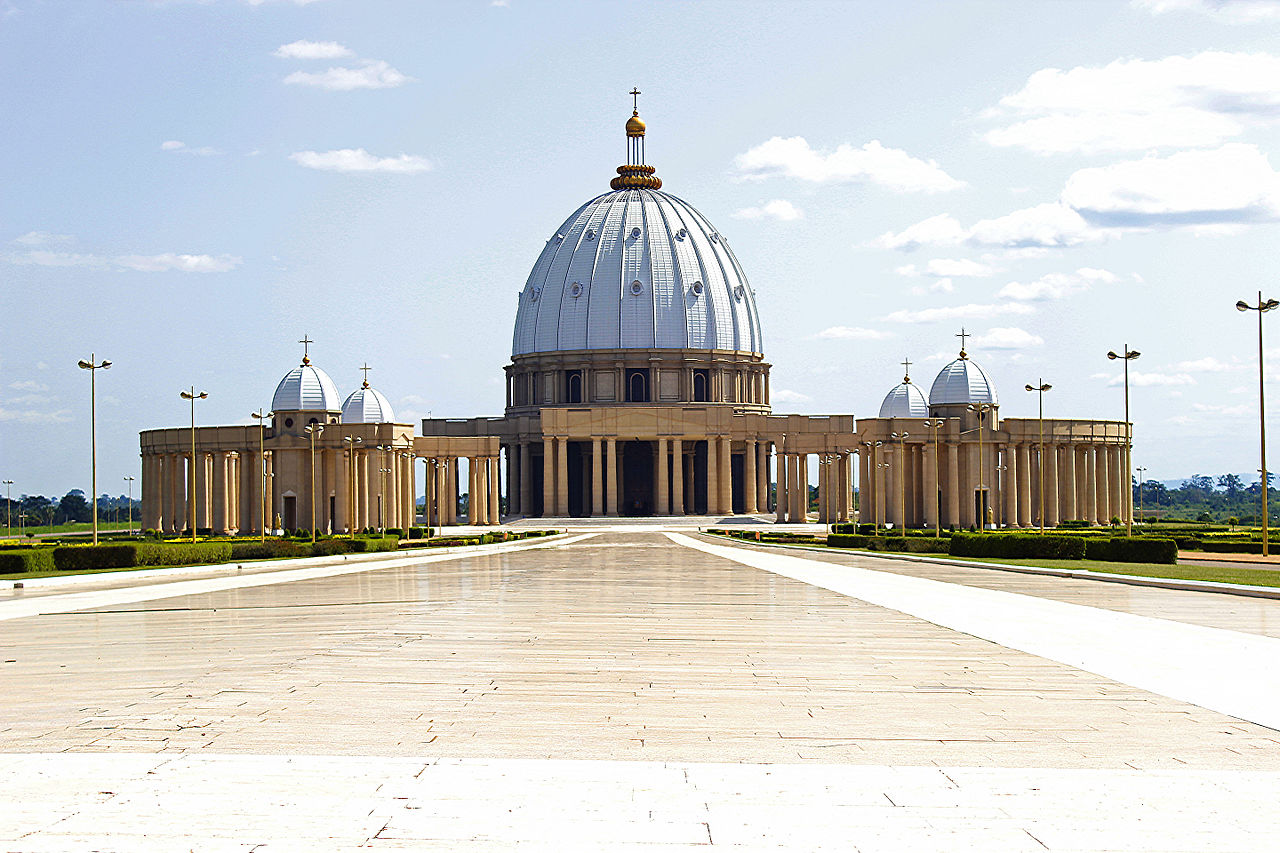
- Yamoussoukro: The official capital, with the Basilica of Our Lady of Peace.
- Korhogo: The home of Senufo culture, busiest from February to May with the cotton and cashew trade.
Places to visit
- City
- Park
- Mountain
Cities
- Abidjan: The administrative and business centre on the coastal lagoons, where the embassies are.
- Yamoussoukro: The official capital since 1983, with the Basilica of Our Lady of Peace.
- Grand-Bassam: A colonial coastal town where people from Abidjan spend the weekend; the sea is dangerous for swimming.
- Bouaké: The second largest city.
- Korhogo: The home of the Senufo people, busy with the cotton and cashew trade from February to May. It lies in the Savanes province, south of the northern area where the UK advises against all travel.
- San-Pédro: The second port city.
- Grand-Lahou: A town between a lagoon and the beach, with an eroding coastline.
- Aboisso: A stop on the road between Abidjan and the Ghanaian border.
Beyond the cities
- Taï National Park (park): The largest tropical rainforest in West Africa, a UNESCO site; check the advice on the Liberian border area.
- Comoé National Park (park): The largest national park, with elephants, lions and antelopes, a UNESCO site; the UK advises against all travel there.
- Mount Nimba Strict Nature Reserve (mountain): The highest point of the country, a UNESCO site in the forests on the Liberian border; check the border advice.
Regions
- Lagunes: The coastal lagoons around Abidjan.
- Eastern Plantations: Partly farmed country between Lake Kossou and Ghana, with Yamoussoukro.
- Southwestern Forests: Wet tropical forest on the Liberian border, home of the Kru people and of Taï National Park.
- Northern Savanna: The mostly Muslim north, with Bouaké, Korhogo and Comoé National Park.
Things to do
See
- Grand-Bassam Grand-Bassam: Walk among the colonial buildings of the old coastal town; Canada advises against swimming in the sea here.
- Basilica of Our Lady of Peace Yamoussoukro: The great basilica of the official capital.
- Taï National Park Southwestern Forests: The largest tropical rainforest in West Africa, listed by UNESCO.
- Senufo culture Korhogo: The heartland of the Senufo people in the north.
Do
- Ivorian football Abidjan: Ligue 1 runs from October to May; internationals are played at the Stade Olympique d'Ebimpé and the Stade Félix-Houphouët-Boigny.
Eat
- Attiéké with grilled fish: Grated cassava that looks like couscous, served with fish, tomato, onion and cucumber.
- Alloco: Fried plantain with a spicy sauce and boiled eggs, sold everywhere.
- Braised chicken and fish: Found on almost every corner; ask for extra vegetables, and avocado in season.
- Kedjenou: A popular spicy stew.
Itineraries
Abidjan and Grand-Bassam in 5 days (5 days)
- Abidjan (3 nights): Restaurants, markets and the lagoons; move around by ride-hailing app or pre-booked taxi.
- Grand-Bassam (2 nights): The colonial town by the sea; enjoy the beach but do not swim.
Abidjan, Yamoussoukro and Grand-Bassam in 6 days (6 days)
- Abidjan (2 nights): The business capital on the lagoons; get around by orange taxi, agreeing the fare first, or by ride-hailing app.
- Yamoussoukro (2 nights): The official capital and its Basilica of Our Lady of Peace. Intercity buses are comfortable, but military checkpoints add hours to the trip.
- Grand-Bassam (2 nights): The colonial town by the sea, an easy ride back towards Abidjan airport; enjoy the beach but do not swim.
Climate and best time to visit
The coast is tropical and the far north semi-arid. On the coast it rains from May to July and again in October and November: in Abidjan June is by far the wettest month, with more than 450 mm on average, while January and February get very little rain. Inland the rainy seasons fall from mid-March to mid-May and mid-July to mid-October in the centre, and from July to November in the north. Torrential rain can bring floods and landslides.
The dry months from December to March are the easiest time to travel. From December to February the harmattan, a hot, dusty wind from the Sahara, blows across the country: drink plenty of water.
Holidays and events
- 1 January 2026 · New Year's Day
- 6 April 2026 · Easter Monday
- 1 May 2026 · Labour Day
- 14 May 2026 · Ascension Day
- 25 May 2026 · Whit Monday
- 7 August 2026 · Independence Day
- 15 August 2026 · Assumption Day
- 1 November 2026 · All Saints Day
- 15 November 2026 · National Peace Day
- 25 December 2026 · Christmas Day
Getting there and around
| Main airports | ABJ |
|---|---|
| International driving permit | Required |
Getting there
By air: the Félix-Houphouët-Boigny International Airport (ABJ) in Abidjan has daily flights from Paris and Brussels and regular flights to other African capitals. Photography at the airport is prohibited.
By land: the UK and Canada advise against all travel near the borders with Mali and Burkina Faso, and against non-essential travel near the Liberian border. From Ghana, daily buses run between Accra and Abidjan, and from the Elubo border crossing shared taxis go to Aboisso, then buses to Abidjan. Expect many checkpoints, and carry your yellow fever certificate: without it you can be refused entry.
Getting around
Main roads are generally paved and buses between cities are fairly modern, but checkpoints are frequent and add time; slow down, stay calm and show your papers when asked. The UK warns of unofficial roadblocks set up by armed robbers (coupeurs de route), mostly on quiet secondary roads, and of attacks on cars on the main roads in the west, by day as well as at night. Avoid driving after dark, when unlit roads and stray livestock add to the danger. To drive you need the 1968 International Driving Permit (or a local licence), your licence, the car registration and insurance papers.
In Abidjan, the UK recommends ride-hailing apps, whose cars are better maintained than ordinary taxis; Canada advises against public transport, including the gbaka minibuses and the crowded SOTRA buses. If you take a taxi, ask your hotel to call one, agree the fare first and make sure the driver picks up nobody else. Do not use public transport after dark.
Flying to Côte d’Ivoire? PartnerCompare fares and find the cheapest datesSearch flightsWhere to stay
- Simple hotels: Rooms with a fan from about XOF 6,000 and with air conditioning from about XOF 10,000, according to Wikivoyage in October 2026.
- Beach resorts: Resort lodgings on the coast draw many visitors.
Accommodation is relatively expensive compared with food. Armed break-ins happen in Abidjan, so choose a place with proper security. Outside the big cities tourist facilities are limited: plan ahead, carry water, food and some cash, and consider a reputable tour operator.
Eat and drink
Dishes to try
- Attiéké: Grated cassava that looks like couscous, often served with grilled fish and fresh vegetables.
- Alloco: Fried plantain with a spicy vegetable sauce and boiled eggs.
- Garba: One of the national dishes.
- Kedjenou: A spicy stew, very popular.
- Braised chicken and fish: Sold on almost every corner; when you order, say whether you want the intestines.
- Shoukouilla: Charcoal-grilled meat.
Drinks
- Bottled water: Drink it instead of tap water.
Good food is cheap, Abidjan has very good restaurants, and street food is generally fairly clean. If you prefer familiar food, Abidjan also has burger places and French restaurants.
Entry requirements and visas
| Passport validity | At least 6 months: the UK counts from the date you arrive, Canada from the date you leave |
|---|
| Passport | Entry | Max stay | Notes |
|---|---|---|---|
| United Kingdom | Evisa | Apply and pay online at least 10 working days ahead, then collect the visa at Abidjan airport. | |
| Canada | Evisa | Get the pre-enrolment receipt and approval online before you fly; the visa is issued at Abidjan airport. |
Other nationalities: check the official source below.
Unless you are from an ECOWAS country, you need a visa approved before you travel. You apply and pay online, at least 10 working days ahead according to the UK; once approved, you print the pre-enrolment receipt and approval and collect the visa on arrival at Abidjan airport.
A yellow fever certificate is required for every traveller aged 9 months or more. Travellers arriving from countries with Ebola cases are screened and may be monitored for up to 21 days. You can bring in up to XOF 500,000 in cash, and you must declare foreign currency. Art objects you buy need an export permit from the National Museum. Rules depend on your passport and can change: check with the embassy of Côte d'Ivoire before you book.
Money and payments
| Currency | West African CFA Franc (XOF) |
|---|---|
| Cards | Limited |
The currency is the West African CFA franc (XOF), fixed to the euro at EUR 1 = XOF 655.957. ATMs are found in Abidjan and most large towns, usually at banks, and take Visa and Mastercard. Major hotels and some restaurants and shops take cards, but carry cash outside the big cities.
Card and ATM fraud is frequent: use machines inside banks or in public places, cover the keypad, keep your card in sight when paying, and check your statements. The UK advises taking transport to and from ATMs and banks rather than walking.
Costs and budget
- Room with a fan: from XOF 6,000
- Room with air conditioning: from XOF 10,000
- Taxi ride in Abidjan: USD 2-4
Food is cheap and accommodation relatively expensive. The prices here are those listed on Wikivoyage when we read it in October 2026. You can bring in up to XOF 500,000 in cash.
Health
| Required vaccines | Yellow fever certificate for all arriving travellers aged 9 months or more |
|---|---|
| Recommended vaccines | Routine vaccines, including measles (MMR), Yellow fever, Hepatitis A, Hepatitis B, Typhoid, Polio: a single adult booster, Meningococcal, for the meningitis belt in the dry season (roughly December to June), Cholera may be considered for areas with active transmission, Rabies, for some travellers: ask a travel clinic, Mpox, for travellers at risk of sexual exposure |
| Malaria | Widespread |
| Tap water | Not safe |
See a travel health professional at least 6 to 8 weeks before you go. The CDC recommends prescription medicine against malaria for the whole country. Poliovirus has been found in the past year, cholera was recently active in Abidjan and the Lagunes and Bas-Sassandra areas, rabid dogs are common, and the UK also lists dengue and Zika. Drink bottled water, not tap water.
Medical care in Abidjan is of a reasonable standard but can be expensive, and emergency care is limited to a few large hospitals; outside Abidjan facilities are basic. Clinics usually want a deposit, a payment guarantee or proof of insurance, and serious cases may need evacuation: get insurance that covers it. Bring enough of your medicines in their original containers. For an ambulance, dial 185.
This is general information, not medical advice: check with a travel health professional before you go.
Safety
- United States: Level 2: Exercise Increased Caution (2026-10-20)
- Canada: Exercise a high degree of caution (2026-10-20)
- United Kingdom: Advises against all travel to parts of the country (2026-10-20)
Canada asks for a high degree of caution because of crime, and the US for increased caution. The UK advises against all travel within 40 km of the borders with Burkina Faso and Mali, to the northern Zanzan and Savanes provinces and to Comoé National Park, because of the risk of terrorist attacks and kidnapping; Canada advises against all travel within 50 km of those borders. Near the Liberian border, the UK advises against all but essential travel within 20 km, and Canada against non-essential travel within 25 km in the Cavally, San Pedro and Tonkpi regions. Terrorist attacks could also happen elsewhere, including Abidjan, at beach resorts, hotels, restaurants and big events.
In Abidjan and other cities pickpocketing is common, and violent crime, such as armed hold-ups, burglary and carjacking, happens especially at night. Do not walk after dark, use ride-hailing apps or pre-arranged taxis, keep valuables and jewellery out of sight, and do not resist an attack. Demonstrations can happen, especially around elections; avoid them, and be alert near military sites.
The sea is dangerous: strong currents and rip tides drown many people every year, beaches have no lifeguards, and Canada advises against swimming in the sea, especially at Grand-Bassam. In the rainy season flash floods have caused deaths. Emergency numbers: police 110, 111 or 170, fire 180, ambulance 185.
Customs and etiquette
The country asks to be called Côte d'Ivoire rather than Ivory Coast; say it roughly as coat dee-VWAR. Dress conservatively, and modestly when you visit religious places, and behave discreetly. Always ask before you photograph people. Photography is prohibited near military sites, government buildings, radio and TV stations, the Presidency, the airport and the Charles de Gaulle and Houphouët-Boigny bridges in Abidjan.
Carry your passport: the UK says the police do not always accept copies. Same-sex relations are not illegal, but attitudes are less tolerant and there is no legal protection against discrimination. Drug offences bring long prison sentences or heavy fines.
Language
| Official languages | French |
|---|---|
| English | Rare |
| Hello | Bonjour bawn-ZHOOR |
|---|---|
| Good evening | Bonsoir bawn-SWAHR |
| Please | S'il vous plaît seel voo PLEH |
| Thank you | Merci merr-SEE |
| Excuse me | Excusez-moi ehk-SKEW-zay MWAH |
| Do you speak English? | Parlez-vous anglais ? par-lay VOO ahng-LEH |
| How much (is this)? | Combien ça coûte ? COMM-bee-yan SAH coot |
| Where is ...? | Où se trouve ... ? oo suh TROOV |
What to pack
- Printed e-visa approval: You collect the visa at Abidjan airport with it.
- Yellow fever certificate: Required for everyone aged 9 months or more, at the airport and at land borders.
- Original passport: The police do not always accept copies.
- 1968 International Driving Permit: Needed to drive; get it before you travel.
- Malaria tablets and insect repellent: The CDC recommends malaria medicine for the whole country.
- Some cash: Cards are accepted only in larger places, and you need cash outside the cities.
- Basic French: English is rarely spoken outside the big hotels.
- Insurance with medical evacuation: Care outside Abidjan is basic.
Quick reference
Country facts
| Capital | Yamoussoukro |
|---|---|
| Population | 32,711,547 (2025) |
| Area | 318,000 km² |
| Time zone | Africa/Abidjan (UTC+0) |
| Calling code | +225 |
| Driving side | right |
Emergency numbers
| Police | 110, 111 or 170 |
|---|---|
| Ambulance | 185 |
| Fire | 180 |
Frequently asked questions
Do I need a visa for Côte d'Ivoire?
Yes, unless you are from an ECOWAS country: apply for the e-visa online before you travel and collect it at Abidjan airport. Check the rules with the embassy before you book.
Do I need a yellow fever vaccination?
Yes. A yellow fever certificate is required for all travellers aged 9 months or more.
Is it safe to travel to Côte d'Ivoire?
The US asks for increased caution and Canada for a high degree of caution; the UK and Canada advise against all travel near the borders with Mali and Burkina Faso. Read the safety section and the official links.
Can I swim at the beaches near Abidjan?
Be very careful: currents and rip tides are strong, there are no lifeguards, and Canada advises against swimming in the sea, especially at Grand-Bassam.
Can I drink the tap water?
No. Drink bottled water.
When is the best time to visit Côte d'Ivoire?
The dry months from December to March; on the coast the heaviest rain falls from May to July.
More Travel Stories from Africa
 Morocco
 Cabo Verde +1
 Colombia +1
Sources This guide was last checked on · 20 sources
- Wikivoyage: Côte d'Ivoire · Overview, Places to visit, Things to do, Itineraries, Climate and best time to visit, Getting there and around, Where to stay, Eat and drink, Entry requirements and visas, Money and payments, Costs and budget, Health, Customs and etiquette, Language, What to pack, Frequently asked questions
- Wikidata: Côte d'Ivoire · Overview, Places to visit, Money and payments, Language, Country facts
- Government of Canada: Côte d'Ivoire travel advice (updated 14 October 2026) · Overview, Places to visit, Things to do, Climate and best time to visit, Getting there and around, Where to stay, Entry requirements and visas, Money and payments, Health, Safety, Customs and etiquette, What to pack, Frequently asked questions
- US Department of State: Côte d'Ivoire travel advisory · Overview, Safety, Frequently asked questions
- UK FCDO: Côte d'Ivoire warnings and insurance · Overview, Places to visit, Safety, Frequently asked questions
- UK FCDO: Côte d'Ivoire regional risks · Places to visit, Things to do, Getting there and around, Safety
- UK FCDO: Côte d'Ivoire travel advice and map (Edition 3) · Places to visit, Safety
- WMO World Weather Information Service: Abidjan · Climate and best time to visit
- UK FCDO: Côte d'Ivoire safety and security · Climate and best time to visit, Getting there and around, Where to stay, Eat and drink, Money and payments, Safety, Customs and etiquette, What to pack
- Nager.Date: public holidays in Côte d’Ivoire, 2026 · Holidays and events
- Wikidata: Abidjan airport (Port Bouët) · Getting there and around
- UK FCDO: Côte d'Ivoire entry requirements · Entry requirements and visas, Money and payments, Costs and budget, Health, What to pack, Frequently asked questions
- CDC Travelers' Health: Côte d'Ivoire · Entry requirements and visas, Health, What to pack, Frequently asked questions
- ISO 4217 (SIX), published 2026-09-17 · Money and payments
- UK FCDO: Côte d'Ivoire health · Health
- UK FCDO: Côte d'Ivoire getting help · Health, Safety, Emergency numbers
- Wikivoyage: French phrasebook · Language
- World Bank, SP.POP.TOTL · Country facts
- World Bank, AG.LND.TOTL.K2 · Country facts
- IANA Time Zone Database, zone.tab · Country facts
Suggest an update
Travel rules, prices and timetables change. If something in this guide is out of date, tell us: we check every suggestion against an official source before changing the page.