

- Local time
- 21:05
- Currency
- Eritrean Nakfa (ERN)
- Capital
- Asmara
- Calling code
- +291
- Drive on the
- right
Overview
Italian-era Asmara, the old port of Massawa and the Dahlak islands. The UK and Canada advise against non-essential travel: read the advice first.
Eritrea sits on the Red Sea in East Africa. It was an Italian colony until the Second World War, then joined to Ethiopia, and became independent in 1993. Asmara, the capital, lies in the highlands, between 1,500 and 3,500 metres, and is known for its Italian-era buildings, among them the Fiat Tagliero service station shaped like an aircraft. The road down the escarpment leads to the port of Massawa and to the Dahlak islands, with clean beaches and reefs. Keren is linked to the capital by frequent buses, and hilltop Orthodox monasteries such as Debre Bizen stand in the highlands.
Travel here is hard work. You need a visa from an embassy before you go, and a government permit for any trip outside the area around Asmara, with checkpoints on the roads. Internet is very limited and foreign SIM cards do not work. The UK advises against all but essential travel to the whole country and against all travel within 25 km of its borders, and Canada advises against non-essential travel: read the safety section before you plan.
- Asmara: The highland capital, with its Italian-era churches, opera house and a service station shaped like an aircraft.
- Massawa: The Red Sea port, and the starting point for boats to the Dahlak islands.
- Dahlak islands: An archipelago of white beaches, lagoons and coral reefs.
- Debre Bizen: A hilltop Orthodox monastery with an old library; only men may enter.
- The road down the escarpment: From the highlands to the coast, through the green eastern slopes.
Places to visit
- City
- Island
- Historic site
Cities
- Asmara: The capital, in the highlands, with Italian-era architecture; to go beyond its surrounding province you need a travel permit.
- Keren: A highland town linked to the capital by several buses a day.
- Massawa: The port on the Red Sea, hot all year, base for diving and for boats to the Dahlak islands.
- Nakfa: The old base of the independence fighters in the northern mountains, with a war museum; it gave its name to the currency.
Beyond the cities
- Dahlak islands (island): A marine national park, the largest archipelago in the Red Sea, reached only by chartered boat from Massawa.
- Debre Bizen (site): A hilltop Orthodox monastery founded in 1361, with a centuries-old library; women may not enter.
- Debre Sina (site): A hilltop Orthodox monastery and the goal of a yearly pilgrimage.
- Matara (site): Ruins from the Aksumite Empire, partly destroyed in the 1998-2000 war.
Regions
- Highlands: The central and southern plateau, with Asmara: mild and dry, rain from May to September.
- Western lowlands: Hot plains, savannah in the south and desert in the north.
- Sahel: The arid mountains of the north, with Nakfa.
- Eastern escarpment: The green seaward slopes of the highlands, rich in birds.
- Northern coast and Dahlak islands: Massawa, mangroves and the coral reefs of the archipelago.
- Southern coast: Volcanoes, salt pans and extreme heat between Massawa and Assab; not open without guides.
Things to do
See
- Fiat Tagliero Asmara: An old service station built to look like an aircraft, with two 21-metre wings.
- Church of Our Lady of the Rosary Asmara: The main church of the Italian colonists, in Lombard Romanesque style, with a tall bell tower.
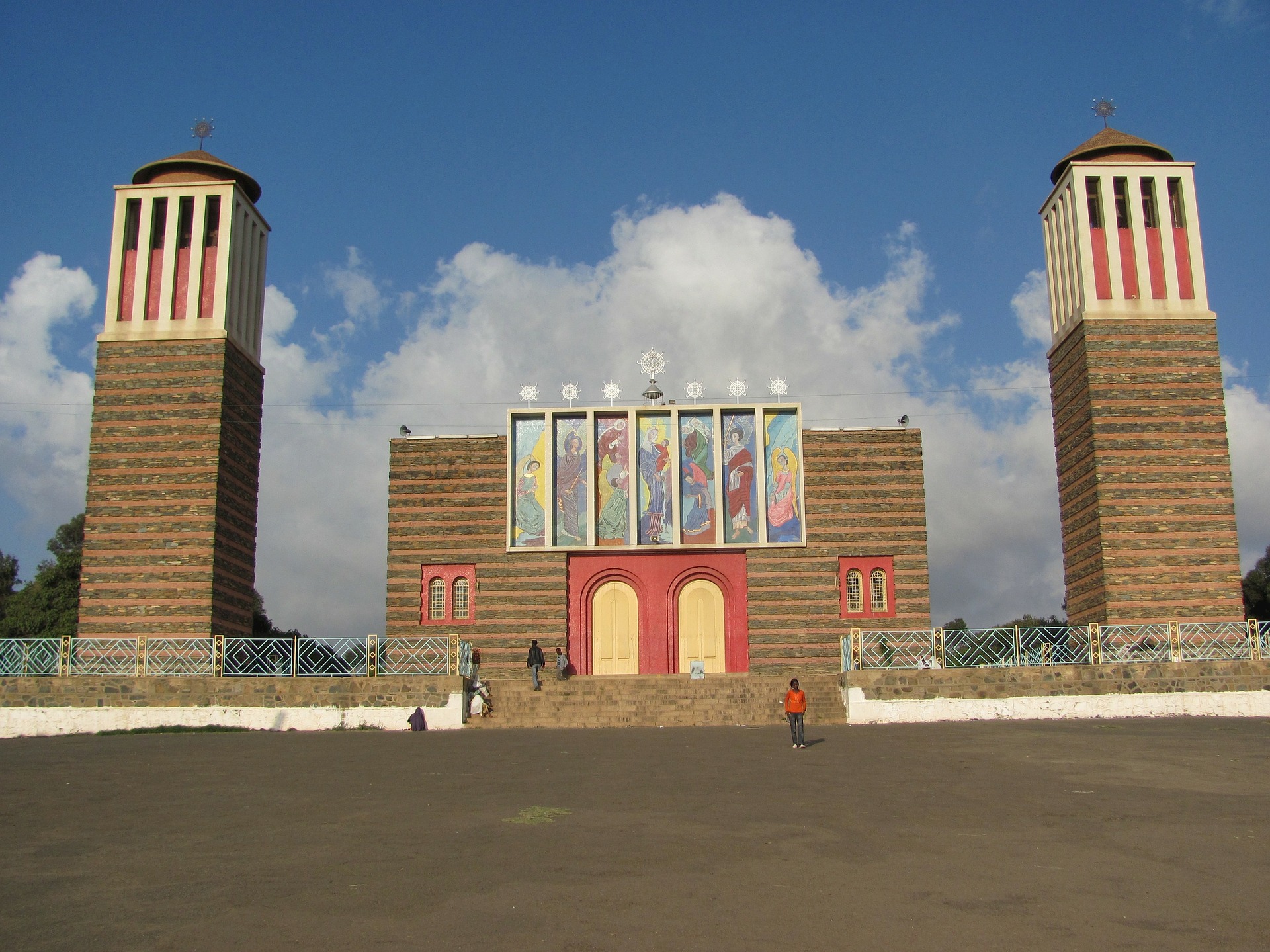
- Enda Mariam Orthodox Cathedral Asmara: The Orthodox cathedral in the centre of the city, with a gate on each of its four sides.
- Asmara Opera House Asmara: A theatre built in 1920 by the Italians.
- Al Khulafa Al Rashidin Mosque Asmara: A mosque that mixes Italian and local Moorish styles.
- War museum in Nakfa Nakfa: A museum of the independence struggle, in the old rebel base.
Do
- Dahlak islands Massawa: Charter a boat from a licensed company in Massawa for beaches and diving; longer cruises are very expensive.
- Debre Bizen: Men can hike up to the monastery for the views and the old library.
Eat
- Injera and stews: The highland meal: spicy stews served on a spongy flatbread and eaten with the hands.
Shop
- Souvenirs in Asmara Asmara: Leather, olive wood, clay and straw crafts, home-spun cotton, frankincense and myrrh.
Itineraries
Asmara and Massawa in 6 days (6 days)
- Asmara (3 nights): The Italian-era centre; apply for your travel permit at the Ministry of Tourism on arrival.
- Massawa (3 nights): By bus or car down the escarpment, with your permit; a boat trip to the Dahlak islands.
Asmara and Keren in 4 days (4 days)
- Asmara (2 nights): The city's churches, mosque and opera house.
- Keren (2 nights): Several buses a day from Asmara; you still need a travel permit.
Climate and best time to visit
| Jan | Feb | Mar | Apr | May | Jun | Jul | Aug | Sep | Oct | Nov | Dec | |
|---|---|---|---|---|---|---|---|---|---|---|---|---|
| Max °C | 23 | 24 | 25 | 25 | 25 | 25 | 22 | 22 | 23 | 22 | 22 | 22 |
| Min °C | 6 | 7 | 9 | 10 | 11 | 11 | 11 | 11 | 9 | 9 | 8 | 6 |
| Rain mm | 2 | 2 | 12 | 36 | 42 | 42 | 174 | 165 | 25 | 12 | 17 | 4 |
Asmara, high on the plateau, is mild all year: the average maximum stays between about 21 and 25 °C, and nights drop to 5-6 °C in December and January. The rains come mainly in July and August, with up to about 170 mm a month, and the dry season runs from December to April. Canada says the rainy season runs from June to September, when unpaved roads in the western lowlands become impassable.
The coast is a different world: hot and humid all year, with highs of 37 to 50 °C from May to September and 25 to 35 °C from October to March, and very little rain. The southern coast is even hotter. October to March is the best time for a trip that includes Massawa and the islands; in the highlands the land turns green from August to October.
Holidays and events
- 1 January 2026 · New Year's Day
- 7 January 2026 · Orthodox Christmas
- 19 January 2026 · Orthodox Epiphany
- 8 March 2026 · Women's Day
- 3 April 2026 · Good Friday
- 5 April 2026 · Easter Sunday
- 1 May 2026 · May Day
- 24 May 2026 · Independence Day
- 20 June 2026 · Martyrs' Day
- 1 September 2026 · Revolution Day
Getting around
| Main airports | ASM |
|---|---|
| International driving permit | Required |
You need a travel permit for any trip outside the area around Asmara: apply to the Ministry of Tourism on Harnet Avenue, give the details of the car you will use, and allow several days; permits are not always granted, and checkpoints on the roads check them. Tourists have sometimes not been allowed to use public transport outside Asmara.
Buses and minibuses are the usual way to travel, with several a day from Asmara to Keren and to Massawa; you buy the ticket on board. Canada says buses are unsafe and overcrowded. There are no domestic flights, and the old railway from Asmara to Massawa runs only for chartered tour groups. In Asmara, use the yellow official taxis, agree the fare first and have small notes.
Driving: you need a local permit, issued by the Ministry of Transport and Communication when you show your licence and a 1949 International Driving Permit. Main roads from Asmara to Massawa, Keren, Mendefera, Dekemhare and Barentu are paved; other roads are rough and worse in the rainy season. Expect blind bends, steep drops, few barriers and drivers without lights. Avoid driving after dark and fill the tank before long trips.
Flying to Eritrea? PartnerCompare fares and find the cheapest datesSearch flightsWhere to stay
- Pensions and modest hotels: Cheap, often with shared bathrooms, no air conditioning and no daily cleaning.
- Mid-range hotels: Private bathroom, TV and air conditioning; worth it in hot Massawa.
- Asmara Intercontinental: The only international hotel, the only one with a pool and the only one that takes cards (for a fee).
Asmara has hotels at every price; elsewhere most are modest. Foreigners pay for official hotels in euros or US dollars, and some hotels have one price for foreigners and another for locals. Outside Asmara, Massawa, Keren and Assab, expect only basic places.
Eat and drink
Dishes to try
- Injera with stews: A spongy flatbread of fermented grain topped with spicy meat and vegetable stews, eaten with the hands.
- Shahan ful: A bean stew with bread, usually for breakfast.
- Grilled spicy fish: Red Sea cooking in the simple restaurants of old Massawa.
- Khobzen: Bread soaked in goat's butter and honey, in Massawa.
- Pasta and lasagne: Italian dishes are on menus all over the country.
Drinks
- Beer: One state-owned brand, served cold.
- Suwa and mies: Traditional drinks: suwa is made from bread fermented with honey, mies is a sweet honey wine.
- Fresh juice: Guava is the common, cheap choice in cafés.
Pork is rare, because the local church forbids it. Drink bottled water and check the cap is sealed. To avoid stomach trouble, stick to cooked food and bottled drinks, peel fruit yourself and skip salads and ice cream.
Entry requirements and visas
| Passport validity | At least 6 months (the UK says after the date you arrive, Canada after the date you leave), with 2 consecutive blank pages |
|---|
| Passport | Entry | Max stay | Notes |
|---|---|---|---|
| United Kingdom | Visa required | Get the visa from an Eritrean embassy before you travel. | |
| Canada | Visa required | All visas must be obtained before travel; processing can be long. | |
| United States | Visa required | Apply at an Eritrean embassy before you travel, according to Wikivoyage. | |
| EU / EEA | Visa required | Apply at an Eritrean embassy before you travel, according to Wikivoyage. | |
| Australia | Visa required | Apply at an Eritrean embassy before you travel, according to Wikivoyage. |
Other nationalities: check the official source below.
Everyone needs a visa arranged before travel. Wikivoyage says you apply at the Eritrean embassy in the country of your citizenship, or the one accredited to it, with a detailed itinerary; the process can be slow. On arrival you must also apply for a travel permit to leave the Asmara area. You need a yellow fever certificate if you arrive from a country with yellow fever risk.
Declare all laptops, phones and cameras on arrival, or they may be confiscated when you leave. Declare foreign cash of US$10,000 or more and keep the certificate. When you leave you must show that the foreign money you spent was changed at Himbol, the state exchange, or spent at an official hotel; you cannot take out more than 1,000 nakfa. People the authorities consider Eritrean, including dual nationals, may face national service and need an exit permit. Rules can change: check with the Eritrean embassy before you book.
Money and payments
| Currency | Eritrean Nakfa (ERN) |
|---|---|
| Cards | Rare |
The currency is the nakfa (ERN), pegged to the US dollar. Eritrea runs on cash, and cards are not accepted for everyday payments. Change money only at Himbol, the state exchange, at main banks or at major hotels in Asmara, and keep the receipts: you have to account for your foreign currency when you leave. Paying in foreign currency is illegal, except at official hotels, which charge foreigners in euros or dollars.
Do not change money on the street: Wikivoyage warns that such deals can bring serious trouble. Refuse banknotes issued before 1 January 2016, which are no longer valid, and check whether the planned exchange of old notes for new ones has happened before you buy a lot of nakfa.
Costs and budget
- Bottled water: Nkf 20-30
- Room in a cheap pension in Asmara: Nkf 100
- Room in a modest hotel in Asmara: Nkf 200
- Room at the Asmara Intercontinental: a little over US$150
Local food, budget hotels and buses are cheap: Wikivoyage reckons you need less than US$50 a day if you eat locally, sleep in budget hotels and use public transport. Imports, fuel, private transport, upmarket hotels and government fees such as visas and permits are expensive. The prices here are those listed on Wikivoyage when we read it in October 2026, without a date.
Health
| Required vaccines | Yellow fever certificate, only if you arrive from a country with yellow fever risk (from 9 months of age) |
|---|---|
| Recommended vaccines | Routine vaccines, including measles (MMR), Hepatitis A, Hepatitis B, Typhoid, Meningococcal, for parts of the country in the dry season (December to June), Rabies, only for some travellers: ask a travel clinic |
| Malaria | Some areas |
| Tap water | Not safe |
Malaria is a risk in all areas below 2,200 metres, but not in Asmara; the CDC recommends preventive tablets for those areas, and the parasite is resistant to chloroquine. Rabid dogs are common. Do not drink the tap water, and be careful with food: many visitors get sick. Altitude sickness is a risk in parts of the country.
Asmara has three public hospitals; elsewhere hospitals are poorly equipped, and in rural areas care is very limited. Hospitals ask for a cash deposit or payment up front, and serious cases may need an expensive evacuation, so get insurance that covers it. Few medicines are available: bring enough for your stay plus extra, and a medical kit if you leave the towns. For an ambulance, dial 122244; the operator may not speak English.
This is general information, not medical advice: check with a travel health professional before you go.
Safety
- United States: Level 2: Exercise Increased Caution (2026-10-20)
- Canada: Avoid non-essential travel (2026-10-20)
- United Kingdom: Advises against all travel to parts of the country; Advises against all but essential travel to parts of the country (2026-10-20)
The UK advises against all travel within 25 km of all of Eritrea's land borders, with Sudan, Ethiopia and Djibouti, and against all but essential travel to the rest of the country. Canada advises against non-essential travel to Eritrea and against all travel within 25 km of its borders. Both point to tensions with neighbouring countries and military activity near the borders, where there are also landmines. The situation can change quickly, and help from foreign embassies is very limited: the authorities may not tell your embassy if you are detained.
Asmara is relatively safe, but there is some street crime at night, and pickpockets target tourists. Do not walk alone after dark and keep phones, cameras and passports out of sight. Women may face harassment. Crime and banditry are more common in border areas and on the coast north of Massawa. Checkpoints are common; carry ID and your travel permits, and keep away from military sites. Power cuts are frequent, even in Asmara. Eritrea has active volcanoes, Nabro and Dubbi, and earthquakes are possible. At sea, the southern Red Sea has a risk of piracy, and boats entering Eritrean waters without permission have been seized.
Customs and etiquette
Always carry ID: a copy of your passport photo page is enough, with the original in a safe place. Photographing government buildings and military sites is illegal, and so is photographing airports, ports and people in uniform; ask before photographing people or their property, and get a permit from the Ministry of Tourism for the tank graveyard in Asmara. Same-sex relationships are illegal and can bring a prison sentence. Drug offences are punished severely: pack your own bags and never carry anyone else's.
Eritreans are polite and soft-spoken. Dress is Western, but revealing clothes are poorly received, and kissing in public is frowned upon. Do not use your left hand to greet, eat or pass things. Avoid harsh criticism of the country, its religion or its politics. During Ramadan (the next one starts around 7 February 2027) be discreet about eating, drinking and smoking in public in the daytime.
Language
| English | Common |
|---|
| Hello | ሰላም selam |
|---|---|
| Thank you | የቐኔለይ yekenyeley |
| Please (to a man / a woman) | በጃኻ / በጃኺ bejakha / bejakhi |
| Yes | እወ eweh |
| Goodbye | ደሓን ኹን dehan-koon |
| Do you speak English? (to a man) | ኢንግልዘኛ ትዛረብዶ inglizenya tzarebdo |
What to pack
- Visa, passport with 2 blank pages, and copies: Carry a copy of the photo page at all times.
- All the cash you need, in euros or US dollars: Cards are not accepted for everyday payments.
- Exchange receipts and currency declaration: You must account for your foreign money when you leave.
- Travel itinerary and car details: Needed for the visa and the travel permit.
- Medicines, with extra: Few medicines are available in Eritrea.
- Malaria tablets and repellent: For the lowlands and the coast, below 2,200 metres.
- International Driving Permit (1949): To get a local driving permit.
- Phone charger and power bank: Power cuts are frequent, and Canada advises a spare battery when you drive.
Quick reference
Country facts
| Capital | Asmara |
|---|---|
| Population | 3,607,003 (2025) |
| Area | 120,800 km² |
| Time zone | Africa/Asmara (UTC+3) |
| Calling code | +291 |
| Driving side | right |
Staying connected
| SIM and eSIM | International SIM cards do not work, roaming and mobile data are not available, and you need a residence permit to buy a local SIM. Phone networks are unreliable outside Asmara and the larger towns. |
|---|---|
| Wi-Fi | Internet is very restricted, mainly in hotels and a few internet cafés, and the authorities can cut it off. |
Emergency numbers
| Police | 113 |
|---|---|
| Ambulance | 122244 |
| Fire | 116 |
Frequently asked questions
Do I need a visa for Eritrea?
Yes. Everyone needs a visa arranged at an Eritrean embassy before travel, and a permit to travel outside the Asmara area.
Is it safe to travel to Eritrea?
The UK advises against all but essential travel to the whole country and against all travel near its borders, and Canada advises against non-essential travel. Read the official advice before you plan anything.
Can I use my phone in Eritrea?
Not with a foreign SIM card: roaming does not work, and local SIM cards need a residence permit. Internet is limited to hotels and a few cafés.
Can I use cards in Eritrea?
No, apart from the Intercontinental hotel in Asmara. Bring cash and change it only at official exchanges.
Is there malaria in Eritrea?
Yes, below 2,200 metres, but not in Asmara. Ask a doctor about preventive tablets if you go to the lowlands or the coast.
When is the best time to visit Eritrea?
October to March for the coast and the islands, when it is less hot. Asmara is mild all year, with most rain in July and August.
More Travel Stories from Africa
 Kenya
Sources This guide was last checked on · 19 sources
- Wikivoyage: Eritrea · Overview, Places to visit, Things to do, Itineraries, Climate and best time to visit, Getting around, Where to stay, Eat and drink, Entry requirements and visas, Money and payments, Costs and budget, Health, Customs and etiquette, Language, What to pack, Staying connected, Frequently asked questions
- Wikidata: Eritrea · Overview, Places to visit, Money and payments, Country facts
- UK FCDO: Eritrea warnings and insurance · Overview, Safety, Frequently asked questions
- Government of Canada: Eritrea travel advice (updated 14 October 2026) · Overview, Climate and best time to visit, Getting around, Where to stay, Entry requirements and visas, Money and payments, Health, Safety, Customs and etiquette, What to pack, Staying connected, Frequently asked questions
- UK FCDO: Eritrea safety and security · Things to do, Itineraries, Getting around, Safety, Customs and etiquette, What to pack, Staying connected
- WMO World Weather Information Service: Asmara · Climate and best time to visit
- Nager.Date: public holidays in Eritrea, 2026 · Holidays and events
- UK FCDO: Eritrea entry requirements · Getting around, Entry requirements and visas, Money and payments, What to pack, Frequently asked questions
- CDC Travelers' Health: Eritrea · Entry requirements and visas, Health, Frequently asked questions
- ISO 4217 (SIX), published 2026-09-17 · Money and payments
- UK FCDO: Eritrea health · Health, What to pack
- UK FCDO: Eritrea getting help · Health, Safety, Emergency numbers
- US Department of State: Eritrea travel advisory · Safety
- UK FCDO: Eritrea travel advice · Safety
- UK FCDO: Eritrea regional risks · Safety
- Wikivoyage: Tigrinya phrasebook · Language
- World Bank, SP.POP.TOTL · Country facts
- World Bank, AG.LND.TOTL.K2 · Country facts
- IANA Time Zone Database, zone.tab · Country facts
Suggest an update
Travel rules, prices and timetables change. If something in this guide is out of date, tell us: we check every suggestion against an official source before changing the page.