

- Local time
- 12:37
- Currency
- Algerian Dinar (DZD)
- Capital
- Algiers
- Calling code
- +213
- Drive on the
- right
Overview
Roman cities, the Casbah of Algiers and the rock art of the Sahara, in Africa's largest country. Few tourists go, and you need a visa in advance.
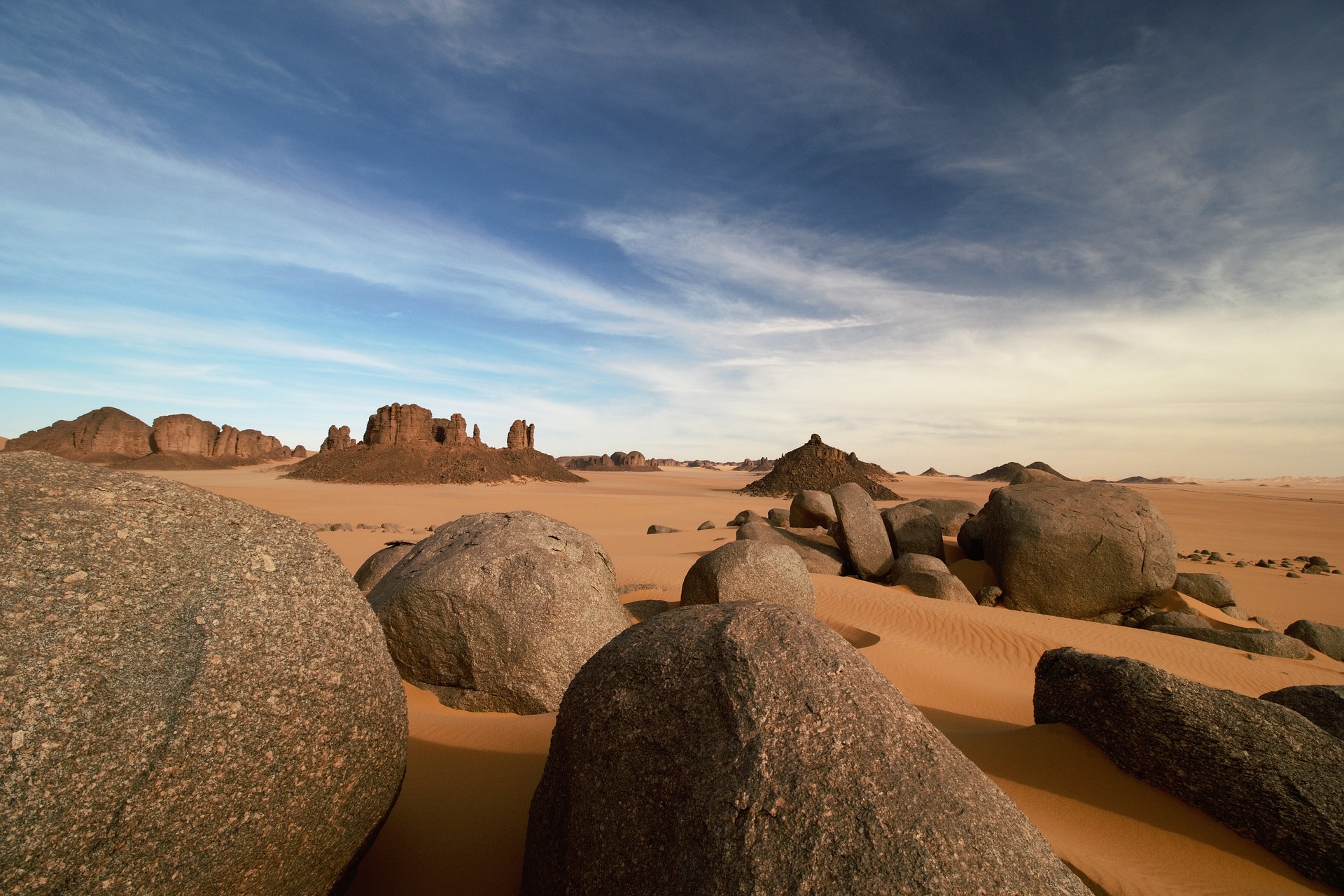
Algeria is the largest country in Africa, and the Sahara covers about 90% of it. The north is a strip of Mediterranean coast and mountains, where Algiers, Oran and Constantine mix French colonial buildings with Ottoman palaces and old mosques. Inland lie well-preserved Roman towns such as Timgad and Djémila. In the south, the five fortified towns of the M'zab Valley, the Hoggar Mountains around Tamanrasset and the prehistoric rock art of Tassili n'Ajjer are the reasons to cross the desert.
Few foreign tourists travel here, so hotels are aimed at business and domestic travellers and good budget places are rare. Getting a visa takes paperwork and time, the economy runs almost entirely on cash, and French is far more useful than English. The UK and Canada advise against travel to the border areas: read the safety section before you plan a desert trip.
- The Casbah of Algiers: The old town of the capital, a tangle of lanes above the bay.
- Timgad and Djémila: Two Roman cities in the north-east, with forums, temples and mosaics.
- Tipasa: Phoenician, Roman and Byzantine ruins by the sea, in the region of Algiers.
- Constantine: The city of bridges, built around a deep gorge.
- The M'zab Valley: Five fortified desert towns of cube-shaped houses, the heart of Mozabite culture.
- Tassili n'Ajjer and the Hoggar: Sandstone plateaus with prehistoric rock art, and the mountains of the Tuareg.
Places to visit
- City
- Park
- Mountain
- Historic site
- Area
- District
Cities
- Algiers: The capital: colonial buildings on steep hills above the bay, and the old Casbah.
- Oran: The second city, lively and a little rough, with the Santa Cruz fort above the bay; known as the city of raï music.
- Constantine: The city of bridges, spread around a deep gorge, with traces of Roman, Arab and Ottoman times.
- Annaba: An eastern port near the Tunisian border, next to the ruins of Hippo Regius.
- Tlemcen: A city of history and fine architecture, with the Grand Mosque and the remains of the Mansourah Mosque.
- Batna: The main town of the Aurès, and the base for visiting Timgad.
- Sétif: A trade city on the high plateaus, with a mild climate and some snow in winter; the base for Djémila.
- Tamanrasset: The largest town in the south, starting point for trips into the Sahara and the Hoggar Mountains.
- Timimoun: A small Saharan oasis town and a good base for trips into the desert.
Beyond the cities
- Casbah of Algiers (district): The old town of Algiers, crumbling but lived in; visit it with a local guide.
- Timgad (site): A Roman city in the Aurès Mountains, known as the Pompeii of Africa.
- Djémila (site): A former Roman military colony and UNESCO World Heritage site, with a forum, temples, houses and mosaics.
- Tipasa (site): Phoenician, Roman and Byzantine ruins on the coast, with a theatre, an amphitheatre and a basilica.
- Hippo Regius (site): An ancient Numidian city just south of Annaba, where Saint Augustine lived, with Roman baths and a forum.
- M'zab Valley (area): Five fortified towns in the desert, whose cube-shaped houses inspired modern architects.
- Tassili n'Ajjer (park): A sandstone plateau in the Sahara and UNESCO World Heritage site, with more than 15,000 prehistoric paintings and engravings.
- Hoggar Mountains (mountain): The desert mountains around Tamanrasset, a land of Tuareg traditions.
- Grand Erg Oriental (area): The great sea of dunes near El Oued, the second largest dune field in the Sahara.
Regions
- Central Algeria: The starting point for most trips: Algiers, Tipasa, Bejaia and the Kabylie region.
- Northeast Algeria: Mountains and hills with many historic sites: Constantine, Annaba, Batna and Timgad.
- Northwest Algeria: The mountainous coast west of Algiers, with Oran, Mostaganem and Tlemcen.
- Saharan Atlas: The mountain range inland of the high plateaus, around Béchar.
- Saharan Algeria: The least populated part of the country: desert, Tamanrasset and Ghardaïa.
Things to do
See
- Timgad Batna: Walk the streets of a well-preserved Roman city in the Aurès Mountains.
- Djémila Sétif: A former Roman military colony with its forum, temples and mosaics, listed by UNESCO.
- Tipasa Central Algeria: Ruins of three civilisations next to the sea, with views over the Mediterranean.
- Hippo Regius Annaba: The city of Saint Augustine, with Roman baths and a forum.
- The Casbah Algiers: The old town of Algiers: go with a good local guide and tell your hotel your plans.
- The bridges of Constantine Constantine: Cross the high bridges over the gorge that splits the city.
- Santa Cruz fort Oran: A fort on the mountain above Oran, with wide views over the city and the bay.
- Mosques of Tlemcen Tlemcen: The Grand Mosque and the remains of the Mansourah Mosque.
- The M'zab Valley Saharan Algeria: Five fortified desert towns of geometric, cube-shaped houses.
- Rock art of Tassili n'Ajjer Saharan Algeria: Thousands of prehistoric paintings and engravings on a sandstone plateau, including the famous Running Horned Woman.
Do
- Desert trips from Tamanrasset Tamanrasset: Explore the Hoggar Mountains in a 4x4, always with an experienced guide from a reputable company.
- Hiking in Chréa National Park: Treks among wooded peaks, with a ski station in winter.
- Beaches near Oran Oran: The Turquoise Coast has some of the better stretches of the Mediterranean shore; cleanliness varies.
Eat
- Fish in the ports: Almost every fishing port near Algiers and on the coast has restaurants serving the fresh catch.
Itineraries
Algiers and the Roman north-east in 8 days (8 days)
- Algiers (3 nights): The Casbah with a guide, and a day trip to the ruins of Tipasa.
- Constantine (2 nights): By the night train from Algiers; the bridges and the gorge.
- Batna (1 night): For a day at Timgad.
- Sétif (2 nights): For the Roman town of Djémila.
Oran and Tlemcen in 4 days (4 days)
- Oran (2 nights): The Santa Cruz fort and the coast; about 4-5 hours by train from Algiers.
- Tlemcen (2 nights): The Grand Mosque and the Mansourah ruins.
The Hoggar from Tamanrasset in 5 days (5 days)
- Algiers (1 night): Fly south: overland travel in the Sahara is long and risky.
- Tamanrasset (4 nights): Trips into the Hoggar Mountains with a guide and a 4x4; check the latest official advice first.
Climate and best time to visit
| Jan | Feb | Mar | Apr | May | Jun | Jul | Aug | Sep | Oct | Nov | Dec | |
|---|---|---|---|---|---|---|---|---|---|---|---|---|
| Max °C | 17 | 17 | 19 | 21 | 24 | 28 | 31 | 32 | 30 | 26 | 21 | 18 |
| Min °C | 6 | 6 | 7 | 9 | 12 | 16 | 19 | 20 | 18 | 14 | 10 | 7 |
| Rain mm | 81 | 73 | 55 | 58 | 42 | 9 | 5 | 8 | 28 | 59 | 90 | 91 |
The coast has a Mediterranean climate. In Algiers the average maximum is about 17 °C in January and 32 °C in August, and almost no rain falls from June to August. The rainy season runs from November to March, when floods can cut roads in the north. In July and August wildfires are common in the north.
The Sahara, which covers most of the country, is far hotter: summer temperatures go well above 40 °C and can reach 50 °C, and sand and dust storms are most frequent in summer in the south. May, June, September and October are the most comfortable months for the north; in the desert, avoid the summer heat.
Holidays and events
- 1 January 2026 · New Year's Day
- 12 January 2026 · Amazigh New Year
- 1 May 2026 · Labour Day
- 5 July 2026 · Independence Day
- 1 November 2026 · Revolution Day
Getting around
| Main airports | ALG, ORN, CZL |
|---|---|
| International driving permit | Recommended |
Flying is the most convenient way to cover long distances in such a big country, with Air Algérie and Tassili Airlines; expect delays. You need your passport for domestic flights. Trains run by SNTF link the northern cities, slowly: Algiers to Oran takes 4-5 hours, and a night train runs from Algiers to Annaba via Constantine. Tickets are sold only at stations. Long-distance buses connect the main cities.
In Algiers most taxis have meters: insist on using them, and avoid unofficial taxis. Uber does not work here, but the Heetch and Yassir apps do. Ask your hotel to call a reputable firm, especially after dark.
Driving: the road accident rate is very high, lane discipline is poor and roads can have sand drifts, large potholes and speed bumps. Avoid minor roads at night outside towns, and slow down at police and military checkpoints. A UK photocard licence is valid for 3 months, but the authorities may ask for an International Driving Permit, and Canada lists it as required: get one before you go. Take only a 4x4 into the Sahara, and check where you can buy fuel before long journeys.
Flying to Algeria? PartnerCompare fares and find the cheapest datesSearch flightsWhere to stay
- Hotels: Mostly mid-range and upmarket, aimed at business and domestic travellers; service is often one star below the rating.
- Budget hotels: Few and often very basic, so budget travellers usually end up in cheaper mid-range hotels.
- Summer houses on the coast: Rented by the month from mid-June to the end of August; inspect before you pay.
You need your passport to check in at any hotel. For the visa application you must show hotel bookings that cover your whole stay. In remote areas, Canada recommends hotels with strong security measures.
Eat and drink
Dishes to try
- Couscous: Steamed semolina with a sauce of meat, chickpeas and vegetables such as carrots and courgettes.
- Chorba: A meaty soup.
- Rechta: Hand-made noodles served in a clear chicken broth with potatoes and chickpeas.
- Chakchouka: Peppers, onions and tomatoes cooked together, sometimes with eggs.
- Mechoui: Lamb grilled over charcoal.
- Mhadjeb: A flaky semolina pancake stuffed with onions, tomatoes, garlic and spices.
- Taguella: The bread of the desert nomads, baked in the sand.
- Qalb el louz and makroudh: Semolina and almond cake in honey syrup, and pastries filled with dates or almonds.
Drinks
- Green tea: Served very sweet.
- Coffee: Strong.
- Wine and beer: Algeria still makes some good red wines and local beers, sold in bar-restaurants, better hotels and liquor stores in the big cities.
| Tipping | Not expected in taxis; you can round up to the next DA10. |
|---|
Alcohol is not sold everywhere, and fast-food places and coffee shops do not serve it. In fish restaurants in the ports you often have to ask for it. Drinking alcohol in a public place is illegal. During Ramadan check restaurant opening hours, most restaurants stop serving alcohol, and eating or drinking in public in the daytime is not done.
Entry requirements and visas
| Passport validity | At least 6 months after the date you arrive |
|---|
| Passport | Entry | Max stay | Notes |
|---|---|---|---|
| United Kingdom | Visa required | Apply to the Algerian consulate before you travel. | |
| Canada | Visa required | Apply to the Algerian embassy or the nearest consulate before you travel. | |
| United States | Visa required | Apply to an Algerian embassy or consulate before you travel. | |
| EU / EEA | Visa required | Apply to an Algerian embassy or consulate before you travel. | |
| Australia | Visa required | Apply to an Algerian embassy or consulate before you travel. |
Other nationalities: check the official source below.
Almost everyone needs a visa, arranged in advance at an Algerian embassy or consulate. The application usually asks for a passport valid more than 6 months, photos, forms, your itinerary, hotel bookings covering your whole stay (or a notarised invitation if you stay with a resident) and recent bank statements. You normally apply in the country where you live, and the consulate can keep your passport for 5-9 working days. A tourist visa on arrival may be possible at some airports if most of your trip is in the south and booked through an approved local agency: ask the consulate first.
Overstaying can mean detention at the airport and up to 3 months in prison. You need a yellow fever certificate if you arrive from a country with yellow fever risk, including after a transit of more than 12 hours there.
Customs rules are strict. Declare foreign cash on arrival (the UK government says above EUR 5,000; Canada says all foreign currency) and keep the form and your exchange receipts for departure. Visitors cannot take Algerian dinars in or out. Drones, binoculars, telescopes and some photo equipment need authorisation, and anything that looks antique needs proof of authenticity. Rules depend on your passport and can change: check with the Algerian embassy or consulate before you book.
Money and payments
| Currency | Algerian Dinar (DZD) |
|---|---|
| Cards | Limited |
Algeria runs on cash. Cards are usually accepted in major hotels but rarely in restaurants and shops, and ATMs that take foreign cards, in banks and a few major hotels, are unreliable. Bring enough euros or US dollars for your trip, in clean, undamaged notes: other currencies are hard to change.
There are no ordinary exchange offices, even at the airport: banks and post offices change money. You will see street money changers in most cities, but the Canadian government warns that changing money on the black market is illegal, and on departure you may have to show your currency declaration and the bank receipts for your exchanges. Keep coins and small notes: sellers often have no change for large ones.
Costs and budget
- Metro ticket in Algiers: DA50
- Bottled water, 1.5 litres: DA40
- Bus between major cities: DA500-2,000
- Train Algiers-Oran, second class: DA900-1,130
- Prepaid SIM with 100 GB of data (September 2025): DA2,500
Day-to-day costs are low: transport is cheap, a full meal costs DA100-1,000, and most sights charge so little that you can pay in small change. Hotels are the exception, because good budget places are rare and many travellers pay more for a room than they expected. The prices here are those listed on Wikivoyage when we read it in October 2026, and they can change quickly.
Health
| Required vaccines | Yellow fever certificate, only if you arrive from a country with yellow fever risk (from 9 months of age, including transits of more than 12 hours) |
|---|---|
| Recommended vaccines | Routine vaccines, including measles (MMR), Hepatitis A, Hepatitis B, Typhoid, Polio: a single adult booster, Rabies, only for some travellers: ask a travel clinic |
| Malaria | None |
| Tap water | Varies |
Check the recommended vaccines with a travel health professional at least 8 weeks before you go. Poliovirus has been found in Algeria in the last year, so make sure your polio vaccination is up to date. Rabid dogs are common: avoid contact with animals. In the south, do not rely on tap water and drink bottled water, which is cheap; take care with food in summer, when power cuts can spoil refrigerated food.
Good healthcare is mainly found in the big cities of the north. Private clinics are better equipped than public hospitals, but they expect immediate payment in cash, and in the Sahara care is very limited: bring your own medical supplies. Get insurance that covers medical evacuation. Altitude sickness is a risk in parts of the country, and in the desert heatstroke and dehydration can be fatal. For an ambulance, dial 1021 or 16.
This is general information, not medical advice: check with a travel health professional before you go.
Safety
- United States: Level 2: Exercise Increased Caution (2026-10-20)
- Canada: Exercise a high degree of caution (2026-10-20)
- United Kingdom: Advises against all travel to parts of the country (2026-10-20)
The UK advises against all travel within 30 km of the borders with Libya, Mauritania, Mali and Niger, and of the border with Tunisia in the provinces of Illizi and Ouargla and the Chaambi mountains; it advises against all but essential travel near the rest of the Tunisian border. Canada advises against all travel within 200 km of the borders with Mali, Mauritania and Niger and within 50 km of those with Libya, Morocco and Tunisia, except for the N44 highway to the Oum Tboul crossing into Tunisia. Both point to a threat of terrorism and kidnapping, highest in remote desert and border areas. The security presence is strong and visible, and the authorities may give foreign visitors an escort.
In the big cities pickpocketing and petty theft occur, especially after dark. Do not carry large sums or valuables, and do not accept lifts from strangers: use a taxi recommended by your hotel. Visit the Casbah of Algiers with a good local guide. Avoid demonstrations and political gatherings, and follow the instructions of the security forces. Women travelling alone may face harassment.
For desert trips, never go alone: travel in a 4x4 with an experienced guide, carry plenty of water and get insurance that includes rescue and medical evacuation. Earthquakes are a risk in the north, including Algiers, and summer wildfires and floods in the rainy season can be dangerous.
Customs and etiquette
Dress conservatively: foreign women are not expected to cover their hair, but revealing clothes are out of place, and public displays of affection, even holding hands, are not accepted. Some mosques are closed to non-Muslims: ask before you enter. During Ramadan (the next one starts around 7 February 2027) do not eat, drink, smoke or chew gum in public in the daytime. Preaching or handing out religious material is illegal, and so are sexual acts between people of the same sex.
Do not photograph military sites, government buildings, bridges or security staff, and ask before you photograph people. Honour matters: avoid criticising anyone in public, show respect to older people, and take an interest in the country's history, which is appreciated. The colonial period and the civil war of the 1990s are painful subjects, so approach them with care. The working week runs from Sunday to Thursday.
Language
| Official languages | Arabic, ber |
|---|---|
| English | Limited |
| Hello (French) | Bonjour bawn-ZHOOR |
|---|---|
| Hello (Algerian Arabic, informal) | Ahla AH-la |
| Please (French) | S'il vous plaît seel voo PLEH |
| Thank you (French) | Merci merr-SEE |
| Yes / No (Algerian Arabic) | Ih / Lala ih / LA-la |
| Excuse me (French) | Excusez-moi ehk-SKEW-zay MWAH |
| Do you speak English? (French) | Parlez-vous anglais ? par-lay VOO ahng-LEH |
| How much is a ticket to ...? (French) | Combien coûte le billet pour ... ? kom-BYAN koot luh bee-YEH poor |
What to pack
- Visa, passport and copies: You need your passport at every hotel and on domestic flights; keep copies of the photo page and visa apart.
- Hotel bookings and itinerary: The visa application and the border check ask for them.
- Euros or US dollars in clean notes: Cards and ATMs are unreliable, and worn notes are refused.
- Currency declaration form and exchange receipts: You may have to show them when you leave.
- International Driving Permit: If you plan to drive; get it before you leave home.
- Plug adapter: Only if your plugs are not type C or F (the European two-pin plugs).
- Modest clothes: Revealing clothes are out of place, especially during Ramadan.
- Medical supplies and insurance with evacuation: Healthcare in the Sahara is very limited.
Quick reference
Country facts
| Capital | Algiers |
|---|---|
| Population | 47,435,312 (2025) |
| Area | 2,381,740 km² |
| Time zone | Africa/Algiers (UTC+1) |
| Calling code | +213 |
| Driving side | right |
Electricity and plugs
| Plug types | C, F |
|---|
Staying connected
| SIM and eSIM | Three main networks: Mobilis, Djezzy and Ooredoo. Prepaid SIM cards are easy to buy at any airport; Ooredoo is usually the fastest. Coverage can be patchy or absent in remote areas, especially in the south. |
|---|
Useful apps
- Heetch: Ride-hailing, the easiest choice for foreigners
- Yassir: Algerian ride-hailing app
Emergency numbers
| Police | 17 or 1548 |
|---|---|
| Ambulance | 1021 |
| Fire | 14 |
Frequently asked questions
Do I need a visa for Algeria?
Yes, almost every visitor needs a visa arranged in advance at an Algerian embassy or consulate, with hotel bookings for the whole stay. Check the rules with the consulate before you book.
Can I use cards in Algeria?
Rarely. Algeria is a cash economy: bring euros or US dollars in clean notes, and do not count on ATMs.
Is it safe to travel to Algeria?
The US, Canada and the UK all publish advice for Algeria, and the UK and Canada advise against travel to the border areas. Read the safety section and the official links before you plan your trip.
When is the best time to visit Algeria?
May, June, September and October are the most comfortable months on the coast. Avoid the Sahara in summer, when temperatures go well above 40 °C.
Can I drink the tap water in Algeria?
Do not rely on it, especially in the south: bottled water is cheap and easy to find.
What language is spoken in Algeria?
Arabic and Berber are the official languages, and French is widely used. Few people speak English.
More Travel Stories from Africa
 Colombia +1
 Kenya
Sources This guide was last checked on · 19 sources
- Wikivoyage: Algeria · Overview, Places to visit, Things to do, Itineraries, Climate and best time to visit, Getting around, Where to stay, Eat and drink, Entry requirements and visas, Money and payments, Costs and budget, Health, Customs and etiquette, Language, What to pack, Electricity and plugs, Staying connected, Frequently asked questions
- Wikidata: Algeria · Overview, Places to visit, Money and payments, What to pack, Country facts, Electricity and plugs
- UK FCDO: Algeria entry requirements · Overview, Entry requirements and visas, Money and payments, What to pack, Frequently asked questions
- UK FCDO: Algeria safety and security · Things to do, Getting around, Where to stay, Eat and drink, Safety, Customs and etiquette, What to pack, Staying connected
- Government of Canada: Algeria travel advice (updated 9 September 2026) · Things to do, Climate and best time to visit, Getting around, Where to stay, Eat and drink, Entry requirements and visas, Money and payments, Health, Safety, Customs and etiquette, What to pack, Frequently asked questions
- WMO World Weather Information Service: Algiers · Climate and best time to visit
- Nager.Date: public holidays in Algeria, 2026 · Holidays and events
- CDC Travelers' Health: Algeria · Entry requirements and visas, Health, Frequently asked questions
- ISO 4217 (SIX), published 2026-09-17 · Money and payments
- UK FCDO: Algeria health · Health
- US Department of State: Algeria travel advisory · Safety
- UK FCDO: Algeria travel advice · Safety
- UK FCDO: Algeria warnings and insurance · Safety
- Wikivoyage: French phrasebook · Language
- Wikivoyage: Algerian Arabic phrasebook · Language
- World Bank, SP.POP.TOTL · Country facts
- World Bank, AG.LND.TOTL.K2 · Country facts
- IANA Time Zone Database, zone.tab · Country facts
- UK FCDO: Algeria getting help · Emergency numbers
Suggest an update
Travel rules, prices and timetables change. If something in this guide is out of date, tell us: we check every suggestion against an official source before changing the page.