

- Local time
- 01:23
- Currency
- Egyptian Pound (EGP)
- Capital
- Cairo
- Calling code
- +20
- Drive on the
- right
Overview
The pyramids, the temples of the Nile and diving in the Red Sea. Many passports get a visa on arrival, but expect hassle at the big sites.
Egypt is a desert country cut in two by the Nile: almost everything lives along the river valley and its delta, with the Mediterranean to the north and the Red Sea to the east. A unified kingdom arose here around 3200 BC, and the monuments it left are the reason most people come: the pyramids of Giza and Saqqara near Cairo, the temples of Karnak and Luxor, the royal tombs of the Valley of the Kings and the temples of Abu Simbel near Lake Nasser. Greek, Roman, Christian and Islamic Egypt add Alexandria, the old churches of Cairo and the mosques and bazaar of Islamic Cairo.
Away from the Nile, the Red Sea resorts of Hurghada, Sharm el Sheikh and Dahab are built for diving, and the Sinai has Saint Catherine's Monastery and Mount Sinai. Tourism matters to the economy, so getting in is easy for most Western passports, but touts, scams and requests for tips are common, especially in Luxor. November to March is the most comfortable season. The UK and Canada advise against travel to North Sinai, the Libyan border and much of the Western Desert: read the safety section before you plan.
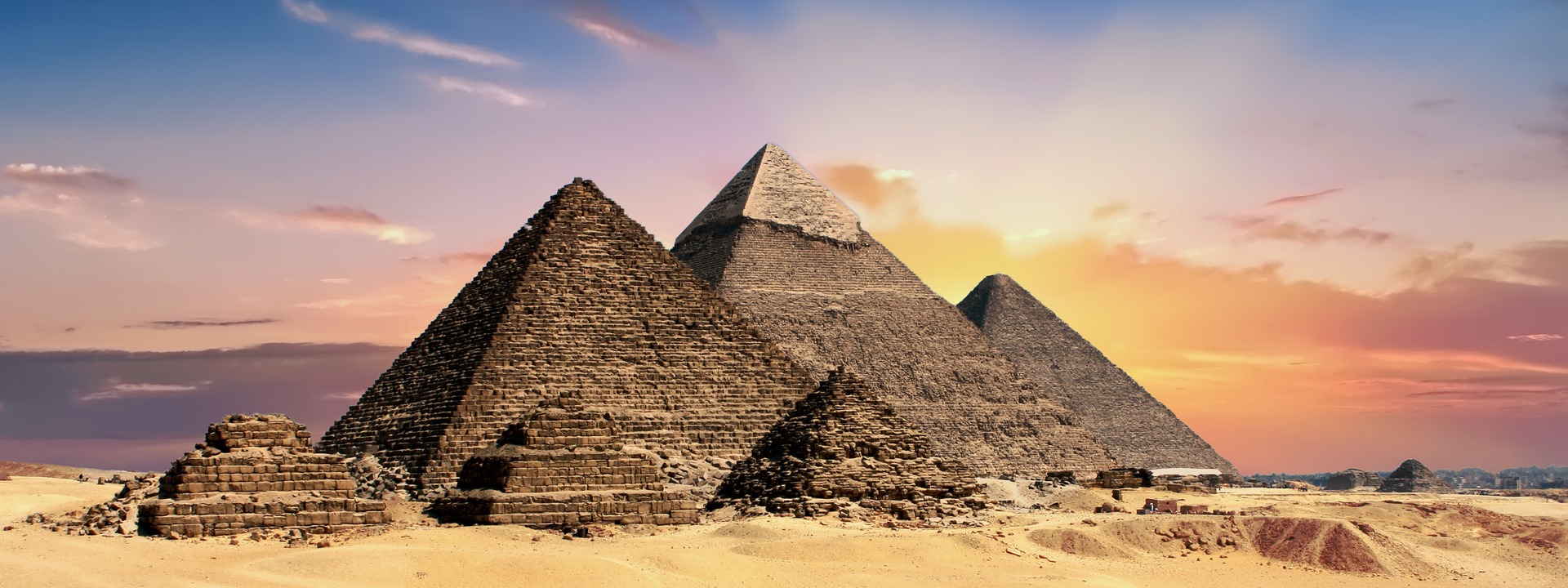
- The pyramids of Giza: The pyramids and the Sphinx on the edge of Cairo.
- Luxor: The temples of Karnak and Luxor, and the royal tombs of the West Bank.
- Abu Simbel: Rock-cut temples in the far south, near Lake Nasser and the Sudanese border.
- A boat on the Nile: A cruise ship, a dahabiya or a felucca between Luxor and Aswan.
- Islamic Cairo: Mosques, old houses and the Khan el-Khalili bazaar.
- The Red Sea: Diving and snorkelling from Hurghada, Sharm el Sheikh and Dahab.
Places to visit
- City
- Town
- Historic site
- Area
Cities
- Cairo: The capital, with the Egyptian Museum and Islamic Cairo; the pyramids are across the river in Giza.
- Alexandria: The Mediterranean port founded by Alexander the Great, with the Bibliotheca Alexandrina and Qaitbay's castle.
- Luxor: The gateway to the Valley of the Kings and the temples of Karnak, and the place where the hassle is worst.
- Aswan: A calmer Nile town than Luxor, with a large souq, the Tombs of the Nobles and trips to Abu Simbel.
- Hurghada: A Red Sea town of all-inclusive resorts and dive centres, with an airport used by many budget travellers.
- Sharm el Sheikh: The big resort town of the Sinai, known for its scuba diving.
- Port Said: The centre of Egypt's third-largest urban area, with a cosmopolitan past and the Lighthouse of Port Said.
Beyond the cities
- Pyramids of Giza (site): The pyramids and the Sphinx on the Giza plateau, at the edge of Greater Cairo.
- Saqqara and Memphis (site): Pyramids, temples and relics in Greater Cairo, often visited on the same day, with a huge statue of Ramesses II at Memphis.
- Dahshur (site): The Red, Bent and Black Pyramids, quieter than Giza.
- Karnak (site): Huge temples in Luxor, with an avenue of ram-headed sphinxes through the middle.
- Valley of the Kings (site): The royal tombs on the West Bank of Luxor.
- Abu Simbel (site): Ancient temples in a remote town in the far south, by Lake Nasser.
- Saint Catherine's Monastery (site): Said to be the oldest continually inhabited monastery, at the foot of Mount Sinai.
- Dahab (town): A Sinai beach town east of Sharm el Sheikh, popular with backpackers and divers.
- Siwa (area): A remote oasis in the Western Desert near the Libyan border, reached by the road from Marsa Matruh.
Regions
- Lower Egypt: The Nile delta and the Mediterranean coast, with Cairo and Alexandria.
- Middle Egypt: The stretch of the Nile where the ancient Upper and Lower kingdoms met.
- Upper Egypt: The temple towns of the southern Nile, including Luxor and Aswan.
- Western Desert: Five oases, each with its own sights, including Siwa.
- Red Sea Coast: Luxury beach resorts, diving and marine life.
- Sinai: A rugged, isolated peninsula with high mountains, relics of the past and scuba diving.
Things to do
See
- Pyramids of Giza and the Sphinx Cairo: The pyramids on the Giza plateau; you can also ride a horse or a camel in the desert next to them, with a local guide.
- Egyptian Museum Cairo: The museum of ancient Egypt, in downtown Cairo.
- Saqqara, Dahshur and Memphis Cairo: Pyramids and temples outside the city; hire a taxi for the whole day to see them together.
- The Citadel Cairo: Salah el-Din's citadel and the Mosque of Mohamed Ali.
- Karnak and Luxor temples Luxor: Two vast temple complexes in the town itself.
- The West Bank of Luxor Luxor: The Valley of the Kings, Medinat Habu and the Temple of Hatshepsut.
- Abu Simbel Aswan: The rock temples near Lake Nasser, one of the great sights of Egypt.
- Aswan's Tombs of the Nobles and Plant Island Aswan: Painted tombs with a view over the town, and an island in the Nile planted with rare trees and flowers.
- Alexandria Alexandria: The Bibliotheca Alexandrina, Qaitbay's castle, Montaza Palace and Greek and Roman remains.
- Saint Catherine's Monastery and Mount Sinai Saint Catherine's Monastery: The old monastery at the foot of Mount Sinai, in the mountains of southern Sinai.
Do
- Nile cruise Aswan: Sail between Luxor and Aswan on a cruise ship, a dahabiya or a felucca, stopping at temples such as Kom Ombo.
- Diving in the Red Sea Sharm el Sheikh: Dive or snorkel from Sharm el Sheikh, Dahab or Hurghada; safety standards vary, so book through a reputable operator.
Eat
- Koshari and ful: Try the everyday dishes: koshari of pasta, lentils and rice, and ful, slow-cooked fava beans.
Shop
- Islamic Cairo and Khan el-Khalili Cairo: Old mosques and houses, and a bazaar for lanterns, spices, cotton and silver; bargain for everything.
Itineraries
Cairo and the Nile in 9 days (9 days)
- Cairo (3 nights): The pyramids of Giza, the Egyptian Museum, and a day by taxi to Saqqara and Dahshur.
- Luxor (3 nights): By sleeper train or plane; Karnak, Luxor temple and the West Bank.
- Aswan (3 nights): By train (2-3 hours) or on a Nile cruise; the Tombs of the Nobles and a trip to Abu Simbel.
Cairo and Alexandria in 5 days (5 days)
- Cairo (3 nights): The pyramids, Islamic Cairo and the Citadel.
- Alexandria (2 nights): By train, 2-3 hours; the library, Qaitbay's castle and fresh fish.
The Sinai coast in 6 days (6 days)
- Sharm el Sheikh (3 nights): Fly in; diving and snorkelling. For short resort stays you may not need a full visa: check the entry section.
- Dahab (3 nights): A slower beach town for diving; book any trip inland through an approved agent.
Climate and best time to visit
| Jan | Feb | Mar | Apr | May | Jun | Jul | Aug | Sep | Oct | Nov | Dec | |
|---|---|---|---|---|---|---|---|---|---|---|---|---|
| Max °C | 19 | 20 | 23 | 28 | 32 | 35 | 35 | 35 | 33 | 30 | 25 | 20 |
| Min °C | 10 | 10 | 12 | 15 | 18 | 21 | 23 | 23 | 22 | 19 | 15 | 11 |
| Rain mm | 5 | 4 | 6 | 1 | 0 | 0 | 0 | 0 | 0 | 0 | 4 | 5 |
Egypt has a desert climate. In Cairo the average maximum is about 19 °C in January and 35 °C in July and August, and it hardly ever rains. Summers are hot, dry and very sunny, humid on the coasts and very dry inland. November to March is the most comfortable time to travel; December to February are the coldest months, and in winter the nights in the southern Nile valley are as cool as in the north, even though the days are warmer.
Only the north coast gets real winter rain, with thunderstorms in Alexandria and Marsa Matruh, and heavy rain can flood low-lying areas in the north. Sand and dust storms are most common in spring, from March to May, and can affect driving and flights. Flash floods hit parts of the Sinai and Upper Egypt a few times in some years, so take care when camping in the desert. Most houses have no central heating, so rooms can feel cold in winter.
Holidays and events
- 7 January 2026 · Christmas Day (Orthodox)
- 29 January 2026 · Revolution Day 2011 / National Police Day
- 13 April 2026 · Easter Monday
- 25 April 2026 · Sinai Liberation Day
- 7 May 2026 · Labour Day
- 27 May 2026 · Eid Al-Adha
- 28 May 2026 · Eid Al-Adha
- 29 May 2026 · Eid Al-Adha
- 30 May 2026 · Eid Al-Adha
- 31 May 2026 · Eid Al-Adha
- 18 June 2026 · Islamic New Year
- 2 July 2026 · June 30 Revolution
- 23 July 2026 · Revolution Day
- 26 August 2026 · Prophet Muhammad's Birthday
- 6 October 2026 · Armed Forces Day
Getting around
| Main airports | CAI, HRG, SSH, LXR, HBE |
|---|---|
| International driving permit | Required |
Flying is often the best way to cover long distances, and advance fares are not expensive: domestic flights, mostly by EgyptAir, link Cairo to Luxor, Aswan, Abu Simbel, Hurghada, Sharm el Sheikh and other cities. Trains follow the Nile from Alexandria through Cairo and Luxor to Aswan, with fast services of 2-3 hours between Cairo and Alexandria and between Luxor and Aswan, and day and night trains from Cairo to Luxor and Aswan. Foreigners pay special fares, and delays of up to an hour are common; the sleeper is run by a private company and sold on its own website. There are no trains to the Red Sea resorts or to Siwa. Long-distance buses link most towns; buy tickets from the company, not from touts, because small operators may be unlicensed. The UK reports serious bus and train accidents, and Canada advises against microbuses.
In Cairo, take white metered taxis and ask the driver to switch the meter on, or agree the fare before you get in; keep small notes for change. Careem, inDrive and Uber work in Cairo, Alexandria and Hurghada. Cairo's metro has three lines, with women-only cars on most of them, but it gets crowded and has pickpockets.
Driving is hard work: accidents are common, traffic rules are widely ignored and many speed bumps are unmarked. You need the 1949 International Driving Permit with your licence, and seatbelts are compulsory in the front. Do not drive outside cities and resorts at night. Off-road travel needs a qualified guide and a permit from the Ministry of Interior.
Flying to Egypt? PartnerCompare fares and find the cheapest datesSearch flightsWhere to stay
- Hotels and resorts: Up to five-star resorts; most major chains are in Greater Cairo, Sharm el Sheikh and Luxor.
- Backpacker hostels: The basic end of the range.
- Nile cruise boats: Floating hotels between Luxor and Aswan, or smaller dahabiyas under sail.
Walk-in prices can be much lower than online rates, because many hotels have no website of their own: in high season, book the first night online and negotiate the rest on the spot, with a screenshot of the online price in hand. Some booking sites say you must pay in Egyptian pounds.
The UK advises women not to let hotel staff into the room when they are alone. Some hotel doctors overcharge: pharmacies outside the hotel are usually cheaper.
Eat and drink
Dishes to try
- Ful medammes: Fava beans slow-cooked and mashed, with cumin, oil and lemon, eaten with baladi bread.
- Ta'meyya: Egyptian falafel, made from fava beans rather than chickpeas; a snack and a weekend breakfast.
- Koshari: Pasta, lentils, rice and chickpeas topped with tomato sauce and fried onions.
- Kofta and kebab: Grilled meatballs and skewers.
- Stuffed vegetables and vine leaves: Dishes shared with the rest of the Middle East.
- Fresh fish: In fish markets you can often pick your fish at a stall and have it cooked on the spot.
Drinks
- Karkadeh: Hibiscus tea, usually iced and very sweet, a speciality of Luxor.
- Asab: Fresh sugar cane juice, sold at juice shops.
- Beer: Stella and Sakkara are the common local lagers.
| Tipping | Not expected in restaurants, although smart places may add a 10-12% service charge. Tips are expected for many tourist services, from tour drivers to toilet attendants; small notes are enough. |
|---|
Many local dishes are vegetarian or vegan, partly because of Coptic fasting days. Prices on English menus can be higher than for locals, so check the price before you order. Buy bottled water only with the seal intact, and be careful with ice, unpasteurised milk and juice that may be mixed with water.
Drinking alcohol outside licensed restaurants, bars, private homes and some tourist resorts is illegal. During Ramadan, alcohol is often sold only in hotels and places that serve foreigners, and on a few days a year it is banned completely. Avoid spirits of unknown origin: counterfeit drinks can contain methanol.
Entry requirements and visas
| Passport validity | At least 6 months (the UK says after the date you arrive, Canada after the date you leave), with at least one blank page |
|---|
| Passport | Entry | Max stay | Notes |
|---|---|---|---|
| United Kingdom | Visa on arrival | E-visa online or visa on arrival for US$30 in cash; no visa for stays under 15 days in the Sinai resorts if you fly into Sharm el Sheikh. | |
| Canada | Visa on arrival | E-visa before travel or a 30-day visa on arrival, paid in US dollars cash. | |
| United States | Visa on arrival | Visa on arrival at major points of entry, according to Wikivoyage; check with the Egyptian embassy. | |
| EU / EEA | Visa on arrival | Visa on arrival at major points of entry, according to Wikivoyage; check with the Egyptian embassy. | |
| Australia | Visa on arrival | Visa on arrival at major points of entry, according to Wikivoyage; check with the Egyptian embassy. |
Other nationalities: check the official source below.
Most Western visitors need a visa but can get it easily. You can apply for a tourist e-visa online before you go, which can save delays, or buy a visa on arrival at the kiosks before immigration at approved airports: US$30, cash only, valid for 30 days. Since 1 August 2026, Cairo airport also sells a digital visa on arrival by card for US$36. Do not buy the visa from agents in the airport, who charge more. If you fly into Sharm el Sheikh and stay less than 15 days in the resorts of Sharm el Sheikh, Dahab, Nuweiba or Taba, you get a free entry stamp instead; to go further you need a full visa.
Entering at Taba from Israel works differently, with border taxes paid in US dollars cash and a full visa only if you leave the Sinai. Keep the entry stamp in your passport: you need it to leave. Overstaying by more than 14 days means a fine. You need a yellow fever certificate if you arrive from a country with yellow fever risk, including transits of more than 12 hours there.
You can bring up to EGP 5,000 (Egyptian pounds) in or out, and must declare foreign currency worth more than US$10,000. Declare expensive electronics and cameras; satellite phones, radios and drones are likely to be confiscated without prior permission. Some medicines are controlled: Canada says narcotic and psychotropic drugs are seized even with a prescription, so carry other medicines in their original packaging with the prescription. Rules depend on your passport and can change: check with the Egyptian embassy or consulate before you book.
Money and payments
| Currency | Egyptian Pound (EGP) |
|---|---|
| Cards | Common |
The currency is the Egyptian pound (EGP), written LE or E£. ATMs are everywhere in the cities and take Visa and Mastercard; Wikivoyage suggests avoiding Euronet machines. Cards are accepted in larger shops, hotels and tourist restaurants, but many merchants take only cash or add a fee. US dollars are preferred at tourist sites, and some tour operators ask for dollars in cash.
Change money at banks or exchange offices, not with street changers. Small notes are always short, and vendors often say they have no change: keep a stock of them. Prices for foreigners are often higher, so learn the Eastern Arabic numerals to read local price tags, and bargain in markets. Egyptian pounds are hard to change abroad, so convert what is left before you leave.
Costs and budget
- Entry to all areas of the Pyramids of Giza: about US$70 equivalent, half with a student or teacher card
- Train Cairo-Luxor, foreigner fare: about US$110
- Petrol, per litre (April 2025): LE15.5-19
- Tip for a tour driver, per person per day: LE50-100
- Tip for a toilet attendant: LE3-5
The Egyptian pound was devalued sharply in 2024, so prices in pounds in older guides are out of date. Big sites are the main expense: most of them give a 50% discount with an ISIC student card or the teacher card, so bring one if you have it. Taxis are cheap and fuel costs little, while tips add up across a trip. The prices here are those listed on Wikivoyage when we read it in October 2026, some from earlier years, and they change quickly.
Health
| Required vaccines | Yellow fever certificate, only if you arrive from a country with yellow fever risk (from 9 months of age, including transits of more than 12 hours) |
|---|---|
| Recommended vaccines | Routine vaccines, including measles (MMR), Polio: a single adult booster, Hepatitis A, Hepatitis B, Typhoid, Rabies, only for some travellers: ask a travel clinic |
| Malaria | None |
| Tap water | Not safe |
See a travel health professional at least 8 weeks before you go. Do not drink the tap water: locals drink it, but it often makes travellers ill. Rabid dogs are common, so avoid contact with animals. Do not swim or wade in the Nile or other fresh water, because of schistosomiasis. Dengue and tick-borne diseases are also present. Dehydration and sunburn are real risks, especially from June to August: carry water and avoid the midday sun.
Some private hospitals in Cairo and Alexandria reach international standards, and good primary care is found around Hurghada and Sharm el Sheikh, but care outside the big cities is often poor. Hospitals may ask for proof of insurance or a deposit, and public hospitals want cash. Get insurance that covers medical evacuation. Pharmacies sell many medicines without a prescription; buy them in their original packaging. For an ambulance, dial 123.
This is general information, not medical advice: check with a travel health professional before you go.
Safety
- United States: Level 2: Exercise Increased Caution (2026-10-20)
- Canada: Exercise a high degree of caution (2026-10-20)
- United Kingdom: Advises against all travel to parts of the country; Advises against all but essential travel to parts of the country (2026-10-20)
The UK advises against all travel to North Sinai and within 20 km of the Libyan border, and against all but essential travel to the northern part of South Sinai beyond the St Catherine-Nuweiba road (except the coasts), to the Ismailiyah Governorate east of the Suez Canal, to the Hala'ib Triangle and Bir Tawil, and to the Western Desert, with exceptions that include the Nile valley sites, Siwa, the White and Black Deserts and the oases of Bahariya, Farafra, Dakhla and Kharga. Canada advises against all travel to northern Sinai, within 50 km of the Libyan border and to the Western Desert west of the Giza-Luxor-Aswan-Abu Simbel road (with some exceptions), and against non-essential travel to the north of South Sinai. Both point to a threat of terrorism; security is heavy at tourist sites, and the UK says the Red Sea tourist areas of southern Sinai are generally low risk. Desert trips to Bahariya, Farafra and the White and Black Deserts need a permit and an official guide.
Crime is generally low, but pickpockets and bag snatchers work at tourist sites and on the Cairo metro, and touts and scammers target visitors. Report crimes to the tourist police (126) before you leave the country. Women often face harassment; the UK reports sexual assaults in Red Sea resorts, often by people the victim had met, including hotel and excursion staff, and advises against taking taxis alone at night. Avoid demonstrations. Landmines remain in some desert and coastal areas, including the Mediterranean shore and the Sinai: ask locally before you go off-road.
For diving, book through reputable operators, ask for a safety briefing and check that your insurance covers rescue, which can cost more than US$4,000 an hour. Wear a helmet on quad bikes, and ask your tour company about the safety of balloon flights. The Red Sea and eastern Sinai are in an active earthquake zone.
Customs and etiquette
Dress modestly, especially in rural areas, mosques and markets: Canada suggests knee-length or longer dresses and long sleeves for women, and no shorts for men outside tourist areas. Women do not need to cover their hair. Physical affection in public is frowned upon, though holding hands is generally fine. Take off your shoes before entering a mosque and do not walk in front of people praying. During Ramadan (the next one starts around 7 February 2027) do not eat, drink or smoke in public in the daytime. The working week runs from Sunday to Thursday.
Greet people with "es-salāmu ʿalēku" before asking for anything, and never criticise someone directly in front of others. Carry your passport, or a copy of it and your visa: police check ID. Ask before you photograph anyone, do not photograph children, and never photograph military sites, bridges, the Suez Canal or government buildings. Drones need permission from the Ministry of Defence. Posting content online that criticises the country or the government can lead to arrest, and trying to convert people is illegal. Same-sex relationships are not explicitly illegal, but people have been prosecuted under other laws. Drug offences carry very heavy sentences, up to the death penalty.
Language
| Official languages | Arabic |
|---|---|
| English | Common |
| Hello (peace be upon you) | السلام عليكو es-salāmu ʿalēku |
|---|---|
| Thank you | شكراً shokràn |
| No, thank you | لا شكراً la shokràn |
| Please (to a man) | من فضلك men fàDlàk |
| Yes / No | أيوا / لا aywa / la |
| Do you speak English? (to a man) | بتتكلم إنجليزى؟ betetkallem engelīzi? |
| Can I buy a ticket? | ممكن أشترى تذكرة momken ashteri tàzkàrà? |
| Goodbye | مع السلامة maʿas-salāma |
What to pack
- Passport valid 6 months, with a blank page: Needed to enter; keep copies of the passport and visa, because police check ID.
- US dollars in cash: The visa on arrival is paid in cash, and dollars are preferred at tourist sites.
- Small notes: Change is always short, for taxis and tips.
- Prescriptions for your medicines: Some medicines are controlled; keep them in their original packaging.
- Modest clothes and a scarf: For mosques, rural areas and the trip to and from the sites.
- Sunglasses, sunscreen and a hat: The sun is strong, especially from June to August.
- Toilet paper and hand gel: Often missing in public toilets and at tourist sites.
- International Driving Permit (1949): Only if you plan to drive; you need it with your licence.
Quick reference
Country facts
| Capital | Cairo |
|---|---|
| Population | 118,365,995 (2025) |
| Area | 995,450 km² |
| Time zone | Africa/Cairo (UTC+2) |
| Calling code | +20 |
| Driving side | right |
Staying connected
| SIM and eSIM | Four networks: Vodafone, Etisalat, We and Orange; Vodafone had the widest 4G coverage in 2022. Wikivoyage warns that phones bought abroad can be blocked on local SIM cards unless an import tax is paid within 90 days, so an international eSIM or roaming may be simpler. |
|---|---|
| Wi-Fi | Free Wi-Fi is common in cafés, restaurants and hotel lobbies; use a VPN for privacy. |
Useful apps
- Careem: Ride-hailing in Cairo, Alexandria and Hurghada
- Uber: Ride-hailing with fixed fares
- inDrive: Ride-hailing
Emergency numbers
| Police | 122 |
|---|---|
| Ambulance | 123 |
| Fire | 180 |
| Tourist police | 126 |
Frequently asked questions
Do I need a visa for Egypt?
Most Western visitors do, but can get an e-visa online or a visa on arrival for US$30 in cash. Short stays in the Sinai resorts after flying into Sharm el Sheikh need only a free entry stamp. Check with the Egyptian embassy before you book.
When is the best time to visit Egypt?
November to March, when it is cooler. Summers are very hot and sand storms are most common in spring.
Can I drink the tap water in Egypt?
No: it often makes travellers ill. Drink bottled water and check that the seal is intact.
Can I use cards in Egypt?
Yes, in larger shops, hotels and tourist restaurants, and ATMs are common in cities. Carry cash for small places, tips and taxis.
Is it safe to travel to Egypt?
The US, Canada and the UK all publish advice for Egypt, and the UK and Canada advise against travel to North Sinai, the Libyan border and much of the Western Desert. Read the safety section and the official links before you go.
Do I need to tip in Egypt?
Not in ordinary restaurants, but tips are expected for many tourist services, from drivers to toilet attendants. Small notes are enough.
More Travel Stories from Africa
 Colombia +1
 Kenya
Sources This guide was last checked on · 20 sources
- Wikivoyage: Egypt · Overview, Places to visit, Things to do, Itineraries, Climate and best time to visit, Getting around, Where to stay, Eat and drink, Entry requirements and visas, Money and payments, Costs and budget, Health, Customs and etiquette, Language, What to pack, Staying connected, Frequently asked questions
- Wikidata: Egypt · Overview, Places to visit, Money and payments, Country facts
- UK FCDO: Egypt entry requirements · Overview, Itineraries, Getting around, Entry requirements and visas, Money and payments, What to pack, Frequently asked questions
- UK FCDO: Egypt warnings and insurance · Overview, Safety
- Wikivoyage: Alexandria · Places to visit, Itineraries
- UK FCDO: Egypt safety and security · Things to do, Getting around, Where to stay, Eat and drink, Safety, Customs and etiquette, What to pack
- Government of Canada: Egypt travel advice (updated 26 May 2026) · Things to do, Climate and best time to visit, Getting around, Entry requirements and visas, Money and payments, Health, Safety, Customs and etiquette, What to pack, Frequently asked questions
- WMO World Weather Information Service: Cairo · Climate and best time to visit
- Nager.Date: public holidays in Egypt, 2026 · Holidays and events
- UK FCDO: Egypt regional risks · Getting around, Safety
- UK FCDO: Egypt health · Where to stay, Health
- CDC Travelers' Health: Egypt · Entry requirements and visas, Health, Frequently asked questions
- ISO 4217 (SIX), published 2026-09-17 · Money and payments
- US Department of State: Egypt travel advisory · Safety
- UK FCDO: Egypt travel advice · Safety
- UK FCDO: Egypt getting help · Safety, Emergency numbers
- Wikivoyage: Egyptian Arabic phrasebook · Language
- World Bank, SP.POP.TOTL · Country facts
- World Bank, AG.LND.TOTL.K2 · Country facts
- IANA Time Zone Database, zone.tab · Country facts
Suggest an update
Travel rules, prices and timetables change. If something in this guide is out of date, tell us: we check every suggestion against an official source before changing the page.