

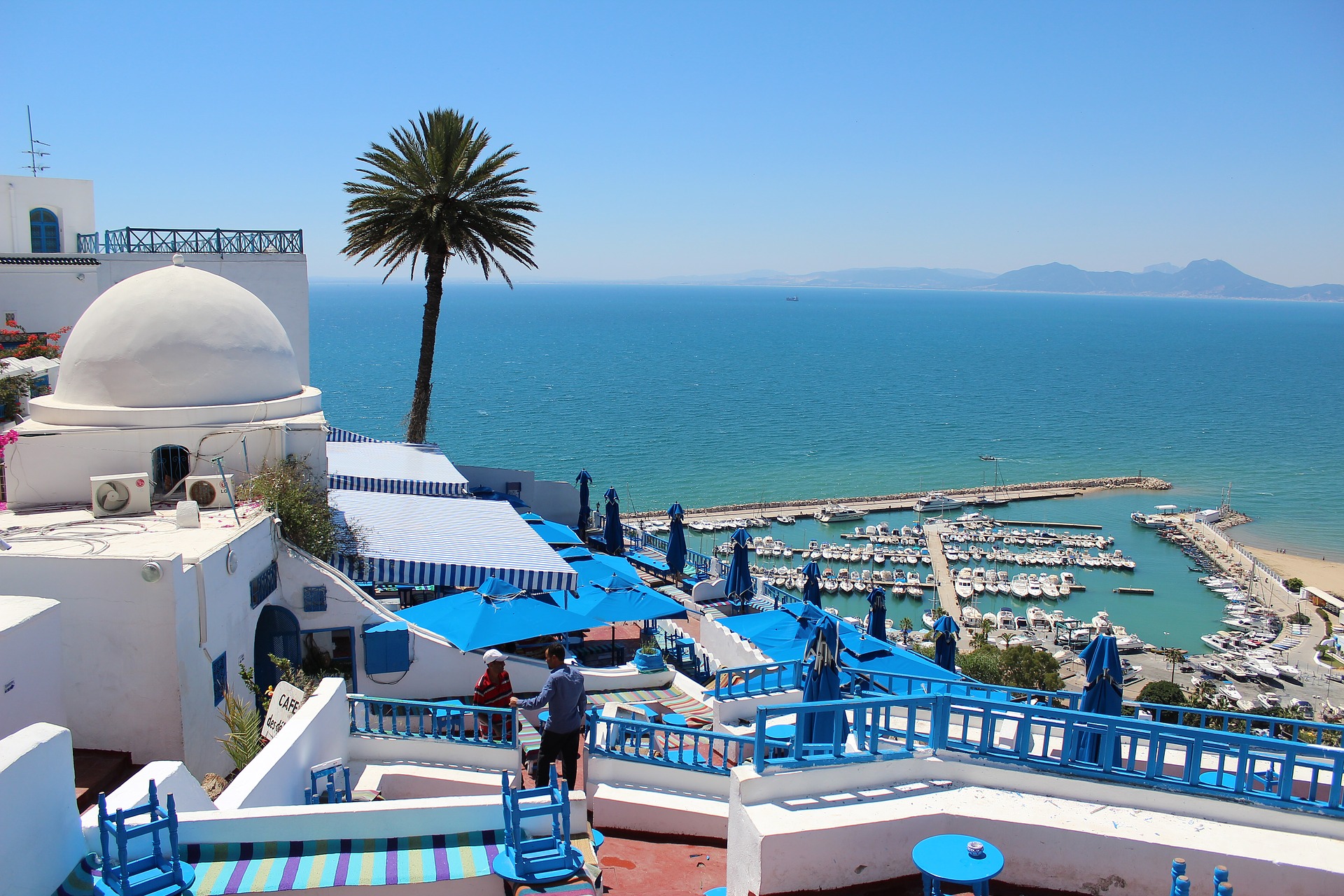
- Local time
- 13:30
- Currency
- Tunisian Dinar (TND)
- Capital
- Tunis
- Calling code
- +216
- Drive on the
- right
Overview
Carthage and Roman ruins, old medinas, Mediterranean beach resorts and a Sahara you can reach by train or shared taxi, in a country used to visitors.
Tunisia sits on the Mediterranean coast of North Africa, between Algeria and Libya. The north has mountains, the centre a hot, dry plain, and the semi-arid south runs into the Sahara. Tourism is well organised, and beach holidays are what the country is best known for: the main resorts are on the east coast, from La Goulette near Tunis down to Monastir, and on the island of Djerba.
The history goes back a long way. Carthage, the Phoenician city that fought three wars with Rome and was destroyed in 146 BC, is now a suburb of Tunis, and Roman remains survive at Dougga and in the amphitheatre of El Jem. Kerkouane is a Punic town, the medina of Sousse is a UNESCO World Heritage Site and Kairouan is a major place of Islamic pilgrimage. In the south, Douz and Tozeur are the bases for desert trips, and the cave homes of Matmata were a set for Star Wars.
Check the travel advice: Canada asks for a high degree of caution across the country because of the risk of terrorism, and the UK and Canada advise against all travel to some areas near the borders with Algeria and Libya. Arabic is the official language and French is widely spoken; English is heard mainly in tourist areas.
- Carthage: The remains of the Phoenician and Roman city, a short light-rail ride from Tunis.
- El Jem: One of the best-preserved Roman amphitheatres, a UNESCO World Heritage Site.
- Medina of Sousse: A UNESCO-listed old town and souk in a popular beach resort.
- Dougga and Kerkouane: A remote Roman city and a Punic settlement, both UNESCO-listed.
- Douz and the Sahara: The "Gate of the Desert", a starting point for treks into the dunes.
- Djerba: A southern island of beaches with a historic synagogue.
Places to visit
- City
- Town
- Island
- Park
- Historic site
Cities
- Tunis: The relaxed capital, with an old souk and easy access to Carthage.
- Sousse: A beach resort whose medina and souk are a UNESCO World Heritage Site.
- Monastir: A resort town with a fortified ribat, a museum and the main charter airport.
- Kairouan: A major site of Islamic pilgrimage.
- Sfax: A historic town with an old kasbah, and the way to the Kerkennah Islands.
- El Kef: A small town in the north-west with a Byzantine kasbah above the medina.
- Gabès: A large town on the east coast, mostly a rail and bus junction.
- Tozeur: A desert town in the west, with an airport, a train from Tunis and dunes around it.
- Douz: The "Gate of the Desert", known for its date palms and desert trips.
Beyond the cities
- Carthage (site): The Phoenician and Roman city, now a suburb of Tunis, reached by light rail.
- El Jem (site): A Roman amphitheatre, among the best preserved anywhere.
- Dougga (site): The well-preserved ruins of a remote Roman city, with few signs.
- Kerkouane (site): The remains of a Punic town, a UNESCO World Heritage Site.
- Djerba (island): A southern island for beach holidays, with one of the last active synagogues in the Arab world.
- Matmata (town): A Berber village of cave dwellings, used as Luke Skywalker's home in Star Wars.
- Ksar Ghilane (area): A Saharan oasis at the edge of the dunes, with a hot spring and an old Roman fort.
- Jebil National Park (park): A large desert park of dunes and rock formations.
- Metlaoui (town): The starting point of the Red Lizard, a restored old train through desert gorges.
Regions
- Northern Tunisia: Tunis, the north coast and mountains, and many of the busiest beach resorts.
- Central Coastal Tunisia: The southern beach resorts and the coast road to Libya; the UK and Canada advise against all travel near the Libyan border.
- Saharan Tunisia: The desert interior: rocky plains, dunes, treks and some major archaeological sites.
Things to do
See
- Carthage by light rail Carthage: The TGM light railway runs from Tunis to Carthage, La Marsa and Sidi Bou Said; a one-way ticket cost about DT 1 in June 2025.
- Amphitheatre of El Jem El Jem: A Roman amphitheatre and UNESCO World Heritage Site.
- Dougga and Kerkouane: Two UNESCO-listed ruins, Roman and Punic, well preserved but with little or no signage.
- Medina of Sousse and ribat of Monastir Sousse: A UNESCO-listed old town and souk, and the fortified monastery (ribat) and museum of Monastir.
- Cave homes of Matmata Matmata: Berber troglodyte dwellings, one of them the set of Luke Skywalker's home.
Do
- Desert trek Douz: Douz and Tozeur are the usual starting points for treks into the Sahara.
- Red Lizard train Metlaoui: Restored wagons from 1904 take you through gorges and desert mountains near Tozeur.
Eat
- Brik: A crisp, thin pastry with a whole egg, parsley and onion, sometimes tuna or lamb: a cheap starter eaten with your fingers.
Drink
- Mint tea and a capucin: Very sweet mint tea at any time of day, or a strong espresso macchiato in a café.
Shop
- Souk of Tunis Tunis: The old medina and its souk; park outside and come in by light rail, tram or taxi.
Itineraries
Tunis, Carthage and the coast in 7 days (7 days)
- Tunis (3 nights): The medina and souk, with Carthage and Sidi Bou Said by light rail.
- Sousse (2 nights): By train from Tunis: the UNESCO-listed medina and the beach.
- Monastir (1 night): By train: the ribat and the museum; charter flights leave from here.
The Sahara from Tozeur to Gabès in 6 days (6 days)
- Tozeur (2 nights): By train or domestic flight from Tunis; the Red Lizard train leaves from nearby Metlaoui.
- Douz (2 nights): Desert treks into the dunes.
- Gabès (1 night): By louage from Douz, about 120 km; trains run back to Tunis.
Climate and best time to visit
| Jan | Feb | Mar | Apr | May | Jun | Jul | Aug | Sep | Oct | Nov | Dec | |
|---|---|---|---|---|---|---|---|---|---|---|---|---|
| Max °C | 16 | 17 | 18 | 21 | 25 | 29 | 33 | 33 | 30 | 25 | 21 | 17 |
| Min °C | 7 | 7 | 8 | 10 | 14 | 17 | 20 | 21 | 19 | 16 | 11 | 8 |
| Rain mm | 59 | 57 | 47 | 38 | 23 | 10 | 3 | 7 | 33 | 66 | 56 | 67 |
The north has mild, rainy winters and hot, dry summers; the south is desert. At Tunis-Carthage the average maximum goes from about 16 °C in December and January to almost 33 °C in July and August, when there is hardly any rain (3 mm in July). Most of the rain falls between October and February, about 56 to 67 mm a month.
Spring and early autumn are the most comfortable times, with average highs between 21 °C in April and 30 °C in September. Summer is holiday time: Canada notes heavy traffic on the roads from July to mid-September, and the UK warns that heatwaves can lead to power cuts.
Holidays and events
- 1 January 2026 · New Year's Day
- 20 March 2026 · Independence Day
- 9 April 2026 · Martyrs' Day
- 1 May 2026 · Labour Day
- 25 July 2026 · Republic Day
- 13 August 2026 · Women's Day
- 15 October 2026 · Evacuation Day
- 17 December 2026 · Revolution Day
Getting there and around
| Main airports | TUN, MIR, NBE, DJE, TOE |
|---|---|
| International driving permit | Required |
Getting there
By air: Tunis-Carthage (TUN) is the main airport for scheduled flights, and Tunisair is the national airline. Monastir (MIR), served by low-cost charter flights from all over Europe, is closer to most resorts; Enfidha-Hammamet (NBE) is the third airport. Djerba (DJE), Tozeur (TOE), Sfax (SFA) and a few others also have international flights.
By sea: ferries link La Goulette, near Tunis, with Malta, Sicily (Trapani and Palermo), Naples, Genoa and Marseille.
By land: Wikivoyage lists a train three times a week between Tunis and Annaba in Algeria. West of Ghardimaou it runs through an area where the UK advises against all but essential travel and Canada against all travel. The UK and Canada also advise against travel to parts of the Libyan border area, and Canada warns that the Libyan border can close at any time for an indefinite period.
Getting around
Trains (SNCFT) run from Tunis to Sousse, Monastir and Sfax, and on to Gabès and Tozeur. They are cheap but tired and often late. A 7-day pass (carte bleue) cost DT 40 (Tunisian dinars, TND) in second class in June 2025, with a small fee to reserve long-distance seats. Canada reports petty crime on trains and derailments every year. Louages, white shared taxis with a red stripe for intercity routes, leave when all eight seats are full, at fixed prices, but drive fast. Intercity buses (SNTRI and local companies) are cheap and rarely full.
Taxis are yellow and mostly take cash. In cities they have meters; for long trips agree the fare first. Ride-hailing works through inDrive and Forus Taxi; Bolt no longer works in Tunisia (2025). Domestic flights with Tunisair Express link Tunis with Tozeur and Djerba.
Driving: the UK says you need a 1968 international driving permit with your UK licence, plus a green card for insurance; Canada says you can drive on a valid Canadian licence but should have an international driving permit. Motorways have a 110 km/h limit; road signs are in Arabic and French. Outside towns, avoid driving at night because of unlit roads and livestock, fill up before long trips into remote areas and stop at police checkpoints. Driving standards can be low: other drivers may ignore traffic lights, and pedestrians often walk on the road. Being over the alcohol limit can mean a fine and prison.
Flying to Tunisia? PartnerCompare fares and find the cheapest datesSearch flightsWhere to stay
- Hotels: Plenty of choice, from beach resorts to small hotels in city streets. A Tunisian 4-star hotel is roughly a 3-star elsewhere.
- Furnished apartments: Private owners rent out their own flats, especially in summer.
| Tourist tax | Hotel tax paid on arrival (2026): TND 8 per person per night in 3-star hotels and TND 12 in 4- and 5-star hotels, for a maximum of ten nights. |
|---|
Book before you arrive: apart from the pricier hotels, most places have no website, and some French helps on the phone. Rooms fill up around Independence Day on 20 March. The hotel tax cannot be reclaimed if you leave early.
Eat and drink
Dishes to try
- Couscous: With marqa stews, the base of most meals.
- Brik: Crisp thin pastry with a whole egg, parsley and onion, sometimes with tuna or minced lamb.
- Tunisian tajine: Not a stew but a baked egg pie with meat or vegetables, herbs and cheese.
- Harissa: A very hot chilli paste served with bread and olive oil at almost every meal.
- Coucha: Shoulder of lamb cooked with turmeric and cayenne pepper.
- Salade méchouia: Puréed grilled vegetables with olive oil, often with harissa and tuna.
- Fricassé: A small fried sandwich with tuna, harissa and olives.
Drinks
- Mint tea: Very sweet, drunk at any time of day; other tea sometimes comes with pine nuts.
- Coffee: Strong, in small cups; locals order a capucin (espresso macchiato) or a direct (latte).
- Celtia: The popular local beer.
- Tunisian wine and boukha: Local wines are served wherever alcohol is sold; boukha is a spirit distilled from figs.
Lamb is the main meat and seafood is plentiful; pork is hard to find outside some supermarkets and tourist hotels. Wikivoyage finds restaurant food often bland and suggests souk food stalls or cheap places serving couscous or coucha. Ask for an itemised paper bill and check menu prices before you order.
Alcohol is legal and served in hotels, bars, licensed restaurants and resorts. Supermarkets cannot sell it on Fridays, and during Ramadan its sale is banned outside holiday resorts. Some bars outside the tourist areas do not admit women.
Entry requirements and visas
| Passport validity | Valid for the length of your stay (UK); at least 6 months beyond the date you leave Tunisia (Canada). A damaged passport can cause problems when you leave. |
|---|
| Passport | Entry | Max stay | Notes |
|---|---|---|---|
| United Kingdom | Visa free | 90 days | Make sure your passport is stamped on arrival; overstaying means a fine. |
| Canada | Visa free | 90 days | For longer stays, contact a Tunisian embassy before you leave. |
Other nationalities: check the official source below.
UK and Canadian citizens can visit Tunisia without a visa for up to 90 days. Border officials can ask for your contact details, a return or onward ticket and proof of accommodation; a few visitors have been refused entry or delayed for lacking proof of a booking.
Tunisia has strict currency controls: declare foreign cash where the rules require it, keep exchange receipts, and do not take dinars in or out. Drones are confiscated without authorisation, and some smart devices, such as smart glasses or walkie-talkies, may be held until you leave. Rules depend on your passport and can change: check the official link or the Tunisian embassy before you book.
Money and payments
| Currency | Tunisian Dinar (TND) |
|---|
The Tunisian dinar (TND, written DT) is a closed currency: you cannot bring it in or take it out, so you change money on arrival. Keep your exchange and ATM receipts, which you need to change dinars back, and spend or change them before departure: customs at the airport can confiscate dinars. Prices are written with three decimals, because a dinar has 1,000 millimes: 5.600 means 5 dinars 600 millimes.
Many ATMs across the country accept Visa and Mastercard. Credit cards work in many places in cities and tourist areas, but taxis usually take only cash, and the UK notes that summer power cuts can briefly stop ATMs and card payments. Carry only the cash you need and a single card.
Health
| Recommended vaccines | Routine vaccines, including measles (MMR), Hepatitis A, Hepatitis B, for unvaccinated travellers under 60, Typhoid, for most travellers, Rabies, for some travellers: rabid dogs are common, Mpox, for travellers at risk of sexual exposure |
|---|---|
| Malaria | None |
No vaccinations are required to enter Tunisia, and the CDC and Canada do not recommend the yellow fever vaccine. Malaria is not listed. Ask a health professional about the recommended vaccines at least a month before you go. Other risks named by the CDC and Canada include leishmaniasis, spread by sand flies, and travellers' diarrhoea: be careful with food, water and ice. Use strong sunscreen.
Medical care is adequate in Tunis and the big cities, where private clinics have English-speaking doctors, but limited in rural areas. There is no free care for foreigners: doctors and clinics want payment on the spot, sometimes in advance, so get travel insurance that covers evacuation. Bring prescription medicines in their original packaging with a note from your doctor. Pharmacies are easy to find and often open late. For an ambulance, call 190.
This is general information, not medical advice: check with a travel health professional before you go.
Safety
- United States: Level 2: Exercise Increased Caution (2026-11-03)
- Canada: Exercise a high degree of caution (2026-10-20)
- United Kingdom: Advises against all travel to parts of the country (2026-10-20)
Border areas: the UK advises against all travel to the Chaambi Mountains National Park, the military zones of Mount Salloum, Mount Sammamma and Mount Mghila, the militarised zone south of El Borma and Dhehiba, the area within 20 km of the Libyan border north of Dhehiba and the town of Ben Guerdane with its surroundings. It advises against all but essential travel to the Kasserine governorate, including Sbeitla, to the area within 75 km of the Libyan border (but not Zarzis, the C118 road or the areas of Medenine governorate north of it), to parts of the Algerian border area in Jendouba and El Kef governorates, including El Feidja National Park, to within 10 km of the rest of the Algerian border and to Mount Orbata. Canada advises against all travel within 20 km of the Algerian border (except the P7 road to the Malloula crossing and the towns of Aïn Draham, Chebika, Mides, Tabarka and Tamerza), within 30 km of the Libyan border, to the Kasserine governorate and to the military zone south of Remada, and against non-essential travel to the Remada delegation and Mount Orbata. The US advises its citizens not to travel within 16 km of the Algerian and Libyan borders, to the Chaambi, Salloum, Sammamma, Mghila and Orbata mountains, or to the military zone south of Remada.
Terrorism: a state of emergency has been in force since 2015, and attacks in the past have targeted resorts and tourist sites. Expect armed security and checkpoints, carry ID and follow instructions. Demonstrations and strikes happen at short notice, mostly in central Tunis, and can disrupt transport: keep away from them. The UK notes tension around migration in some coastal towns, such as Sfax, which can affect anyone perceived to be from sub-Saharan Africa.
Crime: most visits are trouble-free, but theft happens, including from hotel rooms, at airports and on trains, sometimes with a distraction trick. Women may face harassment, more often in summer. Canada warns of marriage scams in some resorts. Follow beach flags, as not all beaches have lifeguards, and wear a helmet on quad bikes.
Customs and etiquette
Tunisia is a Muslim-majority country with long-established Christian and Jewish minorities. Religious proselytising is prohibited, including preaching and possessing or handing out religious material. Beachwear is fine in resorts, but cover up when you visit religious sites or remote areas; the further south you go, the more conservative people are. In many towns the street cafés are for men only. Touts can be persistent: a polite "non, merci" with a smile works best.
During Ramadan (the next one starts in February 2027) avoid eating, drinking or smoking in public during the day, and check opening hours. Same-sex relations are illegal, with fines and prison sentences of six months to three years. Do not photograph government or military sites, and you need permission from the authorities to take antiquities out of the country. Illegal drugs carry severe penalties, including long prison sentences and heavy fines, even if they are legal elsewhere and however small the amount.
Language
| Official languages | Arabic |
|---|---|
| English | Limited |
| Hello | عالسلامة ԑa-is-slāma |
|---|---|
| Please | أمان aṃān |
| Thank you | يعيشك yԑayšik |
| Yes | إيه īh |
| No | لا lā |
| Excuse me / sorry | سامحني sāmaḥnī |
| Goodbye | بالسلامة b-is-slāma |
| How much is this? | بقدّاش؟ b-qaddāš |
| That's too expensive | غالي برشة ġālī barša |
| The bill, please | الحساب يعيشك il-ḥsāb yԑayšik |
What to pack
- Passport in good condition, with a copy of the photo page: A damaged passport can cause trouble on departure, and you must carry ID.
- Hotel booking and return ticket: Border officials can ask for them on arrival.
- Exchange receipts: You need them to change dinars back before you leave.
- Sunscreen, factor 30 or more: Sunburn is a common problem, and sunscreen is cheaper at home.
- Modest clothes: For religious sites, remote areas and the more conservative south.
- International driving permit (1968) and green card: Needed with a UK licence if you plan to drive.
Quick reference
Country facts
| Capital | Tunis |
|---|---|
| Population | 12,348,573 (2025) |
| Area | 155,360 km² |
| Time zone | Africa/Tunis (UTC+1) |
| Calling code | +216 |
| Driving side | right |
Staying connected
| SIM and eSIM | Three mobile operators, Ooredoo, Orange and the state-owned Tunisie Telecom, with wide coverage that reaches some Saharan oases. Ask for a carte prépayée. |
|---|---|
| Wi-Fi | Mobile data works through all three operators; Publinet internet points are found in many towns. |
Emergency numbers
| Police | 197 (towns), 193 (rural areas) |
|---|---|
| Ambulance | 190 |
| Fire | 198 |
Frequently asked questions
Do I need a visa for Tunisia?
Not for stays of up to 90 days with a UK or Canadian passport. Rules depend on your passport, so check the official link or the Tunisian embassy before you book.
Can I take Tunisian dinars out of the country?
No. The dinar is a closed currency: change money in Tunisia, keep your receipts and change what is left before you leave.
Is there a tourist tax in Tunisia?
Yes. In 2026 hotels charge TND 8 per person per night at 3 stars and TND 12 at 4 and 5 stars, for up to ten nights, paid on arrival.
Is Tunisia safe to visit?
The US rates Tunisia Level 2 (exercise increased caution) and Canada asks for a high degree of caution because of terrorism; the UK and Canada advise against travel to some areas near the Algerian and Libyan borders. Most visits are trouble-free; read the safety section for details.
Can I drink alcohol in Tunisia?
Yes, in hotels, bars, licensed restaurants and resorts. Supermarkets do not sell it on Fridays, and sales are banned during Ramadan outside the resorts.
What is the best time to visit Tunisia?
April to June and September to October, when Tunis averages 21 to 30 °C. July and August are hot and busy.
More Travel Stories from Africa
 Morocco
 Cabo Verde +1
 Colombia +1
Sources This guide was last checked on · 21 sources
- Wikivoyage: Tunisia · Overview, Places to visit, Things to do, Itineraries, Climate and best time to visit, Getting there and around, Where to stay, Eat and drink, Entry requirements and visas, Money and payments, Health, Safety, Customs and etiquette, Language, What to pack, Staying connected, Frequently asked questions
- Wikidata: Tunisia · Overview, Places to visit, Money and payments, Country facts
- UK FCDO: Tunisia warnings and insurance (updated 24 July 2026) · Overview, Places to visit, Safety, Frequently asked questions
- Government of Canada: Tunisia travel advice (updated 26 May 2026) · Overview, Climate and best time to visit, Getting there and around, Entry requirements and visas, Money and payments, Health, Safety, Customs and etiquette, Frequently asked questions
- WMO World Weather Information Service: Tunis-Carthage · Climate and best time to visit
- Nager.Date: public holidays in Tunisia, 2026 · Holidays and events
- UK FCDO: Tunisia safety and security · Getting there and around, Eat and drink, Money and payments, Safety, Customs and etiquette, What to pack
- UK FCDO: Tunisia regional risks · Getting there and around, Safety
- UK FCDO: Tunisia entry requirements · Where to stay, Entry requirements and visas, Money and payments, What to pack, Frequently asked questions
- ISO 4217 (SIX), published 2026-09-17 · Money and payments
- CDC Travelers' Health: Tunisia · Health, Frequently asked questions
- UK FCDO: Tunisia health · Health, What to pack
- US Department of State: Tunisia travel advisory · Safety
- UK FCDO: Tunisia travel advice · Safety
- US Department of State: Tunisia travel advisory · Safety
- US Department of State: travel advisories feed (Tunisia) · Safety
- Wikivoyage: Tunisian Arabic phrasebook · Language
- World Bank, SP.POP.TOTL · Country facts
- World Bank, AG.LND.TOTL.K2 · Country facts
- IANA Time Zone Database, zone.tab · Country facts
- UK FCDO: Tunisia getting help · Emergency numbers
Suggest an update
Travel rules, prices and timetables change. If something in this guide is out of date, tell us: we check every suggestion against an official source before changing the page.