

- Local time
- 14:30
- Currency
- South African Rand (ZAR), Namibian Dollar (NAD)
- Capital
- Windhoek
- Calling code
- +264
- Drive on the
- left
Overview
Namibia is a self-drive country of red dunes, desert coast and big game, from Sossusvlei and the Skeleton Coast to Etosha National Park.
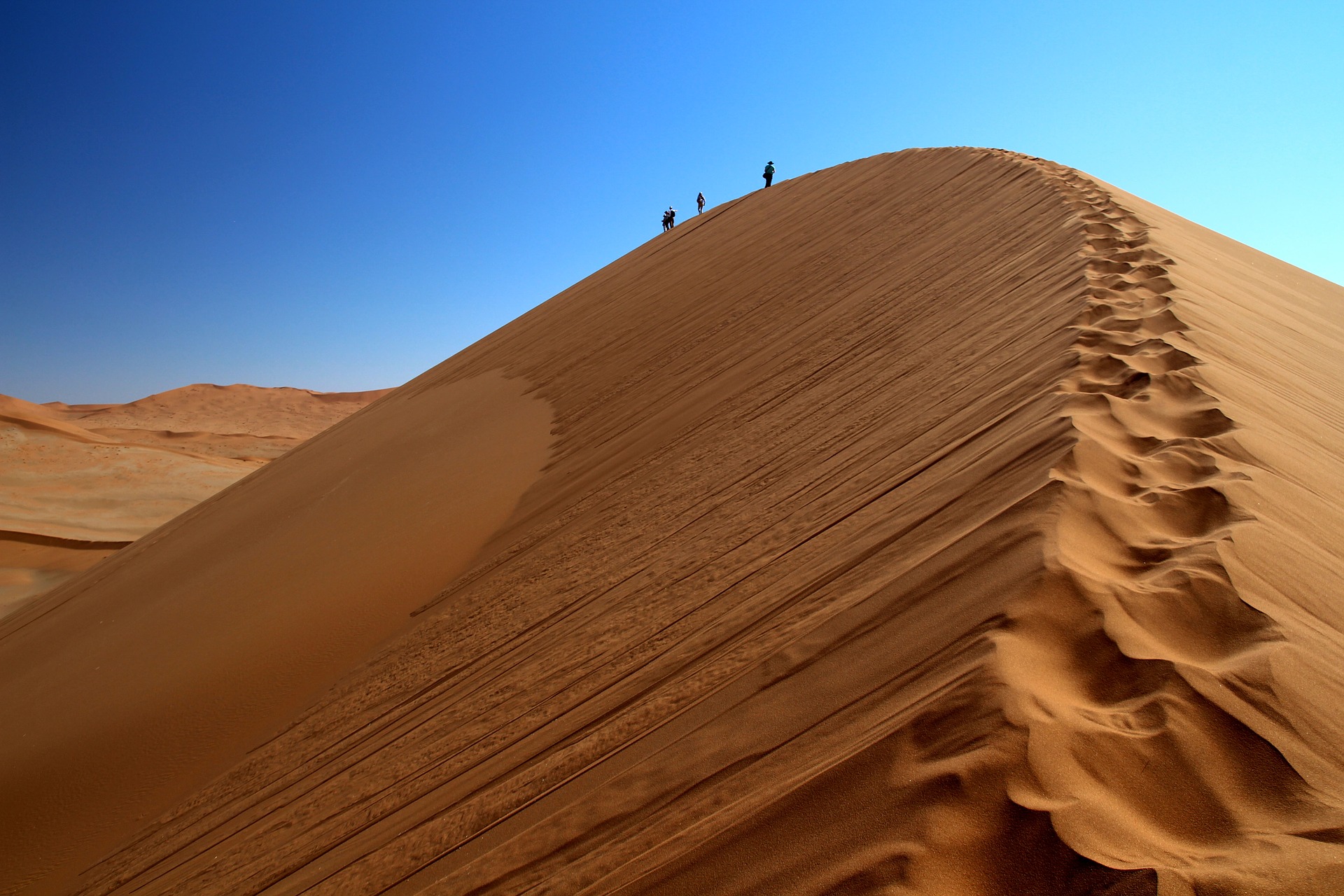
Namibia is a country for long drives and wide open spaces. The Namib Desert runs for nearly 1,000 km along the Atlantic coast, with rust-coloured sand and some of the highest dunes in the world; Sossusvlei is the easiest place to see them. In the far south the Fish River Canyon stretches for 160 km, while in the north the Skeleton Coast is known for its fog and shipwrecks. Etosha National Park, around the Etosha salt pan, is one of the best known parks, and Namibia is one of the countries where you can see all of the Big Five.
The colonial past shows in German buildings in Windhoek and in Lüderitz, next to the ghost town of Kolmanskop, and in the German still spoken by some Namibians. English is the official language; Afrikaans and indigenous languages such as Oshiwambo and Otjiherero are widely used. In Kaokoland, in the north-west, you can visit Himba communities.
Most visitors explore by rented car or on a tour, as public transport does not reach the sights. Distances are huge and most roads outside the towns are gravel, so plan carefully. Canada advises a high degree of caution because of crime, and the US rates Namibia Level 2; the UK does not advise against travel to any part of the country.
- Sossusvlei: Towering rust-red dunes that change colour at sunrise and sunset, in the Namib Desert.
- Etosha National Park: Wildlife around a great salt pan, at its best in the dry winter months.
- Fish River Canyon: A canyon 160 km long and nearly 550 m deep, near the South African border.
- Skeleton Coast: A fog-bound stretch of desert coast with many shipwrecks.
- Lüderitz and Kolmanskop: A German colonial town and an abandoned diamond-mining town taken over by sand.
- Swakopmund: The favourite holiday town of Namibians, with sandboarding and quad biking in the dunes nearby.
Places to visit
- City
- Coast
- Park
- Mountain
- Area
Cities
- Windhoek: The capital and largest city, with the Christuskirche; the place to buy park permits before your trip.
- Swakopmund: The capital of Erongo and a holiday favourite of Namibians, by the dunes and the sea.
- Walvis Bay: A port town with an airport, a base for sandboarding and quad biking in the dunes.
- Lüderitz: A German colonial coastal town, next to the ghost town of Kolmanskop.
- Keetmanshoop: The capital of ǁKaras, on the B1 in the south.
- Mariental: The capital of Hardap, on the B1 north of Keetmanshoop.
- Opuwo: The capital of Kunene and the place to stock up before Kaokoland.
- Katima Mulilo: The capital of the Zambezi region, in the Caprivi Strip.
Beyond the cities
- Sossusvlei (area): A clay pan among high dunes, the easiest way into the Namib Desert.
- Etosha National Park (park): One of the best known parks, around a salt pan that draws animals in the dry season.
- Waterberg Plateau Park (park): Another good park for wildlife.
- Fish River Canyon (park): A canyon 160 km long, near the South African border.
- Skeleton Coast National Park (coast): The northern desert coast, empty and mostly hard to reach, named after its shipwrecks.
- Kaokoland (area): The remote north-west: Himba communities, desert elephants and lions, and the Epupa Falls. You need a 4x4.
- Damaraland (area): Desert landscapes in the north-west.
- Spitzkoppe (mountain): A peak nicknamed the Matterhorn of Namibia.
- Brandberg (mountain): The highest mountain in Namibia, at 2,573 m.
Regions
- Caprivi: The panhandle in the north-east; with two major rivers, one of the few areas with fresh water.
- Kavango: A sparsely populated area along the Okavango River, lined with villages.
- Four-O region: The most densely populated part of the country, though still mainly rural.
- Kunene: The north-west, with Opuwo and Kaokoland.
- Otjozondjupa
- Omaheke: With its capital Gobabis.
- Erongo: The coast around Swakopmund, its capital.
- Khomas
- Hardap: With its capital Mariental.
- ǁKaras: With its capital Keetmanshoop.
Things to do
See
- Dunes at sunrise Sossusvlei: Watch the dunes change colour as the sun rises, or float over them in a hot-air balloon.
- Game drives in Etosha Etosha National Park: Animals gather around the salt pan, a source of water, above all in the dry winter months.
- Kolmanskop Lüderitz: Tours of the abandoned diamond town that the dunes have moved into.
- Fish River Canyon: One of the largest canyons in the world, near the South African border.
Do
- Self-drive safari: Leave the main highways and you will often see giraffe, kudu, oryx, springbok and ostrich outside the parks.
- Sandboarding and quad biking Swakopmund: In the dunes around Swakopmund and Walvis Bay; check that your insurance covers it.
- Visit a Himba or San community: Through a "living village" or with a local guide: Himba in Kaokoland, San at Tsumkwe.
Eat
- A braai: The wood-fired barbecue that every campsite, lodge and home is equipped for.
- Kapana at the market: Grilled beef strips sold at open markets; ask for them mild if you do not like spice.
Drink
- Windhoek Lager: The national beer, brewed in the German tradition; or try a Rock Shandy on a hot day.
Itineraries
Windhoek, the dunes and the coast in 7 days (7 days)
- Windhoek (1 night): Pick up your rental car and any park permits.
- Sossusvlei (2 nights): Dunes at sunrise, perhaps by balloon.
- Swakopmund (3 nights): Sandboarding and quad bikes in the dunes; shuttles also link it with Windhoek.
- Windhoek (1 night): Back to the capital for your flight.
Waterberg and Etosha in 6 days (6 days)
- Windhoek (1 night): Stock up on food and water before heading north.
- Waterberg Plateau Park (2 nights): A first park for wildlife.
- Etosha National Park (3 nights): Game drives around the salt pan; check the malaria advice for the north.
Climate and best time to visit
| Jan | Feb | Mar | Apr | May | Jun | Jul | Aug | Sep | Oct | Nov | Dec | |
|---|---|---|---|---|---|---|---|---|---|---|---|---|
| Max °C | 30 | 29 | 27 | 26 | 23 | 21 | 21 | 24 | 28 | 29 | 30 | 31 |
| Min °C | 18 | 17 | 16 | 13 | 10 | 7 | 7 | 9 | 12 | 15 | 16 | 17 |
| Rain mm | 86 | 91 | 70 | 35 | 6 | 2 | 0 | 1 | 4 | 13 | 29 | 31 |
Namibia is hot and dry. In Windhoek the average maximum is about 31 °C in December and 21 °C in June and July, when nights cool to about 7 °C. Almost all the rain falls in summer, mostly from January to March, with up to about 90 mm in February; from May to September each month gets less than 6 mm.
The dry winter months from May to October are the classic time to visit, when animals gather at the water in Etosha. In the rainy season gravel roads get slippery or break up, so check conditions before you drive. On the coast, thick fog is common where the desert meets the Atlantic.
Holidays and events
- 1 January 2026 · New Year's Day
- 21 March 2026 · Independence Day
- 3 April 2026 · Good Friday
- 6 April 2026 · Easter Monday
- 1 May 2026 · Workers' Day
- 4 May 2026 · Cassinga Day
- 14 May 2026 · Ascension Day
- 25 May 2026 · Africa Day
- 28 May 2026 · Genocide Remembrance Day
- 26 August 2026 · Heroes' Day
- 10 December 2026 · Human Rights Day
- 25 December 2026 · Christmas Day
- 26 December 2026 · Day of Goodwill
Getting there and around
| Main airports | WDH |
|---|
Getting there
By air: Hosea Kutako International Airport, about 45 minutes east of Windhoek, is the main gateway. Connections have been limited since Air Namibia closed in 2021: from Europe there is a direct flight from Frankfurt, and other routes go via Doha, Addis Ababa, South Africa and Luanda.
By road: there are border posts with South Africa, Botswana (including Buitepos on the Trans-Kalahari Highway), Angola and Zambia, some open only by day. Foreign-registered cars pay a cross-border road charge at the border. Intercape and other companies run buses to Windhoek from Cape Town, Johannesburg, Gaborone and Victoria Falls. The passenger train from South Africa was discontinued.
Getting around
Most visitors get around by car, since the main sights are far from the towns and from public transport. Traffic drives on the left. A and B roads are tarred and mostly in very good condition; C roads are tarred or good gravel, and you do not need a 4x4 for the main sights except Kaokoland. Gravel is the real danger: fatal accidents are common, often from speeding, and tourists are often in single-vehicle crashes. In the rainy season the UK advises keeping below 80 km/h on gravel; always carry two spare tyres and plenty of water, fill up at every service station on back roads, and never drive at night outside towns, when wildlife and livestock are on the road. In the rainy season check that your route is passable. The UK notes that many rental insurance policies do not cover accidents without another vehicle or an animal involved, so check yours. Canada strongly recommends getting an International Driving Permit before you leave, as rental companies and insurers may ask for one.
Without a car: shuttle services link Windhoek, Swakopmund, Walvis Bay and other towns. Avoid minibuses, which are unsafe and often crash. Use registered taxis recommended by your hotel, never hail one in the street and do not share with strangers. Westair runs domestic flights, and the Desert Express is a luxury tourist train to Swakopmund and Etosha.
Flying to Namibia? PartnerCompare fares and find the cheapest datesSearch flightsWhere to stay
- Campsites: Near every sight, from simple community sites with water and a dry toilet to private sites with power and private bathrooms.
- National park campsites: Some are remote, without facilities, need a 4x4 and require a permit bought in advance.
- Traditional lodges: Expensive, often all-inclusive with meals, game drives and sundowners; the most remote are reached by plane.
- Newer lodges: More than a bed and breakfast, with a restaurant or activities, at mid-range prices.
- B&Bs: In towns; some call themselves lodges.
- Hostels: A few, only in the older and larger towns.
Prices are often per person rather than per room. Many attractions need a permit that is not always sold on site, so buy permits in Windhoek at the start of your trip. Farms behind fences are private: ask before you camp. In parks, wild animals often come into the camps, so do not walk around at night and never leave children alone.
Eat and drink
Dishes to try
- Braai: A wood-fired barbecue, the national way to eat and socialise.
- Kapana: Grilled beef strips, sold as a snack at markets; usually very spicy.
- Biltong and droewors: Spiced dried meat and dried sausage, ideal for long drives.
- Kingklip and sole: Fresh fish in the coastal towns.
- Pap: Maize or pearl millet porridge, the staple food, eaten with a sauce.
- Vetkoek: Fried dough dumplings, served with meat or sweet.
Drinks
- Windhoek Lager: The flagship beer, brewed by German master brewers.
- Oshikundu: A traditional drink of fermented millet, sold at markets and street stalls.
- Rock Shandy: Lemonade, soda water and a dash of Angostura over ice.
| Tipping | Petrol station attendants expect a small cash tip from tourists, even if you pay by card. |
|---|
Namibians eat a lot of meat, which is good and cheap; fruit and vegetables are mostly imported and expensive, and hard to find in the countryside, so stock up in Windhoek before a self-drive trip. Vegetarians will find dedicated dishes only in Windhoek, Swakopmund and high-end lodges. Shops do not sell alcohol to take away from Saturday at 13:00 until Monday morning, and public holidays count as Sundays.
Entry requirements and visas
| Passport validity | At least 6 months after the date you arrive, with at least 3 blank pages |
|---|
| Passport | Entry | Max stay | Notes |
|---|---|---|---|
| United Kingdom | Visa on arrival | Since 1 April 2025; or apply online for an e-visa. The fee is 1,600 Namibian dollars, less for children. | |
| Canada | Visa on arrival | 90 days | Tourist visa required: apply online or on arrival at Hosea Kutako and Walvis Bay airports and the main land borders. |
Other nationalities: check the official source below.
Since 1 April 2025 British visitors need a visa, which they can get on arrival or apply for online as an e-visa; the fee is 1,600 Namibian dollars (NAD) for anyone over 11. Canadians also need a tourist visa, on arrival or online, for stays of up to 90 days. You may be asked for a return or onward ticket, proof of accommodation, enough money and health insurance.
Check your entry stamp: the dates and the length of stay are checked when you leave, and overstaying or a wrong stamp can lead to fines or arrest. Children under 18 need a full birth certificate showing both parents, and a consent affidavit if they travel with one parent or without them. Working or volunteering on a tourist visa is illegal. Rules depend on your passport and can change: check with the Namibian embassy or high commission before you book.
Money and payments
| Currency | South African Rand (ZAR), Namibian Dollar (NAD) |
|---|---|
| Cards | Common |
The Namibian dollar (NAD) is pegged one to one to the South African rand (ZAR), and both are legal tender, though change usually comes in Namibian dollars. US dollars and euros are not accepted. Banks outside Namibia charge a lot to change Namibian dollars, so swap any left over into rand at a Namibian bank before you leave.
ATMs are found in every town but rarely in villages; use those inside banks or watched by a guard, and cover your PIN. Most service stations in towns take cards, but in the countryside you may need cash, and Canada advises carrying cash for fuel. Card skimming has been reported at some hotels and lodges, so keep your card in sight.
Health
| Required vaccines | Yellow fever, only if you arrive from a country with yellow fever risk, including transits of more than 12 hours there |
|---|---|
| Recommended vaccines | Routine vaccines, including measles (MMR) and polio, Polio: one booster dose for adults, as poliovirus has been found in Namibia in the past year, Hepatitis A, Hepatitis B, Typhoid, for most travellers, Rabies, for some travellers: rabid dogs are common, Cholera, for some travellers going to Kunene or Otjozondjupa, Mpox, for travellers at risk of sexual exposure |
| Malaria | Some areas |
| Tap water | Varies |
The CDC recommends malaria tablets for the northern regions: Kavango, Kunene, Ohangwena, Omaheke, Omusati, Oshana, Oshikoto, Otjozondjupa and Zambezi. Malaria is rare elsewhere and absent in Windhoek. You need a yellow fever certificate only if you come from a country with yellow fever risk. Ask a travel health professional about vaccines and tablets at least a month before you go.
The hot, dry climate can cause dehydration and skin problems, so always carry plenty of water. HIV is common: around 11.8% of adults in 2021, according to UNAIDS. Tap water is usually safe to drink, according to Wikivoyage, except where it is labelled otherwise; campsites next to rivers often pipe water straight from the river. Windhoek has good medical facilities, but private hospitals may ask you to pay before treatment, even if you are insured. For an ambulance, the UK says to call 211111 in Windhoek or 10111 elsewhere; Canada gives 10177 for medical assistance.
This is general information, not medical advice: check with a travel health professional before you go.
Safety
- United States: Level 2: Exercise Increased Caution (2026-11-03)
- Canada: Exercise a high degree of caution (2026-10-20)
- United Kingdom: No advice against travel (2026-10-20)
Crime is the main concern. Muggers target tourists in Windhoek, at any time of day and even in busy central areas. Gangs sometimes try to get into cars at busy intersections in Windhoek, and thefts from cars at service stations are common: lock the doors, keep valuables out of sight and never leave the car unattended. Do not walk alone after dark, and do not enter townships at night unless you are with someone who knows the area. Robberies have also happened at roadside rest stops and birdwatching sites in remote areas.
Take care near the Angolan border, where Canada warns of bandits and poachers, and stay on main roads between Katwitwi and Kongola, where old landmines may remain. In the parks, wild animals can be dangerous: get out of the car only when a guide says it is safe. For desert trips, go with an experienced guide and a 4x4, and get insurance that covers helicopter rescue. Drink-driving is common, especially on weekend evenings, and drivers rarely stop for pedestrians.
Customs and etiquette
Greet people before getting down to business: a quick "How are you?" is expected in markets, taxis and small shops. Shorts are fine everywhere, but full safari outfits look odd outside a safari; dress formally for church and celebrations. Race comes up often in conversation, and the terms used differ from North America: "coloured" means mixed race and is not a word for black people, and the San should not be called Bushmen. If in doubt, just say Namibians. Call townships "locations" or informal areas, not slums.
Carry photo ID, as police checkpoints are common. Do not photograph the President's residence, military sites, government buildings, airports or harbours. Flying a drone needs a permit from the Namibia Civil Aviation Authority, which can take several weeks. Buying or selling protected wildlife products such as ivory or rhino horn is a crime. Exporting diamonds and other minerals, cultural items or wildlife products needs prior approval, and Wikivoyage reports that owning uncut diamonds is illegal. Penalties for drug offences are severe and include long prison sentences. Same-sex relationships are not illegal, but attitudes are conservative, especially in rural areas, and public affection draws attention. Canada notes that this legal status is under judicial challenge and could be reversed.
Language
| Official languages | English |
|---|---|
| English | Common |
| How are you? (informal) | Howzit? |
|---|---|
| Traffic lights | Robots |
| Township | Location |
| Barbecue | Braai |
| Fuel station | Petrol station |
What to pack
- Passport with 6 months' validity and 3 blank pages: Required for entry.
- Full birth certificates for children: Short versions are not accepted at the border.
- Driving licence: UK drivers need their photocard licence in the car.
- Water: at least 2 litres per person, 5 on remote roads: A breakdown can leave you waiting a long time for help.
- Insect repellent and malaria tablets for the north: Malaria is present in the northern regions.
- Warm layers: Winter nights in Windhoek drop to about 7 °C.
- Insurance that covers helicopter rescue: Emergency help is limited in remote parks and deserts.
Quick reference
Country facts
| Capital | Windhoek |
|---|---|
| Population | 3,092,816 (2025) |
| Area | 823,290 km² |
| Time zone | Africa/Windhoek (UTC+2) |
| Calling code | +264 |
| Driving side | left |
Staying connected
| SIM and eSIM | MTC, Telecom and Paratus. MTC has the best coverage of tourist sights. SIM cards are cheap and sold only in the operators' own stores, at the international airport and in larger towns, with your passport. |
|---|---|
| Roaming | Near the borders your phone may connect to stronger foreign networks, at roaming prices. |
| Wi-Fi | Free at the international airport and in almost every restaurant, bar, B&B and campsite; remote lodges may have no internet at all. |
Emergency numbers
| Emergency | 10111, 999, 112 |
|---|
Frequently asked questions
Do I need a visa for Namibia?
Yes, British and Canadian visitors need one, but they can get it on arrival or online. Check with the Namibian embassy before you book.
Do I need a 4x4 in Namibia?
Not for the main sights, which you can reach on tarred or gravel roads, except Kaokoland. Drive slowly on gravel, carry two spare tyres and avoid driving at night.
Is there malaria in Namibia?
In several northern regions, including Kunene and Zambezi (the Caprivi), but not in Windhoek. Ask a travel health professional whether you need tablets.
Can I use South African rand in Namibia?
Yes. The rand is legal tender and worth the same as the Namibian dollar, but change is usually given in Namibian dollars.
When is the best time to visit Namibia?
The dry season from May to October, when animals gather at the water in Etosha. Most rain falls from January to March.
Is Namibia safe?
Canada advises a high degree of caution because of crime and the US rates Namibia Level 2. Be careful in Windhoek, do not walk alone after dark and keep your car locked.
More Travel Stories from Africa
 Morocco
 Cabo Verde +1
 Colombia +1
Sources This guide was last checked on · 17 sources
- Wikivoyage: Namibia · Overview, Places to visit, Things to do, Itineraries, Climate and best time to visit, Getting there and around, Where to stay, Eat and drink, Entry requirements and visas, Money and payments, Health, Safety, Customs and etiquette, Language, What to pack, Staying connected, Frequently asked questions
- Wikidata: Namibia · Overview, Places to visit, Money and payments, Country facts
- Government of Canada: Namibia travel advice (updated 15 October 2026) · Overview, Things to do, Climate and best time to visit, Getting there and around, Where to stay, Entry requirements and visas, Money and payments, Health, Safety, Customs and etiquette, What to pack, Frequently asked questions
- US Department of State: Namibia travel advisory · Overview, Safety
- WMO World Weather Information Service: Windhoek · Climate and best time to visit
- UK FCDO: Namibia safety and security (updated 10 December 2025) · Climate and best time to visit, Getting there and around, Eat and drink, Money and payments, Safety, Customs and etiquette, What to pack, Frequently asked questions
- Nager.Date: public holidays in Namibia, 2026 · Holidays and events
- UK FCDO: Namibia entry requirements (updated 10 December 2025) · Entry requirements and visas, Health, What to pack, Frequently asked questions
- ISO 4217 (SIX), published 2026-09-17 · Money and payments
- CDC Travelers' Health: Namibia · Health, What to pack, Frequently asked questions
- UK FCDO: Namibia health · Health
- UK FCDO: Namibia travel advice · Safety
- US Department of State: Namibia travel advisory · Safety
- World Bank, SP.POP.TOTL · Country facts
- World Bank, AG.LND.TOTL.K2 · Country facts
- IANA Time Zone Database, zone.tab · Country facts
- UK FCDO: Namibia getting help · Emergency numbers
Suggest an update
Travel rules, prices and timetables change. If something in this guide is out of date, tell us: we check every suggestion against an official source before changing the page.