Essaouira is a walled port on Morocco’s Atlantic coast, and it makes a good winter break if you want sea air, fresh fish and a walled old town at a slower pace than Marrakech. It has just become easier to reach by air. On 29 October 2026 Aeroroutes reported that Royal Air Maroc relaunched its Casablanca to Essaouira route on 28 October, with ATR 72 aircraft twice a week, for the first time since September 2020. On Sundays the flight leaves Casablanca at 09:30 and lands at 10:50; on Wednesdays it leaves at 16:00 and lands at 17:20. The return flights leave Essaouira at 11:30 on Sundays and 18:00 on Wednesdays.
With a connection in Casablanca, Essaouira now works for a long weekend or a few quiet days at the end of a bigger trip through Morocco.
What winter is like
Essaouira has no station in the World Meteorological Organization’s city list. The nearest is Agadir, about three hours down the coast by bus. There, the official WMO climate normals (1991 to 2020) give average highs of 22.1°C in December and 21.1°C in January, with four to six rainy days a month. Treat that as a rough guide for Essaouira.
The other thing to know is the wind. Wikivoyage calls Essaouira the Windy City and explains that strong wind and currents make lying on the beach and swimming difficult at times. That is exactly why it is a centre for kitesurfing and windsurfing, with good wind on most days of the year. Come for walks, fish and the medina, and bring a warm layer.
The medina and the port
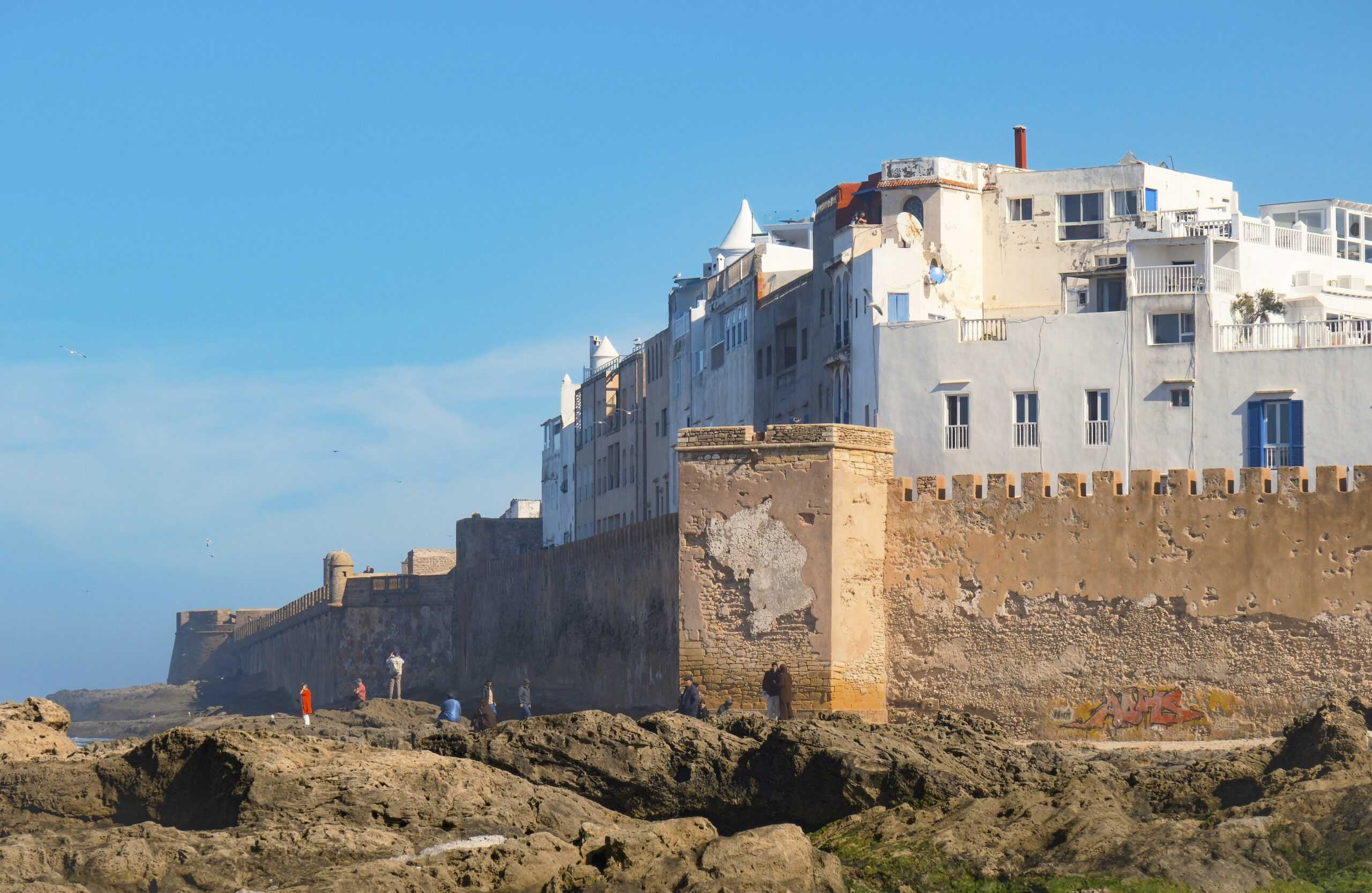
The medina of Essaouira is a UNESCO World Heritage site, an 18th-century fortified town laid out by a French architect, with sea walls, city walls and a working harbour. A simple route from Wikivoyage:
- start at the fish market at the west end of the medina;
- walk the sea wall and the Skala tower, north-east of Place Moulay Hassan, and come back to the square for sunset;
- cross the markets east towards Bab Doukkala, looking in at the artisans’ workshops on the way.
The citadel opens from 09:00 to 17:00, with an entry fee of 60 dirham for foreigners when Wikivoyage last checked it. The medina is meant to be free of motor traffic, but mopeds ignore the rule, so keep an eye out in the narrow lanes.
Eat what the boats bring in
The best meal in town is the simplest one. At the fish market you buy your fish, then take it to the small kitchens nearby, which cook it and add salad, olives and bread for about 25 dirham, according to Wikivoyage. The same page warns that seafood sold to tourists in restaurants can be expensive, and that prices on the board at the market are not always the prices you pay, so agree before you buy.
For a longer walk, follow the long beach south to Diabat and its ruined fort, or cross the shallow river towards the ruins of an 18th-century sultan’s palace in the hills.
Getting there and around
Besides the new flight, most visitors arrive by coach. Wikivoyage lists Supratours and CTM from Marrakech, about three hours, at 80 dirham plus 5 dirham per piece of luggage, and CTM coaches to Agadir (three hours) and Casablanca (six hours) about four times a day. Coaches often sell out, so book the day before. From the airport, city bus 2 costs 7 dirham and runs roughly hourly, and a shuttle bus costs 50 dirham.
For British passport holders, the UK Foreign Office says you can visit Morocco without a visa for up to 90 days for tourism. Your passport must be valid for at least three months after you arrive and must not be damaged: the authorities have refused entry to travellers with damaged passports. Entry rules depend on your passport, so check the official advice for your nationality.
If you want more winter sun on the Atlantic, our story on Cabo Verde for winter sun covers the islands further south. Practical details on money, health and transport are in our Morocco travel guide, and more countries are in the Africa guides. If a quiet winter break appeals, book the coach or the Sunday flight first, then a riad inside the walls.
Cover photo: Christinagrabelusshaikh, CC BY-SA 4.0, via Wikimedia Commons