

- Local time
- 12:30
- Currency
- West African CFA Franc (XOF)
- Capital
- Bamako
- Calling code
- +223
- Drive on the
- right
Overview
Mali has Timbuktu, Djenné's mud mosque and the Dogon cliffs, but the UK, Canada and the US advise against all travel there. Read the official advice first.
Before anything else: the UK advises against all travel to the whole of Mali, Canada says to avoid all travel and the US rates it Level 4 (do not travel). The UK asks anyone already in the country to leave by commercial flight if it is safe to do so, and not by land. Travel insurance may not cover you if you go against this advice. The section on safety below has the details.
Mali is a landlocked country in the Sahel, with savannah in the south and desert in the north. The Niger River crosses it, and in the rainy season it floods a wide plain, the Inner Niger Delta, at the edge of the desert. Three great West African empires controlled the trade across the Sahara from here, and under the Mali Empire the cities of Djenné and Timbuktu were centres of trade and Islamic learning. The country has four UNESCO World Heritage Sites, among them Djenné and the Bandiagara Escarpment of the Dogon.
Bamako, the capital and by far the largest city, has a good claim to be the music capital of West Africa. Bambara and many other African languages are spoken by most people, French is the common language between groups, and very few people speak English.
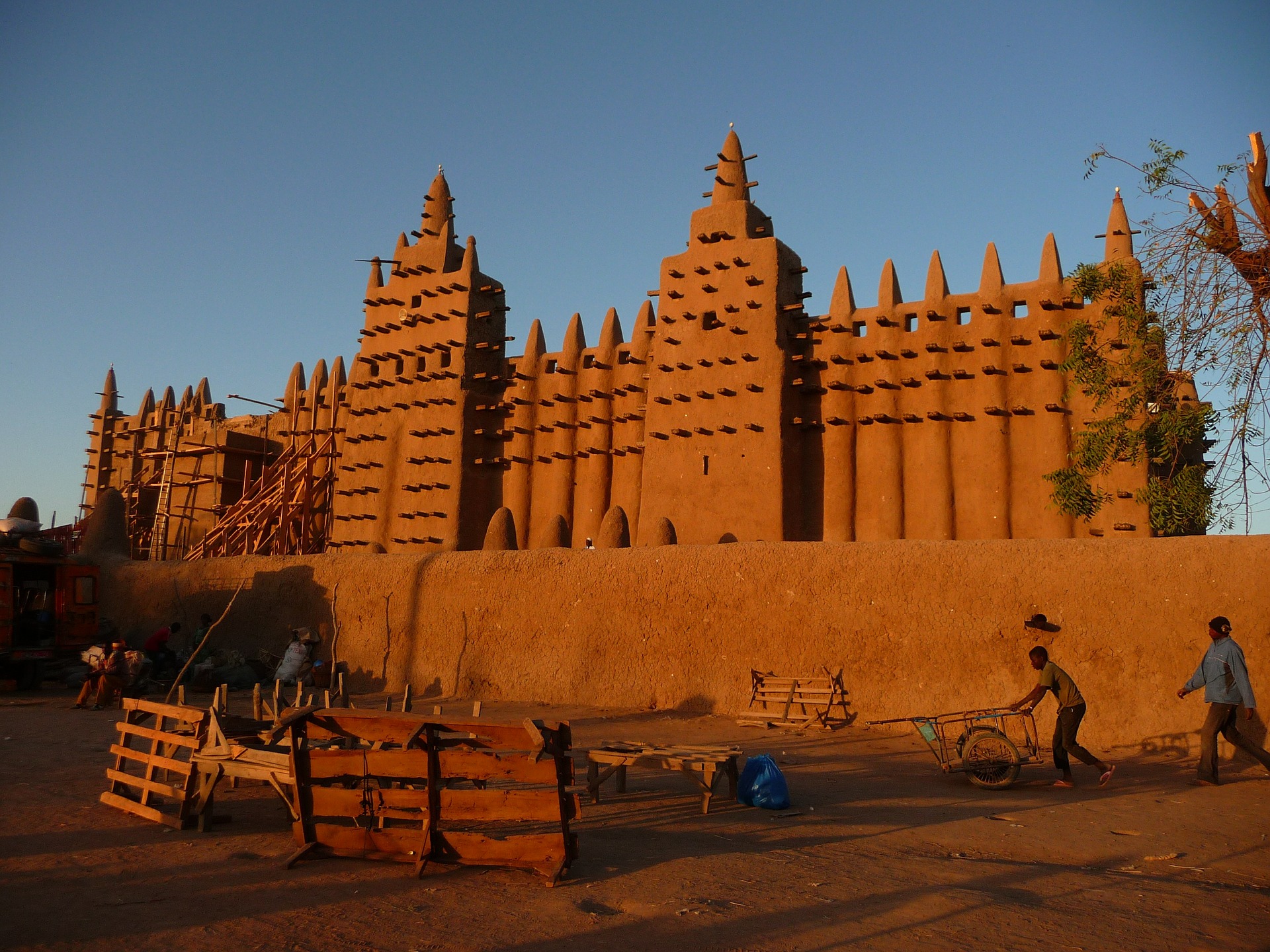
- Djenné: A town of multi-storey mud buildings and a UNESCO World Heritage Site, with the Great Mosque, built of mud in 1907.
- Dogon Country: Villages scattered along the cliffs of the Bandiagara Escarpment, a UNESCO World Heritage Site.
- Timbuktu: The Saharan city of the gold trade and Islamic scholarship, now a centre of Tuareg culture.
- Inner Niger Delta: The Niger splits into many channels and floods a broad plain in the rainy season.
- Gao: A city on the Niger, once capital of the Songhai Empire, with the Tomb of Askia.
- Music of Bamako: The capital has a good claim to be the music capital of West Africa.
Places to visit
- City
- Town
- Historic site
- Area
Cities
- Bamako: The capital and by far the largest city, with a strong music scene.
- Sikasso: The second city, once capital of the Kénédougou Empire. Canada reports clashes between the authorities and armed groups in the Sikasso region.
- Ségou: The third city, once capital of the Bamana Empire. The UK reports continuing violence between communities in the Ségou region.
- Mopti: A city spread over three islands in the Niger, the gateway to Dogon Country. The UK reports continuing violence between communities in the Mopti region.
- Timbuktu: The historic Saharan city of trade and Islamic learning, now a centre of Tuareg culture. The UK says terrorist groups have repeatedly shelled Timbuktu airport since August 2023.
- Gao: A small city on the Niger in the far east, once capital of the Songhai Empire. The UK lists Gao among the places hit by coordinated attacks on 25 April 2026.
- Kayes: The westernmost big city, near the border with Senegal. The UK reports criminal gangs kidnapping westerners in the Kayes region.
Beyond the cities
- Djenné (town): A small UNESCO-listed town of mud buildings, once a rival of Timbuktu in religion and trade.
- Bandiagara Escarpment (site): The cliffs of Dogon Country, with villages along their face; a UNESCO World Heritage Site.
- Inner Niger Delta (area): A floodplain where the Niger forms a huge seasonal lake on the edge of the desert.
- Adrar des Ifoghas (area): A sandstone plateau in the Sahara with rock paintings and old salt mines.
Regions
- Kayes
- Koulikoro
- Mopti
- Ségou
- Sikasso
- Gao
- Kidal
- Timbuktu
Things to do
See
- Great Mosque of Djenné Djenné: Built of mud in 1907, with five storeys and three towers, and replastered by the townspeople every year. Non-Muslims cannot go inside.
- The rooftops of Djenné Djenné: From above, the town is a landscape of soft, rounded mud shapes.
Do
- Dogon Country: Trekking between the cliffside villages of the Bandiagara Escarpment.
- A pirogue on the Niger: A trip on the river in a traditional boat; larger boats run only in the high-water season, from about August to November.
- Drumming lessons: Mali is a popular place to learn the djembe and other drums.
Eat
- Rice with peanut sauce: Rice with sauce is the everyday dish; the peanut version is called tiga diga na.
Drink
- Bissap: A hibiscus drink, called dabileni in Bambara, boiled during preparation.
Shop
- Crafts and music: Masks, bogolan (cotton cloth dyed with mud), blankets, musical instruments, and Tuareg silver jewellery and leather goods.
Climate and best time to visit
| Jan | Feb | Mar | Apr | May | Jun | Jul | Aug | Sep | Oct | Nov | Dec | |
|---|---|---|---|---|---|---|---|---|---|---|---|---|
| Max °C | 33 | 36 | 39 | 40 | 39 | 35 | 32 | 31 | 32 | 35 | 35 | 33 |
| Min °C | 17 | 20 | 23 | 25 | 25 | 24 | 22 | 22 | 22 | 21 | 18 | 17 |
| Rain mm | 1 | 1 | 2 | 20 | 54 | 132 | 224 | 290 | 196 | 66 | 5 | 1 |
Mali has a rainy season from about June to October, starting earlier in the south. In Bamako almost all the rain falls in these months, with about 290 mm in August, the wettest month, while from November to March each month gets less than 6 mm. Heavy rain can bring floods and landslides and makes roads difficult, even in Bamako.
After the rains comes a cooler, green period, from November to early February: in Bamako average highs are about 33 °C in December and January, with nights around 17 °C. Then the heat builds. March to May is hot and very dry, with average highs of 38.5 to 39.6 °C in Bamako, the peak in April.
Holidays and events
- 1 January 2026 · New Year's Day
- 20 January 2026 · Armed Forces Day
- 15 March 2026 · Leylatoul Qadr (Roughly Date)
- 19 March 2026 · Korité (Roughly Date)
- 25 March 2026 · Martyrs' Day
- 6 April 2026 · Easter Monday
- 1 May 2026 · Workers' Day
- 25 May 2026 · Africa Day
- 26 May 2026 · Tabaski (Roughly Date)
- 25 June 2026 · Ashura (Roughly Date)
- 25 August 2026 · Mawloud (Roughly Date)
- 1 September 2026 · Baptism of the Prophet (Roughly Date)
- 22 September 2026 · Independence Day
- 25 December 2026 · Christmas Day
Getting there and around
Getting there
By air: the UK advises anyone in Mali to leave by commercial flight if it is safe, and never overland. Air France and other European airlines have suspended their flights to Bamako; Wikivoyage lists Royal Air Maroc via Casablanca, Turkish Airlines via Istanbul and Ethiopian Airlines via Addis Ababa as the main links. Flights can be cancelled or diverted at short notice, and attacks near Bamako airport closed it temporarily in April 2026. Security at the airport is heavy and vehicles are searched. Fake taxi drivers and guides work around the airport: use only pre-arranged transport.
By land: the UK says leaving Mali by road to neighbouring countries is too dangerous, because of attacks on the highways, and Canada advises staying away from all border areas. The railway to Dakar has not run since 2009.
Getting around
Canada advises against travelling by land outside Bamako, and the UK describes airports outside the capital as extremely dangerous. Armed groups have set up blockades on the main roads of the south and west, including those around Bamako, and target fuel trucks; landmines are used on roads in the centre, north and north-east.
In Bamako, travel only by day and in pre-arranged transport with trusted drivers, keep doors locked and windows shut, and vary your routes. Police checkpoints are common: slow down, follow instructions and keep your ID with you. People dressed as police have demanded money from drivers at night; ask for identification and a receipt, but do not resist if you feel threatened. Fuel is short, with long queues and higher prices. Public transport in the capital is unreliable; agree taxi fares before you set off.
Where to stay
- Hotels: From simple places to western-standard hotels, found in all tourist areas.
- Auberges and homestays: Simple guesthouses and rooms with local families.
- Rooftop beds: The cheapest option: a mattress with a mosquito net on a roof terrace, with shared toilets and showers.
The UK and Canada list hotels and places frequented by foreigners among possible targets of attack, and Canada notes a lack of safe hotels in the north. If you travel despite the advice, the UK suggests taking professional security advice before you go.
Eat and drink
Dishes to try
- Rice with sauce: The most common dish, with a sauce of peanut (tiga diga na), tomato and onion, or leaves and okra, often with fish or meat.
- Tô: A thick, jelly-like corn or millet dish eaten with sauce, more village food than restaurant food.
- Couscous: Common in the north.
- Street food: Omelette sandwiches for breakfast, rice and sauces at lunch, and beans, kebabs, fish or meatballs in the evening.
Drinks
- Bissap (dabileni): A hibiscus drink that is boiled during preparation, so generally safe.
- Soft drinks: Widely available and safe to drink.
- Bagged water: Treated water in branded bags is sold in Bamako; do not confuse it with tap water sold in unmarked bags.
Bamako has good restaurants serving Chinese, Vietnamese, Italian and Lebanese food at near western prices. Drink only boiled or bottled water and avoid ice, as the UK advises. Peel fruit, avoid salads and eat meat well cooked. During Ramadan, do not eat or drink in public in the daytime.
Entry requirements and visas
| Passport validity | At least 6 months beyond the date you leave Mali (Canada); the UK asks for a passport valid for the length of your stay |
|---|
| Passport | Entry | Max stay | Notes |
|---|---|---|---|
| United Kingdom | Evisa | Apply and pay online on the website of the Malian Ministry of Foreign Affairs; an entry permit is issued electronically. | |
| Canada | Visa required | You must get your visa before you arrive. |
Other nationalities: check the official source below.
All three governments advise against travel to Mali, and your insurance may not be valid if you go. UK and Canadian citizens need a visa before arrival; for UK citizens the application and payment are now fully online. A yellow fever vaccination certificate is required for all travellers aged 9 months or older.
You must declare goods that may be prohibited or taxed, and you need an export permit from the Ministry of Arts and Culture, issued through the director of the National Museum, to take cultural or archaeological objects out of Mali. Rules depend on your passport and can change: check the official link or the embassy of Mali before you book.
Money and payments
| Currency | West African CFA Franc (XOF) |
|---|---|
| Cards | Rare |
The currency is the West African CFA franc (XOF), shared with seven other countries and fixed at 655.957 francs to the euro. Credit cards are rarely accepted outside a few major hotels, according to Canada. Ecobank ATMs accept Visa and Mastercard, but Canada says ATMs are hard to find outside Bamako. Card and ATM fraud happens: use machines inside banks or in well-lit public places, cover the keypad and watch your card when someone else handles it. Take particular care at ATMs, the UK adds. Long power cuts can disrupt banking.
Health
| Required vaccines | Yellow fever, for all travellers aged 9 months or older |
|---|---|
| Recommended vaccines | Routine vaccines, including measles (MMR) and diphtheria, Polio: a single adult booster, since poliovirus has been found in Mali in the past year, Hepatitis A, Hepatitis B, Typhoid, for most travellers, Meningococcal disease, for the meningitis belt in the dry season (roughly December to June), Rabies, for some travellers: rabid dogs are common and vaccine is often not available after a bite, Mpox, for travellers at risk of sexual exposure |
| Malaria | Widespread |
| Tap water | Not safe |
Malaria is present in all areas, and the CDC recommends prescription medicine to prevent it. Dengue, chikungunya and Zika are also present, so pregnant women should talk to a doctor before any trip. Avoid swimming in fresh water because of schistosomiasis. See a travel health professional at least a month before you go.
Medical facilities are very limited, and emergency response is minimal: the ambulance number is 15, but you may have to arrange your own transport to a hospital. Pharmacies are easy to find in Bamako. Get insurance that covers medical treatment and repatriation, and check that it is valid for Mali.
This is general information, not medical advice: check with a travel health professional before you go.
Safety
- United States: Level 4: Do Not Travel (2026-10-20)
- Canada: Avoid all travel (2026-10-20)
- United Kingdom: Advises against all travel (2026-10-20)
The official advice is clear: the UK advises against all travel to the whole country, Canada says to avoid all travel and the US rates Mali Level 4. The UK and Canada ask anyone in Mali to leave by commercial flight if it is safe; the UK warns against leaving by road. Consular help is severely limited, especially outside Bamako, so you need an emergency plan that does not depend on your government.
The UK and Canada describe a very high threat of terrorist attacks and kidnapping across the whole country, including Bamako, where attacks near the airport in April 2026 closed it for a time. Westerners are specifically targeted. Armed groups have blockaded the roads to the capital, causing severe fuel shortages, and power cuts can last more than 8 hours. Violent crime and armed robbery are also high, especially in Bamako and the south, and carjackings happen across the country, especially in the north.
A state of emergency is in force, with random ID checks and roadblocks, and curfews may be declared: always carry your original passport. Travel only by day, avoid regular patterns, stay away from demonstrations and large gatherings, and keep several days' supply of food and water.
Customs and etiquette
Most Malians are Muslim, in a secular state. Dress modestly and respect religious customs. During Ramadan do not eat, drink, smoke or chew gum in public in the daytime, even in your car, and do not play loud music or dance.
Greetings matter a lot. Take time to greet people, vendors included, and ask about their family, their children and their work; the usual reply is ça va, all is well. Always ask before photographing people, and never photograph military or government sites.
Carry your original passport: without it you can have problems at security checks. The UK says same-sex relations are illegal, with prison sentences of up to seven years under the penal code of December 2024. Drug penalties are severe, with jail sentences and heavy fines. If you are involved in a business dispute, the authorities may stop you from leaving the country.
Language
| English | Rare |
|---|
| Good morning, how are you? | Bonjour, ça va ? |
|---|---|
| And your family? | Et votre famille ? |
| And your children? | Et vos enfants ? |
| And your work? | Et votre travail ? |
| All is well | Ça va |
What to pack
- Passport, visa and copies kept apart: You must carry the original, and copies help if it is stolen.
- Yellow fever certificate: Required for all travellers aged 9 months or older.
- Malaria tablets, repellent and a mosquito net: Malaria is present in every area.
- A personal emergency plan: Consular help is severely limited and flights can be cancelled at short notice.
- Several days' supply of food and water: The UK advises a stock in case of unrest.
- A translation app: Few officials or health workers speak English.
Quick reference
Country facts
| Capital | Bamako |
|---|---|
| Population | 25,198,821 (2025) |
| Area | 1,220,190 km² |
| Time zone | Africa/Bamako (UTC+0) |
| Calling code | +223 |
| Driving side | right |
Emergency numbers
| Police | 17 |
|---|---|
| Ambulance | 15 |
| Fire | 18 |
Frequently asked questions
Is it safe to travel to Mali?
The UK advises against all travel to the whole country, Canada says to avoid all travel and the US rates Mali Level 4 (do not travel). Read the official advice before making any plans.
Do I need a visa for Mali?
Yes. UK citizens apply online through the Malian Ministry of Foreign Affairs, and Canadians must get a visa before arrival. Check the official link or the embassy before you book.
Is yellow fever vaccination required for Mali?
Yes, for all travellers aged 9 months or older.
Do I need malaria tablets for Mali?
Yes. Malaria is present in all areas and the CDC recommends prescription medicine to prevent it.
Do people speak English in Mali?
Very few do. Bambara and other African languages are the most spoken, and French is the common language between groups.
More Travel Stories from Africa
 Morocco
 Cabo Verde +1
 Colombia +1
Sources This guide was last checked on · 18 sources
- Wikivoyage: Mali · Overview, Places to visit, Things to do, Climate and best time to visit, Getting there and around, Where to stay, Eat and drink, Money and payments, Customs and etiquette, Language, Frequently asked questions
- Wikidata: Mali · Overview, Places to visit, Money and payments, Country facts
- UK FCDO: Mali warnings and insurance (updated 10 July 2026) · Overview, Getting there and around, Entry requirements and visas, Safety, Frequently asked questions
- Government of Canada: Mali travel advice (updated 9 October 2026) · Overview, Places to visit, Getting there and around, Where to stay, Entry requirements and visas, Money and payments, Health, Safety, Customs and etiquette, What to pack, Frequently asked questions
- UK FCDO: Mali safety and security · Places to visit, Climate and best time to visit, Getting there and around, Where to stay, Eat and drink, Money and payments, Safety, Customs and etiquette, Language, What to pack
- Wikidata: bogolan · Things to do
- WMO World Weather Information Service: Bamako · Climate and best time to visit
- Nager.Date: public holidays in Mali, 2026 · Holidays and events
- UK FCDO: Mali health (updated 10 July 2026) · Eat and drink, Health
- UK FCDO: Mali entry requirements (updated 10 July 2026) · Entry requirements and visas, Health, What to pack, Frequently asked questions
- CDC Travelers' Health: Mali · Entry requirements and visas, Health, What to pack, Frequently asked questions
- ISO 4217 (SIX), published 2026-09-17 · Money and payments
- UK FCDO: Mali getting help (updated 10 July 2026) · Health, Emergency numbers
- US Department of State: Mali travel advisory · Safety
- UK FCDO: Mali travel advice · Safety
- World Bank, SP.POP.TOTL · Country facts
- World Bank, AG.LND.TOTL.K2 · Country facts
- IANA Time Zone Database, zone.tab · Country facts
Suggest an update
Travel rules, prices and timetables change. If something in this guide is out of date, tell us: we check every suggestion against an official source before changing the page.