

- Local time
- 20:05
- Currency
- South African Rand (ZAR)
- Capital
- Bloemfontein / Cape Town / Pretoria
- Calling code
- +27
- Drive on the
- left
Overview
Safaris in Kruger, Table Mountain and the Cape winelands, the Garden Route and the Drakensberg. Easy to get around, but take crime seriously.
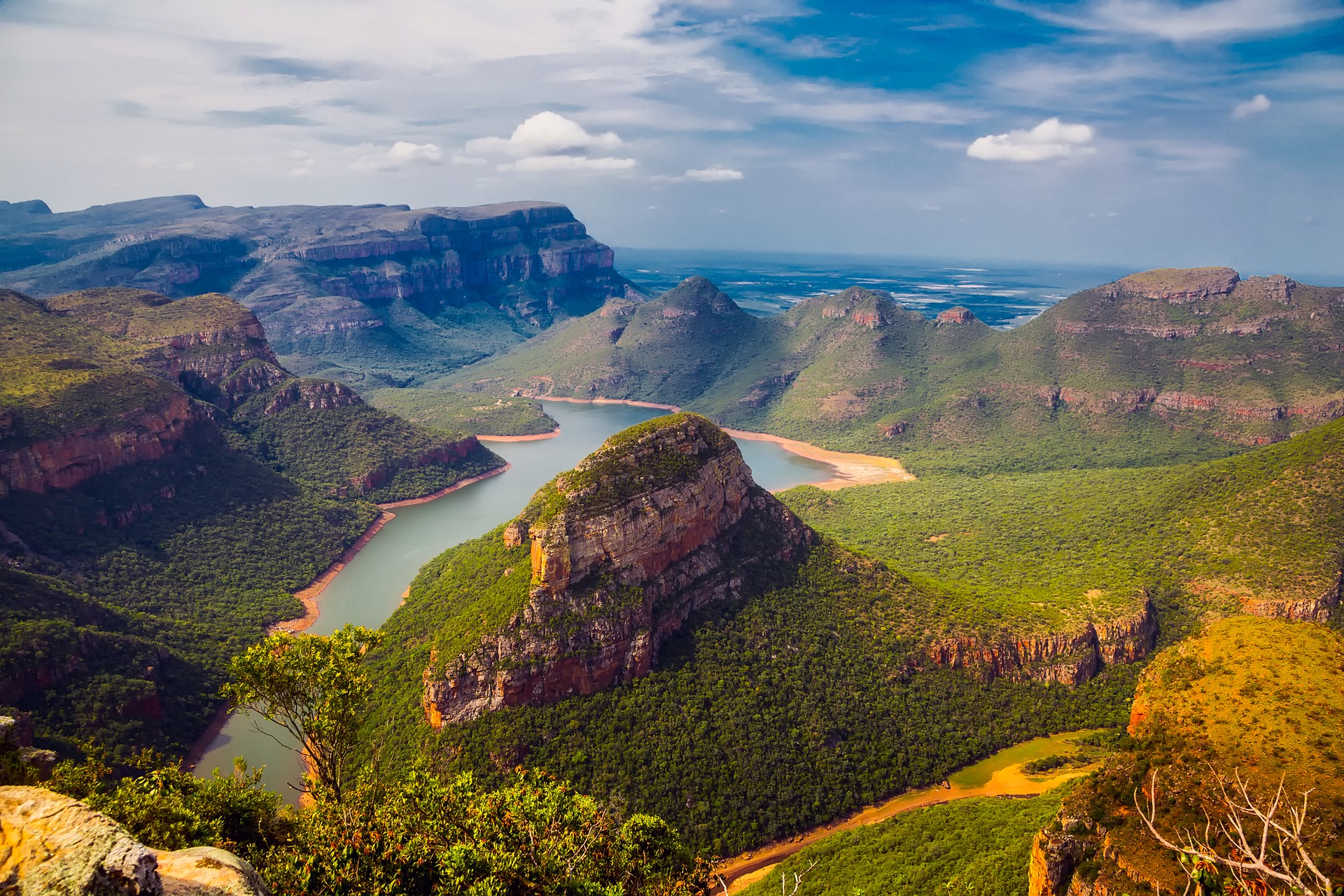
South Africa is the southernmost country in Africa, with more than 2,500 km of coast on the Atlantic and Indian oceans, a dry interior that reaches the Kalahari, and the Drakensberg mountains rising above 3,000 m in the east. It has 12 official languages and a very mixed population, which is why it is often called the Rainbow Nation. It is also a good place to start a trip in southern Africa, since most flights to the region route through South Africa anyway.
Wildlife is the first draw. Kruger National Park is the best-known place to look for the Big Five, Addo Elephant is another popular choice, and the Kgalagadi and iSimangaliso parks show very different landscapes. Around Cape Town you have Table Mountain, the beaches and the winelands near Stellenbosch; further east the Garden Route runs along the coast past lagoons and the Tsitsikamma National Park. The history is told at Robben Island, where Nelson Mandela was imprisoned, at the Apartheid Museum in Johannesburg and at the Cradle of Humankind, where some of the oldest hominid fossils have been found.
Main roads and domestic flights are good, and cards are accepted almost everywhere. The official advice: the US rates South Africa Level 2 (exercise increased caution), Canada advises a high degree of caution because of serious crime, and the UK does not advise against travel. Plan your routes, avoid walking after dark and read the safety section before you go.
- Kruger National Park: The country's best-known safari park, for the Big Five, reached by direct flights from Johannesburg, Cape Town and Durban.
- Table Mountain: The flat-topped mountain above Cape Town, with a cable car and strenuous trails.
- Garden Route: A green coastal road from Mossel Bay to Gqeberha, past lagoons, Knysna and the Tsitsikamma National Park.
- Robben Island: The island off Cape Town where Nelson Mandela was imprisoned for 27 years, now a World Heritage Site.
- Ukhahlamba Drakensberg Park: High mountains on the border with Lesotho, good for hiking, with San rock paintings.
- Cradle of Humankind: Caves near Johannesburg rich in hominid fossils, including Sterkfontein.
Places to visit
- City
- Island
- Park
- Mountain
- Historic site
Cities
- Cape Town: The legislative capital, between the sea and Table Mountain, close to the winelands.
- Johannesburg: The economic centre and the main entry point to southern Africa, with Soweto and the Apartheid Museum.
- Pretoria: The administrative capital, home to the embassies and three universities.
- Durban: The third city, a coastal holiday resort and the heart of the Indian community.
- Gqeberha: Formerly Port Elizabeth, a coastal city in the Eastern Cape close to Addo Elephant National Park.
- Bloemfontein: The judicial capital, seat of the Supreme Court of Appeal.
- Kimberley: Capital of the Northern Cape, known for its diamonds and the Big Hole.
- Polokwane: Capital of Limpopo, a base for the northern part of Kruger.
- Upington: A base for the Kalahari, the Kgalagadi park and the Augrabies Falls.
Beyond the cities
- Kruger National Park (park): A well-managed park and the classic place to look for the Big Five.
- Kgalagadi Transfrontier Park (park): Open Kalahari plains shared with Botswana, with gemsbok and herds of wildebeest.
- Hluhluwe-iMfolozi Park (park): One of the smaller game parks.
- iSimangaliso Wetland Park (park): A World Heritage wetland near the Mozambique border, with landscapes and wildlife unlike the bush parks.
- Ukhahlamba Drakensberg Park (mountain): A World Heritage Site for its landscape, biodiversity and rock art.
- Cradle of Humankind (site): Caves near Johannesburg with hominid and ape fossils, a World Heritage Site.
- Robben Island (island): The prison island off Cape Town where Nelson Mandela spent 27 years.
- Vredefort Dome (site): The remains of the largest and oldest known meteorite impact crater.
- Garden Route (coast): The southern coast from Mossel Bay to Gqeberha, with lagoons, Knysna and the Tsitsikamma National Park.
Regions
- Gauteng: Johannesburg and Pretoria.
- Western Cape: Cape Town, the winelands near Stellenbosch, the whale coast, Cape Agulhas and the Garden Route.
- Eastern Cape: The Tsitsikamma, the Wild Coast, beaches at Gqeberha, East London and Jeffreys Bay, and Addo Elephant National Park.
- Northern Cape: The largest and least populated province: Kimberley, Upington, the Kalahari and the Augrabies Falls.
- Free State: Bloemfontein and the Vredefort Dome.
- KwaZulu-Natal: Durban, the Drakensberg on the border with Lesotho and the Tugela Falls.
- North West: Rustenburg, Sun City and the Pilanesberg Game Reserve.
- Mpumalanga: Mbombela, the southern part of Kruger and the Blyde River Canyon.
- Limpopo: Polokwane and the northern part of Kruger.
Things to do
See
- Safari in Kruger Kruger National Park: Drive yourself or join a tour to look for the Big Five; in the park stay in your car and keep to the speed limits.
- Robben Island Cape Town: The island prison where Nelson Mandela was held, now one of the country's main sights.
- Apartheid history Johannesburg: The Apartheid Museum in Johannesburg and the District Six Museum in Cape Town.
- Cradle of Humankind Cradle of Humankind: More than 30 caves have yielded important fossils; Sterkfontein is the best known.
Do
- Table Mountain Cape Town: Take the cable car or hike up; the trails are strenuous, so start early, stay on busy marked paths and finish before dark.
- Drive the Garden Route Garden Route: Lagoons, small towns and the Tsitsikamma National Park along the southern coast.
- Whale watching in Hermanus: A popular seaside town for whale watching, also known for cage diving with great white sharks.
- Hike in the Drakensberg Ukhahlamba Drakensberg Park: Mountain trails and San rock paintings; some protected areas take only a limited number of visitors, so book ahead.
Eat
- A braai: Meat grilled over wood or charcoal, often boerewors sausage, the centre of weekend gatherings.
Drink
- Wine around Stellenbosch: The Cape Winelands, with some of the country's more than 800 wineries.
Itineraries
Cape Town and the Garden Route in 10 days (10 days)
- Cape Town (4 nights): Table Mountain, Robben Island and a day in the winelands.
- Garden Route (3 nights): By hire car, or by the hop-on, hop-off Baz Bus that links the hostels between Cape Town and Gqeberha.
- Gqeberha (2 nights): For Addo Elephant National Park: take the N2 via Colchester, as the parks authority advises.
Johannesburg and Kruger in 7 days (7 days)
- Johannesburg (2 nights): The Apartheid Museum and the Cradle of Humankind; visit Soweto with a guide.
- Kruger National Park (4 nights): Fly direct from Johannesburg or drive; avoid the Numbi gate.
Climate and best time to visit
| Jan | Feb | Mar | Apr | May | Jun | Jul | Aug | Sep | Oct | Nov | Dec | |
|---|---|---|---|---|---|---|---|---|---|---|---|---|
| Max °C | 31 | 30 | 27 | 24 | 21 | 18 | 18 | 21 | 25 | 27 | 28 | 30 |
| Min °C | 15 | 15 | 12 | 8 | 2 | -2 | -2 | 1 | 5 | 9 | 12 | 14 |
| Rain mm | 89 | 101 | 76 | 44 | 18 | 11 | 6 | 16 | 21 | 52 | 70 | 66 |
The climate ranges from desert in the north-west to subtropical on the east coast. Most of the country gets its rain in summer, but the Western Cape, around Cape Town, gets it in winter, and in the Eastern Cape it is spread over the year. The table shows Bloemfontein, in the interior: in summer the average maximum is about 30 °C from December to February, with most of the rain (about 101 mm in February); in winter the days are mild, around 18 °C in June and July, but the average minimum drops below zero.
April and May, and September and October, are the easiest months inland: days of about 21 to 27 °C and little rain. In the north-east, including Kruger, malaria is a risk from about November to May. Book early for the school holidays, from early December to mid-January, early April, mid-June to mid-July and late September, when South Africans travel and rooms fill up. The UK notes that floods can happen at any time of year, and wildfires in hot, dry weather, including around Cape Town.
Holidays and events
- 1 January 2026 · New Year's Day
- 21 March 2026 · Human Rights Day
- 3 April 2026 · Good Friday
- 6 April 2026 · Family Day
- 27 April 2026 · Freedom Day
- 1 May 2026 · Workers' Day
- 16 June 2026 · Youth Day
- 10 August 2026 · National Women's Day
- 24 September 2026 · Heritage Day
- 4 November 2026 · Election Day
- 16 December 2026 · Day of Reconciliation
- 25 December 2026 · Christmas Day
- 26 December 2026 · Day of Goodwill
Getting around
Domestic flights link all the main cities several times a day. Long-distance buses run between the big cities, and the Baz Bus is a hop-on, hop-off service for backpackers between Cape Town and Gqeberha along the Garden Route. Most long-distance passenger trains have stopped: as of December 2025 the budget Shosholoza Meyl ran only two routes, less than once a month. The luxury Blue Train and Rovos Rail still run.
For short trips, the UK considers the Gautrain (Johannesburg, Pretoria and O.R. Tambo airport), the MyCiTi bus in central Cape Town and internationally recognised ride-hailing apps, booked through the app, to be the safer options. Both the UK and Canada advise avoiding minibus taxis, and the UK lists Metrorail trains among the riskier services. Do not walk to or from Gautrain stations after dark.
Driving is on the left and is the practical way to see the national parks, which public transport rarely reaches. Main roads are good, but fatal accidents are common, speeding and drink-driving too, and rural roads are often unlit. Keep windows closed and doors locked, do not stop for strangers, and do not follow GPS routes that leave the main roads. Most highways have a limit of 120 km/h. A UK photocard licence is valid for 12 months; hire companies may set a higher minimum age.
Flying to South Africa? PartnerCompare fares and find the cheapest datesSearch flightsWhere to stay
- Hotels and guest houses: Graded from 1 to 5 stars, but the grading is only a rough guide: compare before you book.
- B&Bs: Usually in a family home, with breakfast.
- Backpacker lodges: Found across the country, often with tours, self-catering kitchens and shared bathrooms.
- Self-catering: Cottages, chalets, apartments and bungalows with a kitchen.
- Park camps: Run by the national and provincial park authorities, with reasonably priced rooms, food and guided safaris.
- Camping and caravan parks: In most holiday towns, with shared washrooms.
Many places quote prices per person rather than per room, and do not always say whether breakfast is included: ask. Prices have risen fast in recent years, so compare before you book. Rooms are hard to find during the school holidays, especially from December to January.
Canada says theft from hotel rooms and guest houses is common: check the security of a place before booking, and keep doors and windows locked. Power cuts still happen, so ask how your accommodation copes with them.
Eat and drink
Dishes to try
- Braai: Meat grilled over a wood or charcoal fire, the classic weekend gathering.
- Boerewors: A spicy sausage, often served in a roll with onion and tomato relish.
- Biltong: Seasoned dried meat, made from beef, game or ostrich.
- Bunny chow: Half a loaf of bread filled with lamb or beef curry, a speciality of Durban's Indian community.
- Bobotie: A Cape Malay spiced meatloaf with a savoury custard topping.
- Pap: Maize porridge, eaten runny for breakfast or stiff in place of rice.
- Melktert and koeksisters: Milk tart and a deep-fried, syrupy pastry.
Drinks
- Wine: Mostly from the Cape Winelands and the Orange River, plentiful and affordable.
- Rooibos: A local herbal tea from the Cederberg mountains.
- Amarula: A cream liqueur made from the marula fruit.
- Castle: One of the most popular local beers.
| Tipping | Around 10% is the norm in restaurants and taxis, where staff rely on tips. Give a small tip to petrol station attendants and hotel porters. |
|---|
South African food mixes British, Dutch, German, Indian, Malay and Portuguese influences with African cooking. Cape Town and Durban are good for seafood, while inland fresh fish is harder to find. Vegetarian food is easy to find in the cities, and kosher and halal food in areas with Jewish and Muslim communities. Municipal tap water is usually safe to drink. The legal drinking age is 18, and almost all restaurants are licensed.
Entry requirements and visas
| Passport validity | At least 30 days after the date you leave South Africa, with at least 2 blank pages (UK and Canada) |
|---|
| Passport | Entry | Max stay | Notes |
|---|---|---|---|
| United Kingdom | Visa free | 90 days | For tourism or business; check the date on your entry stamp and do not overstay. |
| Canada | Visa free | 90 days | Officials stamp the number of days you may stay, up to 90, which is not granted automatically: check that the stamp matches your plans. |
| United States | Visa free | 90 days | According to Wikivoyage. |
| Australia | Visa free | 90 days | According to Wikivoyage. |
Other nationalities: check the official source below.
UK and Canadian citizens can visit for up to 90 days without a visa. Your passport must be valid for at least 30 days after you leave and have 2 blank pages, or you can be refused entry. Since 1 July 2026 every traveller entering or leaving must submit an online traveller declaration before travelling. Canada adds that you need a return or onward ticket, or you may have to deposit the cost of a fare home with customs. Overstaying can lead to a ban of up to 5 years.
You need a yellow fever certificate if you arrive from a country with a risk of the disease. Declare cash over ZAR 25,000 (South African rand) per person, or foreign currency worth more than USD 10,000. There are extra rules for travelling with children under 18. Rules depend on your passport and can change: check the official link or the South African embassy before you book.
Money and payments
| Currency | South African Rand (ZAR) |
|---|---|
| Cards | Widespread |
The currency is the South African rand (ZAR). Cards are the main way to pay: Visa and Mastercard are accepted almost everywhere, and some businesses do not take cash. ATMs are everywhere, but local banks add a fee of their own, for example R50 to R75 a withdrawal in March 2023. Use ATMs inside malls or banks, never accept help from strangers, and cover your PIN.
Exchanging cash is costly, as commissions can take 10% or more; change large sums only in banks or secure malls. VAT is 15%, and visitors can claim it back on goods they take out of the country if the total is over R250, at the refund offices at Johannesburg and Cape Town airports.
Health
| Required vaccines | Yellow fever, for travellers aged 1 or older arriving from a country with risk of yellow fever, including airport transits of more than 12 hours there |
|---|---|
| Recommended vaccines | Routine vaccines, including measles (MMR), Hepatitis A, Hepatitis B, Typhoid, for some travellers: rural areas, long stays or visits to friends and relatives, Rabies, for some travellers: rabid dogs are common |
| Malaria | Some areas |
| Tap water | Safe |
Malaria is a risk only in some areas: the CDC lists Kruger National Park and districts along the borders with Mozambique and Zimbabwe in Limpopo, Mpumalanga and KwaZulu-Natal. Wikivoyage notes that the season runs from about November to May. Ask a travel health professional, at least a month before you go, whether you need tablets for your route. HIV is a risk, bilharzia is a risk in still fresh water, and in Johannesburg some people feel the altitude.
Private medical care is of a very high standard but expensive, and there is no healthcare agreement with the UK: get good travel insurance. Many medicines need a prescription from a South African doctor. In an emergency call 112 from a mobile or 10177 for an ambulance.
This is general information, not medical advice: check with a travel health professional before you go.
Safety
- United States: Level 2: Exercise Increased Caution (2026-10-20)
- Canada: Exercise a high degree of caution (2026-10-20)
- United Kingdom: No advice against travel (2026-10-20)
The US rates South Africa Level 2 (exercise increased caution), Canada advises a high degree of caution because of serious crime, and the UK does not advise against travel. Crime is the main concern: violent muggings, carjackings, smash-and-grab thefts at junctions and express kidnappings, in which victims are forced to withdraw cash. Most violent crime happens in townships, informal settlements, some city centres and isolated areas, and the risk rises after dark. Do not walk around at night, keep valuables out of sight, and visit townships only with a reliable guide.
On the road, keep windows closed and doors locked, park in well-lit places and do not stop for people who appear to need help. Criminals sometimes pose as police in unmarked cars with blue lights: if in doubt, drive on to a police station. There have been attacks on hikers in Table Mountain National Park, including Lion's Head and Signal Hill: keep to busy, marked trails, in groups of 4 or more. For Kruger avoid the Numbi gate, and for Addo take the N2 via Colchester rather than the R335.
At the beach, swim only between the red and yellow flags; currents drown many people every year. Around Cape Town a flag system warns of sharks. Avoid demonstrations, and be careful with dating apps and drinks from strangers. Police: 10111; all emergencies from a mobile: 112.
Customs and etiquette
South Africans are generally friendly and direct: they will tell you what they think, without meaning to offend. Greet strangers with a smile or a nod; men usually shake hands firmly. Avoid criticising the country's history and steer clear of racial or political remarks unless you know the subject well: many people will gladly talk about their own experiences if you listen.
Same-sex relationships are legal and same-sex marriage is recognised, though open affection may draw attention outside the more cosmopolitan areas. Nude sunbathing is illegal except on designated beaches. Cannabis for personal use is legal, but all other drugs bring long prison sentences. Buying ivory or rhino horn is banned. Carry a copy of your passport photo page and entry stamp, and leave the passport in a safe; any police station will authenticate copies for free.
Language
| Official languages | Afrikaans, South Ndebele, Xhosa, Zulu, Swati, Northern Sotho, Southern Sotho, Tswana, Tsonga, Venda, English, sfs |
|---|---|
| English | Common |
| Hello (Xhosa) | Molo |
|---|---|
| Yes | Yebo |
| How's it going? (a greeting) | Howzit |
| Nice, enjoyable | Lekker |
| Barbecue | Braai |
| Traffic light | Robot |
| Sometime soon | Just now |
| OK | Sharp |
What to pack
- Passport with 2 blank pages: Without them you can be refused entry.
- Return or onward ticket: Without one you may have to leave a deposit with customs.
- Credit card: Cards are the main way to pay, and some places refuse cash.
- Power bank and torch: Power cuts still happen and can last for hours.
- Insect repellent, and malaria tablets for the north-east: Kruger and the border areas have malaria, mainly from November to May.
- Boots and socks for the bush: They protect against snake and insect bites on walks.
- Authenticated copy of your passport: Carry it as ID and leave the original in a safe.
Quick reference
Country facts
| Capital | Bloemfontein / Cape Town / Pretoria |
|---|---|
| Population | 64,747,319 (2025) |
| Area | 1,213,090 km² |
| Time zone | Africa/Johannesburg (UTC+2) |
| Calling code | +27 |
| Driving side | left |
Staying connected
| SIM and eSIM | The networks are Vodacom, MTN, Cell C and Telkom. A prepaid SIM must be registered with your passport and proof of address; in a Vodacom or MTN shop you can be connected on the spot. Mobile data is not cheap. Coverage is good in towns and cities but can be patchy in the countryside, and power cuts can affect the networks. |
|---|---|
| Wi-Fi | Canada warns that public Wi-Fi can be compromised: use secure networks. |
Useful apps
- Uber and Bolt: Ride-hailing; book only through the app and check the car and driver before you get in.
Emergency numbers
| Police | 10111 |
|---|---|
| Fire | 10177 |
Frequently asked questions
Do I need a visa for South Africa?
Not for stays up to 90 days if you hold a UK, Canadian, US or Australian passport. You need a passport valid 30 days after departure with 2 blank pages and an online traveller declaration. Check the official link before you book.
Is South Africa safe for tourists?
The US rates it Level 2 and Canada advises a high degree of caution because of crime; the UK does not advise against travel. Avoid walking after dark, keep car doors locked and visit townships only with a guide.
Do I need malaria tablets for Kruger?
Kruger and the areas along the Mozambique and Zimbabwe borders have malaria, mainly from November to May. Ask a travel health professional about tablets for your route.
When is the best time to visit South Africa?
It depends on the region. Inland, April to May and September to October are mild and fairly dry; Cape Town gets its rain in winter. Avoid the school holidays if you want easy bookings.
Can I drink the tap water in South Africa?
Municipal tap water is usually safe to drink, except in a few areas where you should boil it first.
Do I need cash in South Africa?
Not much. Cards are accepted almost everywhere; keep some small change for tips.
More Travel Stories from Africa
 Kenya
Sources This guide was last checked on · 17 sources
- Wikivoyage: South Africa · Overview, Places to visit, Things to do, Itineraries, Climate and best time to visit, Getting around, Where to stay, Eat and drink, Entry requirements and visas, Money and payments, Health, Safety, Customs and etiquette, Language, What to pack, Staying connected, Frequently asked questions
- Wikidata: South Africa · Overview, Places to visit, Money and payments, Country facts
- UK FCDO: South Africa warnings and insurance (updated 8 July 2026) · Overview
- Government of Canada: South Africa travel advice (updated 15 October 2026) · Overview, Getting around, Where to stay, Entry requirements and visas, Money and payments, Health, Safety, What to pack, Staying connected, Frequently asked questions
- UK FCDO: South Africa safety and security · Things to do, Itineraries, Climate and best time to visit, Getting around, Where to stay, Money and payments, Safety, Customs and etiquette, What to pack, Frequently asked questions
- WMO World Weather Information Service: Bloemfontein · Climate and best time to visit
- Nager.Date: public holidays in South Africa, 2026 · Holidays and events
- UK FCDO: South Africa entry requirements · Entry requirements and visas, What to pack, Frequently asked questions
- CDC Travelers' Health: South Africa · Entry requirements and visas, Health, What to pack, Frequently asked questions
- ISO 4217 (SIX), published 2026-09-17 · Money and payments
- UK FCDO: South Africa health · Health
- US Department of State: South Africa travel advisory · Safety
- UK FCDO: South Africa travel advice · Safety
- World Bank, SP.POP.TOTL · Country facts
- World Bank, AG.LND.TOTL.K2 · Country facts
- IANA Time Zone Database, zone.tab · Country facts
- UK FCDO: South Africa getting help · Emergency numbers
Suggest an update
Travel rules, prices and timetables change. If something in this guide is out of date, tell us: we check every suggestion against an official source before changing the page.