

- Local time
- 22:04
- Currency
- Seychellois Rupee (SCR)
- Capital
- Victoria
- Calling code
- +248
- Drive on the
- left
Overview
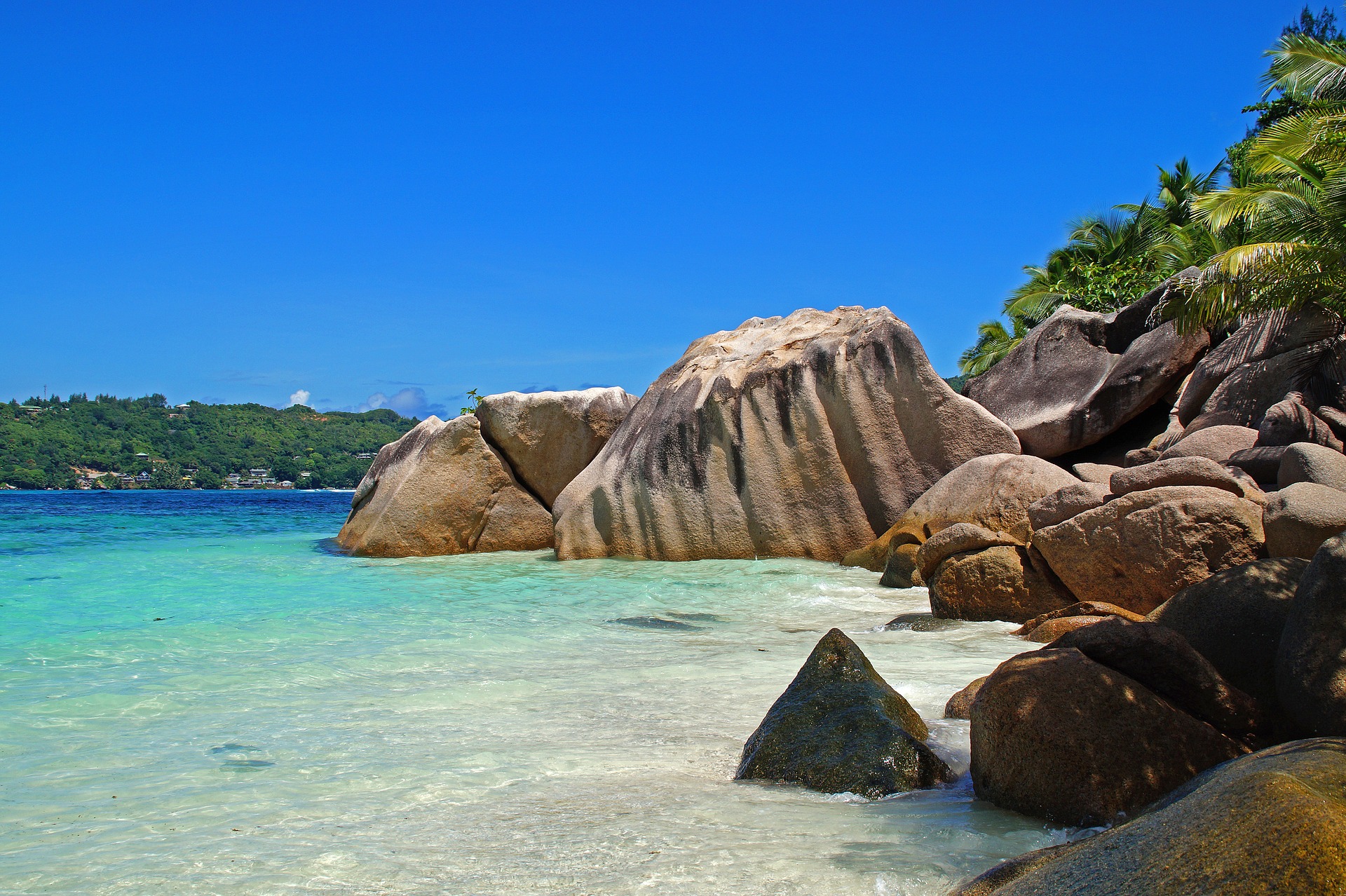
Granite islands with quiet beaches, coral reefs, coco de mer palms and the giant tortoises of Aldabra. Expensive, but not only for luxury trips.
The Seychelles are an island nation in the Indian Ocean, north-east of Madagascar and east of Kenya: 115 islands, of which Mahé, Praslin and La Digue are the largest. Most people, and most of the resorts, are on the granite islands of the inner group. The capital, Victoria, is on Mahé, next to the only international airport. The coral islands of the outer group are mostly uninhabited, and you reach them by private yacht or on small planes to remote airstrips.
People come for the beaches, the snorkelling and diving, and the nature: many plants and animals live nowhere else. Two places are UNESCO World Heritage Sites: the Vallée de Mai on Praslin, home of the coco de mer palm, and Aldabra Atoll, with a population of giant tortoises of more than 150,000. A large part of the islands and the sea around them is protected.
The Seychelles have a reputation for luxury, and prices remain high compared with other tropical beach destinations, but apartments, bungalows and small hotels make a cheaper trip possible. The official advice is reassuring: the US rates the country Level 1, Canada says to take normal precautions and the UK does not advise against travel. Watch out for the sea, though: currents change with the monsoons.
- Vallée de Mai: A UNESCO-listed nature reserve on Praslin, where the coco de mer palm grows the largest seed of any plant.
- Aldabra Atoll: A remote UNESCO-listed coral atoll with a tidal lagoon, giant tortoises, tiger sharks and manta rays.
- Beau Vallon to Anse Major: A coastal walk of about 1.5 to 2 hours on Mahé that ends at a small, empty beach.
- Cousin Island: A small island owned by BirdLife International since 1968, with more than 300,000 birds.
- Marine parks: Sainte Anne and Curieuse marine national parks, for marine life and rare birds.
- Victoria: The capital, with the Natural History Museum and a market selling local spices and produce.
Places to visit
- City
- Island
- Park
Cities
- Victoria: The capital and largest city, on Mahé, with museums and the central market.
- Beau Vallon: A popular beach area on Mahé, the starting point for boat trips and the walk to Anse Major.
- Takamaka: A district of the Seychelles.
Beyond the cities
- Praslin (island): One of the three largest islands, about an hour from Mahé by ferry, home of the Vallée de Mai.
- La Digue (island): A small island 15 minutes by ferry from Praslin, best seen on foot or by bike.
- Vallée de Mai (park): A UNESCO-listed nature reserve with the coco de mer palm.
- Morne Seychellois National Park (park): A national park with one of the last expanses of untouched tropical rainforest.
- Aldabra Atoll (island): A coral atoll about 35 km across, the original home of the giant land tortoise.
- Cousin Island (island): A bird reserve about 1 km across, bought by BirdLife International to protect the Seychelles warbler.
- Sainte Anne Marine National Park (park): A marine reserve for fish and other sea life.
- Curieuse Marine National Park (park): A marine reserve with sea life and rare birds.
Regions
- Inner Seychelles: The granite islands, where most people live and most resorts are.
- Outer Seychelles: Coral islands, mostly uninhabited and rarely visited, reached by yacht or small plane.
Things to do
See
- Vallée de Mai Praslin: A national park and World Heritage Site where you see the coco de mer, the palm with the largest seed of any plant.
- Birds of Cousin Island Cousin Island: More than 300,000 birds on an island about 1 km across, protected by BirdLife International.
- Museums of Victoria Victoria: At the Natural History Museum you can hold a coco de mer; the National Museum of History has photos and a film.
Do
- Walk from Beau Vallon to Anse Major Mahé: About 1.5 to 2 hours along the coast to a small beach with no one on it.
- Snorkelling off Mahé Mahé: Free if you bring your own gear: try the small beaches at Glacis, past Mouse Island at Anse Royale, or the reef at Port Launay. Some hotels lend masks and fins.
- Glass-bottom boat to Baie Ternay Beau Vallon: Boat tours leave from Beau Vallon beach; on the spot you can often bargain a last-minute deal.
- Windsurfing: Usually best around May and October, when the trade winds start and end.
Eat
- Creole seafood: Fish cooked many ways, curries and coconut; red snapper is the fish visitors know best.
Drink
- Seybrew and Takamaka rum: The local light beer costs less from roadside shops than in hotels; end the day with a glass of dark Takamaka rum.
Shop
- Victoria market Victoria: Local produce and spices grown on the islands. A coco de mer nut needs an export licence.
Itineraries
Mahé, Praslin and La Digue in 8 days (8 days)
- Beau Vallon (3 nights): Mahé: the walk to Anse Major, a boat trip to Baie Ternay and a half day in Victoria.
- Praslin (3 nights): By Cat Cocos ferry from Mahé, about an hour, or by plane. The Vallée de Mai.
- La Digue (2 nights): By ferry from Praslin in 15 minutes; walk or cycle around the island.
Mahé in 5 days (5 days)
- Victoria (1 night): The market and the museums.
- Beau Vallon (4 nights): Beaches, snorkelling, the Morne Seychellois National Park; a hire car covers the whole island in a few hours.
Climate and best time to visit
| Jan | Feb | Mar | Apr | May | Jun | Jul | Aug | Sep | Oct | Nov | Dec | |
|---|---|---|---|---|---|---|---|---|---|---|---|---|
| Max °C | 30 | 31 | 31 | 32 | 31 | 29 | 29 | 29 | 29 | 30 | 30 | 30 |
| Min °C | 25 | 25 | 25 | 25 | 26 | 25 | 24 | 24 | 25 | 25 | 24 | 24 |
| Rain mm | 404 | 249 | 202 | 185 | 161 | 116 | 89 | 123 | 163 | 178 | 193 | 306 |
It is hot and humid all year. In Victoria the average maximum stays between 28.5 °C in July and 31.6 °C in April, and the average minimum stays above 24 °C. The difference between the seasons is the wind and the rain. From May to September the south-east monsoon brings cooler, drier weather: July is the driest month, with about 89 mm. From November to March the north-west monsoon is warmer and wetter: January gets about 404 mm and December about 306 mm. April and October are the changeover months, with variable winds.
Canada calls December to March the rainy season, when strong winds and heavy rain can disrupt travel by road. The monsoons also decide where you can swim: the UK says the west coast is unsafe from about December to March and the east coast from about May to September. Hotels are fullest and dearest from December to January and in July and August, and Easter is busy too.
Holidays and events
- 1 January 2026 · New Year's Day
- 2 January 2026 · New Year Holiday
- 3 April 2026 · Good Friday
- 4 April 2026 · Holy Saturday
- 6 April 2026 · Easter Monday
- 1 May 2026 · Labour Day
- 4 June 2026 · Corpus Christi
- 18 June 2026 · Constitution Day
- 29 June 2026 · Independence Day
- 15 August 2026 · Assumption Day
- 1 November 2026 · All Saints' Day
- 8 December 2026 · The Feast of the Immaculate Conception
- 25 December 2026 · Christmas Day
Getting around
| Main airports | SEZ |
|---|
Between islands: Air Seychelles flies between Mahé and Praslin many times a day, and to some outer islands such as Bird, Denis and Desroches. Cat Cocos catamarans cross from Mahé to Praslin in about an hour, several times a day, with a daily extension to La Digue; a one-way ticket cost non-residents SCR 1,300 to 1,820 (Seychellois rupees) in February 2021. Another ferry links Praslin and La Digue in about 15 minutes. You can book both online. Travel by ship to the far outer islands, such as Aldabra, needs approval from the maritime safety authority.
Buses run on Mahé and Praslin. They are cheap, but some routes are infrequent and most stop by 8 pm; since 2023 drivers may refuse large luggage. Taxis are generally good, but not all have meters: agree the fare first. On a long trip a taxi can cost more than a day's car hire.
Driving is on the left. Roads on Mahé are narrow and winding, with sheer drops, hairpin bends, few barriers and deep open drains, and drink-driving is common. You can hire a car only on Mahé and Praslin. A UK photocard licence is valid for 3 months; Canada says Canadians need an international driving permit; hire companies may ask for one anyway, together with a minimum age and years of experience. On the smaller islands such as La Digue and Praslin, walking and cycling are good ways to get around; cycling on Mahé is not advised.
Flying to Seychelles? PartnerCompare fares and find the cheapest datesSearch flightsWhere to stay
- Resorts: Mostly on Mahé and Praslin; a few at the very top end have a private island to themselves.
- Small hotels and guesthouses: Smaller places with Creole hospitality, from basic rooms upwards.
- Apartments and bungalows: The best value on a budget, and handy for cooking with groceries from the larger shops.
Book before you fly: you need proof of confirmed accommodation to enter, and immigration officers ask for the details. Travellers who arrive without a booking may be sent to a counter to book and pay for their whole stay before they can pass.
Most accommodation is expensive, and some islands have only one hotel. Prices rise and rooms run short in the peak seasons, from December to January and in July and August, and around Easter.
Eat and drink
Dishes to try
- Fish: The islands' main product, cooked in many ways; red snapper is the best known.
- Creole curries: Curries and coconut are at the heart of local Creole cooking.
Drinks
- Seybrew: The local beer, light and similar to a Bavarian beer; roadside shops sell it for much less than hotels.
- Takamaka rum: A dark rum, drunk on the beach in the evening.
| Tipping | Many places already add a service charge of 5 to 10%. Tipping is not expected, but leaving the change is appreciated. |
|---|
Seychellois food mixes the cultures of the islands: Creole cooking, seafood, coconut and curry. Besides local restaurants you find Chinese, Indian and Italian ones. To save money, shop where locals do: the larger stores are much cheaper than the convenience shops by the beaches. Nightlife centres on the larger hotels and the clubs of Mahé.
Entry requirements and visas
| Passport validity | Valid for the whole of your stay (UK and Canada); check whether your airline asks for more |
|---|
| Passport | Entry | Max stay | Notes |
|---|---|---|---|
| United Kingdom | Eta | No visa, but you must apply and pay online for a travel authorisation before you go, up to 30 days ahead. On arrival you get a free visitor's permit for 3 months, which you can extend 3 months at a time (for a fee) up to 12 months. | |
| Canada | Eta | 90 days | No tourist visa for stays up to 90 days, but you must obtain a digital travel authorization before departure. |
Other nationalities: check the official source below.
No visa is needed by UK or Canadian citizens, but everyone must get a travel authorisation online before travelling. When you apply you need to show a return or onward ticket, confirmed accommodation and enough money for your stay. At the border you may also be asked for proof of travel insurance that covers medical costs.
If you arrive from a country with a risk of yellow fever, you need a vaccination certificate. Declare cash worth SCR 50,000 or more when you apply for the travel authorisation. Customs rules are strict: declare anything that may be prohibited or taxed. Rules depend on your passport and can change: check the official link or the Seychelles embassy before you book.
Money and payments
| Currency | Seychellois Rupee (SCR) |
|---|---|
| Cards | Common |
The currency is the Seychellois rupee (SCR). Most hotels, restaurants and shops in tourist areas accept debit and credit cards, and you can pay in rupees, euros or US dollars. ATMs are at the airport and in the main tourist areas, and they usually give only rupees.
Change money at banks, hotels, casinos or the international airport: exchanging at anything other than the official rate is prohibited. Card and ATM fraud happens, so cover the keypad and use machines inside banks or shops.
Health
| Required vaccines | Yellow fever, for travellers aged 1 or older arriving from a country with risk of yellow fever, including airport transits of more than 12 hours there |
|---|---|
| Recommended vaccines | Routine vaccines, including measles (MMR), Hepatitis A, Hepatitis B, Typhoid, for most travellers, Rabies, for some travellers |
| Malaria | None |
| Tap water | Varies |
The CDC does not list malaria for the Seychelles, and there is no yellow fever risk, but you need a yellow fever certificate if you come from a country where it occurs. Ask a travel health professional about vaccines at least a month before you go. Mosquitoes spread dengue, chikungunya and Zika, so use repellent. Wikivoyage says tap water is safe in most areas but varies in less developed ones, and suggests bottled water and no swimming in fresh water.
As a tourist you pay for treatment. The main hospital is at Mont Fleuri in Victoria, on Mahé, with an emergency department; there are many private clinics, but isolated islands have few facilities and some have no doctor. Get insurance that covers hospital stays and medical evacuation. Bring enough of your prescription medicines in their original containers. For an ambulance, call 999 (Canada also lists 151 for medical help).
This is general information, not medical advice: check with a travel health professional before you go.
Safety
- United States: Level 1: Exercise Normal Precautions (2026-10-20)
- Canada: Take normal security precautions (2026-10-20)
- United Kingdom: No advice against travel (2026-10-20)
The official advice is the lowest level: the US says to exercise normal precautions, Canada to take normal security precautions, and the UK does not advise against travel. Crime is mostly non-violent: bag snatching, theft from cars, boats and guest houses, and robberies of people walking at night. The UK and Canada mention Beau Vallon, the back streets of Victoria, beaches such as Côte d'Or, hiking trails, ATMs and isolated areas after dark. Keep valuables in the hotel safe and nothing on show in the car. Report a crime to the police on +248 428 8000.
The sea is the main risk. Strong currents and rip tides cause several drownings each year, especially at Beau Vallon when the sea is rough. Few beaches have lifeguards, beaches at the southern tip are never suitable for swimming, and which coast is safe depends on the monsoon. Ask locally and follow the warning flags. On boat trips, make sure there are life jackets and do not board an overloaded boat.
Hiking is generally safe, but trails are not always marked and people do get lost: plan your route and stay on the path. Drug laws are very strict, with sentences up to life imprisonment, and the airport scans the bags of transit passengers too.
Customs and etiquette
Seychellois are friendly, and a few polite words in French or Creole go a long way. Topless sunbathing is uncommon and nudism is not accepted. Same-sex relations are legal, but attitudes vary and same-sex marriage is not recognised.
Respect the environment and leave beaches clean: many species live only here. There are strict rules on bringing in firearms, spear-fishing equipment, fruit and vegetables, and you need an export licence to take a coco de mer nut home.
Language
| Official languages | English, French, Seselwa Creole French |
|---|---|
| English | Common |
What to pack
- Travel authorisation, return ticket and hotel booking: You need them to enter, and immigration checks your accommodation.
- Travel insurance with medical evacuation: You may have to show it at the border, and you pay for all treatment.
- Yellow fever certificate, if you come from a risk country: It is required on arrival from those countries.
- Insect repellent: Mosquitoes carry dengue, chikungunya and Zika.
- Mask and snorkel: Snorkelling off the beaches is free if you have your own gear.
- Prescription medicines in their original containers: Some medicines may not be available.
Quick reference
Country facts
| Capital | Victoria |
|---|---|
| Population | 122,730 (2025) |
| Area | 457 km² |
| Time zone | Indian/Mahe (UTC+4) |
| Calling code | +248 |
| Driving side | left |
Emergency numbers
| Emergency | 999 |
|---|
Frequently asked questions
Do I need a visa for the Seychelles?
UK and Canadian citizens do not need a visa, but everyone must apply online for a travel authorisation before travelling and show a return ticket, a hotel booking and enough money. Check the official link before you book.
When is the best time to visit the Seychelles?
It is hot all year. May to September is cooler and drier; December to March is the wettest time. Hotels are busiest from December to January, in July and August and at Easter.
Is it safe to swim in the Seychelles?
Not everywhere and not all year. Currents depend on the monsoon, few beaches have lifeguards and there are drownings every year. Ask locally and follow the warning flags.
How do I get between the islands?
By Cat Cocos ferry from Mahé to Praslin in about an hour, by ferry from Praslin to La Digue in about 15 minutes, or by Air Seychelles flights.
Can I pay by card in the Seychelles?
Yes, in most hotels, restaurants and shops in tourist areas. ATMs at the airport and in tourist areas usually give only Seychellois rupees.
Is the tap water safe to drink?
It is safe in most areas but varies in less developed ones; bottled water is the safer choice.
More Travel Stories from Africa
 Kenya
Sources This guide was last checked on · 17 sources
- Wikivoyage: Seychelles · Overview, Places to visit, Things to do, Itineraries, Climate and best time to visit, Getting around, Where to stay, Eat and drink, Money and payments, Health, Customs and etiquette, Language, What to pack, Frequently asked questions
- Wikidata: Seychelles · Overview, Places to visit, Money and payments, Language, Country facts
- UK FCDO: Seychelles warnings and insurance (updated 21 January 2026) · Overview
- Government of Canada: Seychelles travel advice (updated 9 June 2026) · Overview, Climate and best time to visit, Getting around, Entry requirements and visas, Money and payments, Health, Safety, Customs and etiquette, What to pack, Frequently asked questions
- WMO World Weather Information Service: Victoria · Climate and best time to visit
- UK FCDO: Seychelles safety and security · Climate and best time to visit, Getting around, Safety, Customs and etiquette, What to pack, Frequently asked questions
- Nager.Date: public holidays in Seychelles, 2026 · Holidays and events
- UK FCDO: Seychelles entry requirements · Where to stay, Entry requirements and visas, What to pack, Frequently asked questions
- ISO 4217 (SIX), published 2026-09-17 · Money and payments
- CDC Travelers' Health: Seychelles · Health, What to pack
- UK FCDO: Seychelles health · Health
- US Department of State: Seychelles travel advisory · Safety
- UK FCDO: Seychelles travel advice · Safety
- World Bank, SP.POP.TOTL · Country facts
- World Bank, AG.LND.TOTL.K2 · Country facts
- IANA Time Zone Database, zone.tab · Country facts
- UK FCDO: Seychelles getting help · Emergency numbers
Suggest an update
Travel rules, prices and timetables change. If something in this guide is out of date, tell us: we check every suggestion against an official source before changing the page.