

- Local time
- 19:03
- Currency
- Central African CFA Franc (XAF)
- Capital
- N'Djamena
- Calling code
- +235
- Drive on the
- right
Overview
Zakouma's wildlife and the desert lakes and rock art of Ennedi, in a country where the US, UK and Canada advise against travel. Read their advice first.
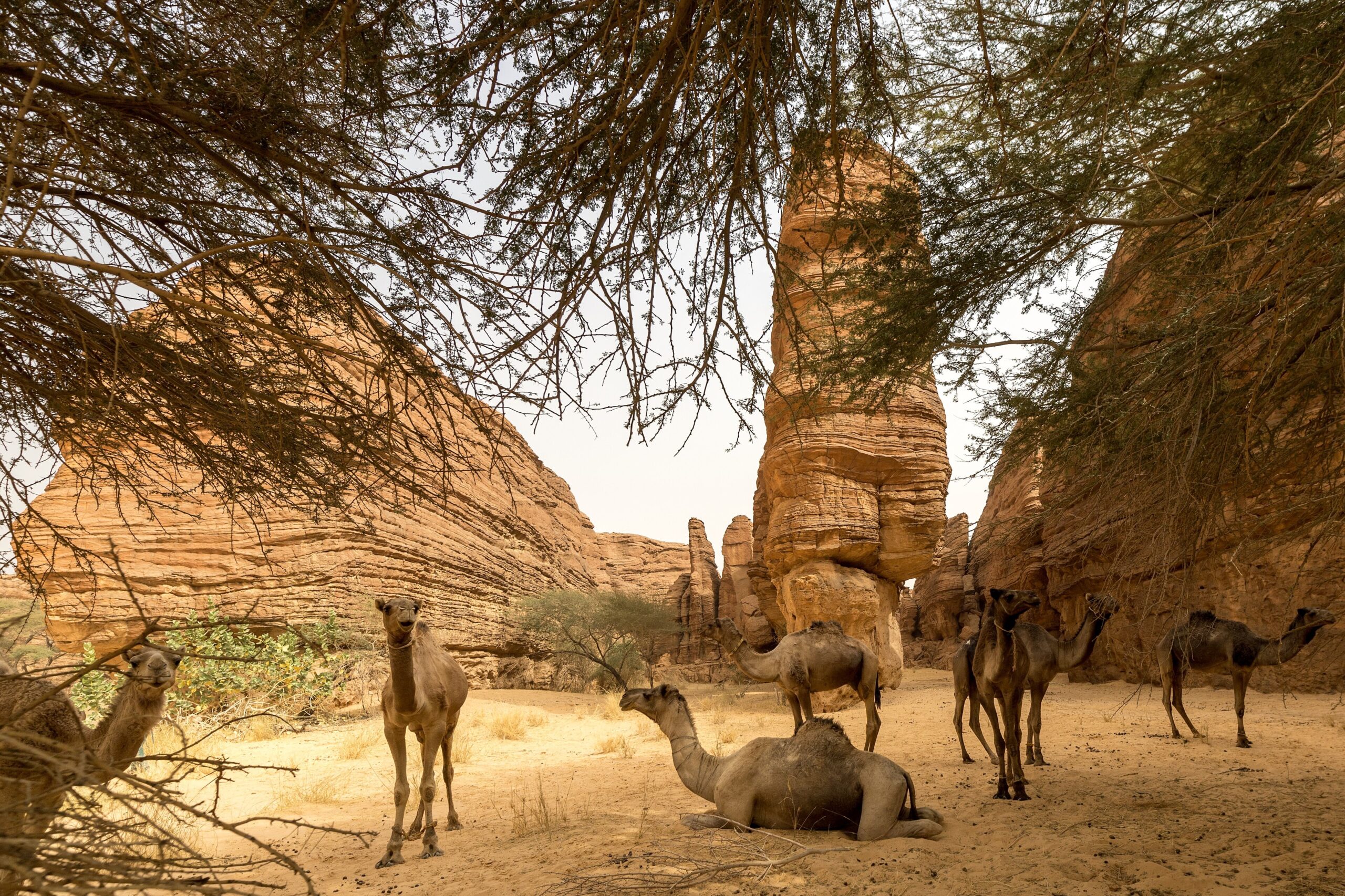
Chad is a landlocked country in the centre of Africa, home to more than 200 ethnic groups. The north is Sahara, with the sandstone Ennedi Massif and the lakes of Ounianga; the centre is arid plain and the south is lower and wetter. Lake Chad gives the country its name, and Zakouma National Park has become a destination for safaris. Arabic and French are the main languages.
Official advice is against travel. The US says Do Not Travel (Level 4). The UK and Canada advise against all but essential travel to the whole country, N'Djamena included, and against all travel to the north, the Lake Chad region and the areas within 30 km of the borders, among others: see the safety section for the exact areas. To leave N'Djamena you need a permit from the Ministry of the Interior, and most of the country can only be visited on an organised tour. UK help on the ground is severely limited, and you should not count on an evacuation.
- Zakouma National Park: Savannah and floodplains with half the world's Kordofan giraffes and nearly 400 bird species.
- Ennedi Massif: Wind-carved sandstone with rock paintings, a UNESCO site in the north; The UK and Canada advise against all travel to the northern provinces.
- Lakes of Ounianga: A group of 18 desert lakes, a UNESCO site in the north; The UK and Canada advise against all travel to the northern provinces.
- N'Djamena: The capital and largest city, with the national museum.
- Gerewol: A week-long festival of the Wodaabe herders in late September, reached only on an organised tour.
Places to visit
- City
- Park
- Mountain
- Historic site
- Area
Cities
- N'Djamena: The capital and largest city, and the arrival point for almost every visitor.
- Moundou: The second city, on the main paved road from N'Djamena.
- Abéché: Capital of Ouaddaï province and once of the Wadai Empire; Canada advises against all travel to the province except the town itself.
- Faya-Largeau: The largest town and oasis of the north, in Borkou province, where the UK advises against all travel.
Beyond the cities
- Zakouma National Park (park): Floodplains, rivers and marshes with the Big Five since black rhinos were brought back, and two safari camps.
- Siniaka-Minia National Park (park): Greater kudu, lions and reintroduced African buffalo.
- Manda National Park (park): Large mammals and a wide range of birds.
- Aouk National Park (park): A mix of mammals and birds, visited on safari trips.
- Sena Oura National Park (park): Forms a biosphere corridor with Bouba Ndjida National Park in Cameroon.
- Ennedi Massif (mountain): UNESCO-listed sandstone shaped by wind, with rock paintings. The UK and Canada advise against all travel to the northern provinces.
- Guelta d'Archei (site): A rare pool of water in the Ennedi, with crocodiles and camel caravans. The UK and Canada advise against all travel to the northern provinces.
- Lakes of Ounianga (area): 18 desert lakes with their own water system, a UNESCO site. The UK and Canada advise against all travel to the northern provinces.
Regions
- Saharan Chad: The north, the driest part of the country.
- Sahelian Chad: The centre, with the capital.
- Soudanian Chad: The south, with a wetter climate.
Things to do
See
- National Museum N'Djamena: The country's national museum, in the capital.
- Gerewol: In the south-west in late September, Wodaabe men dress up and dance to find a wife; the sites can only be reached with an organised tour.
- Mountains of Guéra Sahelian Chad: A central region of mountain ranges and many ethnic groups.
Do
- Safari in Zakouma Zakouma National Park: A Big Five park with Kordofan giraffes, run by the NGO African Parks since 2010, which has almost ended poaching.
- Birdwatching Zakouma National Park: Nearly 400 species have been recorded in the park.
Eat
- Grilled meat and fish: Grilled lamb and camel everywhere, and fish in N'Djamena and the south.
Climate and best time to visit
| Jan | Feb | Mar | Apr | May | Jun | Jul | Aug | Sep | Oct | Nov | Dec | |
|---|---|---|---|---|---|---|---|---|---|---|---|---|
| Max °C | 34 | 36 | 38 | 40 | 40 | 38 | 35 | 32 | 34 | 37 | 36 | 34 |
| Min °C | 16 | 18 | 22 | 25 | 26 | 25 | 24 | 22 | 22 | 23 | 21 | 18 |
| Rain mm | 0 | 0 | 0 | 3 | 12 | 35 | 98 | 166 | 53 | 5 | 0 | 0 |
The rainy season runs from May to October in the south and from June to September in the centre, while the north gets little rain. In Abéché almost all the rain falls between June and September, peaking in August, and the hottest months are April and May, with maximums around 40 °C. Floods in the rainy season can cut roads and damage bridges, and the UK says roads are often impassable from July to October, especially in the south.
The dry months from November to February are the least hot, with maximums of about 33-36 °C in Abéché, and they avoid the floods.
Holidays and events
- 1 January 2026 · New Year's Day
- 8 March 2026 · International Women's Day
- 6 April 2026 · Easter Monday
- 1 May 2026 · Labour Day
- 11 August 2026 · Independence Day
- 1 November 2026 · All Saints' Day
- 28 November 2026 · Republic Day
- 1 December 2026 · Freedom and Democracy Day
- 25 December 2026 · Christmas Day
Getting around
| Main airports | NDJ |
|---|---|
| International driving permit | Required |
To travel outside N'Djamena you need a permit from the Ministry of the Interior, which takes a few days. The UK advises professional security advice before any trip outside the capital, a police or military escort, communications equipment and travelling in convoy; Canada recommends convoys of at least two vehicles and daylight travel only. Carjacking is a high risk on roads outside N'Djamena, in daytime too, and bandits make night driving dangerous. Fuel is often short: carry extra fuel, a spare tyre and supplies.
Roads are mostly unpaved. The main paved roads run from Massakory through N'Djamena to Moundou and Sarh, and from N'Djamena to Abéché, a toll road. Canada says there is no working bus network and advises against trucks and minibuses for travel between towns. In N'Djamena there are car and motorbike taxis, but Canada advises against walking even in daytime, and the UK suggests pre-arranged secure cars. Charter flights serve Zakouma and Faya-Largeau. Canada says you must carry an International Driving Permit, and the UK says British drivers must convert their licence to a Chadian one; Canada also suggests hiring a local driver, as crowds can turn on drivers after an accident.
Where to stay
- Hotels in N'Djamena: Plenty of options, from fairly affordable rooms to international hotels.
- NGO and church guesthouses: Often the cleaner, cheaper choice outside the capital, at around XAF 10,000 a night.
- Safari camps in Zakouma: Two camps, Tinga Camp and Camp Nomade, both expensive; Camp Nomade is by invitation only.
Outside N'Djamena there are few hotels, often basic and not very clean, and none in the desert. The UK lists hotels among the places where terrorist attacks could happen, and Canada reports armed robberies near restaurants in N'Djamena: choose accommodation with good security and keep doors locked.
Eat and drink
Dishes to try
- Grilled lamb and camel: Found all over the country.
- Fish: Common in N'Djamena and the south.
- La boule: A thick paste of millet, sorghum or maize served with sauces, the everyday food of most Chadians.
- La bouille: A thin breakfast porridge of millet, peanut butter and lemon.
Drinks
- Tea, coffee and hot milk: Very popular, and safer because the water has been boiled.
- Soft drinks: Coca-Cola, Sprite, Fanta and the fruity Top are the most common.
- Alcohol: Easy to find in N'Djamena and the south, hard to find and frowned upon outside the cities in the Muslim north and centre.
Food is usually eaten with the hands: use only your right hand, as eating with the left offends Muslims. Choose food that is freshly cooked and still hot. During Ramadan most restaurants in the north and centre close, and eating or drinking in public in the daytime is not accepted. Buy bottled water only in sealed bottles, because some street sellers refill old ones.
Entry requirements and visas
| Passport validity | At least 6 months: the UK counts from the date you arrive, Canada from the date you leave |
|---|
| Passport | Entry | Max stay | Notes |
|---|---|---|---|
| United Kingdom | Visa required | Contact the Chadian embassy in Belgium or in France before you travel. | |
| Canada | Visa required | You also need a return or onward ticket. | |
| United States | Visa required | Wikivoyage lists no exemption for US passports. | |
| EU / EEA | Visa required | Wikivoyage lists no exemption for EU passports. | |
| Australia | Visa required | Wikivoyage lists no exemption for Australian passports. |
Other nationalities: check the official source below.
Almost everyone needs a visa arranged before travel. Chad has few embassies, and you may have to apply in another country; applications usually ask for a passport copy, a photo, an invitation letter, return tickets and a completed form. Wikivoyage reports an online e-visa system that has not always worked, so ask the embassy which route applies to you.
Within 72 hours of arrival you must register with the police and get a registration stamp, at the Commissariat Central in N'Djamena, with a passport photo. A yellow fever certificate is required if you arrive from a country with yellow fever risk (from 9 months of age). You can bring in local and foreign currency if you declare it on arrival; you cannot take Chadian francs out, and you can take out only as much foreign currency as you declared. Declare anything that may be prohibited or taxed. Rules depend on your passport and can change: check with the Chadian embassy before you book.
Money and payments
| Currency | Central African CFA Franc (XAF) |
|---|---|
| Cards | Rare |
The currency is the Central African CFA franc (XAF), fixed to the euro at EUR 1 = XAF 655.957. Cash is what counts: credit cards are accepted only in the major hotels of N'Djamena, and ATMs are rare, though Wikivoyage mentions Ecobank machines that take Mastercard and Visa. Euros and US dollars are often accepted in payment. Some banks give small cash advances on major credit cards.
Declare all the money you bring in, keep the proof from a commercial bank, and remember that you cannot take Chadian francs out of the country.
Costs and budget
- Soft drink, away from expat places: XAF 300-500
- Room in an NGO or church guesthouse: about XAF 10,000
- Toll on the N'Djamena-Abéché road, per station: XAF 500 per car
- Tourist tax per site, such as Guelta d'Archei: XAF 5,000 per person
Chad is expensive compared with much of Africa, especially for accommodation and transport, and most visits need an organised tour, which adds to the cost. Avoid agencies that offer to handle your visa: Wikivoyage reports fees of more than EUR 1,000 for a service where you do most of the work. The prices here are those listed on Wikivoyage when we read it in October 2026.
Health
| Required vaccines | Yellow fever certificate if you arrive from a country with yellow fever risk (from 9 months of age) |
|---|---|
| Recommended vaccines | Routine vaccines, including measles (MMR), Yellow fever, for areas south of the Sahara, Hepatitis A, Hepatitis B, Typhoid, Polio: a single adult booster, Meningococcal, for the meningitis belt in the dry season (roughly December to June), Cholera may be considered for areas with active transmission, Rabies, for some travellers: ask a travel clinic |
| Malaria | Widespread |
| Tap water | Not safe |
See a travel health professional at least 6 to 8 weeks before you go. The CDC recommends prescription medicine against malaria for the whole country; the risk is highest in N'Djamena and the south. Poliovirus has been found in the country in the past year, and cholera is active in several provinces, N'Djamena included. Rabid dogs are common, dengue occurs and there is schistosomiasis in fresh water. Drink only bottled or boiled water and avoid ice. Altitude sickness is a risk in parts of the country.
Medical facilities are poor: even in N'Djamena hospitals are stretched and sometimes hit by strikes, and outside the capital care is extremely limited. Get insurance that covers medical evacuation and hospital stays, and bring a travel health kit. For an ambulance, dial 1212.
This is general information, not medical advice: check with a travel health professional before you go.
Safety
- United States: Level 4: Do Not Travel (2026-10-20)
- Canada: Avoid non-essential travel (2026-10-20)
- United Kingdom: Advises against all travel to parts of the country (2026-10-20)
The US says Do Not Travel. The UK and Canada advise against all but essential travel to the whole of Chad, N'Djamena included; Canada cites terrorism, violent crime and civil unrest. Both advise against all travel to the north (Borkou, Ennedi and Tibesti; Canada makes an exception for the town of Faya-Largeau), the Lake Chad region, the west of Kanem province (around Nokou, says the UK; west of Mao, says Canada) and the areas within 30 km of every border. Canada adds the provinces of Sila, Wadi Fira and Ouaddaï, except the town of Abéché. There are landmines near the border with Libya.
Terrorist groups including Boko Haram and Islamic State West Africa are active around Lake Chad, and the UK sees a high risk of kidnapping there and along the borders with Cameroon, Sudan and the Central African Republic; foreigners, tourists included, are targets. Attacks could hit hotels, restaurants, markets, airports, places of worship and national parks: avoid large gatherings. In N'Djamena armed robbery is common in some districts and near restaurants; do not walk, do not go out alone or at night, and keep car doors locked. The UK warns about the road in front of the Presidential Palace, where shootings have taken place: avoid it at night.
Demonstrations can turn violent, and the authorities may restrict the internet. Celebratory gunfire, though illegal, is common at weddings and after elections: stay indoors, on a lower floor and away from windows. Always carry a certified copy of your passport. Floods in the rainy season can be severe, especially in the south and east. The emergency numbers are 2020 for the police and 1212 for fire and ambulance.
Customs and etiquette
Most people are Muslim, especially in the north and centre: dress modestly and respect religious traditions. During Ramadan (the next one starts around 7 February 2027) do not eat, drink, smoke or chew gum in public in the daytime, and avoid loud music. Eat with your right hand. Many Chadians do not like being photographed, so always ask; Canada says you need a government permit for any photography, and photos of airports, military sites and government buildings are prohibited.
Same-sex sexual activity is illegal, with prison sentences and fines. Drug penalties are severe and prisons are harsh. If you have a Thuraya satellite phone, you must register it with the authorities. Do not discuss the Chadian-Libyan conflict.
Language
| Official languages | French, Arabic |
|---|
| Hello (Chadian Arabic) | Salaam wa alekoum |
|---|---|
| Hello, in reply (Chadian Arabic) | Wa alekoum salaam |
| Thank you (Chadian Arabic) | Shukkran |
| Please (Chadian Arabic) | Min fadlak |
| Yes / No (Chadian Arabic) | Ayé / La |
| Goodbye (Chadian Arabic) | Maa salaama |
| Hello (French) | Bonjour bawn-ZHOOR |
| Thank you (French) | Merci merr-SEE |
| Do you speak English? (French) | Parlez-vous anglais ? par-lay VOO ahng-LEH |
What to pack
- Visa, passport and certified copies: Carry a certified copy of your passport at all times; the police can detain you without ID.
- Passport photos: For the police registration within 72 hours of arrival.
- Travel permit: Needed from the Ministry of the Interior for any trip outside N'Djamena.
- Euros or US dollars in cash, declared on arrival: Cards work only in major hotels, ATMs are rare, and you can take out only what you declared.
- Malaria tablets and insect repellent: The CDC recommends malaria medicine for the whole country.
- Travel health kit: Medical care is extremely limited outside N'Djamena.
- International Driving Permit: Canada says you must carry one to drive.
- Modest clothes: Most people are Muslim, especially in the north and centre.
Quick reference
Country facts
| Capital | N'Djamena |
|---|---|
| Population | 21,003,705 (2025) |
| Area | 1,259,200 km² |
| Time zone | Africa/Ndjamena (UTC+1) |
| Calling code | +235 |
| Driving side | right |
Staying connected
| SIM and eSIM | Airtel and Moov SIM cards are sold on the street almost everywhere, and topping up is simple. 3G and 4G work only in N'Djamena and a few large towns; 2G reaches further. Data-only eSIMs for Chad are also sold online. Social media sites have been blocked at times, and the authorities may restrict internet access. |
|---|---|
| Wi-Fi | Stable wifi is hard to find. |
Emergency numbers
| Police | 2020 |
|---|---|
| Fire | 1212 |
Frequently asked questions
Is it safe to travel to Chad?
The US says Do Not Travel; the UK and Canada advise against all but essential travel to the whole country and against all travel to the north, the Lake Chad region and the border areas. Read the safety section and the official links.
Do I need a visa for Chad?
Almost everyone does, arranged before travel, and you must register with the police within 72 hours of arrival. Check the rules with a Chadian embassy before you book.
Do I need a permit to travel around Chad?
Yes. To leave N'Djamena you need a permit from the Ministry of the Interior, which takes a few days.
Can I use cards in Chad?
Rarely: credit cards work only in the major hotels of N'Djamena and ATMs are rare. Bring cash and declare it on arrival.
Can I drink the tap water in Chad?
No. Drink bottled water from sealed bottles, or boiled water, and avoid ice.
When is the best time to visit Chad?
November to February, in the dry season, when it is least hot and roads are not flooded.
More Travel Stories from Africa
 Kenya
Sources This guide was last checked on · 21 sources
- US Department of State: Chad travel advisory · Overview, Safety, Frequently asked questions
- Government of Canada: Chad travel advice (updated 14 October 2026) · Overview, Places to visit, Things to do, Climate and best time to visit, Getting around, Where to stay, Eat and drink, Entry requirements and visas, Money and payments, Health, Safety, Customs and etiquette, What to pack, Staying connected, Frequently asked questions
- UK FCDO: Chad warnings and insurance · Overview, Safety, Frequently asked questions
- Wikivoyage: Chad · Overview, Places to visit, Things to do, Climate and best time to visit, Getting around, Where to stay, Eat and drink, Entry requirements and visas, Money and payments, Costs and budget, Health, Customs and etiquette, Language, What to pack, Staying connected, Frequently asked questions
- Wikidata: Chad · Overview, Places to visit, Money and payments, Language, Country facts
- UK FCDO: Chad regional risks · Places to visit, Getting around, Safety
- UK FCDO: Chad safety and security · Things to do, Climate and best time to visit, Getting around, Where to stay, Eat and drink, Safety, Customs and etiquette, What to pack
- WMO World Weather Information Service: Abeche · Climate and best time to visit
- Nager.Date: public holidays in Chad, 2026 · Holidays and events
- Wikidata: N'Djamena International Airport · Getting around
- UK FCDO: Chad entry requirements · Entry requirements and visas, What to pack, Frequently asked questions
- CDC Travelers' Health: Chad · Entry requirements and visas, Health, What to pack, Frequently asked questions
- ISO 4217 (SIX), published 2026-09-17 · Money and payments
- UK FCDO: Chad health · Health
- UK FCDO: Chad getting help · Health, Emergency numbers
- UK FCDO: Chad travel advice · Safety
- Wikivoyage: Chadian Arabic phrasebook · Language
- Wikivoyage: French phrasebook · Language
- World Bank, SP.POP.TOTL · Country facts
- World Bank, AG.LND.TOTL.K2 · Country facts
- IANA Time Zone Database, zone.tab · Country facts
Suggest an update
Travel rules, prices and timetables change. If something in this guide is out of date, tell us: we check every suggestion against an official source before changing the page.