

- Local time
- 19:24
- Currency
- Laotian Kip (LAK)
- Capital
- Vientiane
- Calling code
- +856
- Drive on the
- right
Overview
Laos is laid-back South-East Asia: the temples and French houses of Luang Prabang, the Mekong and its 4,000 islands, limestone karsts around Vang Vieng and Nong Khiaw, the mysterious Plain of Jars, Beerlao and spicy laap.
Laos is the only landlocked country in South-East Asia and the most sparsely populated, a land of mountains, rivers and Buddhist temples shaped by the Mekong. It gets far fewer visitors than Thailand or Vietnam, and outside Vientiane it keeps a slow, relaxed pace with little modern building. Luang Prabang, the ancient capital, is a World Heritage city of gilded temples, monks and colonial houses on the Mekong; the karsts of the north around Vang Vieng and Nong Khiaw are good for caves, kayaking and climbing.
The south is flat Mekong country, with the 4,000 islands of Si Phan Don, the coffee-growing Bolaven Plateau and the Khmer temple of Wat Phu. In the north-east, the Plain of Jars is scattered with Iron Age stone jars, in an area heavily bombed during the war; unexploded bombs are still a danger off the beaten track. A Chinese-built railway now links Vientiane, Vang Vieng and Luang Prabang in a few hours.
- Luang Prabang: A World Heritage city of temples, monks and colonial houses.
- Si Phan Don: The 4,000 islands of the Mekong, made for doing nothing.
- Plain of Jars: Thousands of Iron Age stone jars near Phonsavan.
- Vang Vieng: Limestone caves, climbing and tubing on the Nam Song.
- Wat Phu: Angkor-style Khmer temple ruins, a World Heritage Site.
- Lao food: Sticky rice, spicy laap and papaya salad, with a cold Beerlao.
Places to visit
- City
- Town
- Island
- Historic site
- Area
Cities
- Vientiane: The increasingly busy capital on the Mekong, with the gilded stupa of Pha That Luang.
- Luang Prabang: A World Heritage city of temples, colonial architecture and a lively night market.
- Pakse: The gateway to Wat Phu and the 4,000 islands.
- Luang Namtha: The capital of the north, known for trekking.
- Muang Xay: Also called Oudomxay, capital of a multi-ethnic province and a hiking base.
- Tha Khaek: A base for Phou Hin Boun National Park and the Konglor Cave.
- Savannakhet: A Mekong town linked by bridge to Mukdahan in Thailand.
- Pakbeng: The overnight stop of the slow boat to Luang Prabang.
- Huay Xai: A border town on the Mekong facing Thailand. Canada advises against non-essential travel within 10 km of the borders with Thailand and Myanmar in Bokeo province, which includes this town.
Beyond the cities
- Vang Vieng (town): A backpacker town for limestone caves and tubing on the Nam Song.
- Nong Khiaw (town): Karst cliffs, hill-tribe villages, kayaking and cycling.
- Plain of Jars (site): Iron Age burial sites with thousands of stone jars near Phonsavan.
- Wat Phu (site): Ruins of a 12th-century Khmer temple at Champasak, a World Heritage Site.
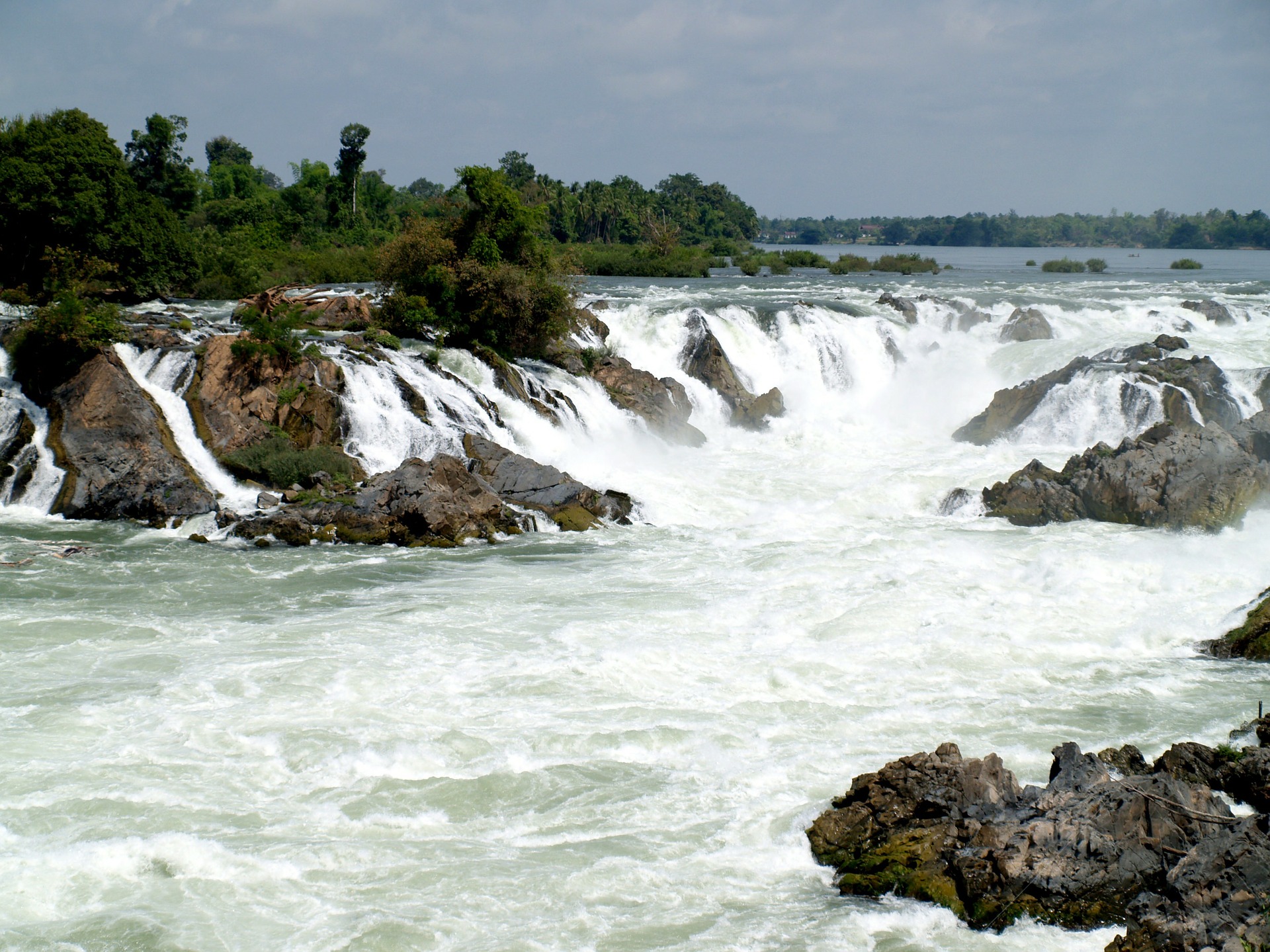
- Si Phan Don (island): The 4,000 islands of the Mekong near Cambodia, with huge waterfalls.
- Bolaven Plateau (area): Highlands of waterfalls, jungle and coffee farms.
- Konglor Cave (site): A famous cave in Phou Hin Boun National Park.
- Ban Nalan Trail (area): A two-day trek with nights in Khmu villages.
- Vieng Xai (site): Karst caves that sheltered a hidden wartime city.
Regions
- Northern Laos: Hill-tribe villages, mountains and the old capital, Luang Prabang.
- Central Laos: The sleepy capital, Vientiane, and rural countryside.
- Southern Laos: The Mekong flatlands, more mountains and the fewest tourists.
Things to do
See
- Temples of Luang Prabang Luang Prabang: Gilded temples and orange-robed monks among wooden and colonial houses.
- Pha That Luang Vientiane: The gilded 16th-century stupa, the national symbol.
- Plain of Jars Plain of Jars: Iron Age stone jars whose purpose is still a mystery.
- Wat Phu Wat Phu: Khmer temple ruins that recall Angkor Wat.
Do
- Herbal sauna: A simple steam bath, often run by temples, open in the evening.
- Trekking and homestays Luang Namtha: Walks in the northern mountains with nights in minority villages.
- Climbing and kayaking Vang Vieng: Limestone karsts for rock climbing; kayaking can be arranged in many places.
- The Bolaven or Thakhek loop Bolaven Plateau: The classic motorbike loops of southern Laos.
Eat
- Laap and sticky rice: The national dish of spicy minced meat, eaten with rice by hand.
Drink
- Lao coffee Bolaven Plateau: High-quality coffee grown on the plateau.
Shop
- Handmade silk Vientiane: Scarves and wall hangings at the Morning Market; beware synthetic fakes.
Itineraries
Vientiane to Luang Prabang in 8 days (8 days)
- Vientiane (2 nights): Temples and Pha That Luang.
- Vang Vieng (2 nights): Caves, karsts and the river; it is on the railway.
- Luang Prabang (3 nights): Temples, the night market and the Mekong.
The mountains of the north in 7 days (7 days)
- Luang Prabang (2 nights): Start in the old capital.
- Nong Khiaw (2 nights): Karst cliffs, kayaking and villages.
- Luang Namtha (1 night): The trekking capital of the north.
- Ban Nalan Trail (1 night): A night in a Khmu village on a two-day trek.
The south and the Mekong in 7 days (7 days)
- Pakse (1 night): The gateway to the south; malaria is present in the southern provinces.
- Bolaven Plateau (2 nights): Waterfalls and coffee farms.
- Wat Phu (1 night): The Khmer temple at Champasak.
- Si Phan Don (2 nights): River life among the 4,000 islands.
Climate and best time to visit
| Jan | Feb | Mar | Apr | May | Jun | Jul | Aug | Sep | Oct | Nov | Dec | |
|---|---|---|---|---|---|---|---|---|---|---|---|---|
| Max °C | 28 | 30 | 33 | 34 | 33 | 32 | 31 | 31 | 31 | 31 | 30 | 28 |
| Min °C | 16 | 19 | 22 | 24 | 25 | 25 | 25 | 25 | 24 | 23 | 19 | 17 |
| Rain mm | 8 | 13 | 34 | 85 | 246 | 280 | 272 | 335 | 297 | 78 | 11 | 3 |
In Vientiane it is warm all year: highs go from about 28 °C in December and January to 34 °C in April, the hottest month. The rains come from May to September, with about 250–335 mm a month, while November to March is almost dry. Wikivoyage describes three seasons: hot from March to May, with temperatures up to 40 °C; wet from May to October, with frequent downpours and occasional Mekong floods; and dry from November to March, cooler, with nights near freezing in the mountains.
November to February, the cooler part of the dry season, is the high season and the best time to visit. Towards its end, the north can be very hazy from field burning. In the rainy season rivers can rise within hours, landslides hit mountain roads, and some provinces become hard to reach.
Getting there and around
| Main airports | VTE, LPQ, PKZ |
|---|
Getting there
By air: Vientiane, Luang Prabang and Pakse have international flights, mostly from Bangkok, China, Vietnam, Seoul, Singapore and Kuala Lumpur. By train: the Laos–China railway runs from Kunming via the Boten border to Vientiane, and since July 2024 an overnight sleeper train runs from Bangkok's Krung Thep Aphiwat station to Khamsavath station in Vientiane. By land: the Friendship Bridge links Nong Khai in Thailand with Vientiane, and other bridges and border posts connect Laos with Thailand, Vietnam, Cambodia and China. A classic route is the two-day slow boat down the Mekong from Huay Xai to Luang Prabang; note that Canada advises against non-essential travel within 10 km of the Thai and Myanmar borders in Bokeo province, where Huay Xai lies.
Getting around
The railway from Vientiane through Vang Vieng and Luang Prabang to the Chinese border is by far the fastest and most comfortable way to travel: about 2 hours from Vientiane to Luang Prabang, against 10 by bus. Demand exceeds supply, tickets go on sale only 3 days ahead (station offices, agencies or the LCR Ticket app), security checks are strict, and you need your ticket to leave the station. An expressway links Vientiane and Vang Vieng in under 1.5 hours by bus; elsewhere buses, minibuses and songthaews are slow, and delays and breakdowns are common. Agree the price of a tuk-tuk first, or use the Loca app; Grab does not operate. Lao Airlines and Lao Skyway fly domestic routes, often cancelled in bad weather.
Speedboats on the Mekong are fast but overloaded and dangerous: insist on a helmet and life jacket. Canada advises against travelling on or across the Mekong after dark. To drive you need a 1949 international driving permit. Roads are poor, many vehicles have no lights, and livestock wander onto the road, so avoid travelling after dark. After an accident you may have to pay compensation even if it was not your fault. Never leave your passport as a deposit when renting a motorbike, and wear a helmet: it is compulsory.
Flying to Laos? PartnerCompare fares and find the cheapest datesSearch flightsWhere to stay
- Guesthouses: The usual choice everywhere.
- Budget and mid-range hotels: Plenty along the Mekong valley tourist route.
- Upmarket hotels: Mainly in Vientiane and Luang Prabang.
- Village homestays: Part of many treks in the north, for example on the Ban Nalan Trail.
Most places to stay are not online: the best way is to find a room on arrival, booking the first night if you are worried. Outside the main tourist spots, choice is limited to basic hotels and guesthouses. Wikivoyage reports that wild camping is not legal. Hotel safes are not always secure, so use your own lock. Sexual relationships between foreigners and Lao nationals are illegal unless they are married under Lao law, and the authorities sometimes demand entry to hotel and guesthouse rooms to check.
Eat and drink
Dishes to try
- Sticky rice (khao niaow): The staple, eaten by hand from small baskets; use your right hand.
- Laap: The national dish: minced meat or fish with herbs, lime and plenty of chilli.
- Tam maak hung: Green papaya salad, Lao-style with fermented crab and strong fish sauce.
- Ping kai and mok pa: Spicy grilled chicken, and fish steamed in a banana leaf.
- Sai oua: Grilled pork sausage with sticky rice and herbs, a classic with beer.
- Khao chi pate: Baguettes filled with pâté, a breakfast favourite.
- Foe: Noodles, thin or wide, a breakfast favourite.
Drinks
- Beerlao: The national beer, made with jasmine rice, now in many styles.
- Lao coffee (kaafeh): High-quality coffee from the Bolaven Plateau; ask for kaafeh thung for the real thing.
- Lao-lao: Cheap rice spirit; drink only commercially made spirit from sealed bottles.
- Coconut juice: Fresh and everywhere.
Lao food is spicy, often more bitter than sweet, and full of fresh herbs and raw vegetables. Vientiane and Luang Prabang also have many Western and French-style restaurants and bakeries. Bars close by 23:00, and nightlife is limited outside Vientiane and Vang Vieng.
Methanol in spirits has killed tourists in Laos, including six in Vang Vieng in 2024: avoid homemade spirits and opened bottles in bars. The authorities have banned Tiger Vodka and Tiger Whisky. Never leave food or drinks unattended, and beware of 'happy' dishes, which may contain drugs.
Entry requirements and visas
| Passport validity | At least 6 months from arrival, with 2 blank pages (FCDO); Canada says at least 6 months beyond the date you leave |
|---|
| Passport | Entry | Max stay | Notes |
|---|---|---|---|
| United Kingdom | Visa on arrival | 30 days | A 30-day tourist visa on arrival at the main airports and many border posts, or an e-visa applied for at least 5 days ahead. |
| Canada | Visa on arrival | 30 days | Tourist visa required: e-visa, or visa on arrival at the main airports and some border crossings. |
Other nationalities: check the official source below.
Most visitors need a visa, available on arrival at the airports of Vientiane, Luang Prabang and Pakse and at many land borders, or as an e-visa in advance. Bring US dollars (about US$40 in 2025) and a passport photo; paying in kip costs more. A tourist visa lasts 30 days and can be extended twice. All visitors must also fill in the Lao Digital Immigration Form online within 3 days before arrival and before departure.
Immigration offices can be hard to find at some land crossings: make sure you get an entry stamp, or you risk fines, detention and deportation. Overstaying is expensive. E-cigarettes and vapes are illegal. Rules depend on your passport: check the official link before you book.
Money and payments
| Currency | Laotian Kip (LAK) |
|---|---|
| Cards | Limited |
Laos uses the kip (₭, LAK), which is hard to exchange outside the country: change leftovers before leaving. US dollars are used for bigger payments, and Thai baht near the Mekong. ATMs are found in the main towns, with fees and low limits (BCEL: 2,000,000 kip, fee 30,000 kip, as of January 2025 according to Wikivoyage); in remote areas there are none and only kip is accepted, so always carry cash. Use ATMs with someone else around, and keep cards and cash in separate bags.
The US dollar gets the best exchange rate; bring clean, unmarked notes from 2009 or later. QR payment apps such as Ezykip work even at night-market stalls. Wikivoyage, read in October 2026, suggests a budget of about US$40 a day, and much less is possible. Many shops close for lunch, and some on Sundays.
Health
| Recommended vaccines | Routine vaccines, including measles (MMR), Polio: a single adult booster, Hepatitis A, Hepatitis B, Typhoid, Japanese encephalitis, for stays of a month or more or rural trips with hiking and camping, Rabies: consider it for outdoor activities, Mpox, for travellers at risk of sexual exposure |
|---|---|
| Malaria | Some areas |
| Tap water | Not safe |
Malaria: the CDC recommends preventive medicine for the southern provinces of Attapeu, Champasak, Khammouane, Salavan, Savannakhet and Sekong; cases are rare in the north and there are none in Vientiane or Luang Prabang. Dengue rises in the rainy season: use strong repellent and sleep under a net. Anthrax has been found in cattle and buffalo near Si Phan Don, Pakse and the Bolaven Plateau: avoid the animals and eat meat well cooked. Rabid dogs are common. Haze and air pollution can be a problem.
Tap water is not drinkable anywhere; bottled water is cheap. Medical care is basic, and outside Vientiane there are no reliable emergency facilities: serious cases usually go to Thailand, so get insurance that covers evacuation. You may have to pay in advance. Ambulance 1195.
This is general information, not medical advice: check with a travel health professional before you go.
Safety
- United States: Level 2: Exercise Increased Caution (2026-10-20)
- Canada: Exercise a high degree of caution (2026-10-20)
- United Kingdom: Advises against all but essential travel to parts of the country (2026-10-20)
The FCDO advises against all but essential travel to Xaisomboun Province, and Canada advises against non-essential travel there and within 10 km of the borders with Thailand and Myanmar in Bokeo province, including the Golden Triangle Special Economic Zone, because of armed groups and crime. Elsewhere the US advises increased caution and Canada a high degree of caution. Bag snatching by people on motorbikes is common: carry bags on the side away from the road. Food and drinks have been spiked, and methanol in spirits has killed tourists. Do not expect much help from the police; ask your accommodation, or call the Vientiane tourist police on 021 251 128.
Unexploded bombs still kill people every year throughout the country, especially around the Plain of Jars, in Xiengkhouang province and near the border with Vietnam: keep to paved roads and well-used paths and never touch metal objects. Drug laws are extremely harsh, with the death penalty for trafficking, and police raid venues used by foreigners. Carry ID at all times. Sexual relations between foreigners and Lao nationals are illegal unless married under Lao law. Tubing, kayaking and boat trips on the Mekong have caused drownings: check that life jackets are provided. From May to October, floods and landslides can cut off roads. Land crossings between Thailand and Cambodia are suspended after fighting along their border: from southern Laos, choose your onward border crossing carefully.
Customs and etiquette
Laos is a deeply Buddhist country. Cover shoulders and knees in temples, and take off your shoes before entering temples and homes. Do not touch anyone on the head or point your feet at people. Monks are highly respected: women must not touch them or hand them things directly, never offer them money, offer your seat on transport, and ask before taking a photo. Do not walk around town in swimwear after a swim.
Photographing military sites, government buildings, bridges, airfields or military personnel is prohibited, and you may be arrested and have your equipment seized. Religious proselytising and nudity in public or at religious sites are also illegal.
Things move slowly; losing your temper only makes everyone lose face. Public drunkenness is frowned upon. Swastikas at temples are an ancient Buddhist symbol. Shops give a plastic bag with everything: say bor torn nyang to refuse it.
Language
| Official languages | Lao |
|---|---|
| English | Limited |
| Hello | ສະບາຍດີ (Sabaidee) sa-bai-dee |
|---|---|
| Please | ກະລຸນາ (Kalunaa) kaw-lu-naa |
| Thank you | ຂອບໃຈ (Khop jai) khawp jai |
| Excuse me / sorry | Khǎw thôht |
| Goodbye and take care | Sôhk dee deuh |
| Do you speak English? | Jâo wâo pháa-sǎa ung-kit dai baw? |
What to pack
- Clean US dollar notes from 2009 or later: For the visa on arrival and the best exchange rates.
- Passport photo: Needed for the visa on arrival.
- Insect repellent with DEET: Dengue, and malaria in the south.
- Clothes that cover shoulders and knees: Required in temples.
- A helmet, if you plan to ride: Rental shops may not supply one.
- Offline maps (OpenStreetMap): Google Maps misses many roads in Laos.
Quick reference
Country facts
| Capital | Vientiane |
|---|---|
| Population | 7,873,046 (2025) |
| Area | 230,800 km² |
| Time zone | Asia/Vientiane (UTC+7) |
| Calling code | +856 |
| Driving side | right |
Staying connected
| SIM and eSIM | Prepaid SIMs from Unitel, TPlus, Lao Telecom or ETL are sold in shops, including at Vientiane airport, without paperwork; ETL has better rural coverage. Near the Thai border, including much of Vientiane, Thai networks also work. The country code is +856. |
|---|---|
| Wi-Fi | Free Wi-Fi is offered by most cafés and almost all accommodation, even budget places. |
Emergency numbers
| Police | 1191 |
|---|---|
| Ambulance | 1195 or 030 525 7239 |
| Fire | 1190 |
| Tourist police | 021 251 128 (Vientiane) |
Frequently asked questions
Do I need a visa for Laos?
Most visitors do, but it is easy: a 30-day visa on arrival at the main airports and many borders, or an e-visa. You must also fill in the online immigration form. Check the official link before you book.
Is there malaria in Laos?
In the southern provinces, where the CDC recommends preventive medicine; not in Vientiane or Luang Prabang.
How do I get train tickets?
Through an agency, at a station office or with the LCR Ticket app; sales open 3 days ahead and trains often sell out.
Can I drink the tap water?
No, nowhere in Laos. Bottled water is cheap.
Is it safe to walk in the countryside?
Keep to paved roads and well-used paths: unexploded bombs remain throughout the country, especially around the Plain of Jars and near the border with Vietnam.
Does Grab work in Laos?
No. Use Loca, or agree the price of a tuk-tuk before you get in.
More Travel Stories from Laos

 Laos
Sources This guide was last checked on · 18 sources
- Wikivoyage: Laos · Overview, Places to visit, Things to do, Itineraries, Climate and best time to visit, Getting there and around, Where to stay, Eat and drink, Entry requirements and visas, Money and payments, Health, Safety, Customs and etiquette, Language, What to pack, Staying connected, Frequently asked questions
- Wikidata: Laos · Overview, Places to visit, Money and payments, Country facts
- Government of Canada: Laos travel advice (updated 15 October 2026) · Places to visit, Getting there and around, Entry requirements and visas, Health, Safety, Customs and etiquette, Frequently asked questions
- WMO World Weather Information Service: Vientiane · Climate and best time to visit
- UK FCDO: Laos safety and security · Climate and best time to visit, Getting there and around, Where to stay, Eat and drink, Money and payments, Safety, Customs and etiquette, What to pack
- UK FCDO: Laos entry requirements · Entry requirements and visas, Frequently asked questions
- ISO 4217 (SIX), published 2026-09-17 · Money and payments
- CDC Travelers' Health: Laos · Health, Frequently asked questions
- UK FCDO: Laos health · Health, What to pack
- US Department of State: Laos travel advisory · Safety
- UK FCDO: Laos travel advice · Safety
- UK FCDO: Laos regional risks · Safety
- UK FCDO: Laos warnings and insurance · Safety
- Wikivoyage: Lao phrasebook · Language
- World Bank, SP.POP.TOTL · Country facts
- World Bank, AG.LND.TOTL.K2 · Country facts
- IANA Time Zone Database, zone.tab · Country facts
- UK FCDO: Laos getting help · Emergency numbers
Suggest an update
Travel rules, prices and timetables change. If something in this guide is out of date, tell us: we check every suggestion against an official source before changing the page.