


- Local time
- 09:37
- Currency
- Cambodian Riel (KHR)
- Capital
- Phnom Penh
- Calling code
- +855
- Drive on the
- right
Overview
Cambodia is home to the temples of Angkor, the Royal Palace and the sobering memorials of Phnom Penh, Mekong river towns and islands off the south coast. Best from November to March.
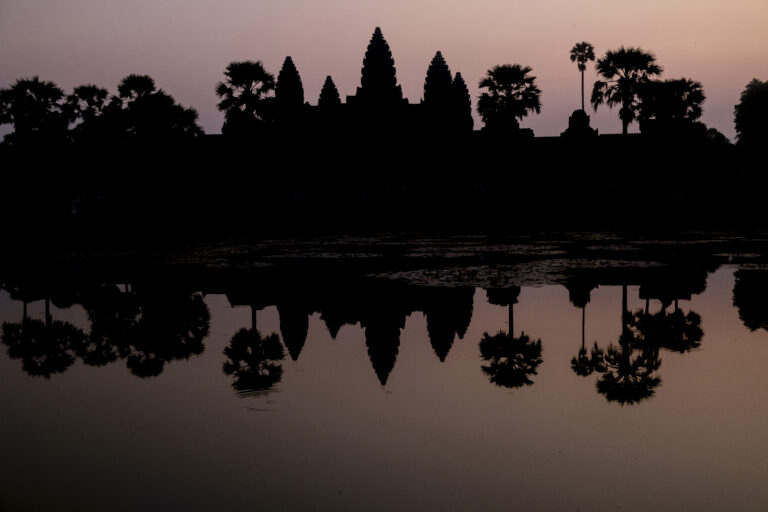
Cambodia's great draw is Angkor, the vast temple complex of the Khmer Empire near Siem Reap, where the ruins of Ta Prohm are wrapped in the roots of giant trees. The capital, Phnom Penh, combines the Royal Palace with the memorials of the 1970s genocide at Choeung Ek and Tuol Sleng, hard but important visits. Along the Mekong, quiet towns such as Kratie are a place to see rare river dolphins, and the Tonle Sap lake has floating villages.
In the south, Kampot, the capital of Cambodian pepper, sits below Bokor National Park, and the islands of Koh Rong are the most popular place for beach time. The country is mostly Theravada Buddhist and still one of the poorer countries in Asia, yet travel is not always cheap. The land border with Thailand has been closed since fighting in 2025, and the UK and Canada advise against travel near it.
- Angkor: The temples of the Khmer Empire, from Angkor Wat to the tree-covered Ta Prohm.
- Phnom Penh: The Royal Palace and the genocide memorials of Choeung Ek and Tuol Sleng.
- Kratie: A relaxed Mekong town, known for its endangered river dolphins.
- Tonle Sap: South-East Asia's largest lake, with floating villages and a bird sanctuary.
- Kampot and Kep: Pepper farms, Bokor National Park and an old seaside resort.
- Koh Rong: The islands off Sihanoukville, the country's favourite beaches.
Places to visit
- City
- Town
- Coast
- Park
- Historic site
- Area
Cities
- Phnom Penh: The capital, with the Royal Palace and the memorials of the Khmer Rouge period.
- Siem Reap: The base for Angkor and other sights of the north.
- Battambang: The second biggest town, known for its bamboo trains. Canada reports landmines in rural Battambang province: stay on main roads.
- Kampot: A riverside town, gateway to Bokor National Park and capital of Cambodian pepper.
- Kratie: A relaxed Mekong town, one of the best places to see river dolphins.
- Kampong Thom: Access to less visited ancient temples.
- Banlung: A far north-eastern town near waterfalls and national parks.
- Sihanoukville: The seaside city of the south and the port for the islands.
Beyond the cities
- Angkor Archaeological Park (site): The great ruins of the Khmer civilisation, near Siem Reap.
- Koh Ker (site): More ancient ruins, 120 km north of Angkor. Landmines remain in rural areas, including around temple complexes: stay on main paths.
- Tonle Sap (area): South-East Asia's largest lake, with floating villages and a major bird sanctuary.
- Bokor National Park (park): A former French hill resort above Kampot, good for hiking.
- Kep (coast): The country's first beach resort, now being rediscovered.
- Kampong Cham (town): A Mekong river town in the countryside.
- Koh Rong and Koh Rong Sanloem (island): Islands off Sihanoukville, the most popular place in Cambodia for beach time.
Regions
- North-western Cambodia: Siem Reap, Angkor, Battambang and the Tonle Sap.
- Mekong Lowlands and Central Plains: Phnom Penh, Kampong Cham and the heart of the country.
- Cardamom and Elephant Mountains: The south-west: Kampot, Kep, Sihanoukville and the islands.
- Eastern Cambodia: Kratie, Banlung and the remote north-east.
Things to do
See
- The temples of Angkor Angkor Archaeological Park: Start early to beat the crowds at Ta Prohm; cover shoulders and knees, as the dress code is enforced.
- Choeung Ek and Tuol Sleng Phnom Penh: The Killing Fields and the genocide museum: shocking, sad and essential to understand the country.
- The Royal Palace Phnom Penh: The beautiful palace in the heart of the capital.
- River dolphins Kratie: A boat trip to see the endangered dolphins of the Mekong.
Do
- Floating villages Tonle Sap: A boat trip from Siem Reap, with lunch on a floating restaurant.
- Hiking in Bokor Bokor National Park: Walks around the old French hill station above Kampot.
- Beaches Koh Rong: The islands of the south-west; medical help there is limited.
- Meditation courses: Ten-day Vipassana courses at several centres in the country.
Eat
- Amok: A steamed curry in banana leaves, one of the national dishes.
Drink
- Iced coffee: Strong coffee with sweetened condensed milk, drunk all day.
Itineraries
Angkor and Phnom Penh in 7 days (7 days)
- Siem Reap (4 nights): Three days in the temples, and a boat to the Tonle Sap.
- Phnom Penh (3 nights): By bus or plane: the Royal Palace and the memorials.
The south coast in 7 days (7 days)
- Phnom Penh (1 night): Start in the capital.
- Kampot (2 nights): Pepper farms and Bokor National Park.
- Kep (1 night): The old seaside resort.
- Koh Rong and Koh Rong Sanloem (3 nights): By boat from Sihanoukville.
Up the Mekong in 6 days (6 days)
- Phnom Penh (1 night): Start in the capital.
- Kampong Cham (1 night): Countryside on the river.
- Kratie (2 nights): The river dolphins.
- Banlung (2 nights): Waterfalls and the far north-east.
Climate and best time to visit
| Jan | Feb | Mar | Apr | May | Jun | Jul | Aug | Sep | Oct | Nov | Dec | |
|---|---|---|---|---|---|---|---|---|---|---|---|---|
| Max °C | 31 | 33 | 35 | 35 | 34 | 33 | 32 | 32 | 32 | 31 | 30 | 30 |
| Min °C | 22 | 23 | 24 | 25 | 25 | 25 | 25 | 25 | 24 | 24 | 23 | 21 |
| Rain mm | 20 | 3 | 63 | 54 | 117 | 138 | 149 | 153 | 253 | 242 | 94 | 29 |
Cambodia is tropical, with a dry season and a wet season. In Phnom Penh the average maximum stays above 30 °C all year and peaks at about 35 °C in March and April; Wikivoyage notes that temperatures can reach 40 °C before the rains. From May to October rain is heavy, with about 250 mm in September and in October, while December to February are almost dry.
November to March is cooler, windier and the most popular time to visit. April and May are the hottest months, and June to September is green and wet; take extra care on rivers in the rainy season, when currents are strong.
Holidays and events
- 1 January 2026 · New Year's Day
- 7 January 2026 · Victory over Genocide Day
- 8 March 2026 · International Women's Day
- 14 April 2026 · Khmer New Year
- 15 April 2026 · Khmer New Year
- 16 April 2026 · Khmer New Year
- 1 May 2026 · Labour Day
- 5 May 2026 · Royal Ploughing Ceremony
- 14 May 2026 · King Sihamoni's Birthday
- 18 June 2026 · Queen Mother's Birthday
- 24 September 2026 · Constitution Day
- 10 October 2026 · Pchum Ben
- 11 October 2026 · Pchum Ben
- 12 October 2026 · Pchum Ben
- 15 October 2026 · Commemoration Day of the King's Father
- 29 October 2026 · Coronation Day of King Sihamoni
- 9 November 2026 · National Independence Day
- 23 November 2026 · Water Festival
- 24 November 2026 · Water Festival
- 25 November 2026 · Water Festival
- 29 December 2026 · Cambodia Peace Day
Getting there and around
| Main airports | KTI, SAI, KOS |
|---|
Getting there
By air: Cambodia has international airports at Phnom Penh (Techo International), Siem Reap and Sihanoukville, with flights from cities across East and South-East Asia. Siem Reap is the best arrival point for Angkor, Phnom Penh for the south and the rest of the country.
By land: the land borders with Thailand are closed (October 2026), after fighting along the border in 2025. From Vietnam, fast boats run daily from Chau Doc up the Mekong to Phnom Penh in about 5 hours, and buses link Ho Chi Minh City with Phnom Penh. There is also a crossing from Laos.
Getting around
Buses cover most routes; Giant Ibis and Mekong Express have the best reputation for comfort and safety, but bus safety is a serious problem in general. Air Cambodia and other airlines fly between Phnom Penh, Siem Reap and Sihanoukville. In towns, take tuk-tuks: agree the fare first, or use the apps Grab (card payment possible) or PassApp (cash). Trains run from Phnom Penh to Battambang and to Sihanoukville via Kampot and Kep.
Motorbikes can be rented in many towns, but not in Siem Reap. Canada says you must have and carry a Cambodian driving licence, and helmets are compulsory on motorbikes. The FCDO says that to hire a car or a motorbike over 125 cc you may need a 1949 international driving permit with your home licence, and a Cambodian licence for long-term rental or a private car. Never leave your passport as a deposit, and avoid road travel after dark, when accidents are more likely. Landmines remain a risk in rural areas, so stay on main roads and paths.
Flying to Cambodia? PartnerCompare fares and find the cheapest datesSearch flightsWhere to stay
- Guesthouses: Basic guesthouses everywhere, even in less visited towns, and very cheap in the countryside.
- Hotels: Western-style hotels in most major towns.
Prices quoted in US dollars are aimed at tourists; places that quote in riel are usually cheaper. On the islands, help in an emergency is far away, so choose carefully.
Eat and drink
Dishes to try
- Amok: A steamed curry, traditionally with fish, served in a banana leaf or a coconut.
- Kuytheav: Noodle soup with pork, beef or seafood, eaten at breakfast.
- Bai sach chrouk: Rice with grilled pork and pickled vegetables, another breakfast favourite.
- Samlor machou: A sweet and sour soup with pineapple, tomatoes and fish.
- Prahok: A fermented fish paste used in many dishes; an acquired taste.
Drinks
- Iced coffee: Vietnamese-style, with sweetened condensed milk.
- Iced lemon tea: Sweet and refreshing.
- Coconut and sugarcane juice: Fresh coconut is a safe choice everywhere.
Khmer food is tasty and cheap, based on rice and sometimes noodles. It is less spicy than Thai food, with black pepper preferred to chilli, and Cambodians love sour flavours. Western food is easy to find in tourist areas but costs about twice as much. Be careful with ice and with raw vegetables washed in untreated water. Methanol in black-market alcohol has caused deaths, and drinks have been spiked in some bars: do not leave your drink unattended.
Entry requirements and visas
| Passport validity | At least 6 months from the date you arrive, undamaged and with no missing pages |
|---|
| Passport | Entry | Max stay | Notes |
|---|---|---|---|
| United Kingdom | Evisa | 30 days | Apply for the e-visa at least 4 days ahead, or get a visa on arrival at airports and land borders, paid in US dollars. |
| Canada | Evisa | 30 days | Single-entry tourist e-visa online, or a visa on arrival at international airports and major land borders. |
Other nationalities: check the official source below.
Tourists need a visa valid for 30 days from entry. The simplest option is the official e-visa; Wikivoyage reports a fee of USD 30 (December 2025) and warns about fake e-visa websites, and that an e-visa avoids extra charges asked at some land borders. A visa on arrival is also available. Keep your passport stamp and departure form, and the visa sticker with you. If you fly into Phnom Penh, Siem Reap or Sihanoukville, fill in the free online e-Arrival Card within 7 days before arrival.
Overstaying is fined with no upper limit and can lead to detention and deportation. You need a yellow fever certificate if you arrive from a country with yellow fever risk. Rules depend on your passport: check the official link before you book.
Money and payments
| Currency | Cambodian Riel (KHR) |
|---|---|
| Cards | Limited |
Cambodia uses two currencies: the riel (KHR) and the US dollar, which is accepted almost everywhere and comes out of most ATMs. Wikivoyage advises paying everyday purchases in riel: US-dollar prices are often rounded at a poor rate, change for large notes is hard to find, and torn or worn dollar bills are refused. Fake dollar bills have been given as change, so check what you receive.
ATMs are common in Phnom Penh, Siem Reap and Sihanoukville but fewer in smaller towns, and most charge a fee for each withdrawal; stock up before going to rural areas. Cards are accepted only in upmarket places, usually with a surcharge of about 3%.
Costs and budget
- Tourist e-visa (December 2025): USD 30
- Tourist SIM, 30 GB for 2 weeks: about USD 5
- Minimum daily budget for a backpacker, as listed on Wikivoyage in October 2026: about USD 15
Cambodia is generally more expensive than Thailand, Vietnam and Laos: Wikivoyage estimates about 50% more than Vietnam per day, mostly because of food. Anything priced in US dollars is aimed at tourists. Away from the main tourist areas, and with some haggling, prices fall considerably.
Health
| Required vaccines | Yellow fever: certificate if you arrive from a country with transmission risk |
|---|---|
| Recommended vaccines | Routine vaccines, including measles (MMR), Hepatitis A, Hepatitis B, Typhoid, Japanese encephalitis, for long stays or rural trips, Rabies: ask a travel clinic, Mpox, for travellers at risk of sexual exposure |
| Malaria | Some areas |
| Tap water | Not safe |
Malaria is present in pockets of rural and forested areas, with little or none in Phnom Penh, Siem Reap and the main temple complex at Angkor Wat. Dengue, chikungunya and Zika are spread by mosquitoes, and schistosomiasis is a risk in fresh water. Check vaccines and antimalarials with a travel health professional at least 6 to 8 weeks before you go.
Reliable medical care is scarce, especially outside the cities; serious cases are usually treated in Bangkok, Ho Chi Minh City or Singapore, so get insurance that covers evacuation. Call 119 for an ambulance. Do not drink tap water, and be wary of ice and raw vegetables. On the islands, emergency help may be very limited or absent.
This is general information, not medical advice: check with a travel health professional before you go.
Safety
- United States: Level 2: Exercise Increased Caution (2026-10-20)
- Canada: Exercise a high degree of caution (2026-10-20)
- United Kingdom: Advises against all but essential travel to parts of the country (2026-10-20)
The UK advises against all but essential travel within 20 km of the land border with Thailand, and Canada against all travel within 50 km of it, after heavy fighting in 2025; a ceasefire was signed on 27 December 2025, but the border crossings are closed and temples there, including Preah Vihear, are shut. Landmines and unexploded weapons remain across the country and are often unmarked: never stray off main routes in rural areas, including around temples.
The most common crime is bag and phone snatching by thieves on motorbikes, often causing injuries, especially along the riverfront and in BKK in Phnom Penh, and in Sihanoukville; carry bags on the side away from the road. Women have been sexually assaulted in Siem Reap and Sihanoukville, including by men posing as motorbike taxi drivers. Drug laws are strict, with zero tolerance. Be wary of job offers promising easy money: criminal groups traffic victims into scam compounds. Avoid protests.
Customs and etiquette
At Angkor Wat and other religious sites you can be refused entry in shorts or skirts above the knee; cover your shoulders too. Outside Phnom Penh and Siem Reap, knee-length shorts or trousers are more respectful, and beachwear is conservative. Always ask before photographing people, especially monks, and never photograph military sites or airports. A permit is needed to buy, own or export cultural or archaeological artefacts.
Monks are revered. Women should not touch them: to give food, place it on a cloth in front of the monk. Do not hand money to monks, but put donations in the temple boxes; monks asking tourists for money are impostors. Give and receive things with the right hand. The Khmer Rouge period is a painful subject: raise it only politely, if at all.
Language
| Official languages | Khmer |
|---|---|
| English | Limited |
What to pack
- Clothes that cover shoulders and knees: Required at Angkor Wat and other religious sites.
- Insect repellent: Malaria, dengue and Zika are spread by mosquitoes.
- A bag you can wear across the body: Bag snatching from passing motorbikes is common.
- Small, clean US dollar notes: Torn or worn notes are refused, and change for large ones is hard to find.
- Printed e-visa: Keep the visa with your passport for entry and exit.
- Dust mask: Useful on longer tuk-tuk rides through dust and traffic fumes.
Quick reference
Country facts
| Capital | Phnom Penh |
|---|---|
| Population | 17,847,982 (2025) |
| Area | 176,520 km² |
| Time zone | Asia/Phnom_Penh (UTC+7) |
| Calling code | +855 |
| Driving side | right |
Staying connected
| SIM and eSIM | Cellcard is the largest network, then Smart and Metfone. Prepaid SIMs need a passport and are sold at Siem Reap airport; in 2025 packages started at about USD 5 for 30 GB for two weeks. Mobile prices are in US dollars. |
|---|---|
| Wi-Fi | Good in the main cities and towns; many islands and remote areas have poor coverage. |
Useful apps
- Grab: Tuk-tuks and taxis, card payment possible
- PassApp: Tuk-tuks and taxis in more cities, cash only
Emergency numbers
| Police | 117 |
|---|---|
| Ambulance | 119 |
| Fire | 118 |
Frequently asked questions
Do I need a visa for Cambodia?
Yes. A 30-day tourist visa is available online as an e-visa or on arrival. Check the official link before you book.
Can I travel overland from Thailand to Cambodia?
Not at the moment: the land borders with Thailand are closed (October 2026). Fly in, or come from Vietnam or Laos.
Should I pay in US dollars or riel?
Both are used. Dollars are accepted almost everywhere, but paying small amounts in riel often works out cheaper and avoids problems with worn notes.
What should I wear to visit Angkor Wat?
Clothes that cover your shoulders and knees: you can be refused entry in shorts or short skirts.
Can I drink the tap water in Cambodia?
It is generally not safe: drink bottled water and be careful with ice.
When is the best time to visit Cambodia?
November to March, the cooler dry season. April and May are very hot, and the rains run from May to October, heaviest in September and October.
More Travel Stories from Cambodia
 Cambodia
Sources This guide was last checked on · 17 sources
- Wikivoyage: Cambodia · Overview, Places to visit, Things to do, Itineraries, Climate and best time to visit, Getting there and around, Where to stay, Eat and drink, Entry requirements and visas, Money and payments, Costs and budget, Health, Safety, Customs and etiquette, Language, What to pack, Staying connected, Frequently asked questions
- Wikidata: Cambodia · Overview, Places to visit, Money and payments, Country facts
- UK FCDO: Cambodia warnings and insurance (updated 19 March 2026) · Overview, Getting there and around, Safety, Frequently asked questions
- Government of Canada: Cambodia travel advice (updated 14 October 2026) · Places to visit, Getting there and around, Entry requirements and visas, Money and payments, Health, Safety, Customs and etiquette, Frequently asked questions
- UK FCDO: Cambodia safety and security · Places to visit, Things to do, Climate and best time to visit, Getting there and around, Eat and drink, Money and payments, Safety, Customs and etiquette, What to pack, Staying connected
- WMO World Weather Information Service: Phnom Penh - Pochentong · Climate and best time to visit, Frequently asked questions
- Nager.Date: public holidays in Cambodia, 2026 · Holidays and events
- UK FCDO: Cambodia entry requirements · Entry requirements and visas, Health, Frequently asked questions
- ISO 4217 (SIX), published 2026-09-17 · Money and payments
- UK FCDO: Cambodia health · Health
- US CDC: Travelers' health, Cambodia · Health
- US Department of State: Cambodia travel advisory · Safety
- UK FCDO: Cambodia travel advice · Safety
- World Bank, SP.POP.TOTL · Country facts
- World Bank, AG.LND.TOTL.K2 · Country facts
- IANA Time Zone Database, zone.tab · Country facts
- UK FCDO: Cambodia getting help · Emergency numbers
Suggest an update
Travel rules, prices and timetables change. If something in this guide is out of date, tell us: we check every suggestion against an official source before changing the page.