


- Local time
- 19:24
- Currency
- Vietnamese Dong (VND)
- Capital
- Hanoi
- Calling code
- +84
- Drive on the
- right
Overview
Hanoi's Old Quarter, the limestone islands of Ha Long Bay, imperial Hue, old Hoi An and the Mekong Delta, in a country where food comes first.
Vietnam is a long country of about 100 million people, stretched between the Chinese border and the Mekong Delta, and food sits at the centre of its culture: cooks in the north keep flavours subtle, the centre likes them spicy and the south sweet. Hanoi, the capital, has the Old Quarter and Hoan Kiem Lake; Ho Chi Minh City, the former Saigon, is the largest city, with pagodas at the foot of skyscrapers. In between lie Hue, where the Nguyễn emperors ruled from 1802 to 1945, and Hoi An, an old trading port with canals and a preserved centre, close to the ruins of My Son.
The landscapes are the other reason to come: the limestone pillars of Ha Long Bay and Ninh Binh, the caves of Phong Nha, rice terraces around Sa Pa in the hills of the north, and the rivers and floating markets of the Mekong Delta. Tourism is less developed than in Thailand, traffic is dense and full of motorbikes, and overcharging foreigners is common, so learn the usual prices. UK citizens can stay 45 days without a visa, while many other visitors need an e-visa. Unexploded landmines remain in former battlefields, especially in central Vietnam and along the Laos border, and tropical storms hit the coast between May and November.
- Hanoi: The capital, with the Old Quarter, Hoan Kiem Lake and the Temple of Literature.
- Ha Long Bay: Thousands of limestone islands and pillars covered in jungle, seen on one- to three-day boat trips.
- Hue: The former imperial capital, with its Citadel and the emperors' tombs along the Perfume River.
- Hoi An and My Son: An old port town protected by preservation laws, and the temple ruins of My Son nearby.
- Ho Chi Minh City: The largest city, with the Reunification Palace, the War Remnants Museum and the Cu Chi tunnels outside town.
- The Mekong Delta: The rice basket of the country, where life moves by boat and markets float on the river.
Places to visit
- City
- Town
- Coast
- Island
- Park
- Historic site
- Area
Cities
- Hanoi: The capital, historic and full of cultural sites, with most sights in the Old Quarter.
- Ho Chi Minh City: The largest and most cosmopolitan city, still often called Saigon, its name in colonial times and as capital of South Vietnam.
- Da Nang: The largest city of central Vietnam, with an international airport close to Hue, Hoi An and My Son.
- Da Lat: A hill station built by the French in the Central Highlands, and the centre of Vietnamese wine.
- Haiphong: The big port of the north, known as the port city.
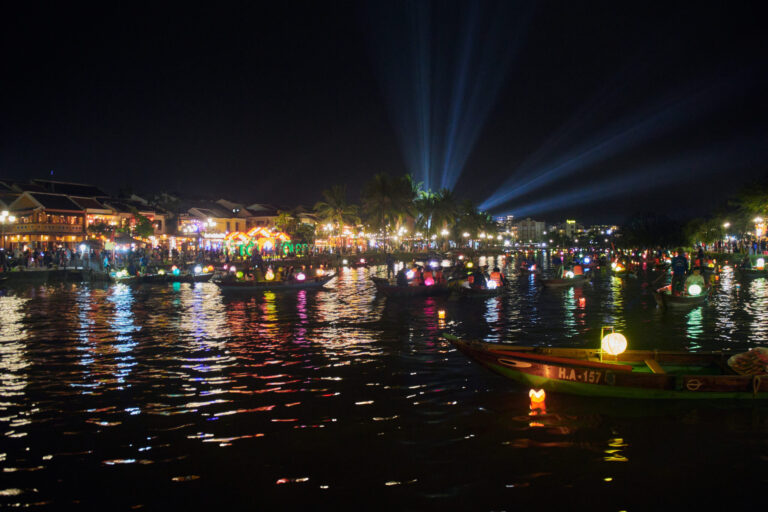
- Hoi An: A well-preserved former trading port with canals and narrow lanes, near the ruins of My Son.
- Hue: The city of the last emperors, with the Citadel and royal tombs on the Perfume River.
- Nha Trang: The largest beach city, spread along the sea, with boat trips to nearby islands.
- Vinh: The main city of the north-central coast, close to Cua Lo Beach.
Beyond the cities
- Ha Long Bay (coast): Thousands of limestone islands in the sea, with floating fishing villages and caves; a UNESCO World Heritage Site.
- Ninh Binh (area): Karst scenery like Ha Long Bay but along rivers, with rice fields and caves around Tam Coc, best seen by boat.
- Sa Pa (town): A hill town near the Chinese border, base for walks through rice terraces and villages of indigenous peoples.
- Cuc Phuong National Park (park): A forest park with rare wildlife, home to the Muong people.
- Phong Nha-Ke Bang National Park (park): A UNESCO-listed cave system with underground rivers and cave beaches.
- The DMZ (site): The former demilitarised zone between North and South, with remains of military bases, mountains and jungle.
- My Son (site): The ruins of Cham Hindu temples near Hoi An, a World Heritage Site.
- Cu Chi tunnels (site): The network of tunnels used during the war, north-west of Ho Chi Minh City.
- Mekong Delta (area): A maze of river branches and rice fields that produces half of the country's farm output, with floating markets.
- Phu Quoc (island): The largest island, off the coast of Cambodia, known for beaches, fish sauce and seafood.
- Con Dao (island): A group of islands off the Mekong Delta, with their own airport.
Regions
- Northern Vietnam: Where Vietnamese civilisation began: Hanoi, mountain scenery and the hill peoples of the north.
- Central Coast: Hue, the seat of the emperors from 1802 to 1945, and the old port of Hoi An.
- Central Highlands: Forested hills, indigenous peoples and the occasional elephant.
- Southern Vietnam: The economic heart around Ho Chi Minh City, and the little-visited Mekong Delta.
Things to do
See
- Old Quarter and Hoan Kiem Lake Hanoi: Most of Hanoi's sights are here, including Bach Ma Temple; the Temple of Literature and the Vietnam Museum of Ethnology are elsewhere in the city.
- The Citadel and the imperial tombs Hue: Small family boats take you up the Perfume River to the tombs south-west of the city, about 4 hours each way.
- Hoi An old town and My Son Hoi An: Walk the lanes and canals of the old port, then visit the Cham temple ruins of My Son nearby.
- Floating markets Mekong Delta: Life here follows the water: take a morning boat tour to a floating market from one of the delta towns.
- War history Ho Chi Minh City: The Reunification Palace, the War Remnants Museum with its war photography and English labels, and the Cu Chi tunnels outside the city.
Do
- A boat trip on Ha Long Bay Ha Long Bay: One- to three-day trips among the limestone islands; most boats visit the same spots, so pick a clear day, and check the boat's registration and life jackets. Lan Ha Bay next door is less busy.
- The caves of Phong Nha Phong Nha-Ke Bang National Park: A UNESCO-listed cave system with underground rivers, stalactites and stalagmites.
- Trekking among rice terraces Sa Pa: Walk the Muong Hoa valley among rice fields and bamboo forest; go with a reputable guide, as in some areas it is illegal to trek without one.
Eat
- Street food: Phở, bánh mì and rice plates at stalls with plastic stools on the pavement, where the most authentic food is; choose places busy with locals.
Drink
- Vietnamese coffee Hanoi and across the country: Iced coffee with condensed milk (cà phê sữa đá) on many street corners, and egg coffee, a speciality of Hanoi.
Itineraries
Hanoi and the north in 8 days (8 days)
- Hanoi (3 nights): The Old Quarter, Hoan Kiem Lake and the Temple of Literature.
- Ha Long Bay (1 night): A boat trip among the islands; check the boat's safety record first.
- Ninh Binh (1 night): Karst, rice fields and caves by boat around Tam Coc.
- Sa Pa (3 nights): Overnight train from Hanoi to Lao Cai, then a bus; walks in the rice terraces.
Central Vietnam in 7 days (7 days)
- Phong Nha-Ke Bang National Park (2 nights): The caves and underground rivers.
- The DMZ (0 nights): On the way south; go with a guide and stay on marked paths, as unexploded weapons remain.
- Hue (2 nights): The Citadel and a boat to the imperial tombs.
- Hoi An (3 nights): The old town and a day trip to My Son; fly home from Da Nang.
Ho Chi Minh City, the Mekong Delta and Phu Quoc in 8 days (8 days)
- Ho Chi Minh City (3 nights): The Reunification Palace, the War Remnants Museum and the Cu Chi tunnels.
- Mekong Delta (2 nights): Boat trips and a floating market in the morning.
- Phu Quoc (3 nights): Beaches and seafood on the largest island.
Climate and best time to visit
| Jan | Feb | Mar | Apr | May | Jun | Jul | Aug | Sep | Oct | Nov | Dec | |
|---|---|---|---|---|---|---|---|---|---|---|---|---|
| Max °C | 20 | 21 | 24 | 28 | 32 | 34 | 33 | 33 | 32 | 30 | 26 | 22 |
| Min °C | 15 | 16 | 19 | 22 | 25 | 26 | 27 | 26 | 25 | 22 | 19 | 15 |
| Rain mm | 28 | 19 | 55 | 79 | 188 | 231 | 300 | 335 | 195 | 126 | 48 | 24 |
Vietnam is long enough to have several climates, and the rains come at different times. In the north there are four seasons. Hanoi has a cool winter, with highs of about 20 °C in January and nights near 15 °C, then a hot, wet summer: highs average about 34 °C in June and August brings about 335 mm of rain. Spring (March and April) and autumn (October to December) are the pleasant times; in the mountains winter can bring occasional snow. The south is hot and dry in March and April, wet from May to November with afternoon downpours, and at its most pleasant from December to February. On the central coast the north-east monsoon brings wind, high seas and rain from September to February, and floods are common in October and November.
If you want to see the whole country in one trip, March and April fall outside the main rains everywhere, though the south is then at its hottest. Tropical storms and typhoons can strike the coast from May to November and sometimes until December. Around Tết, the Lunar New Year in late January or February (the date changes every year), transport is packed, hotels fill up and many shops and restaurants close for several days: arrive somewhere at least two days before and stay put until a couple of days after.
Holidays and events
- 1 January 2026 · New Year's Day
- 30 April 2026 · Reunification Day
- 1 May 2026 · Labour Day
- 2 September 2026 · National Day
Getting there and around
| Main airports | HAN, SGN, DAD |
|---|---|
| International driving permit | Required |
Getting there
By air: the main international airports are Hanoi (HAN) and Ho Chi Minh City (SGN), with many flights from East and Southeast Asia and some from Australia, Europe and the United States. Da Nang (DAD), Nha Trang (Cam Ranh, CXR) and Phu Quoc (PQC) receive flights from nearby Asian countries, and Da Nang is the closest gateway to Hue and Hoi An. If you change to a domestic flight in Hanoi or Ho Chi Minh City, you go through immigration first. As of October 2026 the UK FCDO reports disruption to flights through the Middle East: check with your airline.
By land: a nightly sleeper train runs from Nanning in China to Hanoi in about 12 hours; you can also walk across from Hekou to Lao Cai and take a Vietnamese train to Hanoi. There are no trains to Laos or Cambodia. The main road crossing with Cambodia is Bavet to Moc Bai, on the Phnom Penh to Ho Chi Minh City road, where buses took 6 to 7 hours and cost US$22 to 25 according to Wikivoyage in October 2026; a daily boat also runs from Phnom Penh to Chau Doc. Foreigners can use three crossings with China and six with Laos. An e-visa is valid only for the entry point you chose when you applied, and not every land crossing accepts it.
Getting around
Domestic flights are the quickest way to cover this long country: Hanoi to Ho Chi Minh City takes about 2 hours. The Reunification Express runs 1,723 km between the two cities in more than 30 hours, stopping at Vinh, Hue, Da Nang and Nha Trang; book on the official Vietnam Railways site (dsvn.vn), as look-alike sites charge up to double. An overnight train links Hanoi with Lao Cai for Sa Pa. Keep your ticket stub, which you need to leave the station. Buses reach most towns, including open tour buses for travellers and sleeper buses, but Canada warns that bus accidents are common on long-distance and overnight routes, and things go missing from bags at night.
In cities use Grab or Xanh SM, or a metered taxi from a large company booked by your hotel; Canada advises against motorbike taxis (xe ôm). Driving is on the right and rarely done by visitors: hiring a car with a driver is the norm. The UK says you need a 1968 International Driving Permit and your licence to drive a car or motorbike; Canada says Vietnam does not recognise Canadian licences or permits, so check what applies to you. Third-party insurance is compulsory, helmets are compulsory on motorbikes and any alcohol in your blood is an offence. After an accident you may face criminal charges, have to pay compensation and be stopped from leaving the country. Never leave your passport as a deposit for a vehicle. On boats, including those on Ha Long Bay and the ferry from Ho Chi Minh City to Vung Tau, avoid overloaded vessels and check for life jackets.
Flying to Vietnam? PartnerCompare fares and find the cheapest datesSearch flightsWhere to stay
- Hostels: Dorm beds from about 100,000 dong; cleaner than in neighbouring countries, according to Wikivoyage.
- Budget hotels: Doubles from about 250,000 dong, often clean, with towels and toiletries.
- Mid-range hotels: From about 300,000 dong (more in Hanoi) for a room with private bathroom, air conditioning and TV.
- Homestays and guesthouses: Many are built around a central atrium or stairwell, so noise from the reception and kitchen carries.
- Resorts: Up to top-end resorts, in the big cities and in popular coastal and rural areas.
Prices above are Wikivoyage figures consulted in October 2026. Hotels must register foreign guests with the police, so they ask for your passport at check-in. Some keep it until you leave, but Canada notes there is no known legal requirement for that: ask for it back once you are registered, and never leave it as a deposit. If you stay with friends or in a private home, your host must notify the authorities, or you must do it at the nearest police station; both of you can be fined if nobody does.
Hotels can be loud from early morning, with building sites nearby and staff starting at dawn, so light sleepers should bring earplugs. Minibar drinks cost far more than on the street. Book online or get the room price in writing, in dong, before you check in.
Eat and drink
Dishes to try
- Phở: The national dish: rice noodle soup with beef (phở bò), chicken (phở gà) or tofu (phở chay); in the south it comes with plates of fresh herbs.
- Bánh mì: A baguette filled with grilled meat or pâté, herbs and pickles, sold from street carts.
- Gỏi cuốn: Fresh spring rolls, served with a fish sauce dip.
- Bún bò Huế: Beef soup with herbs and noodles, a dish of the centre.
- Mì quảng: Wheat noodles with herbs, pork and shrimp, from central Vietnam.
- Cao lầu: The noodle dish of Hoi An.
- Cơm: A plate of rice with meat or fish and vegetables, the standard meal of street eateries.
Drinks
- Cà phê sữa đá: Strong coffee with sweetened condensed milk over ice; ask for nóng if you want it hot, đen for black.
- Cà phê trứng: Egg coffee, a Hanoi speciality.
- Beer: Light lagers served over ice: Bia Hanoi in the north, Saigon in the south, Larue and Huda in the centre.
- Fresh juices: Coconut water, sugar cane juice (nước mía) and sinh tố, fruit blended with ice and condensed milk.
- Rượu: Rice spirit served in tiny cups; drink only reputable brands, because of the risk of methanol.
| Tipping | Not part of local custom and generally not expected, though tips are not refused; some places used to Western tourists now expect one. |
|---|
Many dishes use fish sauce (nước mắm), and fresh herbs come with almost every meal. The most authentic food is on the street, at stalls with plastic stools; eat where locals eat and avoid undercooked food. Many stalls do not show prices, so ask before you order. In November 2023 a bánh mì cost about 12,000 to 25,000 dong, a bowl of noodle soup 20,000 to 50,000 and a coffee 15,000 to 20,000. The wet towel and the peanuts put on your table are not free: you pay if you open or eat them.
Vegetarians eat well thanks to Buddhist tradition: look for the word chay (cơm chay, phở chay), but ask about fish sauce in ordinary places. Halal food is rare outside Hanoi and Ho Chi Minh City. Factory ice, shaped like a hollow cylinder, is generally safe; avoid irregular chunks. Alcoholic drinks containing methanol have killed people, including drinks bought in licensed bars and hotels: do not buy alcohol or cigarettes from street vendors. When drinking with Vietnamese people, top up their glass before your own and drink when someone proposes a toast.
Entry requirements and visas
| Passport validity | At least 6 months after the date you arrive, with at least 2 blank pages and no damage (UK advice); Canada asks for 6 months beyond the date you leave |
|---|
| Passport | Entry | Max stay | Notes |
|---|---|---|---|
| United Kingdom | Visa free | 45 days | Tourism or business; for longer stays apply for a 90-day e-visa. |
| Canada | Evisa | 90 days | A visa is required; apply online for a single- or multiple-entry e-visa valid up to 90 days. |
Other nationalities: check the official source below.
UK citizens can stay up to 45 days without a visa; visitors from countries without an exemption need an e-visa, valid up to 90 days with single or multiple entry. According to Wikivoyage in October 2026 it cost US$25 (single) or US$50 (multiple) and took about 3 working days. Apply on the official site, enter your details exactly as in your passport, because an application cannot be corrected and fees are not refunded, and print the approval. You must enter at the port named on the e-visa. Check that the date stamped in your passport is right before you leave border control: overstaying leads to fines, and the authorities can stop you leaving until you pay.
Enter and leave on the same passport. Arriving at Tan Son Nhat (SGN) in Ho Chi Minh City, you are encouraged to fill in an online digital arrival card in the 3 days before you arrive; it is not compulsory yet, but this may change. You may also be asked for a health declaration, and your temperature may be checked. Declare cash over 15 million dong or US$5,000 when you arrive or leave, and more than 300 g of gold, including jewellery, when you arrive. Vapes are banned, and medicines classed as addictive or psychotropic are limited to 7 days' supply, with your prescription and a doctor's letter. Villages near the borders may need a permit from the provincial police. Rules depend on your passport and can change: check the official link before you book.
Money and payments
| Currency | Vietnamese Dong (VND) |
|---|---|
| Cards | Common |
The currency is the dong (VND, ₫). Prices are often written without a symbol, as "100.000" or "100k". Notes run from 1,000 to 500,000 dong. ATMs often pay out in 500,000 notes, so withdraw 4.9 million rather than 5 million to get some smaller ones. ATMs are common in cities and tourist areas; many charge a fee per withdrawal, but a few are free. Cards are increasingly accepted where there are many tourists, and card payments must by law be charged in dong; in small places pay cash, as card and ATM fraud is frequent.
Change money only at official exchange counters with a clear sign: changing elsewhere is illegal. Prices are sometimes shown in US dollars, but payment is almost always expected in dong. Dong are hard to exchange outside Vietnam, so spend or change them before you leave. Some shops refund VAT to foreign visitors if you leave through specific airports or ports.
Health
| Recommended vaccines | Routine vaccines, including measles (MMR), Hepatitis A, Hepatitis B, Typhoid, for most travellers, Japanese encephalitis, for stays of a month or more or rural trips, Rabies, for some travellers |
|---|---|
| Malaria | Some areas |
| Tap water | Not safe |
No vaccinations are required to enter Vietnam. See a travel health professional 6 to 8 weeks before you go. Malaria is found only in rural areas, and there is none in the cities of Hanoi, Ho Chi Minh City, Da Nang, Haiphong, Nha Trang and Quy Nhon. The CDC recommends preventive tablets for rural areas with malaria, except the Mekong and Red River deltas, where cases are rare and avoiding mosquito bites is enough. Dengue, chikungunya and Zika are also spread by mosquitoes, so cover up and use repellent. Dogs with rabies are sometimes found. Do not drink tap water, and stay out of floodwater.
Healthcare is better in Hanoi, Ho Chi Minh City and Da Nang, where private clinics and hospitals have English- or French-speaking staff; elsewhere it is limited, hospitals may ask for payment first and serious cases may be flown to a neighbouring country, so get insurance that covers medical evacuation. Many medicines sold in Vietnam are fake: buy only from reputable pharmacies, ideally in hospitals. Air pollution can be hazardous in the cities. For an ambulance call 115; operators speak only Vietnamese, and a taxi to hospital is often quicker.
This is general information, not medical advice: check with a travel health professional before you go.
Safety
- United States: Level 1: Exercise Normal Precautions (2026-10-20)
- Canada: Take normal security precautions (2026-10-20)
- United Kingdom: No advice against travel (2026-10-20)
Violent crime against foreigners is rare, but petty theft is common, and it increases around Christmas and Tết. Thieves on motorbikes snatch bags and phones: carry your bag on the side away from the traffic, and let it go rather than be dragged. Watch your things on sleeper trains and overnight buses. Use Grab, Xanh SM or a taxi booked by your hotel, as sexual assaults have been linked to unlicensed taxi drivers. Drinks and snacks offered by strangers may be spiked, and alcohol containing methanol has killed people. Beware of free hotel transfers offered at airports, taxi drivers who will not use the meter, and "monks" asking for donations, who are impostors.
Unexploded landmines remain in former battlefields, especially in Quảng Trị province, in central Vietnam and along the Laos border: stay on paved roads and marked paths. Use reputable operators for trekking and boat trips, including on Ha Long Bay. Tropical storms from May to November, and floods in the central region in October and November, can close roads.
Laws are strict. Drug offences carry long prison sentences or the death penalty, and a positive drug test can lead to charges even if you took the drug before arriving. Carry photo ID; a printed copy of your passport photo page and visa is accepted. Avoid all protests, do not photograph military sites, police checkpoints or border crossings, and keep away from political activities and unapproved religious preaching. The authorities can block websites and check your devices, so do not expect privacy online. Exit bans can stop you leaving during investigations, for example after a traffic accident or a business dispute.
Customs and etiquette
Take off your shoes before entering a home and often before temple buildings, and cover your shoulders and knees at religious and cultural sites. In temples enter through the right-hand gate and leave by the left, step over the raised threshold rather than on it, and never climb onto an altar for a photo. At the table, do not stand chopsticks upright in a bowl of rice, which recalls funerals, and do not sit with your back to a family shrine. Hand over and accept business cards with both hands. Ask before you photograph people.
Saving face matters: avoid pointing out other people's mistakes, and never shout, which is deeply insulting. Older people are treated with great respect. Public displays of affection are frowned on, even between married couples. Expect personal questions about your age, marriage and children: they help people work out how to address you. Vietnamese use the given name, not the family name, so a Mr Nguyen Xuan Phuc is called Mr Phuc. Wikivoyage reports that insulting national figures such as Hồ Chí Minh is illegal.
Language
| Official languages | Vietnamese |
|---|---|
| English | Limited |
| Hello | Xin chào seen jow |
|---|---|
| Thank you | Cảm ơn gam uhhn |
| Please | Làm ơn lam uhhn |
| Yes / No | Vâng / Không vuhng / kohng |
| Sorry | Xin lỗi seen loh'EE |
| Goodbye | Chào (or Tạm biệt) jow |
| Do you speak English? | Biết nói tiếng Anh không? bee-IT noh-Y thee-IHNG ayng kohng |
| Help! | Cứu (tôi) với! gih-OO (thoy) vuh-y |
| I'm vegetarian | Ăn chay |
| One, two, three, cheers! | Một, hai, ba, dô! |
What to pack
- Passport, plus printed copies of the photo page and visa: You must carry photo ID; a printed copy is accepted, and you should never leave the original as a deposit.
- Printed e-visa: Wikivoyage advises two paper copies, one for entry and one for exit.
- 1968 International Driving Permit (UK licence holders): Needed with your UK licence to drive a car or motorbike; Canadian permits are not recognised.
- Prescriptions and a doctor's letter: Needed for medicines classed as addictive or psychotropic; prescription medicines worth over US$100 in total must also be declared at customs.
- Insect repellent: Dengue, Zika and, in rural areas, malaria are spread by mosquitoes.
- Clothes that cover shoulders and knees: Expected at temples and cultural sites.
- A padlock and earplugs: For bags on overnight buses and for noisy hotels.
- Contact lens solution: Rarely sold in pharmacies.
- No vape or e-cigarette: They are banned and cannot be brought into the country.
Quick reference
Country facts
| Capital | Hanoi |
|---|---|
| Population | 101,598,527 (2025) |
| Area | 313,429 km² |
| Time zone | Asia/Ho_Chi_Minh (UTC+7) |
| Calling code | +84 |
| Driving side | right |
Staying connected
| SIM and eSIM | SIM cards from Viettel, MobiFone, Vinaphone and Vietnamobile are sold at the airport, at a mark-up, and for less in town. eSIMs can be bought online before you arrive; in October 2026 Wikivoyage listed a free one-day MobiFone eSIM for tourists with 8 GB of data. Coverage is strong in cities and along the main routes, weaker in the mountains. |
|---|---|
| Wi-Fi | Free Wi-Fi is widespread in hotels, cafés, restaurants and bars, and in most airports. Public networks can be compromised, so use secure ones; the authorities can block some websites and social media. |
Useful apps
- Grab: Taxis and motorbike taxis at fixed prices; FCDO recommends booking your full journey in the app.
- Xanh SM: Electric taxis and motorbikes, often with offers; compare with Grab.
- Google Maps: Show drivers your destination and follow the route.
- Foody: The restaurant reviews Vietnamese people use, mostly in Vietnamese.
Emergency numbers
| Police | 113 |
|---|---|
| Ambulance | 115 |
| Fire | 114 |
Frequently asked questions
Do I need a visa for Vietnam?
UK citizens can stay 45 days visa-free. Canadians need an e-visa, valid up to 90 days and good only at the entry point you choose. Rules depend on your passport, so check the official link before you book.
When is the best time to visit Vietnam?
It depends on the region: December to February in the south, spring and autumn in the north. March and April are outside the main rains everywhere, though hot in the south. Tropical storms hit the coast from May to November.
Can I drink the tap water in Vietnam?
No. Drink bottled water, and only take ice that is factory-made.
Do I need malaria tablets for Vietnam?
Not for the cities, which have no malaria. The CDC recommends tablets for rural areas with malaria, except the Mekong and Red River deltas; ask a travel health professional about your route.
Can I ride a motorbike in Vietnam?
Only with the right licence: the UK says you need a 1968 International Driving Permit with your licence, while Canadian permits are not recognised. Accidents are common, helmets are compulsory and any alcohol is an offence. If you are not an experienced rider, do not hire one.
Can I pay by card in Vietnam?
In tourist areas, more and more often, and always in dong. Carry cash for street food, markets and small shops, and change money only at official counters.
More Travel Stories from Vietnam
 Vietnam +1
Sources This guide was last checked on · 18 sources
- Wikivoyage: Vietnam · Overview, Places to visit, Things to do, Itineraries, Climate and best time to visit, Getting there and around, Where to stay, Eat and drink, Entry requirements and visas, Money and payments, Health, Safety, Customs and etiquette, Language, What to pack, Staying connected, Frequently asked questions
- Wikidata: Vietnam · Overview, Places to visit, Money and payments, Country facts
- UK FCDO: Vietnam entry requirements (updated 21 September 2026) · Overview, Getting there and around, Entry requirements and visas, What to pack, Frequently asked questions
- UK FCDO: Vietnam safety and security · Overview, Things to do, Climate and best time to visit, Getting there and around, Where to stay, Eat and drink, Money and payments, Safety, Customs and etiquette, What to pack, Staying connected, Frequently asked questions
- Government of Canada: Vietnam travel advice (updated 19 October 2026) · Things to do, Climate and best time to visit, Getting there and around, Where to stay, Eat and drink, Entry requirements and visas, Money and payments, Health, Safety, Customs and etiquette, What to pack, Staying connected, Frequently asked questions
- WMO World Weather Information Service: Hanoi · Climate and best time to visit
- Nager.Date: public holidays in Vietnam, 2026 · Holidays and events
- UK FCDO: Vietnam warnings and insurance · Getting there and around, Safety
- ISO 4217 (SIX), published 2026-09-17 · Money and payments
- CDC Travelers' Health: Vietnam · Health, Frequently asked questions
- UK FCDO: Vietnam health · Health, What to pack
- US Department of State: Vietnam travel advisory · Safety
- UK FCDO: Vietnam travel advice · Safety
- Wikivoyage: Vietnamese phrasebook · Language
- World Bank, SP.POP.TOTL · Country facts
- World Bank, AG.LND.TOTL.K2 · Country facts
- IANA Time Zone Database, zone.tab · Country facts
- UK FCDO: Vietnam getting help · Emergency numbers
Suggest an update
Travel rules, prices and timetables change. If something in this guide is out of date, tell us: we check every suggestion against an official source before changing the page.