

- Local time
- 07:37 (capital)
- Currency
- Uzbekistani Som (UZS)
- Capital
- Tashkent
- Calling code
- +998
- Drive on the
- right
Overview
Samarkand, Bukhara and Khiva, the great cities of the Silk Road, linked by fast trains. For travellers drawn to history, architecture and hospitality.
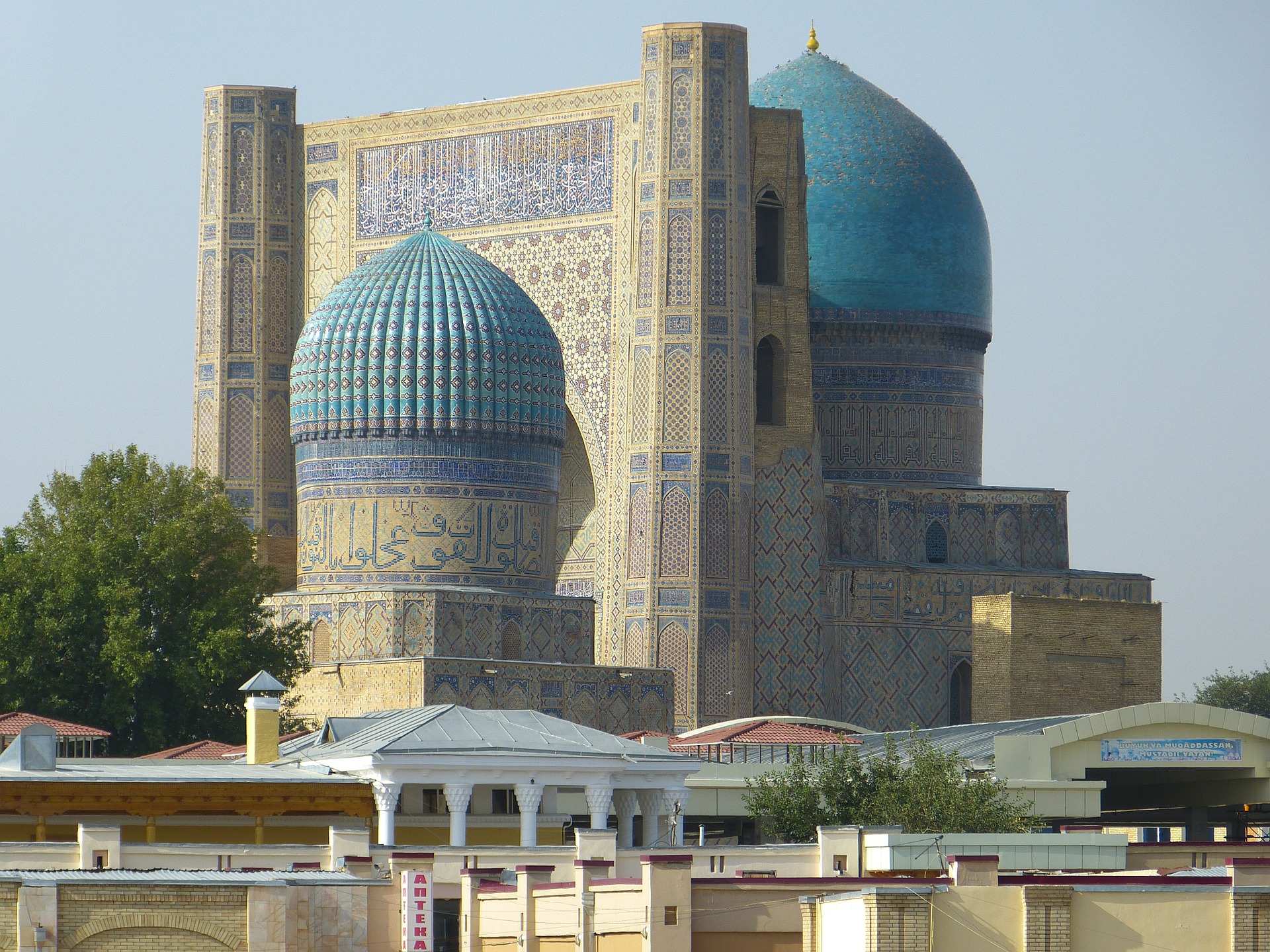
Uzbekistan is the most populous country in Central Asia, and it was once a key part of the Silk Road. Several of its oasis cities were great trading centres on the route: Samarkand, with the Registan, Bukhara, whose historic centre is a UNESCO World Heritage Site, and Khiva, with its old town, the Itchan Kala. Timur, known in the West as Tamerlane, was born in Shakhrisabz, south of Samarkand, where the ruined monuments of his dynasty are also listed by UNESCO. Uzbeks are warm and hospitable, and tea is served almost everywhere.
The country is mostly flat desert crossed by irrigated river valleys, with mountains in the east around the Ferghana Valley and the shrinking Aral Sea in the west. Getting around the main sights is easy: express trains link Tashkent, Samarkand and Bukhara, and the high-speed Afrosiyob reaches Samarkand in about two and a half hours. Summers are very hot, so the most comfortable times are mid-May to early June and August to early September. Uzbek is the official language, Russian is widely spoken in the cities, and in Samarkand and Bukhara you will hear Tajik as often as Uzbek.
- Samarkand: The Registan square and the Timurid monuments of the Gur-Emir and Shah-i Zinda.
- Bukhara: A Silk Road city about 2,500 years old, with a UNESCO-listed historic centre and the Lab-i Hauz ensemble.
- Khiva: The Itchan Kala, an old town with madrasas from the 18th and 19th centuries.
- Shakhrisabz: The birthplace of Timur, with the ruined monuments of his dynasty.
- Nukus and the Aral Sea: The Savitsky Gallery's avant-garde paintings and the dried bed of a vanishing sea.
- A yurt camp in the desert: A night near Aydar Lake or Ayaz-Kala, with a camel trek.
Places to visit
- City
- Town
- Park
- Historic site
- Area
Cities
- Tashkent: The capital and largest city, with the main international airport and the Chorsu bazaar.
- Samarkand: The second city and a UNESCO World Heritage Site, home of the Registan.
- Bukhara: A Silk Road capital whose historic centre of medieval Islamic architecture is listed by UNESCO.
- Khiva: The old town of the Itchan Kala, 30 km from Urgench.
- Shakhrisabz: A small city south of Samarkand whose Timurid historic centre is a UNESCO site.
- Nukus: The capital of Karakalpakstan, home of the Savitsky Gallery's avant-garde paintings.
- Urgench: The airport and railway station for Khiva.
- Namangan: The third largest city, on the northern edge of the Ferghana Valley.
- Andijan: The fourth largest city, in the heart of the Ferghana Valley.
- Termez: The southernmost city, with important Buddhist finds; parts of the city lie within 5 km of the Afghan border, where Canada advises against all travel (see Safety).
Beyond the cities
- Aral Sea (area): A huge lake that has been drying up, leaving old cargo ships lying in the dust.
- Moynaq (town): The town for the Aral Sea, 70 km from the railway at Kungrad.
- Ayaz-Kala (site): Ancient fortresses, with a yurt camp on a hill nearby, about 100 km from Khiva.
- Aydar Lake (area): A lake in the Kyzylkum desert with yurt camps and camel trips, about three hours from Samarkand or Bukhara.
- Ugam-Chatkal National Park (park): Western Tien Shan mountains about 80 km from Tashkent, with walnut forests and trekking; large parts need a travel permit.
- Chimgan (area): A ski resort in Ugam-Chatkal National Park, one of the complexes of the Chimgan-Charvak-Beldersay resort zone.
- Zaamin National Park (park): A mountain national park; large parts lie in border areas that need a travel permit.
- Ferghana Valley (area): The most fertile and populous part of the country, ringed by the mountains of Tajikistan and Kyrgyzstan.
- Jeyran Ecological Centre (park): A fenced reserve 40 km from Bukhara breeding the Central Asian gazelle, Przewalski's horses and kulans.
Regions
- Tashkent Region: The political and economic centre and the main point of arrival.
- Samarkand through Bukhara: A large oasis along the Zarafshon river, with Central Asia's two great Silk Road cities.
- Northern Uzbekistan: Khiva, the Aral Sea and long stretches of desert, including the autonomous Republic of Karakalpakstan.
- Ferghana Valley: The most fertile and populous region, in the east.
- Southern Uzbekistan: The mountainous south, home to many of the country's Tajiks.
Things to do
See
- The Registan Samarkand: The most famous sight of the Silk Road; Samarkand also keeps the Shir-Dor and Tilla-Kari madrasas from the 16th and 17th centuries.
- Old Bukhara Bukhara: The Pay-i Kalan ensemble, the Kalan Mosque, the Lab-i Hauz and the Taq-i Zargaran, the goldsmiths' domed market.
- The Itchan Kala Khiva: An old town with madrasas from the 18th and 19th centuries.
- Savitsky Gallery Nukus: An avant-garde painting collection in the capital of Karakalpakstan.
Do
- Ride the Afrosiyob Tashkent to Samarkand: Central Asia's only high-speed train, about 2 hours 30 minutes from Tashkent to Samarkand.
- Camel trek from a yurt camp Aydar Lake or Ayaz-Kala: A night in a desert yurt camp with meals and a camel ride.
- Trekking and rafting Ugam-Chatkal National Park and the Chatkal river: Mountain trails near Tashkent and rafting on the Chatkal or the Syr Darya; check whether your route needs a border-area permit.
Eat
- Osh (plov): The national dish of rice, carrots, onions and mutton; every region cooks it its own way, so try it in more than one place.
Drink
- Green or black tea: Drunk everywhere instead of water, green in summer and black in winter; served the traditional way, it goes from pot to cup and back three times.
Shop
- Bazaars Tashkent: Rugs, silk, spices, handicrafts and traditional clothes in the Chor Su and Eski Djouva bazaars of the old city; haggling is expected, and about 20% off is normal.
Itineraries
The Silk Road cities in 9 days (9 days)
- Tashkent (2 nights): Bazaars and the metro; take the Afrosiyob to Samarkand.
- Samarkand (3 nights): The Registan, Gur-Emir and Shah-i Zinda.
- Shakhrisabz (0 nights): A day trip south of Samarkand to Timur's home town.
- Bukhara (3 nights): The old centre on foot, and the Jeyran Ecological Centre 40 km away.
- Aydar Lake (1 night): A yurt camp and a camel trek, about three hours from Bukhara.
Khiva, Karakalpakstan and the Aral Sea in 7 days (7 days)
- Khiva (3 nights): The Itchan Kala; Urgench, 30 km away, has the airport and the station.
- Ayaz-Kala (1 night): Desert fortresses and a yurt camp on the hill.
- Nukus (2 nights): The Savitsky Gallery; shared taxis are the realistic way here from Khiva.
- Moynaq (1 night): The town for the Aral Sea and its stranded ships.
Tashkent and the mountains in 5 days (5 days)
- Tashkent (2 nights): The capital and its bazaars.
- Chimgan (1 night): A ski resort in the mountains.
- Ugam-Chatkal National Park (2 nights): Trekking and rafting with a reputable guide; check permits for areas near the border.
Climate and best time to visit
| Jan | Feb | Mar | Apr | May | Jun | Jul | Aug | Sep | Oct | Nov | Dec | |
|---|---|---|---|---|---|---|---|---|---|---|---|---|
| Max °C | 6 | 8 | 14 | 22 | 27 | 33 | 36 | 34 | 29 | 21 | 14 | 9 |
| Min °C | -3 | -2 | 4 | 10 | 14 | 18 | 19 | 17 | 12 | 7 | 3 | -0 |
| Rain mm | 55 | 47 | 72 | 64 | 32 | 7 | 4 | 2 | 5 | 34 | 45 | 53 |
Uzbekistan is very hot and sunny for most of the year. In Tashkent the average maximum is about 36 °C in July, and Canada's advice notes that summer temperatures often go above 40 °C; heat and cold waves, called chilla, can last up to 40 days. Winters are cold: Tashkent averages about 6 °C by day and -3 °C at night in January, and in the west temperatures can fall below -30 °C. Rain falls mainly from November to May (March is the wettest month in Tashkent) and is rare in summer, when Tashkent gets less than 10 mm a month from June to September.
The most comfortable times to visit are mid-May to early June and August to early September, according to Wikivoyage, avoiding the peak of the summer heat. Spring and autumn also bring rainy, cloudy and windy days. Heavy rain and melting snow can cause floods and mudflows, especially in the Samarkand, Jizzakh, Navoi and Kashkadarya regions, and can close roads.
Getting there and around
| Main airports | TAS |
|---|---|
| International driving permit | Required |
Getting there
By air: Tashkent International Airport (TAS) is the main gateway, served by Uzbekistan Airways and several international airlines. Turkish Airlines also flies from Istanbul to some regional airports. Escalation in the Middle East has caused widespread flight disruption, including airspace closures: check with your airline before you travel. By train: passenger services run only to Kazakhstan and through Kazakhstan to Russia, including Tashkent to Moscow three times a week and a weekly Nukus to Almaty train via Tashkent.
By land: border posts are usually open in business hours, and at many crossings you take a shared taxi to the border, walk across and find another on the other side. The main road crossing from Kazakhstan is Gisht Kuprik (Chernyaevka) between Shymkent and Tashkent, open 07:00 to 21:00, where waits of several hours have been reported. From Tajikistan, crossings include Panjakent for Samarkand and Bekobod for Tashkent; from Turkmenistan, Farap-Alat for Bukhara, Shavat-Dashoguz for Khiva and Hojayli for Nukus, with your Turkmen visa arranged in advance. Kyrgyz authorities may close crossings without warning, so check before you go. The Friendship Bridge to Afghanistan is closed to foreigners.
Getting around
Trains are the most comfortable way between the main cities. The Afrosiyob high-speed train takes about 2 hours 30 minutes from Tashkent to Samarkand, and the slower Sharq takes under 7 hours to Bukhara via Samarkand. In February 2025 an Afrosiyob ticket from Tashkent to Samarkand cost 270,000 so'm in economy and 396,000 so'm in business, and the Sharq about 179,250 so'm. Book online on the Uzbekistan Railways website, at least two weeks ahead (sales open 45 days before), and carry your passport, which you need to buy tickets. Overnight trains run from Tashkent via Samarkand to Kungrad, for Khiva and the Aral Sea.
Shared taxis leave from ranks when full and are the only realistic way between Nukus and Khiva or from Khiva to Bukhara (6 to 8 hours from Urgench); agree the price before you get in. In Tashkent the metro covers most central places by day, and ride-hailing apps such as Yandex Go and MyTaxi give you licensed cars with fixed fares. Canada advises avoiding ordinary taxis, which are hard to tell apart from unlicensed ones, may lack seatbelts and may pick up other passengers. Intercity buses are crowded and often without air conditioning.
Driving: traffic drives on the right, and you need a 1968 International Driving Permit with your licence; a UK licence is valid for 30 days. The minimum driving age is 18, and some rental firms ask for 21. Seatbelts are compulsory and using a phone while driving is banned. Rural and mountain roads are often poorly surfaced and badly lit, fuel stations are few, traffic police stop drivers often and roadside cameras enforce speed limits. Avoid driving at night.
Flying to Uzbekistan? PartnerCompare fares and find the cheapest datesSearch flightsWhere to stay
- Hotels: Found across the country; established hotels register your stay for you.
- Homestays and private houses: Your host must register you with the local OVIR office or online through Emehmon.
- Yurt camps: Near Aydar Lake and Ayaz-Kala, with meals included and camel trips.
- Camping and camper vans: Allowed, but you must register yourself online through Emehmon within 3 days of arrival.
| Tourist tax | Usually included in the hotel bill; private hosts pay it for you. If you camp or register yourself online, you pay it per day, and in 2026 only with an Uzbek debit card in local currency. |
|---|
Every stay has to be registered, so ask your hotel for a copy of the registration slip and keep it with your train tickets for overnight journeys: you may be asked for it when you leave the country. If you stay longer than 3 days in another city, you need to register again there. Wikivoyage reports that some hotels no longer register guests by default, so ask at check-in.
Eat and drink
Dishes to try
- Osh (plov): The national dish: rice, carrots, onions and mutton, sometimes with peas, raisins, dried apricots, pumpkin or quince.
- Non: Round bread served with every meal; Samarkand's obi-non is baked in clay ovens.
- Lagman: A thick noodle soup with meat, vegetables and spices.
- Manti: Dumplings filled with lamb and onion.
- Somsa: Pastry pockets of meat, pumpkin or potato, sold on the street; in spring, made with wild greens.
- Shashlik: Grilled skewers of marinated veal or mutton, served with raw onion.
- Shurpa and mastava: Mutton and vegetable soup, and a rice soup with vegetables.
Drinks
- Tea: Served everywhere, green in summer and black in winter.
- Uzbek wine: Produced locally and sold in licensed shops.
- Vodka: Widely sold; avoid home-brewed vodka and brandy, which may contain methanol.
- Kumis: Fermented mare's milk, which is alcoholic.
Uzbek cooking mixes Indian, Iranian, Arab, Russian, Chinese and even Korean influences, and bread comes with every meal. In restaurants always ask for the menu or the price before you order: some places overcharge tourists by up to five times. Bread is treated with respect, so do not throw it away in public.
Beer is sold in every shop, while wine and spirits are sold only in licensed shops, and it is illegal to sell alcohol to anyone aged 20 or under. Smoking is still allowed in many bars and restaurants. During Ramadan cafés and restaurants may change their menus and are busy around the evening meal that breaks the fast.
Entry requirements and visas
| Passport validity | At least 3 months after the date you arrive (UK advice); Canada asks for 6 months from the date you enter, and the passport must be in good condition |
|---|
| Passport | Entry | Max stay | Notes |
|---|---|---|---|
| United Kingdom | Visa free | 30 days | Tourism or business. |
| Canada | Visa free | 30 days | Tourist, business and student visas not required for stays of up to 30 days. |
Other nationalities: check the official source below.
UK and Canadian citizens can visit for up to 30 days without a visa. Other nationalities may be able to apply for an e-visa online. Make sure your passport is stamped on entry: border guards check it when you leave, and overstaying, even briefly, can mean a fine and deportation. Rules depend on your passport and can change: check the official link or the Uzbek embassy before you book.
Registration: you must be registered within 3 days of arrival, weekends included. Hotels do it for you; in a private house your host registers you, and if you camp you register yourself online through Emehmon. You may have to account for every night when you leave, with fines for missing days. Some tourist areas, including parts of the Surkhandarya region and the mountains near the Tajik and Kyrgyz borders, need special permission.
Customs: declare precious metals and gems over 65 grams and large sums of cash. The UK FCDO gives a threshold of US$10,000, while Canada's advice says to declare foreign currency worth more than US$2,000, so declare if in doubt. Fill in two copies of the declaration and have both stamped: you cannot leave with more foreign currency than you brought in. Declare prescription medicines and carry the prescription and a doctor's letter; codeine and some other common medicines are restricted. Drones need a licence before you arrive.
Money and payments
| Currency | Uzbekistani Som (UZS) |
|---|---|
| Cards | Limited |
The currency is the Uzbek so'm (UZS), which you cannot buy outside Uzbekistan. US dollars are the easiest currency to exchange, but exchange booths refuse damaged or marked notes and dollars issued before 2013; Canadian dollars cannot be exchanged at all. Change money only at banks, official booths and major hotels: changing on the black market is illegal and carries harsh penalties.
Outside the main cities few ATMs accept foreign cards and machines often run out of cash, so withdraw what you need in Tashkent, Samarkand or Bukhara before heading to the regions. International cards are accepted in larger hotels, restaurants and cafés in the main cities, sometimes with a surcharge of about 1%, but rarely elsewhere. Carpets, artwork and pricier hotels are often priced in US dollars. Prices are fixed only in department stores: in bazaars and souvenir shops, expect to haggle.
Health
| Recommended vaccines | Routine vaccines, including measles (MMR), Hepatitis A, Hepatitis B, Rabies, for some travellers: dogs with rabies are common, Typhoid, for rural areas, long stays or visiting friends and relatives |
|---|---|
| Malaria | None |
| Tap water | Varies |
No vaccinations are required to enter Uzbekistan, and yellow fever vaccination is not recommended. Ask a travel health professional about the recommended vaccines at least 8 weeks before you go. Treat tap water as unsafe outside Tashkent, and peel fruit and vegetables. Rabies is common in dogs and vaccines after a bite may be available only in larger towns, so avoid animals. Ticks can carry Crimean-Congo haemorrhagic fever: cover up in rural areas and avoid contact with animal blood.
Medical care is generally poor, especially in rural hospitals, so avoid anything but essential treatment and get insurance that covers evacuation: serious cases are usually sent to Europe or New Delhi. Bring enough of your medicines in their original containers, as counterfeit and expired drugs are common. Air pollution is high in Tashkent and the Ferghana Valley from November to February, and the air in Karakalpakstan and Khorezm can be poor all year because of storms from the Aral Sea. Altitude sickness is a risk in the mountains. For an ambulance, call 103.
This is general information, not medical advice: check with a travel health professional before you go.
Safety
- United States: Level 1: Exercise Normal Precautions (2026-10-20)
- Canada: Take normal security precautions (2026-10-20)
- United Kingdom: No advice against travel (2026-10-20)
Canada advises against all travel within 5 km of the border with Afghanistan, and the UK FCDO asks you to be cautious near that border and to follow local instructions; check the advice before you go. The border along the Amu Darya is fenced and heavily guarded, you risk arrest if you approach the fence or photograph military sites, and many sights near it need a permit or an organised tour. Marked and unmarked minefields may remain near the borders with Tajikistan and Kyrgyzstan: stay on main roads and cross only at official posts.
Pickpocketing and bag snatching are common in bazaars and on public transport, and more frequent at night in Tashkent, Bukhara, Samarkand and the Ferghana Valley. People posing as police have robbed foreigners: ask to see credentials. Watch for street scams such as the stranger who has "found" cash, and count your change. Card fraud happens, so use ATMs inside banks. Avoid demonstrations.
You must carry your passport at all times: the police check often and can fine or arrest you without it. Ask before photographing government buildings, airports, bridges, police stations and metro stations, and be careful what you post online about public buildings, the flag or local customs. Same-sex relationships are illegal. Uzbekistan is in an active earthquake zone, and planned power cuts in winter can leave buildings without heating. For any emergency call 112; the English-speaking tourist hotline is 1173.
Customs and etiquette
Respect for the elderly runs through daily life: defer to older people in every situation. Use your right hand to give and take tea and cups, as the left is considered unclean. In a home, your host will pour only a little tea at a time; a cup filled to the top may be a hint that it is time to leave. Bread is sacred: you do not have to finish it, but never waste it in public.
Islam is closely observed in rural areas, so dress conservatively and behave discreetly. It is illegal to cover your face in public, except for reasons such as weather or health, and religious proselytising is illegal. During Ramadan, which in 2027 is expected to begin on or around 7 February, avoid eating, drinking or smoking in public by day. Open flirting is not welcome; men with a question should, where possible, ask another man. Check before taking photos of officials or buildings.
Language
| Official languages | Uzbek |
|---|---|
| English | Limited |
| Hello | Assalomu alaykum (informal: Salom) |
|---|---|
| Thank you | Rahmat |
| Please | Marhamat |
| Yes / No | Ha / Yo'q |
| Excuse me | Kechirasiz |
| Sorry | Uzr |
| Goodbye | Hayr |
| Do you speak English? | Siz inglizcha gaplashasizmi? |
| How much? | Qancha? |
| Help! | Yordam! |
What to pack
- Passport: You must carry it at all times, and it must be stamped on entry.
- 1968 International Driving Permit: Needed with your licence to drive; UK permits cannot be bought outside the UK.
- Clean US dollar notes issued in 2013 or later: Damaged or older notes are refused, and few ATMs outside the cities take foreign cards.
- Medicines in their original containers, with prescriptions and a doctor's letter: Customs control medicines strictly and counterfeit drugs are common.
- Hotel registration slips: Keep them: you may be asked for them when you leave.
- Toilet paper: Useful on long bus journeys.
Quick reference
Country facts
| Capital | Tashkent |
|---|---|
| Population | 37,053,428 (2025) |
| Area | 438,510 km² |
| Time zone | Asia/Samarkand (UTC+5), Asia/Tashkent (UTC+5) |
| Calling code | +998 |
| Driving side | right |
Staying connected
| SIM and eSIM | Beeline, Mobiuz, Ucell and UzTelecom sell SIM cards and eSIMs at kiosks in the arrivals area of Tashkent airport; bring your passport. Wikivoyage reported in March 2026 that global eSIM providers use only the Beeline network, which is weaker outside the cities. |
|---|---|
| Wi-Fi | Offered by some restaurants; internet cafés exist in most cities, usually with slow connections. |
Useful apps
- Yandex Go: Taxis with fixed fares.
- MyTaxi: Licensed taxis.
- Yandex Maps or 2GIS: Navigation, more accurate here than Google Maps.
- Emehmon: Online registration of your stay if you camp or register yourself.
Emergency numbers
| Emergency | 112 |
|---|---|
| Police | 102 |
| Ambulance | 103 |
| Fire | 101 |
Frequently asked questions
Do I need a visa for Uzbekistan?
UK and Canadian citizens can stay up to 30 days without a visa. Rules depend on your passport, so check the official link before you book.
Do I need to register my stay in Uzbekistan?
Yes, within 3 days of arrival. Hotels do it for you; keep the registration slips, as you may be asked for them when you leave.
When is the best time to visit Uzbekistan?
Mid-May to early June and August to early September. Summers often go above 40 °C, and winters are cold.
Can I drink the tap water in Uzbekistan?
Treat it as unsafe outside Tashkent and drink bottled or treated water.
Can I pay by card in Uzbekistan?
In larger hotels, restaurants and cafés in the main cities, yes. Elsewhere you need so'm in cash, and you cannot buy so'm before you arrive.
How do I travel between Samarkand and Bukhara?
By train: the Afrosiyob and Sharq link Tashkent, Samarkand and Bukhara. Book a couple of weeks ahead and carry your passport.
More Travel Stories from Asia

 Laos
 Cambodia
From the original Tourist4Tourist guide, written by travellers. Not yet checked against current sources.
National festivals and holidays
- Silk and Spice Festival in Bukhara: The Silk and Spice Festival is held in Bukhara every year in May. Many people from different parts of Central Asia come to Bukhara to visit and take part in the Festival. Many craftsmen exhibit their works during the Festival, visitors can see and buy handmade items like: carpets, jewellery, and etc. During the Festival people can find out about traditions of different nations of Central Asian Republics.
Sources This guide was last checked on · 18 sources
- Wikivoyage: Uzbekistan · Overview, Places to visit, Things to do, Itineraries, Climate and best time to visit, Getting there and around, Where to stay, Eat and drink, Entry requirements and visas, Money and payments, Health, Safety, Customs and etiquette, Language, What to pack, Staying connected, Frequently asked questions
- Wikidata: Uzbekistan · Overview, Places to visit, Money and payments, Country facts
- Government of Canada: Uzbekistan travel advice · Places to visit, Climate and best time to visit, Getting there and around, Where to stay, Entry requirements and visas, Money and payments, Health, Safety, Customs and etiquette, What to pack, Frequently asked questions
- WMO World Weather Information Service: Tashkent · Climate and best time to visit
- UK FCDO: Uzbekistan safety and security · Getting there and around, Eat and drink, Money and payments, Safety, Customs and etiquette, What to pack, Staying connected
- UK FCDO: Uzbekistan regional risks · Getting there and around, Safety
- UK FCDO: Uzbekistan warnings and insurance · Getting there and around
- UK FCDO: Uzbekistan entry requirements (updated 19 March 2026) · Where to stay, Entry requirements and visas, What to pack, Staying connected, Frequently asked questions
- ISO 4217 (SIX), published 2026-09-17 · Money and payments
- CDC Travelers' Health: Uzbekistan · Health, Frequently asked questions
- UK FCDO: Uzbekistan health · Health
- US Department of State: Uzbekistan travel advisory · Safety
- UK FCDO: Uzbekistan travel advice · Safety
- UK FCDO: Uzbekistan getting help · Safety, Emergency numbers
- Wikivoyage: Uzbek phrasebook · Language
- World Bank, SP.POP.TOTL · Country facts
- World Bank, AG.LND.TOTL.K2 · Country facts
- IANA Time Zone Database, zone.tab · Country facts
Suggest an update
Travel rules, prices and timetables change. If something in this guide is out of date, tell us: we check every suggestion against an official source before changing the page.