

- Local time
- 03:22
- Currency
- Bhutanese Ngultrum (BTN)
- Capital
- Thimphu
- Calling code
- +975
- Drive on the
- left
Overview
Bhutan is a small Himalayan kingdom of fortress-monasteries, masked festivals and mountain treks, where every visitor pays a daily sustainable development fee.
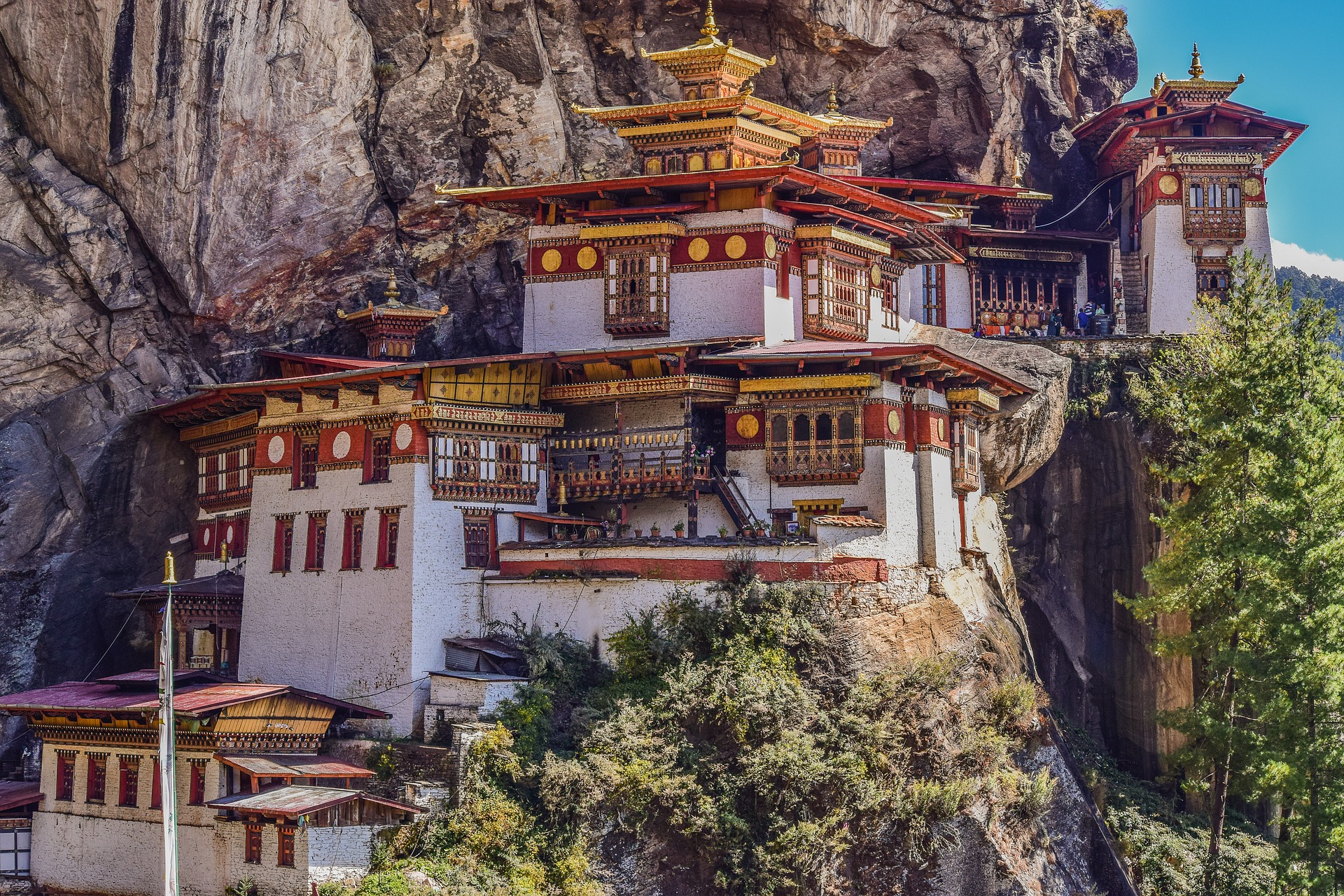
Bhutan lies in the Himalayas between Tibet and India, and its strong sense of tradition sets it apart from its large neighbours. Buddhism shapes daily life: monasteries stand in remote valleys, and each district is run from a dzong, an old fortress that houses both the local government and the monks. The best-known sight is Taktsang, the Tiger's Nest, a monastery built on a cliff above the Paro valley.
Travel here works differently. Visitors from most countries pay a sustainable development fee of USD 100 per adult per night, need a visa arranged in advance and use licensed guides to visit places of interest. Most trips follow the western valleys of Paro, Thimphu and Punakha, then continue east towards Jakar. The tshechu festivals, with masked dances performed by monks, and treks such as the Druk Path draw visitors in spring and autumn.
- Tiger's Nest (Taktsang): The monastery on a cliff above Paro, the most visited monument in the country.
- Punakha Dzong: Bhutan's most celebrated fortress-monastery, in a warm low valley.
- Thimphu: The capital, with the giant Buddha Dordenma statue and Tashichho Dzong.
- Jakar and Bumthang: Often seen as the birthplace of Buddhism in Bhutan, with Kurje Lhakhang.
- Tshechu festivals: Religious festivals with masked dances, above all in Paro and Thimphu.
- Treks: From the Druk Path between Paro and Thimphu to the very tough Snowman Trek.
Places to visit
- City
- Park
Cities
- Thimphu: The capital, with the Buddha Dordenma and Tashichho Dzong.
- Paro: Home of the international airport and of the Tiger's Nest monastery.
- Punakha: Home to Bhutan's most celebrated dzong, in a valley with hot summers and mild winters.
- Jakar: A town in the Bumthang region, seat of the first kings and of early Buddhism in Bhutan.
- Phuentsholing: The border town where travellers arrive by road from India.
- Trashigang: A picturesque administrative town in the east.
- Trashiyangtse: An attractive eastern town known for the Chorten Kora stupa.
- Mongar: One of the largest towns in the east.
Beyond the cities
- Tiger's Nest (Taktsang) (site): A monastery of 1692 on a cliff in the Paro valley, linked to Guru Rinpoche.
- Phobjikha (area): A popular valley stop on the way from Punakha to central Bhutan.
- Jigme Dorji National Park (park): A large protected area in the north-west, crossed by several treks.
- Royal Manas National Park (park): A protected area in the south, on the border with India.
- Phrumsengla National Park (park): A national park in central Bhutan.
- Sakteng Wildlife Sanctuary (park): A sanctuary in the far east, reached on the Merak to Sakteng trek.
Regions
- Western Bhutan: Paro, Thimphu, Punakha and Phuentsholing: the part most visitors see.
- Central Bhutan: Jakar and the Bumthang valleys, Trongsa and Phobjikha.
- Eastern Bhutan: Trashigang, Trashiyangtse and Mongar, only recently opened up to tourism.
Things to do
See
- Hike to the Tiger's Nest Paro: Walk up to the monastery on its cliff, the country's most famous sight.
- Punakha Dzong Punakha: Fortress architecture and art treasures, built without nails or plans.
- Buddha Dordenma Thimphu: A 51.5 m gilded bronze Buddha above the southern approach to the capital.
- Kurje Lhakhang Jakar: A temple built around a cave where Guru Rinpoche meditated.
Do
- A tshechu festival: Masked dances by monks in temples and dzongs, mostly in late summer and autumn; Thimphu's is the best known.
- The Druk Path trek Paro to Thimphu: The most popular trek; carry all food and camping gear, as there is nowhere to stay at altitude.
- The Jomolhari and Laya Gasa treks: Popular high-mountain treks, best in spring and autumn.
Eat
- Ema datshi: The national dish of chillies and cheese; say clearly if you do not like it hot.
Drink
- Butter tea: Suja, a strong traditional tea, or the sweet milk tea called cha.
Itineraries
Paro, Thimphu and Punakha in 7 days (7 days)
- Paro (2 nights): Arrive by air and hike to the Tiger's Nest.
- Thimphu (2 nights): The capital's dzong and the Buddha Dordenma.
- Punakha (2 nights): The great dzong in its low valley.
- Paro (1 night): Back for the flight out.
Western and central Bhutan in 10 days (10 days)
- Paro (2 nights): The Tiger's Nest.
- Thimphu (2 nights): The capital.
- Punakha (2 nights): Punakha Dzong.
- Phobjikha (1 night): On the road east.
- Jakar (3 nights): Bumthang's temples; there is a domestic airport for the way back.
Overland from India in 6 days (6 days)
- Phuentsholing (1 night): By road from Siliguri, about three hours from Bagdogra airport.
- Thimphu (3 nights): Up the mountain road to the capital.
- Paro (2 nights): The Tiger's Nest before you fly or drive out.
Climate and best time to visit
| Jan | Feb | Mar | Apr | May | Jun | Jul | Aug | Sep | Oct | Nov | Dec | |
|---|---|---|---|---|---|---|---|---|---|---|---|---|
| Max °C | 15 | 17 | 19 | 22 | 25 | 27 | 27 | 27 | 26 | 23 | 20 | 16 |
| Min °C | -2 | 0 | 4 | 8 | 12 | 15 | 16 | 16 | 15 | 9 | 3 | -1 |
| Rain mm | 6 | 9 | 20 | 29 | 48 | 92 | 147 | 121 | 72 | 42 | 1 | 4 |
Climate depends on altitude. Thimphu, at the heart of the western valleys, has mild summers and cold, very dry winters: in January the average maximum is about 15 °C and nights fall below freezing, while in July and August the maximum is about 27 °C. Almost all the rain falls between June and September, peaking in July. The far north is under snow all year, Punakha is warmer than the other valleys, and the south along the Indian border is hot and humid.
Wikivoyage recommends spring, when rhododendrons bloom, and autumn and early winter, when clear skies show the Himalaya. Autumn and spring are also the best trekking seasons: paths are muddy in summer and snowbound in winter. The monsoon, from June to September, brings frequent landslides.
Getting there and around
| Main airports | PBH |
|---|
Getting there
By air: Paro is the only international airport, reached by Druk Air and Bhutan Airlines from cities such as Bangkok, Delhi, Kolkata, Kathmandu, Dhaka, Dubai and Singapore. The approach through a winding valley is famous among pilots, and weather often affects flights. Foreigners pay much higher fares than locals, so some fly instead to Bagdogra (IXB) in India, about three hours by road from the border.
By road: the land entry for most foreigners is Phuentsholing, on the border with West Bengal; buses run there from Siliguri and Kolkata. The border with China is closed.
Getting around
Most visitors travel with a vehicle and driver provided by their tour operator. Roads are full of hairpin bends, so bring travel sickness tablets; the UK government warns that accidents are a major cause of injury and that roads are dangerous in the monsoon, so avoid travelling at night. There are no traffic lights in the country. Rental cars come with a driver; driving your own vehicle means hiring a guide and paying a daily charge. Domestic flights link Paro with Jakar, Gelephu and Yongphula near Trashigang, but schedules are sparse and flights are often cancelled.
Flying to Bhutan? PartnerCompare fares and find the cheapest datesSearch flightsWhere to stay
- Tourist hotels: In every town on a road, with very variable standards.
- Luxury hotels: Five-star resorts only in Paro, Jakar, Punakha, Gangtey and Thimphu.
- Homestays: Listed by the tourism authorities, in areas without hotels.
- Camping: The only option on high treks, with all food and equipment carried in.
Besides the room, every adult visitor pays the sustainable development fee of USD 100 per night; children pay less. Wikivoyage reports that the fee is waived for a single night spent in one of the border towns.
Eat and drink
Dishes to try
- Ema datshi: The national dish: chillies in a sauce of local cheese, sometimes with beans, potatoes or mushrooms.
- Momos: Tibetan-style dumplings with pork, beef or cabbage and cheese.
- Phaksha paa: Pork cooked with red chillies, often with radish or spinach.
- Hoentoe: Buckwheat dumplings filled with turnip greens and cheese.
- Jasha maru: Spicy minced chicken with tomatoes, served with rice.
- Red rice: A nutty local rice, pale pink and slightly sticky when cooked.
Drinks
- Suja: Butter tea, strong and traditional.
- Cha: Sweet milk tea, close to Indian chai.
- Ara: A spirit made from rice or maize, common in rural areas and in the east.
- Druk beers: Local beers sold in 650 ml bottles; Druk 11000 is strong.
Rice comes with every meal, with one or two dishes of meat or vegetables, and chilli is the dominant flavour, often eaten raw. Good coffee is easy to find only in Thimphu, Paro and Jakar. Alcohol is legal, but there are limits on how much tourists can buy at once. Drink only boiled or purified water.
Entry requirements and visas
| Passport validity | At least 6 months after the date you plan to leave Bhutan |
|---|
| Passport | Entry | Max stay | Notes |
|---|---|---|---|
| United Kingdom | Visa required | Apply in advance through a Bhutanese tour operator, a hotel or the Department of Immigration; the visa is issued on arrival. Fee USD 40. | |
| Canada | Visa required | Arranged in advance; Canada says you must book a travel package through an authorised agent. |
Other nationalities: check the official source below.
All visitors except Indian citizens need a visa approved before they travel, and pay a sustainable development fee of USD 100 per adult per night. The UK government says you can arrange the visa through a Bhutanese tour operator, a hotel or directly online, and that a guide is needed to visit places of interest; permits for some areas are obtained by your guide. Canada says you need a special permit to travel outside Thimphu and Paro. You can enter by air at Paro or by road at Phuentsholing.
At customs, declare anything subject to duty. Exporting antiques is illegal. Imported tobacco is taxed: keep the receipt. Canada says electronic devices such as laptops, phones and cameras must be registered on arrival and are checked when you leave. You may carry up to 30,000 ngultrum in or out. Rules depend on your passport: check the official link before you book.
Money and payments
| Currency | Bhutanese Ngultrum (BTN) |
|---|---|
| Cards | Limited |
The currency is the ngultrum (BTN, Nu), fixed at par with the Indian rupee. Indian rupee notes of ₹200 or less are accepted everywhere, but ngultrum cannot be used in India. US dollars are widely accepted too. Outside airlines and five-star resorts, international cards are not widely accepted. ATMs that take Visa and Mastercard are mostly in Thimphu and Paro and are not fully reliable, so carry cash. Bring small notes for donations at temples.
Costs and budget
- Sustainable development fee, per adult per night: USD 100
- Visa application fee (one-off): USD 40
- Entry to some religious sites: Nu 500 to 1,000
- Tourist SIM, unlimited 4G for 14 days (April 2025): Nu 2,000
The daily fee makes Bhutan an expensive destination before you count hotels, guide and transport. Flights to Paro cost foreigners much more than locals, which is why some visitors fly to Bagdogra in India and continue by road.
Health
| Recommended vaccines | Routine vaccines, including measles (MMR), Hepatitis A, Hepatitis B, Typhoid, Japanese encephalitis, for long stays in rural areas, Rabies: ask a travel clinic |
|---|---|
| Malaria | Some areas |
| Tap water | Not safe |
Altitude sickness is a real risk in the mountains and can start from about 2,500 m: tell your guide and go down if you have palpitations, breathlessness or a severe headache. The CDC does not recommend malaria medicine for Bhutan, and Canada says limited malaria transmission may occur but the risk to travellers is very low; outbreaks of malaria and dengue happen mainly near the Indian border in the monsoon. Check vaccines with a travel health professional at least 6 to 8 weeks before you go.
The Jigme Dorji Wangchuck National Referral Hospital in Thimphu handles surgery and emergencies; elsewhere care is basic, and complex cases need evacuation to India or Thailand, so get insurance that covers helicopter evacuation. Call 112 for an ambulance. Tap water is not safe: boil or purify it. Thimphu has many street dogs; if one bites you, get a rabies vaccination at once.
This is general information, not medical advice: check with a travel health professional before you go.
Safety
- United States: Level 1: Exercise Normal Precautions (2026-10-20)
- Canada: Take normal security precautions (2026-10-20)
- United Kingdom: No advice against travel (2026-10-20)
Crime is low, but valuables have been stolen from vehicles at tourist sites, so do not leave anything in the car. The police in Thimphu are visible and speak English. Penalties for drugs are severe, with sentences from 3 years to life.
The main risks are natural and on the road. Car accidents are a leading cause of injury, mountain roads are hazardous in the monsoon, from June to September, when landslides are frequent, and avalanches are a risk in the high mountains. Bhutan lies in an active earthquake zone. Bears can be a threat in remote areas. Same-sex relations are legal, but same-sex unions are not recognised.
Customs and etiquette
Bhutanese people take their customs seriously. In temples and dzongs, remove your shoes and hat, avoid shorts and revealing clothes, and ask your guide before taking photos or filming, which is not allowed in many places. Walk past stupas and mani stones with your right side towards them, turn prayer wheels clockwise and never sit on religious objects. A small donation at monasteries is customary but not compulsory.
The king and the royal family are deeply respected: never criticise them. Show respect to older people. Trying to convert others is illegal. Smoking is frowned upon and banned in public places and near monasteries, littering is illegal, and harming protected species can lead to prison.
Language
| Official languages | Dzongkha |
|---|---|
| English | Widespread |
What to pack
- Travel sickness tablets: The mountain roads are an endless series of hairpin bends.
- Layers and warm clothes: Winter nights in Thimphu fall below freezing, and the passes are cold all year.
- Clothes for temples: Shorts and revealing clothes are not appropriate in dzongs and monasteries.
- First aid kit and stomach medicine: Medical care outside Thimphu is basic.
- Cash in small notes: Cards are rarely accepted and temple donations are made in cash.
- Receipts for tobacco and a list of your devices: Customs may ask for proof of duty paid and check registered electronics when you leave.
Quick reference
Country facts
| Capital | Thimphu |
|---|---|
| Population | 796,682 (2025) |
| Area | 38,140 km² |
| Time zone | Asia/Thimphu (UTC+6) |
| Calling code | +975 |
| Driving side | left |
Staying connected
| SIM and eSIM | SIM cards are sold at Paro airport by Bhutan Telecom (B-Mobile) and TashiCell; in April 2025 a 14-day unlimited 4G plan cost Nu 2,000. Most of the country has mobile coverage. |
|---|---|
| Wi-Fi | Available in most hotels. |
Emergency numbers
| Police | 113 |
|---|---|
| Ambulance | 112 |
| Fire | 110 |
Frequently asked questions
Do I need a visa for Bhutan?
Yes, everyone except Indian citizens needs a visa approved before travel, usually arranged through a tour operator or a hotel. Check the official link before you book.
What is the sustainable development fee?
A charge of USD 100 per adult per night that most visitors pay on top of hotels and transport; children pay less.
Do I need a guide in Bhutan?
Yes, the UK government says you need a tour guide to visit places of interest, and permits for some areas are arranged by the guide.
When is the best time to visit Bhutan?
Spring and autumn are the best seasons for trekking and views; early winter has clear skies. The monsoon from June to September brings rain and landslides.
Can I use Indian rupees in Bhutan?
Yes, Indian rupee notes of ₹200 or less are accepted, and the ngultrum has the same value. US dollars are also widely accepted.
Can I drink the tap water in Bhutan?
No. Boil or purify it, or drink bottled water.
More Travel Stories from Asia
 Cambodia
Sources This guide was last checked on · 15 sources
- Wikivoyage: Bhutan · Overview, Places to visit, Things to do, Itineraries, Climate and best time to visit, Getting there and around, Where to stay, Eat and drink, Entry requirements and visas, Money and payments, Costs and budget, Health, Safety, Customs and etiquette, Language, What to pack, Staying connected, Frequently asked questions
- Wikidata: Bhutan · Overview, Places to visit, Money and payments, Country facts
- UK FCDO: Bhutan entry requirements · Overview, Getting there and around, Where to stay, Entry requirements and visas, Money and payments, Costs and budget, What to pack, Frequently asked questions
- WMO World Weather Information Service: Thimphu · Climate and best time to visit, Frequently asked questions
- Government of Canada: Bhutan travel advice (updated 14 October 2026) · Climate and best time to visit, Entry requirements and visas, Health, Safety, Customs and etiquette, What to pack, Frequently asked questions
- UK FCDO: Bhutan safety and security · Getting there and around, Safety, Customs and etiquette
- ISO 4217 (SIX), published 2026-09-17 · Money and payments
- UK FCDO: Bhutan health · Health, Language, What to pack
- US CDC: Travelers' health, Bhutan · Health
- US Department of State: Bhutan travel advisory · Safety
- UK FCDO: Bhutan travel advice · Safety
- World Bank, SP.POP.TOTL · Country facts
- World Bank, AG.LND.TOTL.K2 · Country facts
- IANA Time Zone Database, zone.tab · Country facts
- UK FCDO: Bhutan getting help · Emergency numbers
Suggest an update
Travel rules, prices and timetables change. If something in this guide is out of date, tell us: we check every suggestion against an official source before changing the page.