

- Local time
- 07:37 (capital)
- Currency
- Kazakhstani Tenge (KZT)
- Capital
- Astana
- Calling code
- +7
- Drive on the
- right
Overview
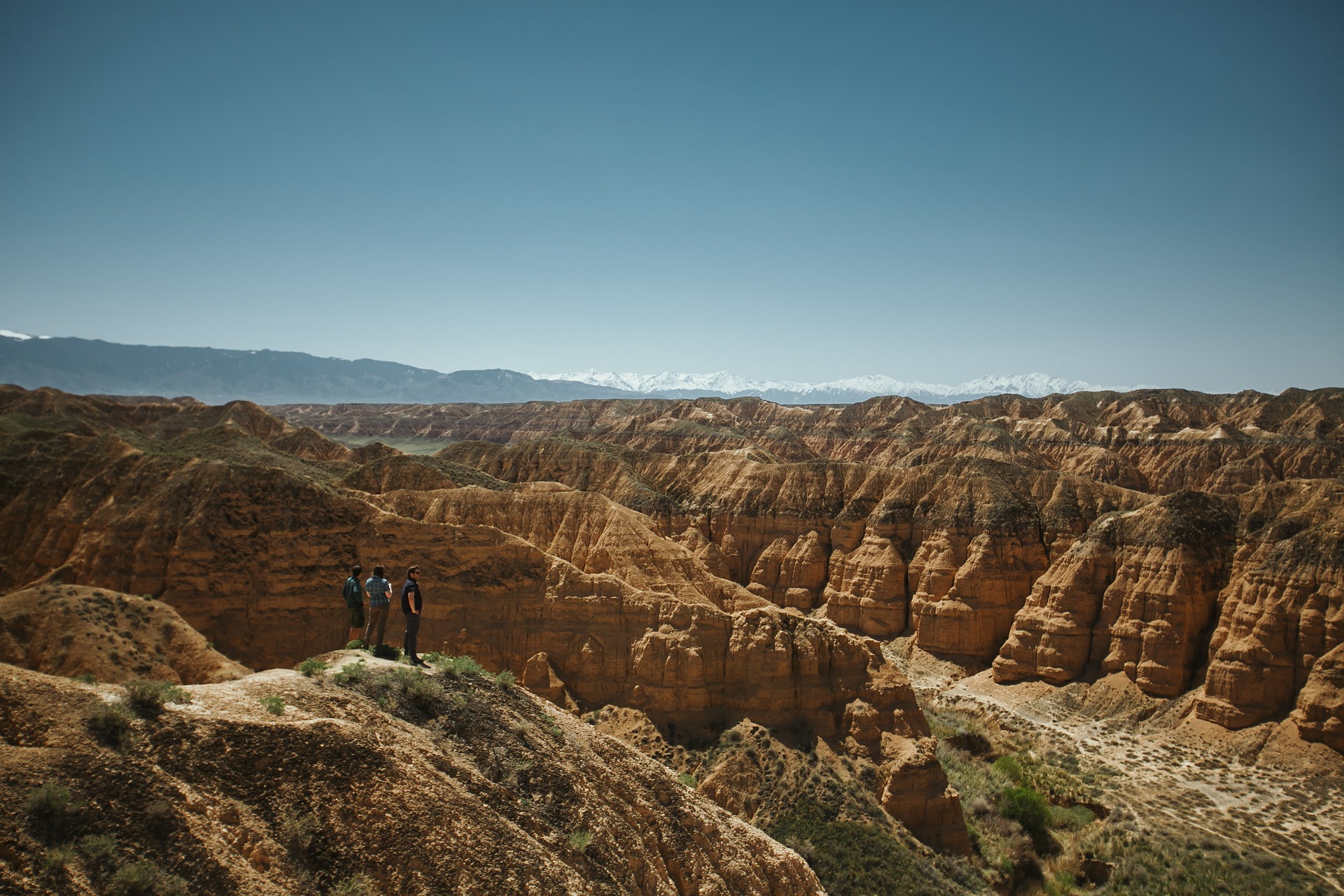
Kazakhstan, the giant of Central Asia, mixes Almaty's mountain backdrop and Astana's brand-new skyline with endless steppe, the Altai, mountain lakes and Silk Road towns such as Turkestan, linked by long, sociable train rides.
Kazakhstan is by far the largest country in Central Asia and, after Russia, the largest of the former Soviet states; a small part of it lies west of the Ural River, in Europe. Kazakh and Russian are both official, and Russian is the more useful of the two. Oil and gas have made it the richest country in the region, and the money shows in Astana, the capital since 1997, a city of new buildings that is still growing fast.
The country lacks the grand Islamic monuments of its southern neighbours, because the Kazakhs were nomads on horseback; what it has is space and nature. Almaty, the largest city, has Medeu and other mountain spots close by. The south has old market towns and Turkestan's historic monuments, the east the Altai mountains, and in between lies the steppe. Trains are slow but a good way to meet people.
- Almaty: The largest city, with mountains on its doorstep.
- Astana: The capital since 1997, a showcase of new architecture.
- Kolsay Lakes: Lakes in the Kungey Alatau mountains.
- Turkestan: An ancient Silk Road town with important historic monuments.
- Altai Mountains: Remote alpine scenery in the far east of the country.
- The steppe: Wide, empty spaces between the cities.
Places to visit
- City
- Town
- Park
- Mountain
- Historic site
- Area
Cities
- Almaty: The largest city and capital until 1997, a must-see with mountains close by.
- Astana: The capital since 1997, new and growing fast; a few days are enough.
- Shymkent: The third-largest city, an old market town near the mountains and Tashkent.
- Turkestan: An ancient town between Persian and nomadic cultures, with important historic monuments.
- Pavlodar: A northern city founded in 1720, with a striking mosque, Orthodox churches and memorials.
- Semey: A university city near the former atomic test site.
- Ust-Kamenogorsk: A mostly Russian-speaking mining city in the Altai.
- Atyrau: The oil capital, close to large oilfields.
Beyond the cities
- Trans-Ili Alatau (mountain): A 200 km long mountain range near Almaty.
- Medeu (site): A spot in the mountains near Almaty.
- Kolsay Lakes (area): Lakes in the Kungey Alatau mountains.
- Talgar (town): A town at the foot of the Talgar mountains, near Almaty.
- Aksu-Zhabagly (park): A nature reserve in the south.
- Burabay (area): An area in the north with one of the few campsites in the country.
- Karkaraly National Park (park): A national park.
- Altai Mountains (mountain): Remote, beautiful alpine scenery in the far east.
- Baikonur (site): The spaceport from which Gagarin flew. The town is a closed area: you need prior permission from the Kazakh authorities, and tours take weeks to approve.
Regions
- Almaty Province: The former capital, treks into the Tian Shan, historic towns and ancient petroglyphs.
- Kazakhstani North: Cold steppe with the capital, the Russian minority and industrial cities.
- Kazakh Desert: Ancient desert cities along the Silk Road.
- Altai: Remote, beautiful alpine scenery.
- Caspian Basin: Caspian beaches and the oil industry; tribal ties are still strong here.
- Central Highlands: Endless, thinly populated steppe.
Things to do
See
- Almaty and its mountains Almaty: A Soviet-style city with Medeu and the Trans-Ili Alatau right behind it.
- New Astana Astana: A capital of modern buildings, in contrast with the rest of the country.
- Kolsay Lakes Kolsay Lakes: Lakes in the Kungey Alatau mountains, in the south-east.
- Historic Turkestan Turkestan: Monuments of a town that stood between Persian and nomadic worlds.
- Horse culture at festivals: The horse is still central to Kazakh life, and festivals show it at its best.
Do
- A long train ride: Shared compartments, food from the platform and curious fellow travellers.
- Banya and sauna: Saunas are a big part of social life, especially in Almaty and Astana.
Eat
- Beshbarmak: The national dish of meat and flat noodles, served for sharing.
Drink
- Kumiss and tea: Kumiss is fermented mare's milk; strong tea matters a lot in Kazakh culture.
Shop
- Felt and carpets: Handmade felt items and the traditional syrmak and tekemet rugs.
Itineraries
Almaty and the mountains in 7 days (7 days)
- Almaty (3 nights): The city, Medeu and the Trans-Ili Alatau.
- Kolsay Lakes (2 nights): Lakes in the Kungey Alatau mountains.
- Talgar (1 night): Walks at the foot of the Talgar mountains.
- Almaty (1 night): Back to the city.
The south and the Silk Road in 6 days (6 days)
- Shymkent (2 nights): An old market town near the mountains.
- Aksu-Zhabagly (2 nights): A nature reserve.
- Turkestan (2 nights): Historic monuments of the Silk Road.
Astana and Burabay in 5 days (5 days)
- Astana (3 nights): The new capital and its architecture.
- Burabay (2 nights): One of the few campsites in the country.
Climate and best time to visit
| Jan | Feb | Mar | Apr | May | Jun | Jul | Aug | Sep | Oct | Nov | Dec | |
|---|---|---|---|---|---|---|---|---|---|---|---|---|
| Max °C | -13 | -11 | -5 | 9 | 20 | 25 | 27 | 24 | 19 | 9 | -3 | -10 |
| Min °C | -22 | -22 | -16 | -2 | 6 | 11 | 13 | 11 | 5 | -2 | -11 | -19 |
| Rain mm | 17 | 15 | 15 | 22 | 33 | 33 | 53 | 35 | 24 | 30 | 21 | 20 |
In Astana winters are long and very cold: January averages a high of about −13 °C and a low of −22 °C, and highs stay below freezing from November to March. Summer is warm, with July highs around 27 °C, and the little rain that falls comes mostly in summer, peaking in July. Winter roads can be icy or closed by snowstorms and strong winds.
May to September is the warmest and easiest time to travel. In the mountains the FCDO warns that weather changes fast, snow can fall at altitude even in summer, and heavy snow can block roads and trekking routes in autumn and winter. The domestic football season runs from March to November to avoid the winter.
Holidays and events
- 1 January 2026 · New Year's Day
- 2 January 2026 · New Year's Day
- 8 March 2026 · International Women's Day
- 21 March 2026 · Nauryz Meyramy
- 22 March 2026 · Nauryz Meyramy
- 23 March 2026 · Nauryz Meyramy
- 1 May 2026 · Kazakhstan People's Unity Day
- 7 May 2026 · Defender of the Fatherland Day
- 9 May 2026 · Great Patriotic War Against Fascism Victory Day
- 6 July 2026 · Capital City Day
- 30 August 2026 · Constitution Day
- 25 October 2026 · Republic Day
- 16 December 2026 · Independence Day
Getting there and around
| Main airports | ALA, NQZ |
|---|---|
| International driving permit | Required |
Getting there
By air: Air Astana, the national airline, flies to Europe and much of Asia, and many foreign airlines serve the country; for some regions it is quicker to connect through Istanbul or a Middle Eastern hub. By train: slow but comfortable trains link Almaty with Moscow (about 77 hours), Novosibirsk and Ürümqi in China (34 hours), with long waits at the borders. By road: buses run from Bishkek in Kyrgyzstan to Almaty in about 4 hours, and sleeper buses from Ürümqi take a day or more; queues at road borders can last up to 24 hours. Freighters cross the Caspian between Baku and Aktau but can be held up for days or even weeks before entering port.
Getting around
Distances are huge. The train is the most popular way between cities: the ordinary train from Almaty to Astana takes almost 24 hours, the faster Talgo about 9. Tickets can be bought online, and the trains stop long enough at stations to buy food on the platform; lock your compartment at night. Air Astana and its budget arm FlyArystan cover domestic routes, most often Astana–Almaty. Long-distance buses are faster than trains but less comfortable, and much cheaper than flying, and marshrutka minibuses run around and between towns; Canada advises avoiding them to or between rural areas, as they often lack seatbelts.
Uber and Bolt do not work, but Yandex Go does and is cheap. The FCDO advises using pre-ordered licensed taxis rather than flagging cars down, and never using unofficial taxis or a taxi that already has a passenger. Driving: you need a 1968 international driving permit with your licence, and the minimum age is 18. Roads are often poor and unsignposted, driving is erratic, petrol stations are few outside cities, and night driving is best avoided. Front seat belts are compulsory and enforced, and there is zero tolerance for drinking and driving.
Flying to Kazakhstan? PartnerCompare fares and find the cheapest datesSearch flightsWhere to stay
- Hotels: From very cheap rooms around €10 (as listed on Wikivoyage in November 2026) to luxury hotels; the cheapest are not online and need a phone call in Russian.
- Hostels: A dorm bed in the big cities costs about US$10–20, as listed on Wikivoyage in November 2026.
- Mid-range doubles: A comfortable double room costs about US$60–80, as listed on Wikivoyage in November 2026.
- Yurt stays: Recreated for tourists, not part of everyday life.
- Camping: Campsites are almost absent except at Burabay, but you can camp in many empty places.
Your hotel or host must register your arrival with the authorities within 3 working days. If you camp in the wild, take plenty of water, as you can go days without seeing anyone, and ask permission if you camp near herders.
Eat and drink
Dishes to try
- Beshbarmak: Horse meat (or beef or lamb) with flat pasta, potato and onion; the national dish, often for two or three.
- Kazy: Handmade horse meat sausage, often served cold as a starter.
- Laghman: Thick noodles with meat, carrot and onion, usually as a soup.
- Manty: Large steamed dumplings of meat and onion, sometimes pumpkin.
- Plov: Rice fried with meat and carrots, sometimes raisins.
- Shashlyk: Marinated meat grilled on skewers, with flatbread and onion.
- Baursak: Fried bread, like an unsweetened doughnut, best eaten hot.
- Korean salads: Spicy, garlicky salads sold in the bazaars, a legacy of the Korean community.
Drinks
- Kumiss: Fermented mare's milk, tart and slightly alcoholic.
- Shubat: Fermented camel's milk.
- Tea (shai): Strong and everywhere; tea time matters in Kazakh culture.
- Kvas: A fermented drink sold in bottles or by the cup from street tanks.
- Local beer, cognac and vodka: Good beers from Karaganda and Almaty; buy spirits in supermarkets, not corner kiosks.
Food is meat-heavy: dishes without meat are usually cooked in meat stock, so vegetarians do best with markets, mall food courts and clear requests (bez myasa, without meat). Most Kazakhs do not eat pork, and dumplings and sausages are made with beef or mutton. In simple places each item is priced separately, and English menus are rare outside Almaty. Caviar is cheap in the bazaars but cannot be taken out of the country.
Alcohol can be sold only to people aged 21 or over, and shops cannot sell it between 23:00 and 08:00 (spirits over 30% not between 21:00 and 12:00); bars and restaurants are exempt. Drinking in the street can get you fined or held overnight.
Entry requirements and visas
| Passport validity | UK passports: at least 30 days from your arrival, with one blank page. Canadian passports: at least 3 months beyond the date you plan to leave, with one blank page. |
|---|
| Passport | Entry | Max stay | Notes |
|---|---|---|---|
| United Kingdom | Visa free | 30 days | Up to 30 days per visit and no more than 90 days in any 180. From 1 November 2026 you should have an electronic travel authorisation (QazETA); from 1 July 2027 it is mandatory. |
| Canada | Visa free | 30 days | Up to 30 days per visit, for a maximum of 90 days in 180. |
| United States | Visa free | 30 days | Visa-free for up to 30 days. |
| EU / EEA | Visa free | 30 days | Visa-free for up to 30 days. |
| Australia | Visa free | 30 days | Visa-free for up to 30 days. |
Other nationalities: check the official source below.
Most Western visitors can stay up to 30 days without a visa, and no more than 90 days in any 180-day period. The FCDO says that from 1 November 2026 visa-free visitors should apply for a free Electronic Travel Authorisation on the QazETA portal, at least 72 hours before travel. Until 30 June 2027 you will not be refused entry without one, but from 1 July 2027 it is mandatory. It does not lengthen your stay. Your hotel or host must register you within 3 working days of arrival.
A yellow fever certificate is needed if you arrive from a country with a risk of transmission. Declare cash worth more than US$10,000. Some areas, including the town of Baikonur, are closed without prior permission. Rules depend on your passport: check the official link before you book.
Money and payments
| Currency | Kazakhstani Tenge (KZT) |
|---|
Kazakhstan uses the tenge (₸, KZT). Change money only at banks or official exchange offices, which ask for your passport and may refuse damaged notes or US dollars printed before 2013. Depending on your bank you can withdraw tenge from ATMs: use machines inside banks where possible, check street ATMs for tampering, and keep your card in sight when paying. Not all hospitals take international cards, so carry some cash.
As listed on Wikivoyage in November 2026, a street snack costs well under US$1, a dorm bed US$10–20 and a comfortable double room US$60–80. You must declare cash over US$10,000 on arrival. You cannot take more than US$10,000 in foreign cash out of the country: a larger declared sum can leave only in tenge.
Health
| Required vaccines | Yellow fever: certificate if you arrive from a country with a risk of transmission |
|---|---|
| Recommended vaccines | Routine vaccines, including measles (MMR), Hepatitis A, Hepatitis B, Typhoid: consider it for rural areas, long stays or visits to friends and relatives, Rabies: consider it for outdoor activities or if care could be hard to reach, Tick-borne encephalitis, for extensive time outdoors where ticks live, Mpox, for travellers at risk of sexual exposure |
| Malaria | None |
| Tap water | Varies |
The CDC lists no malaria for Kazakhstan. Ticks are the main outdoor risk: Canada notes that tick-borne encephalitis is highest from April to November for people hiking or camping in forests. Rabid dogs are common, so avoid animals. Altitude sickness is a risk in the mountains. Wikivoyage reports that tap water in towns is more or less drinkable, but advises boiling it; bottled water is cheap and easy to find.
Medical care is below Western standards and staff rarely speak English; outside the cities bring your own supplies. Have insurance that covers evacuation, and some cash, as many hospitals do not take foreign insurance or cards. Prescriptions must be local or translated into Kazakh or Russian. Ambulance 103.
This is general information, not medical advice: check with a travel health professional before you go.
Safety
- United States: Level 1: Exercise Normal Precautions (2026-10-20)
- Canada: Take normal security precautions (2026-10-20)
- United Kingdom: No advice against travel (2026-10-20)
All three governments advise normal precautions. Pickpocketing is common in markets and on public transport, and there have been violent thefts at night around bars and nightclubs in Almaty, Astana, Atyrau and Aktau: avoid walking alone at night, pre-book your transport and do not use unofficial taxis. Drinks may be spiked in clubs. Lock your compartment on overnight trains, and watch for card fraud at ATMs.
Carry your original passport at all times: police can ask for it and copies are not accepted. Drug penalties are severe, and posting images that disrespect religion, culture or the national flag is an offence. Do not photograph military sites, borders, airports or official buildings. A 2025 law bans the 'promotion' of non-traditional sexual orientations, and public acceptance of LGBT+ people is limited. Some areas, including Baikonur, are closed without permission. In the mountains, avalanches, mudslides and sudden weather are real risks: go with a reputable agency and never trek alone. Almaty lies in an active earthquake zone. Almaty mountain rescue 109 or 112.
Customs and etiquette
Kazakhs are proud of their country and language: a few words of Kazakh are met with delight, while negative comments about Kazakhstan or jokes about religion can quickly start an argument. Most people are tired of hearing about Borat. Tea time is an important part of hospitality, and on long train rides people will share their food and expect you to share yours.
Islam is the main religion in a secular state; during Ramadan be considerate around mosques and at sunset meals. Smoking and vaping are banned in most public places, and e-cigarettes cannot be sold or imported. It is illegal to cover your face in public, except for weather, medical, work, cultural or sports reasons. Religious activity without government approval, such as distributing religious material, can lead to heavy fines, jail or deportation. Many museums and attractions close on Mondays for cleaning.
Language
| Official languages | Kazakh, Russian |
|---|---|
| English | Limited |
| Hello | Здравствуйте (Zdravstvuyte) ZDRAHST-vooy-tyeh |
|---|---|
| Thank you | Спасибо (Spasibo) spuh-SEE-buh |
| Please | Пожалуйста (Pozhaluysta) pah-ZHAH-luh-stuh |
| Excuse me | Извините (Izvinite) eez-vee-NEET-yeh |
| Do you speak English? | Вы говорите по-английски? (Vy govorite po-angliyski?) vyh guh-vah-REE-tyeh pah ahn-GLEES-kee |
| Hello (Kazakh) | Сәлеметсіз бе? sah-lem-met-siz-be |
| Thank you (Kazakh) | Рақмет raq-met |
| Goodbye (Kazakh) | Сау болыңыз sau-bolyngyz |
What to pack
- Passport: You must carry the original at all times; copies are not accepted.
- 1968 international driving permit: Needed with your licence if you plan to drive.
- Clean, recent US dollar notes: Exchange offices refuse damaged notes and dollars printed before 2013.
- Prescriptions translated into Russian or Kazakh: Local pharmacies need a local or translated prescription.
- Warm layers and sun protection: In the mountains it can snow in summer, and sunburn is a risk.
- Insect and tick repellent: Ticks carry encephalitis in forests and mountains.
Quick reference
Country facts
| Capital | Astana |
|---|---|
| Population | 20,843,754 (2025) |
| Area | 2,699,700 km² |
| Time zone | Asia/Almaty (UTC+5), Asia/Qyzylorda (UTC+5), Asia/Qostanay (UTC+5), Asia/Aqtobe (UTC+5), Asia/Aqtau (UTC+5), Asia/Atyrau (UTC+5), Asia/Oral (UTC+5) |
| Calling code | +7 |
| Driving side | right |
Staying connected
| SIM and eSIM | Roaming is usually expensive. An eSIM works on arrival; local SIMs from Beeline, Activ or Tele2 need your passport, and your phone's IMEI must be registered at imei.kz within 30 days or the SIM is blocked. If you cannot register, use an eSIM. Phone numbers start with +7. |
|---|---|
| Wi-Fi | Fast in the cities, but public networks usually need a Kazakh phone number or ID to log in; in the countryside both Wi-Fi and mobile data are slow or absent. |
Emergency numbers
| Emergency | 112 |
|---|---|
| Police | 102 |
| Ambulance | 103 |
| Fire | 101 |
Frequently asked questions
Do I need a visa for Kazakhstan?
Not for stays of up to 30 days with a UK, EU, US, Canadian or Australian passport. From 1 November 2026 you should apply for an online travel authorisation (QazETA), and from 1 July 2027 it is mandatory. Check the official link before you book.
Do I need to register on arrival?
Your hotel or host registers you with the authorities within 3 working days.
Should I learn Russian or Kazakh?
Russian is more useful for getting around, but a few words of Kazakh are much appreciated.
Can I use Uber in Kazakhstan?
No. Uber and Bolt do not work, but Yandex Go does and is cheap.
Can I visit Baikonur?
Only with prior permission: the town is a closed area, and tours take weeks to approve.
Is the tap water safe?
Wikivoyage reports that it is more or less drinkable in towns, but advises boiling it. Bottled water is cheap and easy to find.
More Travel Stories from Asia

 Laos
 Cambodia
Sources This guide was last checked on · 19 sources
- Wikivoyage: Kazakhstan · Overview, Places to visit, Things to do, Itineraries, Climate and best time to visit, Getting there and around, Where to stay, Eat and drink, Entry requirements and visas, Money and payments, Health, Safety, Customs and etiquette, Language, What to pack, Staying connected, Frequently asked questions
- Wikidata: Kazakhstan · Overview, Places to visit, Money and payments, Country facts
- UK FCDO: Kazakhstan safety and security · Places to visit, Climate and best time to visit, Getting there and around, Eat and drink, Money and payments, Safety, Customs and etiquette, What to pack
- Wikivoyage: Almaty · Places to visit
- WMO World Weather Information Service: Astana · Climate and best time to visit
- Nager.Date: public holidays in Kazakhstan, 2026 · Holidays and events
- Government of Canada: Kazakhstan travel advice (updated 15 October 2026) · Getting there and around, Entry requirements and visas, Health, Safety, Customs and etiquette, Frequently asked questions
- UK FCDO: Kazakhstan entry requirements · Where to stay, Entry requirements and visas, Money and payments, Staying connected, Frequently asked questions
- ISO 4217 (SIX), published 2026-09-17 · Money and payments
- CDC Travelers' Health: Kazakhstan · Health, Frequently asked questions
- UK FCDO: Kazakhstan health · Health, What to pack
- US Department of State: Kazakhstan travel advisory · Safety
- UK FCDO: Kazakhstan travel advice · Safety
- Wikivoyage: Russian phrasebook · Language
- Wikivoyage: Kazakh phrasebook · Language
- World Bank, SP.POP.TOTL · Country facts
- World Bank, AG.LND.TOTL.K2 · Country facts
- IANA Time Zone Database, zone.tab · Country facts
- UK FCDO: Kazakhstan getting help · Emergency numbers
Suggest an update
Travel rules, prices and timetables change. If something in this guide is out of date, tell us: we check every suggestion against an official source before changing the page.