

- Local time
- 01:03
- Currency
- Hong Kong Dollar (HKD), Macanese Pataca (MOP)
- Calling code
- +853
- Drive on the
- left
Overview
Macau mixes Portugal and China: a World Heritage old town of churches, temples and cobbled squares, the giant casinos of the Cotai Strip, quiet villages on Taipa and Coloane, beaches, and Macanese food, an hour by ferry from Hong Kong.
Macau, a former Portuguese colony and now a Special Administrative Region of China, keeps its own border controls, currency and laws, so for most visitors it feels like a separate country. It is one of the most densely populated places in the world and best known for gambling: the casinos of the old waterfront and the reclaimed Cotai Strip draw huge crowds, especially at weekends.
There is much more than casinos. A large part of the Macau Peninsula is a UNESCO World Heritage Site, where churches, temples, fortresses and cobbled squares mix Portuguese and Chinese styles; Taipa and Coloane have old fishing villages, hiking trails and two beaches. The food is a big draw, from Cantonese dim sum to Portuguese and Macanese dishes, including egg tarts. Cantonese is the main language; Portuguese is official but little spoken, and English is common in hotels, casinos and museums.
- Historic Centre: A World Heritage old town of churches, temples and squares.
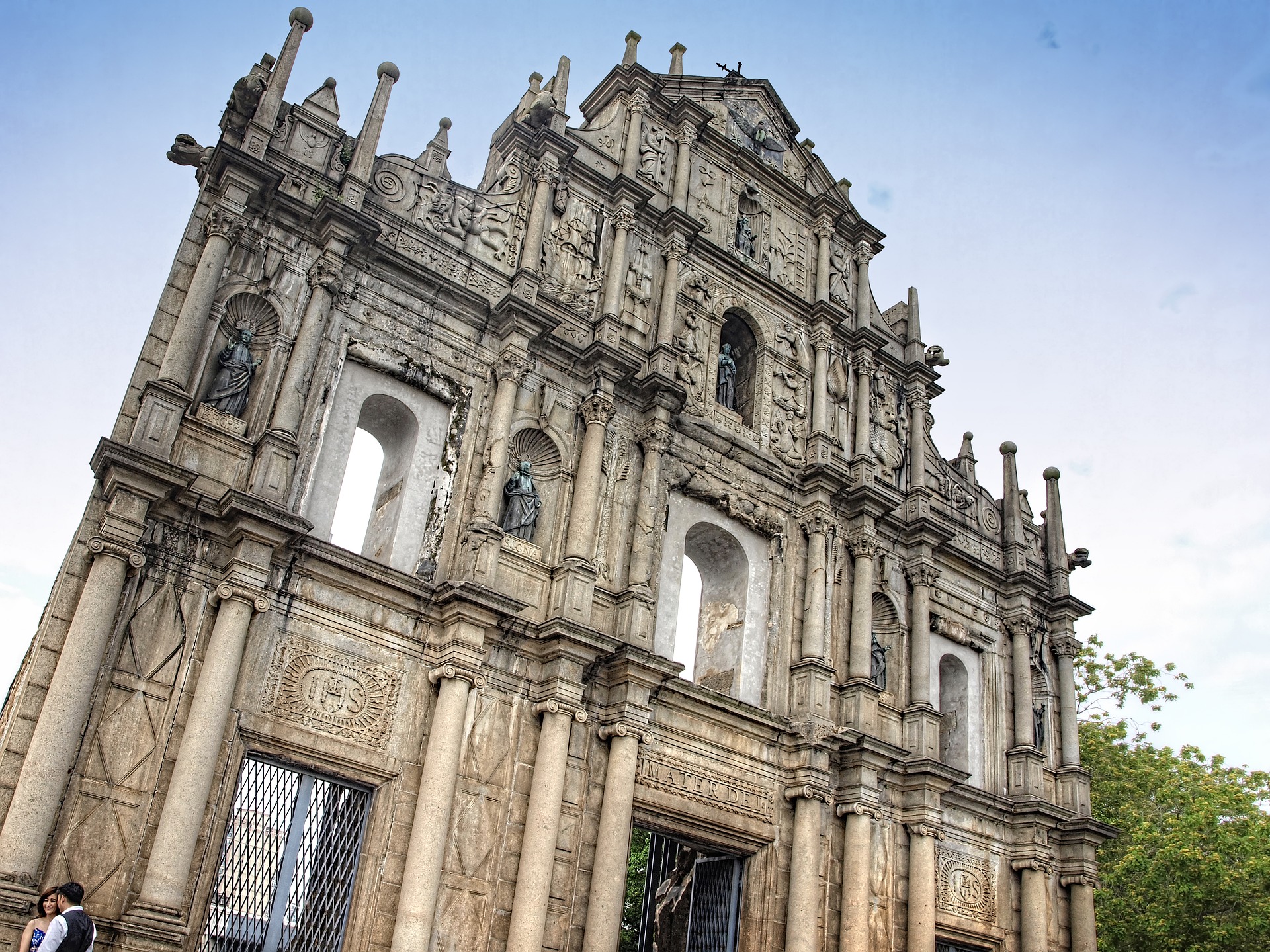
- Ruins of St. Paul's: The ruins of a church in the old town.
- Cotai Strip: Giant casino resorts, shows and shopping.
- Taipa and Coloane villages: Colonial shops and houses along narrow lanes.
- Macau Tower: Great views, and a 233 m bungy jump, among the highest in the world.
- Macanese food: A mix of Portuguese, Chinese, African and Asian flavours.
Places to visit
- Coast
- Island
- Park
- Historic site
- District
Beyond the cities
- Macau Peninsula (district): The old city, with most of the sights, hotels and restaurants.
- Senado Square (site): A square in the World Heritage old town, with Portuguese-style paving.
- Ruins of St. Paul's (site): The ruins of a church, reached by a street of beef jerky shops.
- Macau Tower (site): A tower with sweeping views and adventure sports.
- Taipa (island): An island with a pretty old village, Portuguese and Macanese restaurants and hiking trails.
- Cotai (district): Reclaimed land between the islands, now the strip of giant casino resorts.
- Coloane (island): The most rural part of Macau, with a quiet village and hills for hiking.
- Hac Sa Beach (coast): A black-sand beach on Coloane, busy at weekends.
- Seac Pai Van Park (park): A park on Coloane, home to the Giant Panda Pavilion.
Regions
- Macau Peninsula: The historic city and the old casino district.
- Taipa: An island with the airport and an old village.
- Cotai: Reclaimed land with the biggest casino resorts.
- Coloane: Quiet and green, with a village and beaches.
Things to do
See
- Heritage walk Senado Square: Follow the old town's 25 listed buildings and squares on foot.
- Ruins of St. Paul's Ruins of St. Paul's: The church ruins, with jerky shops offering samples on the way up.
- Taipa and Coloane villages Taipa: Former fishing villages with colonial shops and houses.
- Giant pandas Seac Pai Van Park: The Macao Giant Panda Pavilion on Coloane.
Do
- Casinos of Cotai Cotai: The "Las Vegas Strip of the East", led by the Venetian; minimum age 21.
- Bungy jump Macau Tower: A 233 m jump, among the highest in the world.
- Beaches and hikes Coloane: Hac Sa and Cheoc Van beaches, and trails in the hills.
Eat
- Egg tarts and Macanese dishes: Pastéis de nata, African chicken and minchi.
Shop
- Almond cookies: Macau's favourite souvenir, sold everywhere.
After dark
- The House of Dancing Water Cotai: A lavish water show at City of Dreams.
Itineraries
Macau in 3 days (3 days)
- Macau Peninsula (1 night): Senado Square, the Ruins of St. Paul's and the old town on foot; Macau Tower at sunset.
- Taipa (1 night): The old village, then the casinos and shows of Cotai.
- Coloane (1 night): The village, the pandas and Hac Sa Beach.
Getting there and around
| Main airports | MFM |
|---|
Getting there
By sea: most visitors arrive by ferry. Boats from Sheung Wan on Hong Kong Island run around the clock, about every 15–30 minutes by day; others leave from Kowloon and from Shenzhen and Zhuhai. Night and weekend crossings cost more, and touts sell tickets for boats about to leave. By bus: shuttle buses cross the Hong Kong–Zhuhai–Macau Bridge every few minutes, day and night, in about 40 minutes. By air: Macau International Airport is popular with low-cost airlines from Asia and mainland China. On foot: from Zhuhai in mainland China you cross at Portas do Cerco (the Barrier Gate), which is very busy, or at Hengqin, linked to Macau's light rail. Leaving for mainland China counts as an international crossing: you need a Chinese visa.
Getting around
The old city is best seen on foot: it is compact and hilly, and you will get lost, which is part of the fun. Buses have a flat fare of MOP 6, unchanged since 2018 according to Wikivoyage, with no change given (Hong Kong coins accepted), and are cheaper with a Macau Pass card or the MPay app; routes can be hard to follow, so have your destination written in Chinese. The light rail links the Taipa ferry terminal and the airport with Taipa, Cotai and Barra. Casinos and hotels run free shuttle buses, many from the ferry terminal.
Taxis are cheap, but few drivers speak English: carry your destination in Chinese. Uber and other ride-hailing apps are illegal, and police act against drivers and passengers. Traffic drives on the left; with a UK licence you need a 1949 international driving permit (Canada also advises carrying one), and you must register to drive for more than 14 days.
Flying to Macau? PartnerCompare fares and find the cheapest datesSearch flightsWhere to stay
- Casino resorts: Large, high-end hotels on the Cotai Strip and Taipa.
- Peninsula hotels: Most of Macau's hotels, close to the old town.
- Coloane: Few, quieter places, including a beachside pousada.
Prices peak on Friday and Saturday nights, when crowds come to gamble; booking through a travel agent, even on the day, is often cheaper than walking in. You must stay in licensed accommodation: you can be fined up to MOP 3,000 if you do not, and the Macao Tourism Office lists licensed places. 'Saunas' in Inner Harbour hotels are often fronts for sex work.
Eat and drink
Dishes to try
- Pastéis de nata: Egg tarts, crisp outside and soft inside.
- Galinha à africana: Barbecued chicken in spicy piri-piri sauce.
- Galinha à portuguesa: Chicken in a coconut curry, a Macanese invention.
- Minchi: Minced pork stir-fried with potatoes and onions.
- Pork chop bun: A fried pork chop in a fresh bun, Macau's burger.
- Bacalhau: Portuguese salted cod with potatoes and vegetables.
- Serradura: A "sawdust" pudding of cream and crumbled biscuits.
- Dim sum: Cantonese food is still the local favourite.
Drinks
- Portuguese wine: Good value, including vinho verde, a young white that suits salty Macanese food.
- Bubble tea: A favourite with young locals.
| Tipping | Not expected; full-service restaurants usually add a service charge, and hotel porters may expect about MOP 10. |
|---|
Macanese cuisine mixes Portuguese and Chinese cooking with spices from Africa, India and South-East Asia; many 'Portuguese' restaurants actually serve Macanese dishes. Taipa is a good place to try both, while simple Cantonese eateries in the centre serve rice and noodle dishes cheaply, often with menus only in Chinese. Vegetarians can try the Buddhist vegetarian places on the Peninsula.
The drinking age is 18, and drunken behaviour is not tolerated. There is lively nightlife in the bars along Avenida Sun Yat Sen.
Entry requirements and visas
| Passport validity | UK: at least 90 days after the date you leave Macau. Canada: at least 30 days after the date you leave |
|---|
| Passport | Entry | Max stay | Notes |
|---|---|---|---|
| United Kingdom | Visa free | 180 days | Up to 6 months without a visa. |
| Canada | Visa free | 30 days | Visa-free for up to 30 days; extensions from the Immigration Department. |
Other nationalities: check the official source below.
Macau has its own immigration rules, separate from mainland China and Hong Kong. Visitors may be asked to show at least MOP 5,000 and an onward ticket. Passports are not stamped: you get a landing slip instead. If you go on to mainland China, you need a Chinese visa before reaching the border, and a double or multiple-entry visa if you come back the same way.
The UK says you need a yellow fever certificate if you arrive from a country with a risk of transmission; the CDC and Canada say it is not required. Declare cash over MOP 120,000. Rules depend on your passport: check the official link before you book.
Money and payments
| Currency | Hong Kong Dollar (HKD), Macanese Pataca (MOP) |
|---|---|
| Cards | Common |
Macau uses the pataca (MOP), pegged to the Hong Kong dollar. Hong Kong dollars are accepted almost everywhere at 1:1, a small loss for you, and casinos prefer them; government offices and museums take only patacas. Patacas are hard to exchange abroad, so do not leave with many. Banks and ATMs are on almost every street. Visa, Mastercard and American Express are widely accepted in larger restaurants and shops, though smaller ones may set a minimum spend.
Many shops take the Macau Pass card and the MPay app; Hong Kong's Octopus card generally does not work. Unlicensed money changers are illegal: use banks or official exchanges. Bargaining is limited to a little haggling in small shops. You must declare more than MOP 120,000, or the same in other currencies, when you enter or leave Macau.
Health
| Required vaccines | Yellow fever: the UK says you need a certificate if you arrive from a country with a risk of transmission; the CDC and Canada say it is not required |
|---|---|
| Recommended vaccines | Routine vaccines, including measles (MMR), Hepatitis A, Hepatitis B, Typhoid: consider it for long stays or visits to friends and relatives, Mpox, for travellers at risk of sexual exposure |
| Malaria | None |
| Tap water | Safe |
The CDC lists no malaria for Macau. There have been cases of dengue, mostly controlled by spraying, so use repellent, especially at dusk. Tap water is safe, but many locals boil or filter it because of old building pipes. The jump from hot, humid streets to cold air-conditioning makes some people ill: carry a long-sleeved layer.
Healthcare is fine for routine care, but complex cases are usually sent to Hong Kong, where visitors pay the full cost: have insurance that covers it and evacuation. UK prescriptions are not valid; you need a local doctor. Emergency 999.
This is general information, not medical advice: check with a travel health professional before you go.
Safety
- United States: Level 3: Reconsider Travel (2026-10-20)
- Canada: Exercise a high degree of caution (2026-10-20)
- United Kingdom: No advice against travel (2026-10-20)
The US advises reconsidering travel, and Canada advises a high degree of caution because of the risk of arbitrary enforcement of local laws; the UK does not advise against travel. Crime is low, but pickpockets work in crowds, at tourist sights, at the border posts and in casinos late at night; watch your bags when checking out of hotels, and keep an eye on your card when paying. Ignore touts offering cheap rides from the ferry terminal, people asking for money because they have 'lost their wallet', and scam text messages near the Barrier Gate.
Photographing or filming people without their permission is a crime, and so is photographing military sites. Drug laws are strict. Online gambling and unlicensed money changers are illegal. Typhoons can strike from May to November: when signal 8 or higher is raised, everything closes and you should stay indoors, and storm surges can flood the city. Emergency 999.
Customs and etiquette
Manners are much like in Hong Kong. Locals are used to Westerners after centuries of Portuguese rule, but do not assume they speak English or Portuguese; a few words of Cantonese help. Hand over business cards with both hands. In Chinese temples, do not point at statues of deities with your index finger: use your thumb or an open palm. Drunken behaviour is frowned upon.
Canada warns that national security offences are broadly and vaguely defined and can include activities that took place outside Macau.
Gambling is the main industry, and casinos are built to be addictive: play responsibly. Taking photos in the gambling areas of casinos is prohibited. Many taxi drivers are off duty on Sundays.
You cannot bring e-cigarettes, vaporizers or their refills into or out of Macau, and offenders face heavy fines.
Language
| Official languages | Chinese, Portuguese |
|---|---|
| English | Common |
| Hello | 你好 (Néih hóu) |
|---|---|
| Please | 請 (Chéng) |
| Thank you (for help) | 唔該 (M̀h'gōi) |
| Thank you (for a gift) | 多謝 (Dōjeh) |
| Excuse me | 唔好意思 (M̀h'hóu yisi) |
| Goodbye | 再見 (Joigin) |
What to pack
- Passport valid 90 days beyond your stay: Required for entry.
- Hong Kong dollars or patacas in cash: Buses need the exact fare and give no change.
- Your hotel's address in Chinese: Most taxi drivers speak only Cantonese.
- A long-sleeved layer: Air-conditioning indoors is cold after the summer heat.
- Insect repellent: Dengue occurs.
- A 4G or 5G phone with VoLTE: 2G and 3G networks are switched off.
Quick reference
Country facts
| Population | 685,900 (2025) |
|---|---|
| Area | 33 km² |
| Time zone | Asia/Macau (UTC+8) |
| Calling code | +853 |
| Driving side | left |
Staying connected
| SIM and eSIM | Coverage is excellent, but only 4G and 5G with VoLTE work. CTM sells a 5-day prepaid tourist card and eSIMs; SIMs must be registered in your name. The country code is +853. |
|---|---|
| Wi-Fi | Free public Wi-Fi ('FreeWiFi.MO by WiFiGo') is available in many places and on buses, though not very reliable. The internet is not censored, unlike in mainland China. |
Emergency numbers
| Emergency | 999 |
|---|
Frequently asked questions
Do I need a visa for Macau?
Not for tourism if you hold a UK or Canadian passport: UK citizens can stay up to 6 months, Canadians 30 days. Rules depend on your passport: check the official link before you book.
Can I use Hong Kong dollars in Macau?
Yes, almost everywhere at 1:1. Government offices take only patacas.
How do I get from Hong Kong to Macau?
By ferry from Sheung Wan or Kowloon, or by shuttle bus across the Hong Kong–Zhuhai–Macau Bridge, about 40 minutes.
Is Uber available in Macau?
No. Uber and other ride-hailing apps are illegal; use licensed taxis, buses or the free casino shuttles.
What is the minimum age for casinos?
21.
Can I drink the tap water?
It is safe, but many locals boil or filter it because of old pipes in buildings.
More Travel Stories from Asia
 Cambodia
Sources This guide was last checked on · 15 sources
- Wikivoyage: Macau · Overview, Places to visit, Things to do, Itineraries, Getting there and around, Where to stay, Eat and drink, Entry requirements and visas, Money and payments, Health, Safety, Customs and etiquette, Language, What to pack, Staying connected, Frequently asked questions
- Wikidata: Macau · Overview, Places to visit, Money and payments, Country facts
- UK FCDO: Macao safety and security · Getting there and around, Safety
- Government of Canada: Macau travel advice (updated 09 October 2026) · Getting there and around, Entry requirements and visas, Money and payments, Safety, Customs and etiquette, Frequently asked questions
- UK FCDO: Macao entry requirements · Where to stay, Entry requirements and visas, What to pack, Frequently asked questions
- ISO 4217 (SIX), published 2026-09-17 · Money and payments
- CDC Travelers' Health: Macau · Health, Frequently asked questions
- UK FCDO: Macao health · Health
- US Department of State: Macau travel advisory · Safety
- UK FCDO: Macau travel advice · Safety
- Wikivoyage: Cantonese phrasebook · Language
- World Bank, SP.POP.TOTL · Country facts
- World Bank, AG.LND.TOTL.K2 · Country facts
- IANA Time Zone Database, zone.tab · Country facts
- UK FCDO: Macau getting help · Emergency numbers
Suggest an update
Travel rules, prices and timetables change. If something in this guide is out of date, tell us: we check every suggestion against an official source before changing the page.