

- Local time
- 07:37
- Currency
- Maldivian Rufiyaa (MVR)
- Capital
- Malé
- Calling code
- +960
- Drive on the
- left
Overview
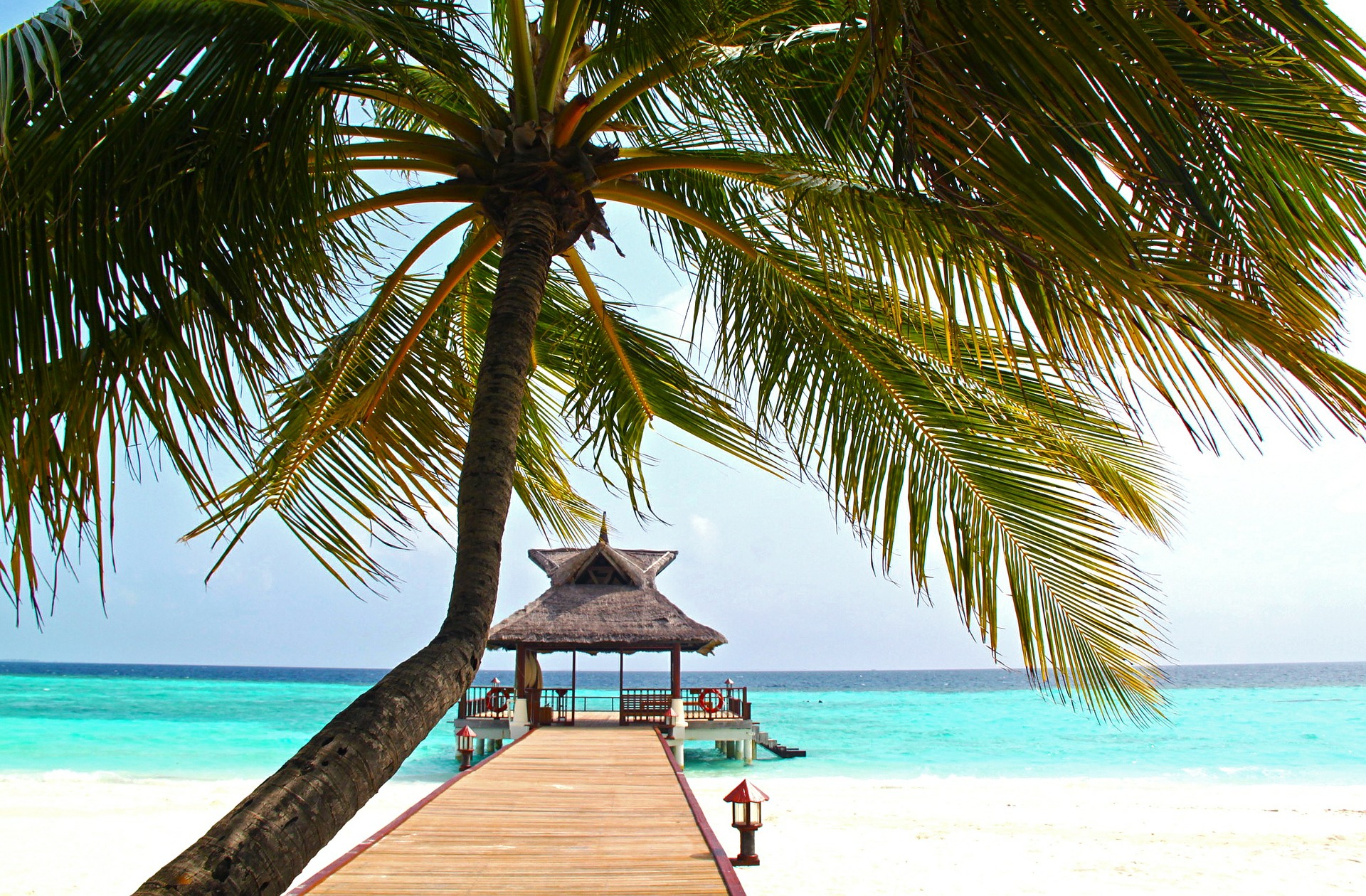
The Maldives are a chain of coral atolls in the Indian Ocean: white beaches, turquoise lagoons and overwater villas, superb diving with mantas and whale sharks, and, beyond the resorts, local islands with guesthouses, fishing villages and Maldivian food.
The Maldives are about 1,192 low-lying coral islands grouped in 26 ring-shaped atolls in the Indian Ocean. The classic image of a palm-covered islet, white sand and an overwater villa over a turquoise lagoon is real: many resorts occupy an entire island of their own. The sea is the main attraction, with more than 2,000 species of fish, reef sharks, turtles, rays, dolphins and, in the right season, manta rays and whale sharks; diving is excellent and even a mask and snorkel reveal a lot.
Since 2008 visitors can also stay on inhabited islands, where guesthouses cost a fraction of a resort and you see the fishing villages, mosques and cafés of everyday life. Local islands follow strict Muslim norms: no alcohol and modest dress. Malé, the capital, is crammed onto a small island next to the airport.
- Diving and snorkelling: Clear water, coral reefs, manta rays and sharks.
- Baa Atoll: A UNESCO biosphere reserve, with mantas gathering at Hanifaru Bay.
- Resort islands: An island to yourself, from dive resorts to luxury villas.
- Local islands: Guesthouses and village life at a fraction of resort prices.
- Malé: The crowded capital, with the National Museum and old mosques.
- Surfing: Uncrowded waves from March to October.
Places to visit
- City
- Island
- Area
Cities
- Malé: The capital and by far the largest city, packed onto a small island.
- Addu City: The second city, in the far south, with Gan airport.
- Fuvahmulah: An island just north of Addu, well off the beaten track.
- Kulhudhuffushi: The largest town in the northern Maldives.
Beyond the cities
- Hulhumalé (island): A part of Malé near the airport, handy for a night before a transfer.
- Maafushi (island): A popular inhabited island with many guesthouses.
- Rasdhoo (island): A small inhabited island, capital of North Ari Atoll.
- Ukulhas (island): A small inhabited island, about 1 km long, in Ari Atoll.
- Thoddoo (island): An isolated inhabited island, the largest producer of watermelons in the country.
- Mathiveri (island): An island of North Ari Atoll.
- Baa Atoll (area): A UNESCO biosphere reserve with rich coral reefs; manta rays gather at Hanifaru Bay.
Regions
- Kaafu: The atolls around Malé and the airport, with many family resorts and local islands such as Maafushi.
- Alifu (Ari): West of Kaafu, the second most popular group.
- Baa: A UNESCO biosphere reserve.
- Seenu (Addu): The southernmost atoll, with Gan International Airport.
Things to do
See
- Manta rays at Hanifaru Bay Baa Atoll: One of the largest gatherings of mantas in the world.
- National Museum Malé: Carved woodwork, religious pieces and historic objects.
- Local island life Maafushi: Guesthouses, cafés and villages beyond the resorts.
Do
- Scuba diving: Reefs, mantas, sharks and wrecks; liveaboards can be cheaper than resorts.
- Snorkelling the house reef: Many islands have a reef you can reach straight from the beach.
- Surfing: Best from March to October, with the biggest waves in June to August.
Eat
- Mas huni for breakfast: Tuna, coconut, onion and chilli, scooped up with roshi flatbread.
- Hotaa cafés Malé: Cheap local cafés serving short eats and fish curry.
Itineraries
Local islands on a budget in 7 days (7 days)
- Hulhumalé (1 night): A first night near the airport.
- Maafushi (3 nights): Guesthouses, beaches and day trips by boat.
- Rasdhoo (2 nights): The capital of North Ari Atoll.
Ari Atoll island-hopping in 6 days (6 days)
- Rasdhoo (2 nights): The atoll capital.
- Ukulhas (2 nights): A small inhabited island about 1 km long.
- Thoddoo (1 night): An isolated farming island.
The far south in 5 days (5 days)
- Addu City (3 nights): Reached by domestic flight to Gan.
- Fuvahmulah (1 night): Off the beaten track.
Climate and best time to visit
| Jan | Feb | Mar | Apr | May | Jun | Jul | Aug | Sep | Oct | Nov | Dec | |
|---|---|---|---|---|---|---|---|---|---|---|---|---|
| Max °C | 30 | 31 | 31 | 32 | 31 | 31 | 31 | 30 | 30 | 30 | 30 | 30 |
| Min °C | 26 | 26 | 26 | 27 | 26 | 26 | 26 | 26 | 25 | 25 | 25 | 25 |
| Rain mm | 114 | 38 | 74 | 123 | 219 | 167 | 150 | 176 | 199 | 194 | 231 | 217 |
In Malé it is warm all year, with highs of 30–32 °C and lows of 25–27 °C every month. February and March are the driest months (about 40 and 75 mm), while from May to December rain is about 150 mm or more a month, peaking in November at over 230 mm. Wikivoyage notes that rain increases with the south-west monsoon from April to October, especially from June to November.
January to April is the driest period. Surfers come from March to October, when the biggest waves arrive in June to August. Heavy rain can cause flash floods on low-lying islands.
Getting there and around
| Main airports | MLE, GAN |
|---|
Getting there
By air: almost everyone arrives at Velana International Airport on Hulhulé, next to Malé, with flights from China, India, Sri Lanka, Dubai, South-East Asia and Europe; many stop in Colombo. Gan airport, in Addu Atoll, has a few international flights. Departure tax is normally included in your ticket. By sea: there are no regular passenger boats to the Maldives.
Getting around
Resorts near Malé send speedboats or dhonis to the airport; distant ones use seaplanes, which do not fly after dark, so a late arrival may mean a night in Malé or Hulhumalé. Seaplane delays of several hours are common, and evening flights are often cancelled. Domestic airlines fly from Malé to Gan, Fuvahmulah, Kulhudhuffushi and other islands. On a budget, public ferries run by MTCC link islands cheaply, and RTL buses serve Malé and the airport.
You can travel freely between inhabited islands, but Canada notes that you need permission to visit uninhabited islands or islands outside the tourism zone. On boat trips, listen to the safety briefing and make sure life jackets are provided. Few islands have roads for cars, and traffic drives on the left. Rules on licences differ: the UK says you need an international driving permit with your licence, while Canada says you need a local driving permit and international licences are not accepted.
Flying to Maldives? PartnerCompare fares and find the cheapest datesSearch flightsWhere to stay
- Dive resorts: Simple on land but with excellent house reefs, often in remote atolls.
- Holiday resorts: Large, family-friendly resorts with many facilities, mostly in Kaafu near Malé.
- Luxury resorts: Overwater villas, gourmet food and high prices.
- Guesthouses: On inhabited islands such as Maafushi, from about US$30 or €25–35 a night as listed on Wikivoyage in October 2026.
- Village homestays: Informal rooms on remote islands, from about €15 a night as listed on Wikivoyage in October 2026.
Most resorts have an island to themselves, and many cater mainly to one nationality. Overwater bungalows look wonderful but can be packed close together, too shallow for swimming at low tide and noisy in a storm. Factor in transfer time and cost: far-flung resorts are quieter, with better diving, but need a seaplane. Staying on inhabited islands means following local Muslim norms.
Eat and drink
Dishes to try
- Mas huni: Smoked or canned tuna with coconut, onion, chilli and lime, the classic breakfast.
- Garudhiya: A clear fish broth served with rice, lime, chilli and onions.
- Riha: Spicy fish curries with coconut.
- Roshi: Unleavened flatbread, like roti.
- Fihunu mas: Grilled fish basted with chilli.
- Hedhikaa: Fried snacks such as gulha and bajiya, usually filled with fish.
Drinks
- Alcohol: Only on resorts and liveaboard boats; banned elsewhere.
- Bottled water: Very expensive in resorts, often around US$5 a bottle.
| Tipping | A 10% service charge is added to almost everything; tipping is not compulsory, though many visitors tip. |
|---|
Resorts serve mostly European or general Asian food; half or full board can save money but limits your choice. In Malé, local cafés called hotaa serve a full Maldivian meal for about Rf20, while tourist restaurants are pricier. Maldivian food revolves around fish, especially tuna, and is spicy and full of coconut, with few vegetables.
Alcohol brought in is confiscated at the airport. Never take alcohol out of your resort: drinking or being drunk on inhabited islands can lead to arrest and deportation.
Entry requirements and visas
| Passport validity | At least 1 month from arrival, undamaged (FCDO, for UK passports); at least 6 months from entry for Canadian passports (Canada) |
|---|
| Passport | Entry | Max stay | Notes |
|---|---|---|---|
| United Kingdom | Visa on arrival | 30 days | A 30-day visa on arrival if you enter as a tourist. |
| Canada | Visa on arrival | 30 days | A 30-day visa on arrival, extendable to a total of 90 days. |
Other nationalities: check the official source below.
UK and Canadian tourists get a 30-day visa on arrival. Canada says you need an onward or return ticket and proof of sufficient funds, and you must submit the online traveller declaration (IMUGA) within 96 hours before your flight lands. A yellow fever certificate is needed if you arrive from a country with a risk of transmission.
Bags are X-rayed on arrival. You cannot bring in alcohol, pork, vaping products, pornography, or items considered contrary to Islam such as idols and bibles. Taking out coral, shells, sand or tortoiseshell is forbidden. Rules depend on your passport: check the official link before you book.
Money and payments
| Currency | Maldivian Rufiyaa (MVR) |
|---|---|
| Cards | Common |
The currency is the rufiyaa (MVR), but resorts price everything in US dollars and take cards or hard currency. US dollars are accepted almost everywhere. If you visit Malé or local islands, some rufiyaa helps; change money at the Bank of Maldives at the airport and keep the receipt if you want to change it back. ATMs are only in Malé and the more populated non-resort islands, according to Canada. Card and ATM fraud happens: use ATMs inside banks or in busy places.
Resorts are expensive, since guests depend on them for everything: as listed on Wikivoyage in October 2026, allow about US$1,000 per couple per week for meals, drinks and excursions at a mid-range resort. On local islands costs are much lower, with cheap food and ferries.
Health
| Required vaccines | Yellow fever: certificate from 9 months of age if you arrive from a country with a risk of transmission, including airport transits of more than 12 hours there |
|---|---|
| Recommended vaccines | Routine vaccines, including measles (MMR), Hepatitis A, Hepatitis B, Typhoid |
| Malaria | None |
| Tap water | Varies |
The Maldives are malaria-free, but dengue occurs, so use repellent. Most health problems come from the sun, the heat and diving: drink plenty of water and stay in the shade. Tap water is not drinkable at every resort, so ask.
The only fully equipped hospitals are in Malé and Hulhumalé, and many resorts are hours from emergency care, though most have a doctor or nurse. There are three decompression chambers: check how your dive operator would get you to one. Serious cases may be flown abroad, so have insurance that covers evacuation and diving. Ambulance 102.
This is general information, not medical advice: check with a travel health professional before you go.
Safety
- United States: Level 2: Exercise Increased Caution (2026-10-20)
- Canada: Exercise a high degree of caution (2026-10-20)
- United Kingdom: No advice against travel (2026-10-20)
The US advises increased caution and Canada a high degree of caution because of the threat of terrorism; the UK does not advise against travel, but notes that attacks cannot be ruled out. Crime is low on resort islands, though things left on the beach or in unlocked rooms can disappear. In Malé and Hulhumalé there is gang violence, including knife crime: avoid empty streets on foot after dark, and stay away from protests. Solo women may face harassment. Police: 119.
Strong currents drown tourists every year: swim only where resort staff say it is safe. Boat propellers have caused fatal accidents near whale shark sites in South Ari. Drug laws are extremely strict, with penalties up to death. Alcohol is allowed only in resorts. Same-sex relations are illegal, and so is public worship of any religion other than Islam.
Customs and etiquette
The Maldives are a strictly Muslim country. Outside resorts, including on beaches used by locals, cover your shoulders and avoid short or tight shorts; bikinis are allowed only in designated areas on some local islands. Nudity and topless sunbathing are banned everywhere, including resorts. Avoid speaking negatively about religion.
Canada notes that possessing or using e-cigarettes and vapes is illegal and punished with a fine, and smoking is banned in public places, including beaches, outside designated areas. Anyone born after 31 December 2006 may not buy or use tobacco.
During Ramadan, do not eat, drink or smoke in public in the daytime outside resorts. Many resorts have a no-shoes policy, and staff often speak German or Italian as well as English.
Language
| Official languages | Divehi |
|---|---|
| English | Widespread |
| Hello (formal) | އައްސަލާމު ޢަލައިކުމް (Assalaamu alaikum) |
|---|---|
| Hello / welcome | މަރުޙަބާ (Maruhabaa) |
| Thank you | ޝުކުރިއްޔާ (Shukuriyyaa) |
| Please | އާދޭސް ކޮށްފަ (Aadheys koffa) |
| Excuse me | މަޢާފް ކުރޭ (Ma'aaf kurey) |
| Yes / No | Aan / Noon |
What to pack
- Onward or return ticket and proof of funds: Needed for the visa on arrival.
- US dollars: Accepted almost everywhere, and resorts price in dollars.
- Clothes covering shoulders and knees: Required on local islands and their beaches.
- Sun protection and a water bottle: Sunburn and heatstroke are the main health problems.
- Insect repellent: Dengue occurs on some islands.
- Insurance covering diving and evacuation: Hospitals and decompression chambers can be hours away.
Quick reference
Country facts
| Capital | Malé |
|---|---|
| Population | 529,676 (2025) |
| Area | 298 km² |
| Time zone | Indian/Maldives (UTC+5) |
| Calling code | +960 |
| Driving side | left |
Staying connected
| SIM and eSIM | Dhiraagu (wider coverage) and Ooredoo sell prepaid SIMs and eSIMs with 4G and 5G data at their shops in the airport arrivals area. The country code is +960. |
|---|---|
| Wi-Fi | Most hotels and cafés offer Wi-Fi, but it is usually slow, and many public hotspots require a local phone number. |
Emergency numbers
| Police | 119 |
|---|---|
| Ambulance | 102 |
| Fire | 118 |
Frequently asked questions
Do I need a visa for the Maldives?
UK and Canadian tourists get a 30-day visa on arrival; Canada says you need an onward or return ticket and proof of sufficient funds. Fill in the IMUGA declaration within 96 hours before landing. Check the official link before you book.
Can I drink alcohol in the Maldives?
Only on resort islands and liveaboard boats. Alcohol is banned on inhabited islands, and any you bring is confiscated at the airport.
Can I visit the Maldives on a budget?
Yes, by staying in guesthouses on inhabited islands, from about US$30 a night as listed on Wikivoyage in October 2026, and using public ferries.
How do I get to my resort?
By speedboat for resorts near Malé, by seaplane or domestic flight for distant ones. Seaplanes do not fly after dark.
When is the best time to visit?
January to April is the driest period; rain increases from May, especially from June to November.
Can I wear a bikini?
Yes in resorts, but on local islands only on designated beaches; elsewhere cover your shoulders and thighs.
More Travel Stories from Asia

 Laos
 Cambodia
Sources This guide was last checked on · 16 sources
- Wikivoyage: Maldives · Overview, Places to visit, Things to do, Itineraries, Climate and best time to visit, Getting there and around, Where to stay, Eat and drink, Entry requirements and visas, Money and payments, Health, Safety, Customs and etiquette, Language, What to pack, Staying connected, Frequently asked questions
- Wikidata: Maldives · Overview, Places to visit, Money and payments, Country facts
- WMO World Weather Information Service: Male' · Climate and best time to visit
- UK FCDO: Maldives safety and security · Climate and best time to visit, Getting there and around, Eat and drink, Safety, Customs and etiquette, What to pack
- Government of Canada: Maldives travel advice (updated 09 October 2026) · Getting there and around, Entry requirements and visas, Money and payments, Health, Safety, Customs and etiquette, What to pack, Frequently asked questions
- UK FCDO: Maldives entry requirements · Where to stay, Entry requirements and visas, What to pack, Frequently asked questions
- ISO 4217 (SIX), published 2026-09-17 · Money and payments
- CDC Travelers' Health: Maldives · Health
- UK FCDO: Maldives health · Health
- US Department of State: Maldives travel advisory · Safety
- UK FCDO: Maldives travel advice · Safety
- UK FCDO: Maldives getting help · Safety, Emergency numbers
- Wikivoyage: Dhivehi phrasebook · Language
- World Bank, SP.POP.TOTL · Country facts
- World Bank, AG.LND.TOTL.K2 · Country facts
- IANA Time Zone Database, zone.tab · Country facts
Suggest an update
Travel rules, prices and timetables change. If something in this guide is out of date, tell us: we check every suggestion against an official source before changing the page.