

- Local time
- 13:39
- Currency
- Polish Zloty (PLN)
- Capital
- Warsaw
- Calling code
- +48
- Drive on the
- right
Overview
Rebuilt old towns in Kraków, Warsaw and Gdańsk, castles, primeval forest with bison, lakes and the Tatra Mountains, at some of Europe's lowest prices.
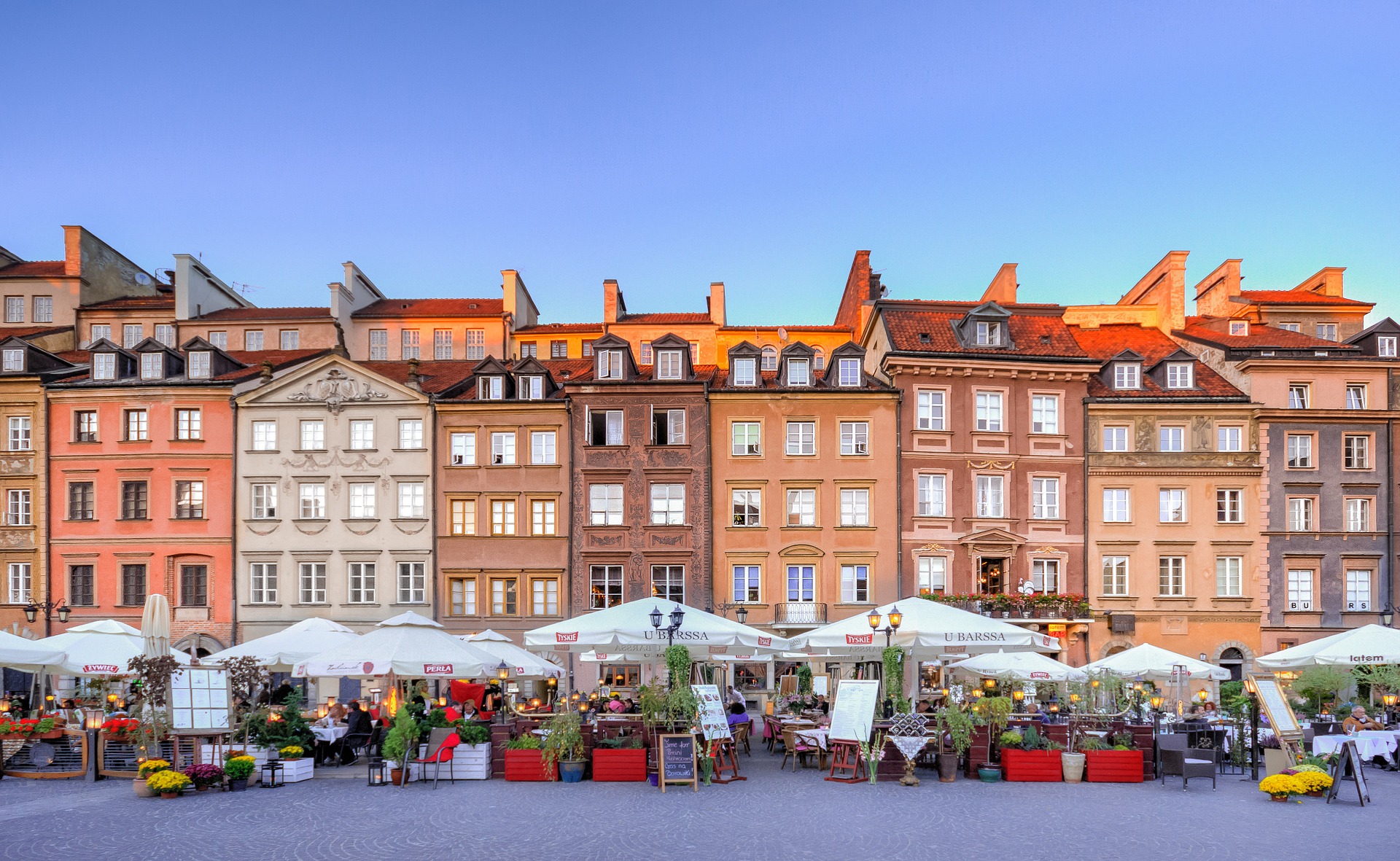
Poland stretches from the Baltic coast in the north to the Tatra Mountains in the south, with forests, lakes, rolling hills and plains in between. Its cities carry a thousand years of history: Kraków, the old royal capital, has a UNESCO-listed centre around the largest medieval market square in Europe; Warsaw's old town, almost destroyed in the Second World War, was carefully rebuilt; Gdańsk shows its Hanseatic past and Toruń its Gothic architecture. Auschwitz-Birkenau, near Kraków, is a sobering World Heritage memorial to the Holocaust.
Nature is never far: Białowieża's ancient forest is the only place where European bison live in the wild, the Masurian lakes are made for sailing, rivers in the north for canoeing, and the mountains of the south offer marked trails for every level. Trains and buses are cheap and frequent, and prices in Poland are among the lowest in Europe. Poland uses the złoty (PLN) and is part of the EU and the Schengen area.
- Kraków: The cultural capital, with a UNESCO-listed centre and the largest medieval market square in Europe.
- Warsaw: The capital, with its rebuilt old town and the Royal Route.
- Gdańsk: A Hanseatic port city, rebuilt after the war, and gateway to the Baltic resorts.
- Auschwitz-Birkenau: The Nazi extermination camp, a World Heritage memorial about 50 km from Kraków.
- Wieliczka Salt Mine: Worked continuously since the 13th century, a UNESCO site and an easy day trip from Kraków.
- Białowieża National Park: Primeval forest on the Belarus border, home to wild European bison.
Places to visit
- City
- Park
- Mountain
- Historic site
- Area
Cities
- Kraków: The historic capital, full of churches and monuments around the great market square; a UNESCO World Heritage Site.
- Warsaw: The capital and business centre; its old town was rebuilt after the war.
- Gdańsk: A beautiful Hanseatic port city, a base for the Baltic resorts.
- Wrocław: A Silesian city on 12 islands with many bridges and Centennial Hall.
- Poznań: A merchant city regarded as a birthplace of the Polish nation.
- Toruń: A medieval city of Gothic architecture that escaped wartime destruction.
- Lublin: The largest city in the east, with a well-preserved old town.
- Łódź: A former textile city with Piotrkowska Street, a long pedestrian avenue of 19th-century buildings.
- Zamość: A Renaissance "ideal town", listed by UNESCO.
Beyond the cities
- Auschwitz-Birkenau (site): The former Nazi extermination and labour camps, a UNESCO World Heritage Site.
- Wieliczka Salt Mine (site): A salt mine worked since the 13th century, a UNESCO World Heritage Site.
- Malbork Castle (site): A huge Gothic brick castle, a UNESCO World Heritage Site.
- Białowieża National Park (park): Ancient woodland on the Belarus border, with wild bison.
- Tatra Mountains (mountain): The highest mountains in Poland, with demanding trails such as the Eagle's Path.
- Masurian Lake District (area): Around 2,000 lakes, with sailing centres at Giżycko and Mikołajki.
- Słowiński National Park (park): Large sand dunes by the Baltic Sea.
- Karkonosze National Park (park): Mountains around Śnieżka with waterfalls and easy marked trails.
- Kalwaria Zebrzydowska (site): A monastery from 1600 with a Stations of the Cross complex, a UNESCO site.
Things to do
See
- Kraków's old town Kraków: Monumental buildings, museums and the great market square, now also full of pubs and galleries.
- Auschwitz-Birkenau memorial Auschwitz-Birkenau: A visit like no other World Heritage site, about 50 km from Kraków.
- Wieliczka Salt Mine Wieliczka Salt Mine: An underground world worked for centuries, a day trip from Kraków.
- Warsaw's Royal Route Warsaw: From the rebuilt old town past palaces, churches and squares.
- Malbork Castle Malbork Castle: A vast Gothic brick fortress.
- Bison in Białowieża Białowieża National Park: The last remains of Europe's primeval forest.
Do
- Hiking in the mountains: Easy, well-marked trails in Karkonosze; harder routes in the Tatras, with rock and ice until June; quieter walks in Bieszczady.
- Canoeing: Rent a canoe on rivers such as the Drawa, Biebrza and Brda; agencies collect the boats at the end.
- Sailing in Masuria Masurian Lake District: Light winds and good facilities at Giżycko and Mikołajki.
Itineraries
Kraków and Warsaw in 6 days (6 days)
- Kraków (3 nights): The old town, with day trips to Wieliczka and Auschwitz-Birkenau.
- Warsaw (3 nights): Under 3 hours by train; the old town and the Royal Route.
The north in 6 days (6 days)
- Warsaw (1 night): Start in the capital; Gdańsk is under 3 hours by train.
- Gdańsk (3 nights): The Hanseatic city, the Baltic coast and a day trip to Malbork Castle.
- Toruń (2 nights): A medieval city of Gothic architecture.
Climate and best time to visit
| Jan | Feb | Mar | Apr | May | Jun | Jul | Aug | Sep | Oct | Nov | Dec | |
|---|---|---|---|---|---|---|---|---|---|---|---|---|
| Max °C | 1 | 2 | 7 | 14 | 20 | 22 | 25 | 24 | 18 | 13 | 6 | 2 |
| Min °C | -4 | -4 | -1 | 4 | 9 | 12 | 14 | 13 | 9 | 5 | 1 | -3 |
| Rain mm | 27 | 26 | 30 | 34 | 55 | 70 | 73 | 63 | 47 | 33 | 40 | 35 |
Poland has cold winters and warm summers. In Warsaw the average maximum is about 1 to 2 °C from December to February, with nights well below freezing, and about 24 °C in July and August. Most rain falls in summer, with about 70 mm in June and July, while winter and early spring are the driest months.
May to September is the best time for cities, lakes and mountains; in the Tatras, rock and ice can last on high trails until June. In winter, coal and wood heating causes serious smog, especially in the south and in mountain valleys.
Holidays and events
- 1 January 2026 · New Year's Day
- 6 January 2026 · Epiphany
- 5 April 2026 · Easter Sunday
- 6 April 2026 · Easter Monday
- 1 May 2026 · May Day
- 3 May 2026 · Constitution Day
- 24 May 2026 · Pentecost
- 4 June 2026 · Corpus Christi
- 15 August 2026 · Assumption Day
- 1 November 2026 · All Saints' Day
- 11 November 2026 · Independence Day
- 24 December 2026 · Christmas Eve
- 25 December 2026 · Christmas Day
- 26 December 2026 · St. Stephen's Day
Getting around
| Main airports | WAW, KRK, GDN, KTW, WRO, POZ, WMI |
|---|
Trains are cheap by Western European standards: Warsaw to Kraków (every two hours) and Warsaw to Gdańsk (hourly) both take under 3 hours. Intercity trains are modern and fairly punctual; book online to avoid queues and language problems, and note that InterCity tickets are not valid on regional trains. Buses are often cheaper and faster for short trips, though harder to use without Polish. In cities, validate your ticket at the start of the journey or face a fine.
Driving: a UK photocard licence is valid for 6 months. Roads can be narrow and poorly maintained outside the cities, roadworks are frequent in summer, and some drivers overtake aggressively; avoid driving at night in remote areas. Walkers and cyclists must wear a reflective item at night outside towns. Taxis: use official taxis with the company name and a rate card; unofficial drivers overcharge and some passengers have been assaulted.
Flying to Poland? PartnerCompare fares and find the cheapest datesSearch flightsWhere to stay
- Hotels: Accor (ibis, Novotel, Mercure) covers most of the country; prices are now similar to the rest of Europe.
- Hostels: In the big cities, where staff usually speak English.
- Private rooms, pensions and apartments: Often good value, especially off-season.
- Agritourism farms: Farm stays in the countryside.
Small towns off the tourist trail have little choice. If you stay more than 14 days, your stay must be registered within 48 hours; hotels and hosts normally do it.
Eat and drink
Dishes to try
- Pierogi: Dumplings filled with cottage cheese and onion, meat or forest fruits.
- Żurek: Sour rye soup with sausage and a boiled egg.
- Barszcz: Red beetroot soup, often with small dumplings.
- Bigos: Hunter's stew of meats and sauerkraut.
- Gołąbki: Cabbage rolls stuffed with grains and meat.
- Zapiekanka: An open baguette with mushrooms and melted cheese, sold at street stands.
Drinks
- Beer: Excellent pilsner-style lagers such as Żywiec, Tyskie and Lech, and a growing craft scene.
- Vodka: Try Żubrówka (bison grass) and Żołądkowa Gorzka.
- Nalewka and mead: Traditional fruit liqueurs and honey wine.
| Meal times | Light breakfast, a main meal around 13:00 to 14:00 and supper around 19:00. |
|---|---|
| Tipping | About 10% is usual. If you hand over money and say "thank you", it means keep the change. |
Polish cooking is hearty, with meat, sauces and pickled vegetables, but most restaurants have a vegetarian dish. You must be 18 and show ID to buy alcohol, and drinking in public places is illegal.
Entry requirements and visas
| Passport validity | Issued less than 10 years before you arrive, and valid at least 3 months after you leave the Schengen area |
|---|
| Passport | Entry | Max stay | Notes |
|---|---|---|---|
| EU / EEA | Freedom of movement | EU free movement rules apply. | |
| United Kingdom | Visa free | 90 days | 90 days in any 180-day period across the whole Schengen area. |
| Canada | Visa free | 90 days | 90 days in any 180-day period across the whole Schengen area. |
| United States | Visa free | 90 days | 90 days in any 180-day period across the whole Schengen area. |
| Australia | Visa free | 90 days | 90 days in any 180-day period across the whole Schengen area. |
Other nationalities: check the official source below.
- EES (Entry/Exit System): fingerprints and photo at the border, free
- ETIAS (travel authorisation, EUR 20): not in operation yet
Poland is part of the Schengen area. Visitors from the UK, the US, Canada and Australia can stay up to 90 days in any 180-day period without a visa, counting the days spent in other Schengen countries. Non-EU visitors register fingerprints and a photo in the EU's Entry/Exit System (EES) on their first entry: allow extra time at the border, and at the airport when you leave.
Border staff may ask for a return or onward ticket and proof that you have enough money. Dual British-Polish and Canadian-Polish nationals must enter and leave on Polish documents. Cash of €10,000 or more must be declared, and exporting goods over 55 years old with historic value needs a permit. Vehicles with Russian plates are refused entry.
ETIAS, the online travel authorisation for visa-free visitors, is not in operation yet. Rules depend on your passport and can change: check the official link before you book.
Money and payments
| Currency | Polish Zloty (PLN) |
|---|
Poland uses the złoty (PLN), written zł. Cards are accepted almost everywhere in the big cities, less so in small shops and post offices. When a card terminal or ATM offers to charge you in your home currency, choose złoty instead. Exchange offices (kantor) usually give fair rates, except at stations and tourist hot spots. Check your bill in bars and clubs: visitors have been overcharged on cards at the end of the night.
Costs and budget
- Day return by train Warsaw to Kraków (2021): about 100 zł
- Domestic flight with LOT, booked early (Wikivoyage, read in 2026): 60 to 130 zł
- Prepaid SIM starter kit (Wikivoyage, read in 2026): 5 to 20 zł
According to Eurostat, in 2024 the general price level in Poland was about 72% of the EU average, food in shops about 87% and restaurants and hotels about 92%.
Shopping and transport are cheap, but hotel prices in the big cities are now close to the European average.
Health
| Recommended vaccines | Routine vaccines, including measles (MMR) and polio, Hepatitis A, Hepatitis B, Tick-borne encephalitis, if you will hike or camp in forests between April and November, Rabies, only if you will work with wildlife |
|---|---|
| Tap water | Safe |
Tap water is safe everywhere, though sometimes heavily chlorinated; avoid well water in rural areas. Ticks are common in forests. Winter smog can be heavy, especially in the south.
Public hospitals are similar to those in the UK, and private clinics are cheaper. A European (EHIC) or UK (GHIC) card gives access to medically necessary state healthcare, but it does not replace travel insurance. Dial 112 for an ambulance.
This is general information, not medical advice: check with a travel health professional before you go.
Safety
- United States: Level 1: Exercise Normal Precautions (2026-10-20)
- Canada: Take normal security precautions (2026-10-20)
- United Kingdom: No advice against travel (2026-10-20)
Poland is generally safe. Pickpockets work in crowds, at stations and airports and on trains, and bags are stolen on overnight sleeper trains: lock your compartment and keep valuables on you. Drinks are sometimes spiked in bars and clubs, followed by robbery or overcharging. Use only official taxis. Fights can break out near pubs late at night and at football matches.
In the Tatras, storms, lightning and avalanches are real risks: do not hike alone and stay on marked trails. Access to the borders with Ukraine and Belarus is restricted, and debris from the war in Ukraine has fallen near the border. Do not photograph military sites or fly drones near them. Carry ID at all times; a printed copy of your passport photo page is accepted.
Customs and etiquette
Poles are polite and somewhat old-fashioned: hold doors, say dzień dobry when entering a lift, and do not shake hands with gloves on. Men remove hats in churches. If you are invited home, bring flowers in an odd number (even numbers are for funerals) and ask whether to take off your shoes. Call Poland part of Central Europe, not just Eastern Europe, and start in Polish or English rather than Russian.
Drinking in public is illegal, and drunk people can be held in a sobering-up centre at their own cost. Jaywalking is fined. Small towns can be less tolerant of same-sex couples.
Language
| Official languages | Polish |
|---|---|
| English | Common |
| Hello, good morning (formal) | Dzień dobry jeyn DOB-ry |
|---|---|
| Hi | Cześć chesh-ch |
| Please | Proszę PRO-she |
| Thank you | Dziękuję jen-KOO-yeh |
| Excuse me | Przepraszam pshe-PRA-sham |
| Goodbye | Do widzenia do vee-DZE-nya |
| Do you speak English? | Czy mówisz po angielsku? chi MOO-vish po ang-GYEL-skoo |
What to pack
- Passport or ID, or a printed copy: You must carry ID at all times.
- A reflective band or vest: Compulsory for walkers and cyclists at night outside towns.
- Waterproof jacket and good shoes: Mountain weather changes quickly, even in summer.
- A small lock: To lock your backpack to the luggage rack on overnight trains.
- EHIC or GHIC and travel insurance: The card covers only medically necessary state healthcare.
Quick reference
Country facts
| Capital | Warsaw |
|---|---|
| Population | 36,435,861 (2025) |
| Area | 306,070 km² |
| Time zone | Europe/Warsaw (UTC+1) |
| Calling code | +48 |
| Driving side | right |
Staying connected
| SIM and eSIM | Main networks: Plus, T-Mobile, Orange and Play. Prepaid starter kits cost 5 to 20 zł in shops and kiosks and must be registered with your passport. |
|---|---|
| Roaming | With an EU SIM card you pay home prices for calls, texts and data (roam like at home). Others should check their provider's rates. |
Emergency numbers
| Police | 997 |
|---|---|
| Ambulance | 999 |
| Fire | 998 |
Frequently asked questions
Do I need a visa for Poland?
Not for short trips with an EU, UK, US, Canadian or Australian passport: Poland is in the Schengen area, so you can stay up to 90 days in any 180-day period. Check the official EU link before you book.
Does Poland use the euro?
No, the currency is the złoty (PLN). Cards are widely accepted in the cities.
How do I get from Warsaw to Kraków?
By train: every two hours, in under 3 hours.
Can I drink the tap water?
Yes, tap water is safe throughout Poland, though sometimes heavily chlorinated.
Do I need to tip?
About 10% is usual in restaurants and bars, though not compulsory.
Can I drink alcohol outdoors?
No: drinking in public places is illegal and the police can fine you.
More Travel Stories from Europe
 Portugal
Sources This guide was last checked on · 20 sources
- Wikivoyage: Poland · Overview, Places to visit, Things to do, Itineraries, Climate and best time to visit, Getting around, Where to stay, Eat and drink, Money and payments, Costs and budget, Health, Safety, Customs and etiquette, Language, What to pack, Staying connected, Frequently asked questions
- Wikidata: Poland · Places to visit, Money and payments, Country facts
- WMO World Weather Information Service: Warsaw · Climate and best time to visit, Frequently asked questions
- Nager.Date: public holidays in Poland, 2026 · Holidays and events
- UK FCDO: Poland safety and security · Getting around, Money and payments, Safety, Customs and etiquette, What to pack
- Government of Canada: Poland travel advice (updated 9 September 2026) · Getting around, Where to stay, Entry requirements and visas, Health, Safety, Frequently asked questions
- UK FCDO: Poland entry requirements · Entry requirements and visas, What to pack, Frequently asked questions
- European Union: ETIAS official website · Entry requirements and visas
- ISO 4217 (SIX), published 2026-09-17 · Money and payments
- Eurostat: price level indices, 2024 (EU27 = 100) · Costs and budget
- UK FCDO: Poland health · Health
- US CDC: Travelers' health, Poland · Health
- US Department of State: Poland travel advisory · Safety
- UK FCDO: Poland travel advice · Safety
- Wikivoyage: Polish phrasebook · Language
- World Bank, SP.POP.TOTL · Country facts
- World Bank, AG.LND.TOTL.K2 · Country facts
- IANA Time Zone Database, zone.tab · Country facts
- Your Europe: mobile roaming costs · Staying connected
- UK FCDO: Poland getting help · Emergency numbers
Suggest an update
Travel rules, prices and timetables change. If something in this guide is out of date, tell us: we check every suggestion against an official source before changing the page.