


- Local time
- 11:01
- Currency
- Euro (EUR)
- Capital
- Athens
- Calling code
- +30
- Drive on the
- right
Overview
Greece pairs the Acropolis, Delphi, Olympia and the Meteora monasteries with thousands of islands, from Crete and Rhodes to Santorini and Mykonos, plus mountains, beaches, tavernas and long, sunny summers.
Greece was home to one of Europe's first urban civilisations, and its ruins, Byzantine churches and medieval castles are spread across a mountainous mainland and countless islands in the Ionian and Aegean seas. Most visitors come between April and October for the beaches, the sunny summers, the nightlife and the historic sites; Crete, the Dodecanese, the Cyclades and the Ionian islands get the most tourists, but many areas still see few.
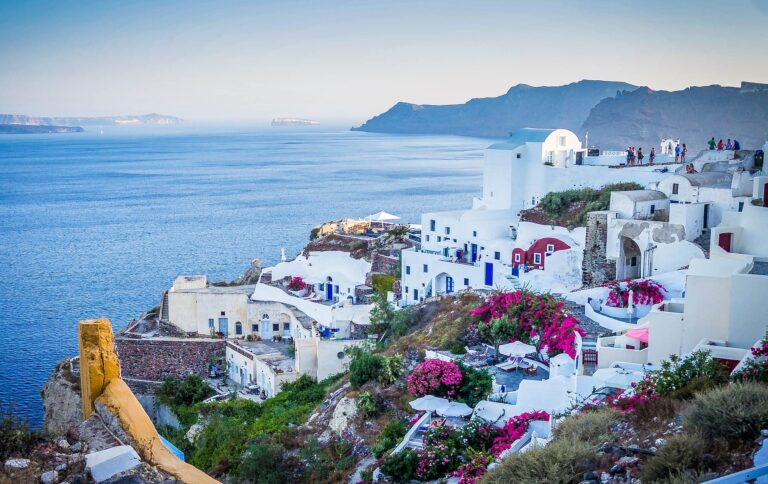
The country is more varied than the postcard image: whitewashed houses and blue domes belong to the Cyclades, while Nafplio has neoclassical streets and Corfu pastel baroque churches. Athens has the Parthenon, Thessaloniki is the main city of the north, and ferries, buses and domestic flights link the mainland with the islands. English is widely understood in tourism and transport.
- Athens: The capital, crowned by the Parthenon on the Acropolis.
- Delphi: The sanctuary of the oracle of Apollo, on a mountainside.
- Meteora: Orthodox monasteries built on top of rock pillars.
- Santorini: A volcanic island with clifftop towns and famous sunsets.
- Crete: The largest island: Knossos, gorges, beaches and mountains.
- Olympia: The sanctuary of Zeus and site of the ancient Olympic Games.
Places to visit
- City
- Island
- Park
- Mountain
- Historic site
- Area
Cities
- Athens: The capital and largest city, home of the Parthenon and the Acropolis.
- Thessaloniki: The second city and main centre of Central Macedonia.
- Heraklion: Crete's largest city and main hub, close to the Minoan site of Knossos.
- Chania: A Cretan city surrounded by beaches, near the Samaria gorge.
- Rhodes: A medieval walled old town, nightlife and beaches.
- Patras: The third city, a ferry port for Italy, known for its wine and carnival.
- Kavala: A port in East Macedonia with ferries to the North Aegean islands.
- Volos: A coastal port with museums and handsome architecture, gateway to Pelion.
Beyond the cities
- Crete (island): The largest Greek island: beaches, snowy peaks, gorges and lively resorts.
- Santorini (island): A volcanic island; its capital Fira sits on the edge of a high cliff.
- Mykonos (island): A famous, stylish island for nightlife, and the boat base for Delos.
- Corfu (island): A large Ionian island with good beaches and a historic town centre.
- Zakynthos (island): An Ionian island whose marine park is a nesting ground of loggerhead turtles.
- Acropolis of Athens (site): The ancient citadel above Athens, with the Parthenon.
- Delphi (site): Site of the famous oracle of Apollo, a major archaeological site.
- Olympia (site): The sanctuary of Zeus, where the ancient Olympic Games were held.
- Meteora (site): Monasteries built high on natural sandstone pillars.
- Knossos (site): The great Minoan site near Heraklion.
- Mycenae (site): A UNESCO-listed ancient citadel in the Peloponnese.
- Epidaurus (site): The vast Sanctuary of Asklepios in the Peloponnese.
- Mount Olympus (mountain): One of the most popular hiking areas in Greece.
- Samaria Gorge (park): A national park and gorge walk in western Crete.
- Mount Athos (area): A semi-independent monastic republic; access is restricted.
Regions
- Peloponnese: Beaches, Olympia, Mycenae and Epidaurus, mountain villages and gorges.
- Central Greece: Athens, many beaches and some of the most famous ancient sites.
- Thessaly: Meteora, Mount Olympus, the Pelion peninsula and the Northern Sporades.
- Northern Greece: The large upper half of the country, still relatively untouristed.
- Greek Islands: Beaches, clear water, villages and ruins across the Aegean and Ionian seas.
- Crete: The largest Greek island, with history, beaches and its own food.
Things to do
See
- The Parthenon Athens: The iconic temple on the Acropolis, a World Heritage Site.
- Delphi Delphi: The sanctuary where the ancient world consulted the oracle of Apollo.
- Meteora monasteries Meteora: Eastern Orthodox monasteries perched on sandstone pillars.
- Delos Mykonos: An island sanctuary near Mykonos, covered in archaeological remains.
- Old town of Rhodes Rhodes: A World Heritage medieval city, once overlooked by the Colossus.
Do
- Island hopping: Ferries link the islands within each group, such as the Cyclades, most days in summer.
- Hiking Mount Olympus, Crete and Epirus: Mount Olympus, the gorges of Crete and the national parks of Epirus are the favourite areas.
- Sailing: The Ionian islands suit beginners; spring and autumn are best in the Aegean.
Eat
- Tavernas and mezes: Shared plates of traditional food; Greeks dine late, around 21:00–23:00.
Drink
- Ouzo and tsipouro: Strong local spirits, best tried with small plates in an ouzeri.
Shop
- Farmers markets: The weekly laiki agora in every town, with olives, nuts and local produce.
Itineraries
Athens and the classical sites in 7 days (7 days)
- Athens (3 nights): The Acropolis, the Parthenon and the city centre.
- Delphi (1 night): The sanctuary of Apollo.
- Olympia (1 night): The birthplace of the Olympic Games.
- Mycenae (2 nights): Mycenae and Epidaurus in the Peloponnese.
Cyclades island hopping in 8 days (8 days)
- Athens (1 night): Ferries leave from Piraeus or Rafina.
- Mykonos (3 nights): Beaches, nightlife and a boat trip to Delos.
- Santorini (3 nights): Clifftop Fira and the views over the caldera.
- Athens (1 night): Back to the capital for the flight home.
Crete in 7 days (7 days)
- Heraklion (3 nights): Knossos and the city.
- Chania (4 nights): Beaches and the Samaria Gorge walk.
Climate and best time to visit
| Jan | Feb | Mar | Apr | May | Jun | Jul | Aug | Sep | Oct | Nov | Dec | |
|---|---|---|---|---|---|---|---|---|---|---|---|---|
| Max °C | 13 | 14 | 16 | 20 | 26 | 31 | 34 | 33 | 29 | 23 | 18 | 14 |
| Min °C | 5 | 5 | 7 | 10 | 14 | 18 | 21 | 21 | 17 | 13 | 10 | 7 |
| Rain mm | 57 | 47 | 41 | 31 | 23 | 11 | 6 | 6 | 14 | 53 | 58 | 69 |
In Athens, average highs go from about 13 °C in January to 33 °C in July and August, and the summer months are almost dry; most rain falls from October to January. Most of the country has a Mediterranean climate with hot, dry summers and a cooler, rainy season from about November to March. The mountains of the interior are cooler, and the north-central and north-eastern interior has cold winters.
The most pleasant weather is in May–June and September–October. From mid-July to mid-August the midday sun is very strong: sightsee in the morning and rest in the afternoon. Winter is not beach weather, but it is mild, quiet and cheaper. The FCDO warns of a high risk of wildfires from April to October.
Holidays and events
- 1 January 2026 · New Year's Day
- 6 January 2026 · Epiphany
- 23 February 2026 · Clean Monday
- 25 March 2026 · Annunciation
- 25 March 2026 · Independence Day
- 10 April 2026 · Good Friday
- 12 April 2026 · Easter Sunday
- 13 April 2026 · Easter Monday
- 1 May 2026 · Labour Day
- 31 May 2026 · Pentecost
- 1 June 2026 · Whit Monday
- 15 August 2026 · Assumption Day
- 28 October 2026 · Ochi Day
- 25 December 2026 · Christmas Day
- 26 December 2026 · St. Stephen's Day
Getting around
| Main airports | ATH, SKG |
|---|
Buses: the KTEL network covers almost the whole country and is reliable and inexpensive; most companies sell tickets online. Trains are few outside the Athens–Thessaloniki line. Ferries radiate from Piraeus, Rafina and Lavrio: boats within an island group are frequent, between groups less so. In winter rough seas can keep boats in port for days, so leave slack before a flight home; in August ferries fill up around the 15 August holiday. Domestic flights from Athens reach most of the country within an hour. Taxis from Athens airport to the centre have fixed fares; Uber and Bolt also operate.
Driving: traffic drives on the right and accident rates are high; drivers often speed and do not always stop at pedestrian crossings. Many motorways are tolled. Non-EU licence holders should carry an international driving permit. Moped and quad riders must wear helmets, and a UK category P licence is not valid in Greece. Most rental cars are manual, and contracts often restrict ferry crossings: inspect the car carefully before signing.
Flying to Greece? PartnerCompare fares and find the cheapest datesSearch flightsWhere to stay
- Family-run pensions: Small, friendly guesthouses, a good way to see local life.
- Hotels: Often simple, with small rooms and a balcony; air conditioning is common, but ask.
- Studios and apartments: Self-catering rooms with a small kitchen, found in almost every resort.
- Rooms at the ferry: On some islands owners meet the ferries: check the location before you accept.
- Villas: For bigger budgets, often near or on the beach.
- Campsites: Use licensed sites: camping and parking motorhomes on beaches and public land is banned.
Rooms on the busiest islands can be hard to find in peak season and at weekends and holidays in the shoulder season: book ahead. Noise from roads, motorbikes and bars is the most common problem, so choose the location with care. A climate resilience fee of €1.50 to €10 per night, depending on the hotel category and the season, replaced the old hotel tax in 2024.
Eat and drink
Dishes to try
- Horiatiki: The "country salad" of tomato, cucumber, feta, onion and olives, dressed only with olive oil.
- Moussaka: Baked eggplant, minced meat, tomato and white sauce.
- Souvlaki and gyros: Grilled skewers, or roast meat wrapped in pita: the classic fast food.
- Grilled octopus: One of the seafood dishes of the coast and islands.
- Fasolada: A dry bean stew, sometimes called the national dish.
- Tiropita and spanakopita: Cheese pie and spinach pie from the bakery, for breakfast.
- Baklava: Layers of thin pastry with honey, cinnamon and walnuts.
Drinks
- House wine: Barrel wine in tavernas, usually local and good value.
- Retsina: A wine flavoured with pine resin: a distinctive taste.
- Ouzo: An anise spirit that turns milky white with water.
- Raki or tsipouro: A strong grape spirit; in Crete it comes after dinner, often with fruit.
- Greek coffee and frappé: Strong coffee with the grounds left in, or shaken iced instant coffee.
| Tipping | Not based on a percentage: leave a euro or two, or a few coins, if you liked the service. Tipping taxi drivers is uncommon. |
|---|
Greeks eat lunch around 14:00–15:00 and dinner around 21:00–23:00. Portions are large and meant to be shared. Bread and water usually arrive when you sit down, and a small cover charge is normal. Fresh fish is sold by the kilogram: ask the price of your portion before ordering. Restaurants must give you an itemised bill.
Vegetarian and vegan restaurants are rare outside Athens and Thessaloniki, but many dishes are meat-free: ask for nistisimo (food for religious fasting), though it may contain honey or seafood. Avoid cheap imported spirits in island bars, which may be local fakes.
Entry requirements and visas
| Passport validity | Issued less than 10 years before you arrive, and valid at least 3 months after you leave the Schengen area |
|---|
| Passport | Entry | Max stay | Notes |
|---|---|---|---|
| EU / EEA | Freedom of movement | Free movement within the EU. | |
| United Kingdom | Visa free | 90 days | 90 days in any 180-day period across the whole Schengen area. |
| Canada | Visa free | 90 days | 90 days in any 180-day period in the Schengen area. |
Other nationalities: check the official source below.
Greece is in the Schengen area. UK and Canadian visitors can stay up to 90 days in any 180-day period without a visa, counting days spent in other Schengen countries; overstaying can lead to a ban of up to 3 years. You may be asked for a return or onward ticket and proof of enough money.
Non-EU visitors are registered in the EU Entry/Exit System, which can mean longer queues; the FCDO says Greece will not collect fingerprints and photos from UK travellers. Canada notes that the ETIAS travel authorisation is not yet open for applications. Cash of €10,000 or more must be declared, and meat and dairy products cannot be brought in from outside the EU. Rules depend on your passport: check the official link before you book.
Money and payments
| Currency | Euro (EUR) |
|---|---|
| Cards | Common |
Greece uses the euro (€). Visa, Mastercard and Maestro are widely accepted in shops, hotels and travel agencies, but not in some restaurants, and souvenir shops may ask for a minimum spend. ATMs are almost everywhere and usually charge €2.50–3 on top of your bank's fees; some do not accept 5-digit PINs.
Carry small notes: many businesses refuse notes above €50. Outside resorts and big supermarkets, shops often close for a long lunch break from about 14:00 to 17:00, then reopen until 20:00. Non-EU residents can claim back VAT in shops offering tax-free shopping.
Costs and budget
According to Eurostat, in 2024 the general price level in Greece was about 81% of the EU average, food in shops about 106% and restaurants and hotels about 86%.
Health
| Recommended vaccines | Routine vaccines, including measles (MMR), Hepatitis A: consider it, Hepatitis B |
|---|---|
| Malaria | None |
| Tap water | Safe |
The CDC does not list malaria for Greece; Canada notes very limited transmission with a very low risk to travellers. Rabid dogs are not common. With a European (EHIC) or UK (GHIC) health card you get medically necessary state healthcare; it does not replace travel insurance. Care is generally good on the mainland but may be limited on the islands, where ambulances can be scarce. Call 112 or 166 for an ambulance.
Pharmacies are well stocked, but rules on some medicines are strict: bring prescription medicines in their original packaging with a doctor's letter. Tap water is drinkable in most tourist areas, though on some small islands it tastes heavily chlorinated and many people prefer bottled water. Summer sun and heat are strong: use sunscreen, wear a hat and drink plenty of water.
This is general information, not medical advice: check with a travel health professional before you go.
Safety
- United States: Level 1: Exercise Normal Precautions (2026-10-20)
- Canada: Take normal security precautions (2026-10-20)
- United Kingdom: No advice against travel (2026-10-20)
Canada and the United States advise normal precautions. Pickpockets and bag thieves target tourists on the Athens metro and airport trains, at stations, beaches and crowded sites; keep your passport and valuables apart. Strikes, sometimes at short notice, can disrupt buses, trains, ferries and flights, and demonstrations are common around Syntagma Square in Athens, especially on 1 May, 17 November and 6 December: keep away from them. The FCDO says terrorists are likely to try to carry out attacks in Greece.
Always carry your passport: police may not accept a copy. Rowdy or indecent behaviour can lead to arrest, and drug penalties are severe. Do not photograph military sites, and never buy or export antiquities. Wildfires are a high risk from April to October: do not light fires or barbecues, and enable emergency alerts on your phone. Earthquakes also occur. On beaches, obey the warning flags. Emergency number 112; the tourist police answer on 1571.
Customs and etiquette
Greeks are informal and judge politeness by behaviour more than words. Say hello first when you enter a café or pass a group: people warm up quickly. Respect older people, try a little of everything if a host offers you food, and avoid calling Greece part of Eastern Europe or the Balkans. The open-palm gesture with spread fingers (mountza) is an insult.
Cover shoulders and knees in churches and monasteries; wraps are often provided at the entrance. Topless sunbathing is not accepted outside tourist areas, and nudism only on designated beaches. Smoking is banned in restaurants and cafés. In many places, including islands, put toilet paper in the bin, not the bowl.
Language
| Official languages | Greek |
|---|---|
| English | Common |
| Hello | Γεια σας (Yia sas) YAH sahss |
|---|---|
| Please | Παρακαλώ (Parakaló) pah-rah-kah-LOH |
| Thank you | Ευχαριστώ (Efcharistó) ef-khah-rees-TOH |
| Yes / No | Ναι / Όχι (Ne / Óchi) neh / OH-hee |
| Excuse me | Συγγνώμη (Signómi) see-GHNO-mee |
| Goodbye | Αντίο (Antío) AHN-dee-oh |
| Do you speak English? | Μιλάτε αγγλικά; (Miláte angliká?) mee-LAH-teh ang-glee-KAH |
What to pack
- Passport: You must always carry it; police may not accept a copy.
- Small euro notes: Many businesses refuse notes above €50.
- Hat, sunglasses and sunscreen: The summer sun is very strong.
- EHIC or GHIC and travel insurance: Include helicopter rescue if you hike.
- Covered shoulders and knees: Required in many churches and monasteries.
Quick reference
Country facts
| Capital | Athens |
|---|---|
| Population | 10,413,962 (2025) |
| Area | 128,900 km² |
| Time zone | Europe/Athens (UTC+2) |
| Calling code | +30 |
| Driving side | right |
Staying connected
| SIM and eSIM | Cosmote, Vodafone and Wind sell prepaid SIM cards; you must show identification to activate one. EU visitors roam at home rates. |
|---|---|
| Wi-Fi | Almost all hotels offer internet access, and cafés usually have free Wi-Fi: ask for the password. |
Emergency numbers
| Emergency | 112 |
|---|
Frequently asked questions
Do I need a visa for Greece?
Not for short stays with a UK or Canadian passport: up to 90 days in any 180-day period in the Schengen area. Check the official link before you book.
When is the best time to visit Greece?
May–June and September–October have the most pleasant weather; July and August are the hottest and busiest.
Can I drink the tap water?
In most tourist areas, yes, though on some small islands it tastes strongly of chlorine and many people buy bottled water.
Should I tip in Greece?
It is not a fixed percentage: leave a euro or two if you liked the service.
How do I travel between the islands?
By ferry, mostly from Piraeus or Rafina; boats within an island group are frequent, between groups less so. Flights are an option for Crete and Rhodes.
Do I need to carry my passport?
Yes: police can ask for ID and may not accept a copy.
More Travel Stories from Greece
 Greece
Sources This guide was last checked on · 18 sources
- Wikivoyage: Greece · Overview, Places to visit, Things to do, Itineraries, Climate and best time to visit, Getting around, Where to stay, Eat and drink, Entry requirements and visas, Money and payments, Health, Safety, Customs and etiquette, Language, What to pack, Staying connected, Frequently asked questions
- Wikidata: Greece · Overview, Places to visit, Things to do, Money and payments, Country facts
- WMO World Weather Information Service: Athens · Climate and best time to visit
- UK FCDO: Greece safety and security · Climate and best time to visit, Getting around, Where to stay, Eat and drink, Customs and etiquette, What to pack, Frequently asked questions
- Nager.Date: public holidays in Greece, 2026 · Holidays and events
- Government of Canada: Greece travel advice (updated 05 October 2026) · Getting around, Entry requirements and visas, Health, Safety, Frequently asked questions
- UK FCDO: Greece entry requirements · Entry requirements and visas, Frequently asked questions
- ISO 4217 (SIX), published 2026-09-17 · Money and payments
- Eurostat: price level indices, 2024 (EU27 = 100) · Costs and budget
- CDC Travelers' Health: Greece · Health
- UK FCDO: Greece health · Health, What to pack
- US Department of State: Greece travel advisory · Safety
- UK FCDO: Greece travel advice · Safety
- Wikivoyage: Greek phrasebook · Language
- World Bank, SP.POP.TOTL · Country facts
- World Bank, AG.LND.TOTL.K2 · Country facts
- IANA Time Zone Database, zone.tab · Country facts
- UK FCDO: Greece getting help · Emergency numbers
Suggest an update
Travel rules, prices and timetables change. If something in this guide is out of date, tell us: we check every suggestion against an official source before changing the page.