

- Local time
- 12:37
- Currency
- Euro (EUR)
- Capital
- Ljubljana
- Calling code
- +386
- Drive on the
- right
Overview
From the Julian Alps to the Adriatic: Lake Bled, the emerald Soča, huge caves, Venetian Piran and baroque Ljubljana. Euro and Schengen.
Slovenia lies in the eastern Alps at the northern end of the Adriatic, and in a small space it moves from Mediterranean beaches to the peaks of the Julian Alps and the rolling hills of the south. Its towns show Austrian and Italian influence: Ljubljana, the compact baroque capital, has been compared to Prague, and Piran on the coast looks like a small Italian town. But nature is the real draw.
Bled has a lake with an island and a castle; Triglav National Park and the emerald Soča valley are made for hiking, rafting and canyoning; and the Karst hides more than 8,000 caves, including Postojna and the UNESCO-listed Škocjan Caves. The country is small enough to see the highlights in a few days. Slovenia uses the euro and is part of the Schengen area.
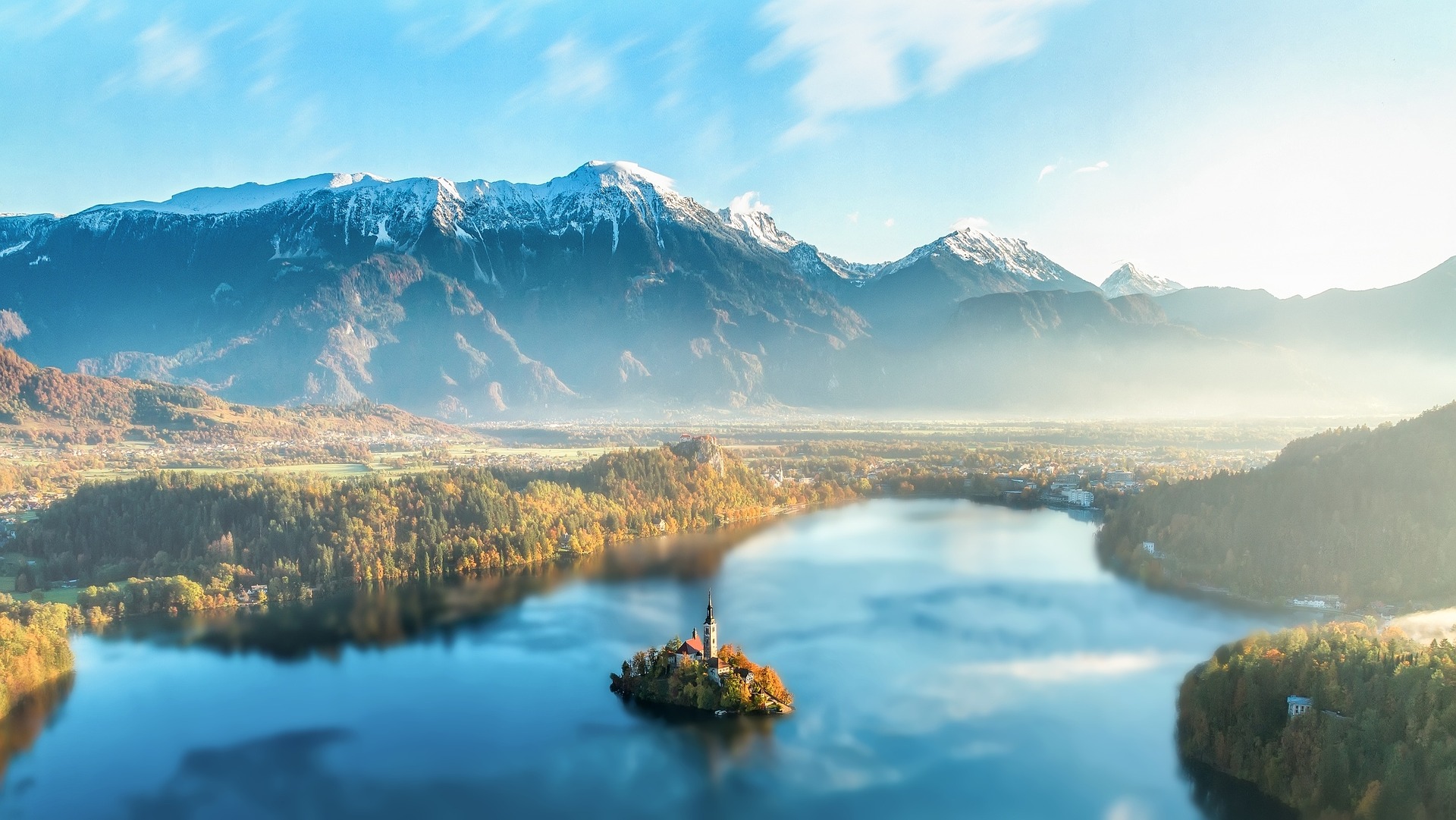
- Lake Bled: A mountain lake with an island and a castle.
- Ljubljana: A picturesque baroque capital, especially lovely in December.
- Postojna and Škocjan caves: A 5.3 km ride through Postojna, and the UNESCO-listed Škocjan Caves.
- Soča valley: An emerald river in the Julian Alps, for rafting and kayaking.
- Triglav National Park: Mountains, huts and trails around the national symbol, Mount Triglav.
- Piran: A Venetian port town, with the salt pans of Sečovlje nearby.
Places to visit
- City
- Park
- Historic site
- Area
Cities
- Ljubljana: The picturesque baroque capital.
- Bled: A romantic mountain lake with its own castle and island.
- Piran: A Venetian port on the coast.
- Koper: The largest town on the coast, also Venetian.
- Maribor: The second city.
- Ptuj: One of the oldest towns in Slovenia.
- Celje: Another of the oldest towns.
- Postojna: The town of the huge Postojna caves.
- Bovec: A centre for rafting, canyoning and paragliding in the Soča valley.
Beyond the cities
- Postojna Cave (site): A 5.3 km cave ride among huge stalactites and stalagmites.
- Škocjan Caves (site): Less commercial than Postojna and just as impressive; a UNESCO World Heritage Site.
- Triglav National Park (park): Home of Mount Triglav, the national symbol; camping is banned.
- Soča (area): One of the most beautiful Alpine rivers, emerald green along its length.
- Lake Bohinj (area): A base for adventure sports in the north-west.
- Sečovlje Salina (park): Quiet salt pans near Piran.
Regions
- Julian Alps: Bled, Bohinj, Triglav National Park and the Soča valley.
- Coast and Karst: The coast with Piran and Koper, and the Karst.
- Central Slovenia: Ljubljana and its surroundings.
- Southeastern Slovenia: Rolling hills and forests in the south.
- Pohorje-Savinjska: One of the six travel regions.
- Eastern Slovenia: The east, with spa resorts and a Hungarian-speaking minority in Prekmurje.
Things to do
See
- Lake Bled Bled: The lake, island and castle; continue to traditional villages and the Pokljuka plateau for hikes.
- Postojna Cave Postojna Cave: A train ride through 5.3 km of caves.
- Škocjan Caves Škocjan Caves: A UNESCO-listed cave system, less commercial than Postojna.
- Piran and the salt pans Piran: The lively coastal town and the salt works of Sečovlje.
- Ljubljana in December Ljubljana: The capital is especially popular for its tasteful Christmas decorations.
Do
- Rafting and canyoning Bovec: In the Soča valley and around Bohinj and Kranjska Gora, cheaper than in Western Europe.
- Hiking in the Julian Alps Triglav National Park: Mountain huts from about 700 m up; some trails include via ferrata sections.
- Spas: Spa resorts in the east of the country.
Drink
- Wine tasting: Reds and dry whites from Goriška Brda, sweeter whites from Štajerska.
Itineraries
Slovenia in 6 days (6 days)
- Ljubljana (2 nights): The baroque capital.
- Bled (2 nights): The lake, and walks in the Julian Alps.
- Postojna (1 night): Postojna Cave and Škocjan Caves.
- Piran (1 night): The coast and the salt pans.
Adventure in the Alps in 4 days (4 days)
- Bovec (3 nights): Rafting, canyoning and paragliding on the Soča.
- Bled (1 night): The lake on the way back towards Ljubljana.
Climate and best time to visit
| Jan | Feb | Mar | Apr | May | Jun | Jul | Aug | Sep | Oct | Nov | Dec | |
|---|---|---|---|---|---|---|---|---|---|---|---|---|
| Max °C | 3 | 6 | 11 | 15 | 21 | 24 | 27 | 26 | 22 | 15 | 8 | 3 |
| Min °C | -3 | -2 | 1 | 5 | 9 | 13 | 15 | 14 | 11 | 7 | 2 | -2 |
| Rain mm | 71 | 71 | 87 | 103 | 113 | 154 | 117 | 134 | 131 | 147 | 137 | 103 |
In Ljubljana the average maximum is about 3 °C in January and 26 to 27 °C in July and August. Rain is plentiful all year, with more than 100 mm a month from April to December. The coast is Mediterranean, the Alps much colder.
May to September is best for hiking, rafting and the coast; winter is for skiing, and December for Ljubljana's festive decorations.
Holidays and events
- 1 January 2026 · New Year's Day
- 2 January 2026 · New Year's Day (second day)
- 8 February 2026 · Prešeren Day
- 5 April 2026 · Easter Sunday
- 6 April 2026 · Easter Monday
- 27 April 2026 · Day of Uprising Against Occupation
- 1 May 2026 · Labour Day
- 2 May 2026 · Labour Day (second day)
- 24 May 2026 · Pentecost
- 25 June 2026 · Statehood Day
- 15 August 2026 · Assumption Day
- 31 October 2026 · Reformation Day
- 1 November 2026 · Day of the Dead
- 25 December 2026 · Christmas Day
- 26 December 2026 · Independence and Unity Day
Getting around
| Main airports | LJU |
|---|
Slovenia is small, but bus services have been cut and are sparse at weekends, so plan ahead (simo.si). Trains (SŽ) are about 30% cheaper than buses but routes often require a change in Ljubljana; buy tickets before boarding to avoid a surcharge.
Driving: you need an e-vignette for motorways. Headlights must always be on, and you must carry a warning triangle, reflective jacket and first aid kit; winter tyres or chains are compulsory from 15 November to 15 March. The alcohol limit is 0.05% (zero for new drivers). Fines are on the spot. A UK licence is valid; Canada requires an International Driving Permit. After a motorway breakdown, call 1970 and use only authorised recovery vehicles with the DARS logo.
Flying to Slovenia? PartnerCompare fares and find the cheapest datesSearch flightsWhere to stay
- Hotels: From five-star hotels to mountain cottages.
- Hostels: In all tourist areas; a dorm bed cost €10 to €20 (Wikivoyage, read in 2026).
- Mountain huts: In Triglav National Park, reached only on foot.
- Tourist farms: Traditional food, local wine and country life.
- Campsites: Only in registered sites; bring a mat, as pitches are often stony.
Wild camping is illegal, with fines of €40 to €500, and enforcement is strict in national parks such as Triglav. Camper vans must use designated stops (PZA).
Eat and drink
Dishes to try
- Soup and meat: A typical meal: beef or chicken broth with noodles, then meat with potatoes and salad.
- Klobasa: Sausages, among many pork products.
- Pizza and pasta: Italian dishes are everywhere, and locals say the pizza rivals Italy's.
Drinks
- Wine: Goriška Brda for reds and dry whites, Štajerska for sweeter whites.
- Beer: Laško and Union are the main brands.
- Coffee: An espresso cost €1 to €1.50 (Wikivoyage, read in 2026); cafés are a way of life.
Food mixes Alpine, Italian, Austrian, Hungarian and Balkan cooking; it is hearty and meaty, so strict vegetarians may struggle. Tap water is drinkable.
Entry requirements and visas
| Passport validity | Issued less than 10 years before you arrive, and valid at least 3 months after you leave the Schengen area |
|---|
| Passport | Entry | Max stay | Notes |
|---|---|---|---|
| EU / EEA | Freedom of movement | EU free movement rules apply. | |
| United Kingdom | Visa free | 90 days | 90 days in any 180-day period across the whole Schengen area. |
| Canada | Visa free | 90 days | 90 days in any 180-day period across the whole Schengen area. |
| United States | Visa free | 90 days | 90 days in any 180-day period across the whole Schengen area. |
| Australia | Visa free | 90 days | 90 days in any 180-day period across the whole Schengen area. |
Other nationalities: check the official source below.
- EES (Entry/Exit System): fingerprints and photo at the border, free
- ETIAS (travel authorisation, EUR 20): not in operation yet
Slovenia is part of the Schengen area. Visitors from the UK, the US, Canada and Australia can stay up to 90 days in any 180-day period without a visa, counting the days spent in other Schengen countries. Non-EU visitors register fingerprints and a photo in the EU's Entry/Exit System (EES) on their first entry: allow extra time at the border, and at the airport when you leave.
There are checks at Slovenia's land borders. Border staff may ask for a return or onward ticket and proof of enough money. Overstays are fined on the spot. You cannot bring meat or milk products into the EU.
ETIAS, the online travel authorisation for visa-free visitors, is not in operation yet. Rules depend on your passport and can change: check the official link before you book.
Money and payments
| Currency | Euro (EUR) |
|---|
Slovenia uses the euro (EUR). ATMs are common, though rarer in villages; some banks charge no fee, others up to €6. Prices are lower than in Italy or Austria; in Ljubljana's old town a half-litre of beer cost about €3, outside the capital about €1.80 (Wikivoyage, read in 2026). Check prices before ordering in bars: some overcharge.
Costs and budget
- Beer (0.5 l) in Ljubljana's old town (Wikivoyage, read in 2026): about €3
- Espresso (Wikivoyage, read in 2026): €1 to €1.50
- Hostel dorm bed (Wikivoyage, read in 2026): €10 to €20
According to Eurostat, in 2024 the general price level in Slovenia was about 87% of the EU average, food in shops about 100% and restaurants and hotels about 90%.
Health
| Recommended vaccines | Routine vaccines, including measles (MMR), Hepatitis A, Hepatitis B, Tick-borne encephalitis, if you will spend time in forests between April and November, Rabies, only if you will work with wildlife |
|---|---|
| Tap water | Safe |
Tap water is drinkable and hygiene standards are high. Use tick repellent in nature: Lyme disease is widespread and ticks also carry encephalitis. Two venomous adders live in the Julian Alps. Air quality can be poor at times. Medical care is very good; a European (EHIC) or UK (GHIC) card covers medically necessary state healthcare. Dial 112.
This is general information, not medical advice: check with a travel health professional before you go.
Safety
- United States: Level 1: Exercise Normal Precautions (2026-10-20)
- Canada: Take normal security precautions (2026-10-20)
- United Kingdom: No advice against travel (2026-10-20)
Slovenia is very safe; petty theft happens in tourist areas and on public transport, and cars are broken into at service areas. Some bars overcharge, and drinks can be spiked.
Bears live in wooded areas throughout the country, even near cities: take care where they have been sighted, and do not leave food around your camp. In the mountains, plan for the weakest member of your group, use marked paths and check the weather; some routes need a harness and helmet. Off-piste skiing risks avalanches. A national siren is tested at noon on the first Saturday of each month.
Customs and etiquette
Slovenians are open and friendly, and a few words of Slovenian are much appreciated. When offered something, expect your host to insist after a polite refusal. Slovenia is proud of its identity and does not like being called Eastern Europe; Slovenian is not the same as Croatian or Serbian. Treat territorial issues with Croatia and the Second World War as sensitive topics.
Carry a copy of your passport: not showing ID can cost €50 to €200. Jaywalking is fined, and tour guides must show an official card.
Language
| Official languages | Slovenian |
|---|---|
| English | Common |
| Hello | Živjo / Zdravo ZHEE-vyoh / ZDRAH-voh |
|---|---|
| Good day | Dober dan DOH-ber dahn |
| Please | Prosim PROH-sihm |
| Thank you | Hvala HVAA-lah |
| Excuse me | Oprostite oh-prohs-TEE-teh |
| Goodbye | Nasvidenje nahs-VEE-deh-nyeh |
| Do you speak English? | Govorite angleško? goh-voh-REE-teh ahn-GLEHSH-koh |
What to pack
- A copy of your passport: Police can fine you if you cannot show ID.
- Tick repellent: Lyme disease and tick-borne encephalitis are common.
- Hiking gear, and a harness and helmet for via ferrata: Some mountain trails require them.
- A camping mat: Campsite pitches are often stony.
Quick reference
Country facts
| Capital | Ljubljana |
|---|---|
| Population | 2,130,986 (2025) |
| Area | 20,134 km² |
| Time zone | Europe/Ljubljana (UTC+1) |
| Calling code | +386 |
| Driving side | right |
Staying connected
| Roaming | With an EU SIM card you pay home prices for calls, texts and data (roam like at home). Others should check their provider's rates. |
|---|
Emergency numbers
| Police | 113 |
|---|
Frequently asked questions
Do I need a visa for Slovenia?
Not for short trips with an EU, UK, US, Canadian or Australian passport: Slovenia is in the Schengen area, so you can stay up to 90 days in any 180-day period. Check the official EU link before you book.
Is wild camping allowed in Slovenia?
No, it is illegal, with fines of €40 to €500, especially in national parks.
Do I need a vignette to drive?
Yes, an e-vignette for motorways.
Can I drink the tap water?
Yes, tap water is drinkable.
Are there bears in Slovenia?
Yes, in wooded areas throughout the country; attacks are rare, but take care where they have been seen.
When is the best time to visit?
May to September for the outdoors; December for Ljubljana's festive season.
More Travel Stories from Europe
 Portugal
Sources This guide was last checked on · 20 sources
- Wikivoyage: Slovenia · Overview, Places to visit, Things to do, Itineraries, Climate and best time to visit, Getting around, Where to stay, Eat and drink, Money and payments, Costs and budget, Health, Safety, Customs and etiquette, Language, What to pack, Frequently asked questions
- Wikidata: Slovenia · Places to visit, Money and payments, Country facts
- WMO World Weather Information Service: Ljubljana · Climate and best time to visit, Frequently asked questions
- Nager.Date: public holidays in Slovenia, 2026 · Holidays and events
- UK FCDO: Slovenia safety and security · Getting around, Where to stay, Safety, Customs and etiquette, What to pack
- Government of Canada: Slovenia travel advice (updated 11 August 2026) · Getting around, Entry requirements and visas, Money and payments, Health, Safety, Frequently asked questions
- UK FCDO: Slovenia entry requirements · Entry requirements and visas, Frequently asked questions
- European Union: ETIAS official website · Entry requirements and visas
- ISO 4217 (SIX), published 2026-09-17 · Money and payments
- Eurostat: price level indices, 2024 (EU27 = 100) · Costs and budget
- UK FCDO: Slovenia health · Health
- US CDC: Travelers' health, Slovenia · Health
- US Department of State: Slovenia travel advisory · Safety
- UK FCDO: Slovenia travel advice · Safety
- Wikivoyage: Slovenian phrasebook · Language
- World Bank, SP.POP.TOTL · Country facts
- World Bank, AG.LND.TOTL.K2 · Country facts
- IANA Time Zone Database, zone.tab · Country facts
- Your Europe: mobile roaming costs · Staying connected
- UK FCDO: Slovenia getting help · Emergency numbers
Suggest an update
Travel rules, prices and timetables change. If something in this guide is out of date, tell us: we check every suggestion against an official source before changing the page.