

- Local time
- 22:09
- Currency
- Romanian Leu (RON)
- Capital
- Bucharest
- Calling code
- +40
- Drive on the
- right
Overview
Medieval Transylvanian towns, castles such as Bran and Peleș, the painted monasteries of Bukovina, the Carpathians and the Danube Delta, at low prices.
Romania is a large country of mountains, unspoilt countryside, historic cities and a busy capital, with a strong Latin heritage that sets it apart from its neighbours. Its forests and the Carpathian Mountains are home to Europe's largest populations of bears and wolves. Transylvania holds the medieval towns of Brașov, Sibiu and Sighișoara, whose citadel is still inhabited, and castles such as Bran, linked with the Dracula legend, and Peleș near Sinaia.
In the north, the painted monasteries of Southern Bukovina and the wooden churches of Maramureș show a countryside where old traditions survive; in the east, the Danube Delta is one of Europe's largest and best-preserved wetlands. Bucharest mixes monumental communist-era buildings with older neighbourhoods. Romania is one of the cheapest countries in the EU, uses the leu (RON) and has been fully in the Schengen area since January 2025.
- Transylvania's towns: Brașov, Sibiu and the inhabited citadel of Sighișoara, a UNESCO site.
- Bran and Peleș castles: The hilltop castle linked with Dracula, and a Neo-Renaissance royal palace near Sinaia.
- Painted monasteries of Bukovina: Churches whose outer walls are covered with religious frescoes.
- Danube Delta: Wetlands with more than 320 bird species in summer, explored by boat.
- Maramureș: Wooden churches and the Merry Cemetery, listed by UNESCO.
- Transfăgărășan road: A spectacular mountain road with endless bends across the Carpathians.
Places to visit
- City
- Park
- Mountain
- Historic site
Cities
- Bucharest: The capital, where communist-era monuments such as the House of the People overlook older neighbourhoods.
- Brașov: A well-kept medieval centre in Transylvania, near Poiana Brașov, Râșnov fortress and Bran Castle.
- Sibiu: One of the best-preserved historic cities, close to the Făgăraș mountains.
- Sighișoara: A medieval citadel that is still lived in, a UNESCO World Heritage Site.
- Cluj-Napoca: The largest city in Transylvania, young and lively thanks to its big university.
- Timișoara: The main city of the Banat, where the 1989 revolution began.
- Iași: The old capital of Moldavia and a major cultural centre.
- Suceava: The medieval capital of Moldavia and a base for the painted monasteries.
- Constanța: The main Black Sea port, with the resort of Mamaia.
Beyond the cities
- Bran Castle (site): A castle on a hilltop, widely associated with Count Dracula.
- Peleș Castle (site): A Neo-Renaissance royal castle near Sinaia.
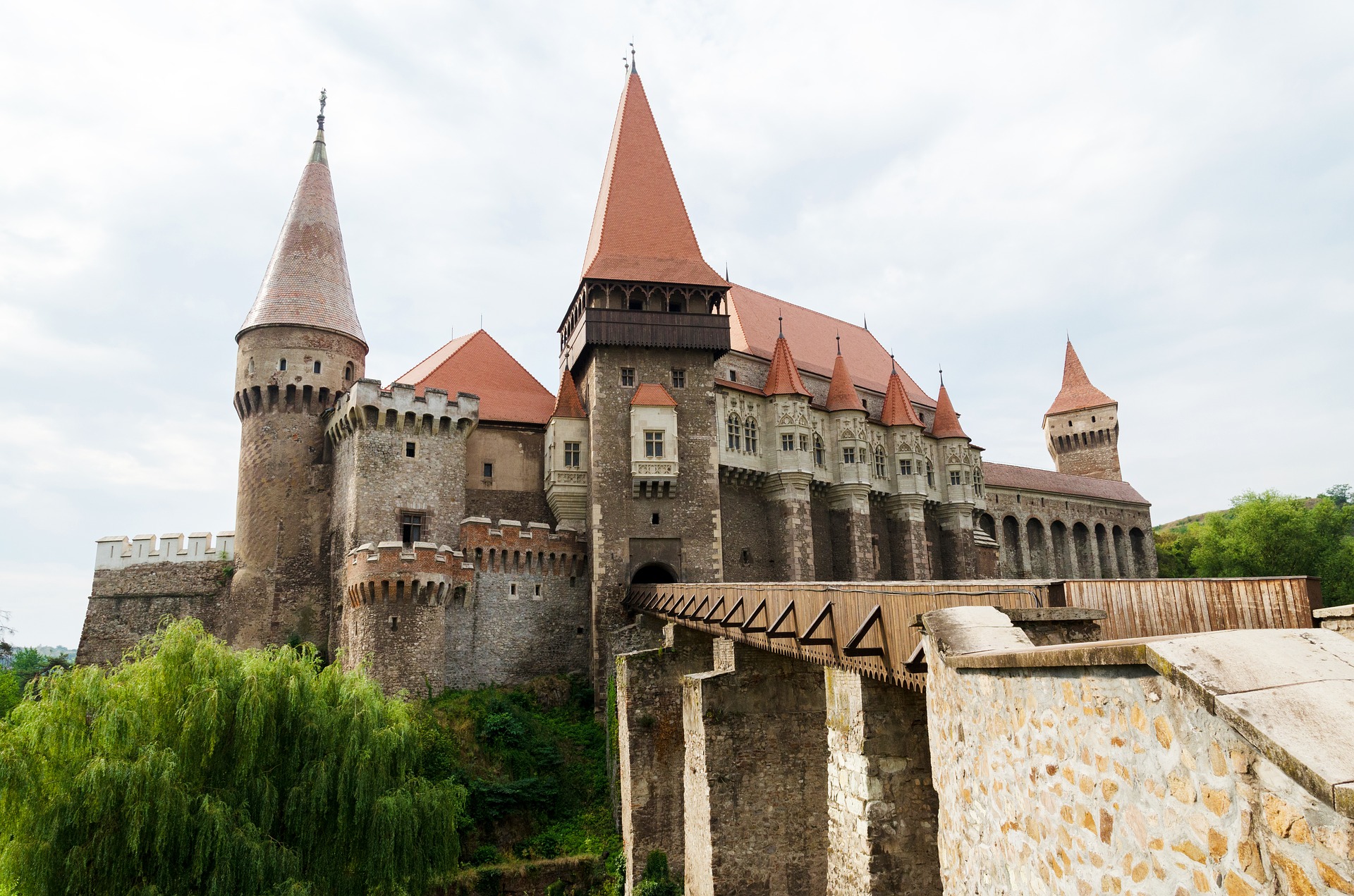
- Corvin Castle (site): A Gothic-Renaissance castle at Hunedoara.
- Danube Delta (park): One of Europe's largest river deltas, rich in birds and explored only by boat.
- Merry Cemetery (site): The colourful cemetery of Săpânța in Maramureș.
- Transfăgărășan (mountain): A mountain road over the Făgăraș range.
- Transylvanian Alps (mountain): Mountains within the Carpathians; ski resorts nearby include Sinaia, Predeal and Poiana Brașov.
Regions
- Transylvania: The largest region, with Brașov, Sibiu, Sighișoara, Cluj-Napoca and fortified Saxon churches.
- Banat: The west of the country, around Timișoara.
- Crișana: Western Romania, served by Timișoara airport.
- Maramureș: Wooden churches, village traditions and the Merry Cemetery.
- Southern Bukovina: The painted monasteries, around Suceava.
- Moldavia: The old principality of Moldavia, with Iași.
- Muntenia: One of the historical regions of the south.
- Oltenia: The south-west, with the fortified boyar houses called cule.
- Northern Dobruja: Dobruja, home to Tatar, Turkish and Ukrainian communities; the only part of Romania in the Balkan peninsula.
Things to do
See
- Sighișoara citadel Sighișoara: A charming medieval fortified town, still inhabited.
- Bran Castle Bran Castle: The castle that fits the Dracula story, with a history of its own.
- Peleș Castle Peleș Castle: The royal palace at Sinaia.
- Painted monasteries: In Southern Bukovina, with complete fresco cycles on their outer walls; Suceava is the base.
- Fortified Saxon churches: Villages across Transylvania with fortified churches.
- Bucharest's monuments Bucharest: The huge Palace of the Parliament, the Arch of Triumph and many museums.
Do
- Danube Delta by boat Danube Delta: Fast boats and fishermen's boats on the channels, among pelicans and cranes.
- Drive the Transfăgărășan or Transalpina Transfăgărășan: Two famous mountain roads; the Transalpina reaches 2,145 m.
- Mountain hiking: Retezat and Rodna national parks, and waterfalls in Cheile Nerei-Beușnița.
Drink
- Local wine: Murfatlar, Cotnari and Drăgășani are among the best wineries; many monasteries sell their own wine.
Itineraries
Transylvania in 7 days (7 days)
- Bucharest (1 night): Arrive and see the Palace of the Parliament.
- Peleș Castle (1 night): Sinaia and its royal castle, in the mountains.
- Brașov (2 nights): The old town, Bran Castle and Râșnov fortress.
- Sighișoara (1 night): The medieval citadel.
- Sibiu (2 nights): Museums, and the Făgăraș mountains in summer.
Moldavia and Bukovina in 4 days (4 days)
- Iași (2 nights): The old capital of Moldavia; Iași has an airport.
- Suceava (2 nights): The painted monasteries of Bukovina.
Climate and best time to visit
| Jan | Feb | Mar | Apr | May | Jun | Jul | Aug | Sep | Oct | Nov | Dec | |
|---|---|---|---|---|---|---|---|---|---|---|---|---|
| Max °C | 3 | 6 | 11 | 18 | 24 | 28 | 30 | 30 | 25 | 18 | 10 | 4 |
| Min °C | -5 | -4 | 0 | 5 | 10 | 14 | 15 | 15 | 11 | 5 | 1 | -3 |
| Rain mm | 33 | 33 | 39 | 49 | 56 | 79 | 64 | 51 | 53 | 47 | 43 | 44 |
Romania has cold winters and hot summers. In Bucharest the average maximum is about 3 °C in January, with nights around -5 °C, and almost 30 °C in July and August. June is the wettest month, with about 80 mm of rain. Winters bring snow to the mountains, where roads are not always cleared and snow chains are needed.
May, June and September are pleasant for cities and hiking; summer is the season for the Black Sea coast and the Danube Delta, and winter for skiing in resorts such as Sinaia and Poiana Brașov.
Holidays and events
- 1 January 2026 · New Year's Day
- 2 January 2026 · Day after New Year's Day
- 6 January 2026 · Epiphany
- 7 January 2026 · Saint John the Baptist
- 24 January 2026 · Union Day/Small Union
- 10 April 2026 · Good Friday
- 12 April 2026 · Easter Sunday
- 13 April 2026 · Easter Monday
- 1 May 2026 · Labour Day
- 31 May 2026 · Pentecost
- 1 June 2026 · Children's Day
- 1 June 2026 · Whit Monday
- 15 August 2026 · Dormition of the Theotokos
- 30 November 2026 · St. Andrew's Day
- 1 December 2026 · National Day/Great Union
- 25 December 2026 · Christmas Day
- 26 December 2026 · St. Stephen's Day
Getting there and around
| Main airports | OTP, CLJ, IAS, TSR, SBZ |
|---|
Getting there
By air: Bucharest Henri Coandă (OTP) has flights to most European capitals; Cluj (CLJ), Iași (IAS), Timișoara (TSR) and Sibiu (SBZ) also have international flights, many with Wizz Air and Ryanair. By train: daily international trains link Romania with Vienna, Budapest, Sofia, Belgrade and other cities, though long journeys are slow. By bus: private coaches serve Chișinău, Sofia, Istanbul and Western Europe. Carry your passport when crossing into Bulgaria or Hungary, where land borders are checked.
Getting around
Trains reach almost every town and are the best option for long distances, but speeds are low and services infrequent on many lines. Choose InterRegio or InterCity trains; Regio trains are very slow and basic. Buses and minibuses (maxi taxi) fill the gaps; they are often cramped, and delays are common. Use autogari.ro for timetables.
Driving: you must pay a road toll (rovinieta) to use the national roads: buy the vignette at border points or at most petrol stations, or you may get a heavy fine. There is zero tolerance for alcohol, refusing a breathalyser test is illegal, winter tyres are compulsory when roads are snowy or icy (usually November to March), and you must carry a first aid kit, fire extinguisher, warning triangle and high-visibility jacket. Canada adds that headlights must be on at all times, phones need a hands-free device and children under 12 cannot sit in the front. Roads are often poor, local driving can be aggressive and the accident rate is high: avoid driving at night outside cities, when carts and livestock are on the road. You must get a report at the scene of an accident. A UK photocard licence is valid, and a Canadian one for up to 6 months. The UK says hire companies often have stricter rules, such as a minimum age or an international driving permit. Taxis are cheap but some overcharge: check the price per kilometre shown on the door, use the booth at Bucharest airport, or use Uber or Bolt.
Flying to Romania? PartnerCompare fares and find the cheapest datesSearch flightsWhere to stay
- Hotels: 4-star prices are close to the rest of Europe; 3-star and below are a little cheaper.
- Bed and breakfasts: Often modern, and sometimes pricier than 2- or 3-star hotels.
- Rooms in private houses: Look for houses marked "cazare".
- Rural guesthouses: Rural tourism is well developed; the ANTREC association lists guesthouses in over 900 places.
Finding a room is easy almost everywhere, but book ahead in Bucharest, Cluj-Napoca, Brașov and Iași. Booking directly with the hotel is often cheaper. Lock valuables away: thefts from hotel rooms are common.
Eat and drink
Dishes to try
- Sarmale: Cabbage rolls stuffed with meat.
- Mămăligă: Polenta, served with many dishes.
- Mici: Grilled skinless spicy sausages, often eaten with beer.
- Ciorbă de burtă: Sour tripe soup.
- Zacuscă: A rich vegetable spread made in autumn.
- Cozonac: Sweet bread baked for Christmas and Easter.
Drinks
- Wine: A tradition of more than 2,000 years; a bottle of Romanian wine costs 10 to 30 lei.
- Beer: Cheap and very common; local brands include Ursus, Timișoreana and Ciuc.
- Țuică and pălincă: Plum brandy and stronger fruit spirits from Transylvania.
| Tipping | About 5 to 10%, expected in restaurants, cafés and taxis. |
|---|
Romanian food mixes Balkan and Central European cooking, with plenty of garlic, dill and bread. Street food includes covrigi (pretzels), langoși and gogoși. If you are invited to eat, expect your hosts to insist when you politely refuse a second helping.
Entry requirements and visas
| Passport validity | Issued less than 10 years before you arrive, and valid at least 3 months after you leave the Schengen area |
|---|
| Passport | Entry | Max stay | Notes |
|---|---|---|---|
| EU / EEA | Freedom of movement | EU free movement rules apply. | |
| United Kingdom | Visa free | 90 days | 90 days in any 180-day period across the whole Schengen area. |
| Canada | Visa free | 90 days | 90 days in any 180-day period across the whole Schengen area. |
| United States | Visa free | 90 days | 90 days in any 180-day period across the whole Schengen area. |
| Australia | Visa free | 90 days | 90 days in any 180-day period across the whole Schengen area. |
Other nationalities: check the official source below.
- EES (Entry/Exit System): fingerprints and photo at the border, free
- ETIAS (travel authorisation, EUR 20): not in operation yet
Romania is part of the Schengen area. Visitors from the UK, the US, Canada and Australia can stay up to 90 days in any 180-day period without a visa, counting the days spent in other Schengen countries. Non-EU visitors register fingerprints and a photo in the EU's Entry/Exit System (EES) on their first entry: allow extra time at the border, and at the airport when you leave.
Romania has been fully in Schengen since 1 January 2025, but carry your passport: land and river borders with Bulgaria and Hungary are checked. You may be asked for a return or onward ticket and proof of enough money. Cash of €10,000 or more must be declared. Romanian children under 18 leaving the country without both parents need notarised consent.
ETIAS, the online travel authorisation for visa-free visitors, is not in operation yet. Rules depend on your passport and can change: check the official link before you book.
Money and payments
| Currency | Romanian Leu (RON) |
|---|
Romania uses the leu (RON), plural lei. Cash is still common, though cards are accepted in many shops and most supermarkets. Pay in lei: euros or dollars are often refused or taken at a poor rate. Use bank ATMs or exchange offices showing "Comision 0%", avoid the airport counters, and never change money in the street, which is illegal and often a scam. Card copying has happened in some bars and restaurants.
Costs and budget
- Bottle of Romanian wine (as listed on Wikivoyage in October 2026): 10 to 30 lei
- Bottle of local beer in a supermarket (as listed on Wikivoyage in October 2026): 2 to 3 lei
- Small rental car, per day (as listed on Wikivoyage in October 2026): from €20 to €30
According to Eurostat, in 2024 the general price level in Romania was about 60% of the EU average, food in shops about 76% and restaurants and hotels about 68%.
Food, transport and accommodation are cheap, while imported goods cost as much as elsewhere in the EU; Bucharest costs more than the national norm.
Health
| Recommended vaccines | Routine vaccines, including measles (MMR), Hepatitis A, Hepatitis B, Tick-borne encephalitis, if you will hike or camp in forests between April and November, Rabies, only if you will work with wildlife, Mpox, for travellers at risk of sexual exposure |
|---|---|
| Tap water | Safe |
Tap water is generally drinkable, though most people buy bottled water. Altitude sickness is possible in the mountains.
Hospitals range from modern to old and poorly equipped; private clinics in the cities are usually better, and many facilities expect cash. A European (EHIC) or UK (GHIC) card gives access to medically necessary state healthcare, but does not replace travel insurance. Dial 112 for any emergency.
This is general information, not medical advice: check with a travel health professional before you go.
Safety
- United States: Level 1: Exercise Normal Precautions (2026-10-20)
- Canada: Take normal security precautions (2026-10-20)
- United Kingdom: No advice against travel (2026-10-20)
Violent crime is rare. Pickpockets and organised thieves work in Bucharest, at stations, on public transport and on the way to the airport; lock your compartment on intercity trains, and beware of fake police officers asking to see your money. Some bars and clubs charge outrageous prices and use their bouncers to make you pay. Drinks can be spiked in bars and clubs: never leave yours unattended.
Bears are common in the Carpathians and sometimes come into towns such as Brașov: never approach or feed them, especially cubs. Stray dogs and sheepdogs can be aggressive. Drones from the war in Ukraine have entered Romanian airspace near the border: follow RO-Alert messages and do not touch debris. The FCDO says that, although Romania has no recent history of terrorism, attacks cannot be ruled out. Drug penalties are severe, and foreigners have received long sentences after arrests at music festivals.
Customs and etiquette
Romanians are hospitable and courteous: shake hands with everyone when you enter a room, greet with bună ziua, respect the elderly and take your shoes off in someone's home. Getting drunk in public is frowned upon. Avoid calling Romanian a Slavic language, confusing Romanians with the Roma, or praising Russia; tensions with the Hungarian minority are also a sensitive topic. Canada says it is illegal to photograph government buildings and military installations without prior permission, so ask before photographing airports and military sites. You must carry photo identification at all times, and Canada says a photocopy of your passport is acceptable. Canada also says Romanian law does not prohibit same-sex sexual acts, though homosexuality is not widely accepted. Illegal drugs, including cannabis, carry severe penalties: expect a long jail sentence and heavy fines, even in transit at the airport.
Language
| Official languages | Romanian |
|---|---|
| English | Common |
| Good day, hello | Bună ziua BOO-nuh ZEE-wah |
|---|---|
| Hi | Salut sah-LOOT |
| Please | Vă rog vuh ROHG |
| Thank you | Mulțumesc mool-tzoo-MESK |
| Excuse me | Pardon pahr-DOHN |
| Goodbye | La revedere lah reh-veh-DEH-reh |
| Do you speak English? | Vorbiți engleză? vor-BEETZ eng-LEH-zuh |
What to pack
- Passport: Land borders with Bulgaria and Hungary are checked.
- Some cash in lei: Many transactions are still in cash.
- Hiking boots and layers: For the Carpathians, where weather changes quickly.
- EHIC or GHIC and travel insurance: The card covers only medically necessary state healthcare.
Quick reference
Country facts
| Capital | Bucharest |
|---|---|
| Population | 19,020,271 (2025) |
| Area | 230,080 km² |
| Time zone | Europe/Bucharest (UTC+2) |
| Calling code | +40 |
| Driving side | right |
Staying connected
| SIM and eSIM | Main networks: Orange, Vodafone and Digi. Prepaid cards and top-ups are sold in almost every shop. |
|---|---|
| Roaming | With an EU SIM card you pay home prices for calls, texts and data (roam like at home). Others should check their provider's rates. |
Emergency numbers
| Emergency | 112 |
|---|
Frequently asked questions
Do I need a visa for Romania?
Not for short trips with an EU, UK, US, Canadian or Australian passport: Romania is in the Schengen area, so you can stay up to 90 days in any 180-day period. Check the official EU link before you book.
Does Romania use the euro?
No, the currency is the leu (RON). Pay in lei: euros are often refused or taken at a poor rate.
Is Bran Castle really Dracula's castle?
It is widely associated with the legend, though there is no clear evidence that it inspired Bram Stoker.
Are bears a danger?
Bears are common in the Carpathians and sometimes enter towns. Keep your distance, never feed them and back away slowly.
Can I drink the tap water?
It is generally drinkable, though most people prefer bottled water.
When is the best time to visit Romania?
May, June and September; summer for the coast and the Danube Delta, winter for skiing.
More Travel Stories from Europe
 Svalbard +1
Sources This guide was last checked on · 21 sources
- Wikivoyage: Romania · Overview, Places to visit, Things to do, Itineraries, Climate and best time to visit, Getting there and around, Where to stay, Eat and drink, Money and payments, Costs and budget, Health, Safety, Customs and etiquette, Language, What to pack, Staying connected, Frequently asked questions
- Wikidata: Romania · Places to visit, Money and payments, Country facts
- WMO World Weather Information Service: Bucharest · Climate and best time to visit, Frequently asked questions
- Nager.Date: public holidays in Romania, 2026 · Holidays and events
- UK FCDO: Romania safety and security (updated 18 September 2026) · Getting there and around, Money and payments, Safety, Customs and etiquette, What to pack
- Government of Canada: Romania travel advice (updated 11 August 2026) · Getting there and around, Entry requirements and visas, Health, Safety, Customs and etiquette, Frequently asked questions
- UK FCDO: Romania entry requirements · Entry requirements and visas, What to pack, Frequently asked questions
- European Union: ETIAS official website · Entry requirements and visas
- ISO 4217 (SIX), published 2026-09-17 · Money and payments
- Eurostat: price level indices, 2024 (EU27 = 100) · Costs and budget
- UK FCDO: Romania health · Health
- US CDC: Travelers' health, Romania · Health
- US Department of State: Romania travel advisory · Safety
- UK FCDO: Romania travel advice · Safety
- Wikivoyage: Romanian phrasebook · Language
- World Bank, SP.POP.TOTL · Country facts
- World Bank, AG.LND.TOTL.K2 · Country facts
- IANA Time Zone Database, zone.tab · Country facts
- Your Europe: mobile roaming costs · Staying connected
- Wikidata: Telekom Romania Mobile · Staying connected
- UK FCDO: Romania getting help · Emergency numbers
Suggest an update
Travel rules, prices and timetables change. If something in this guide is out of date, tell us: we check every suggestion against an official source before changing the page.