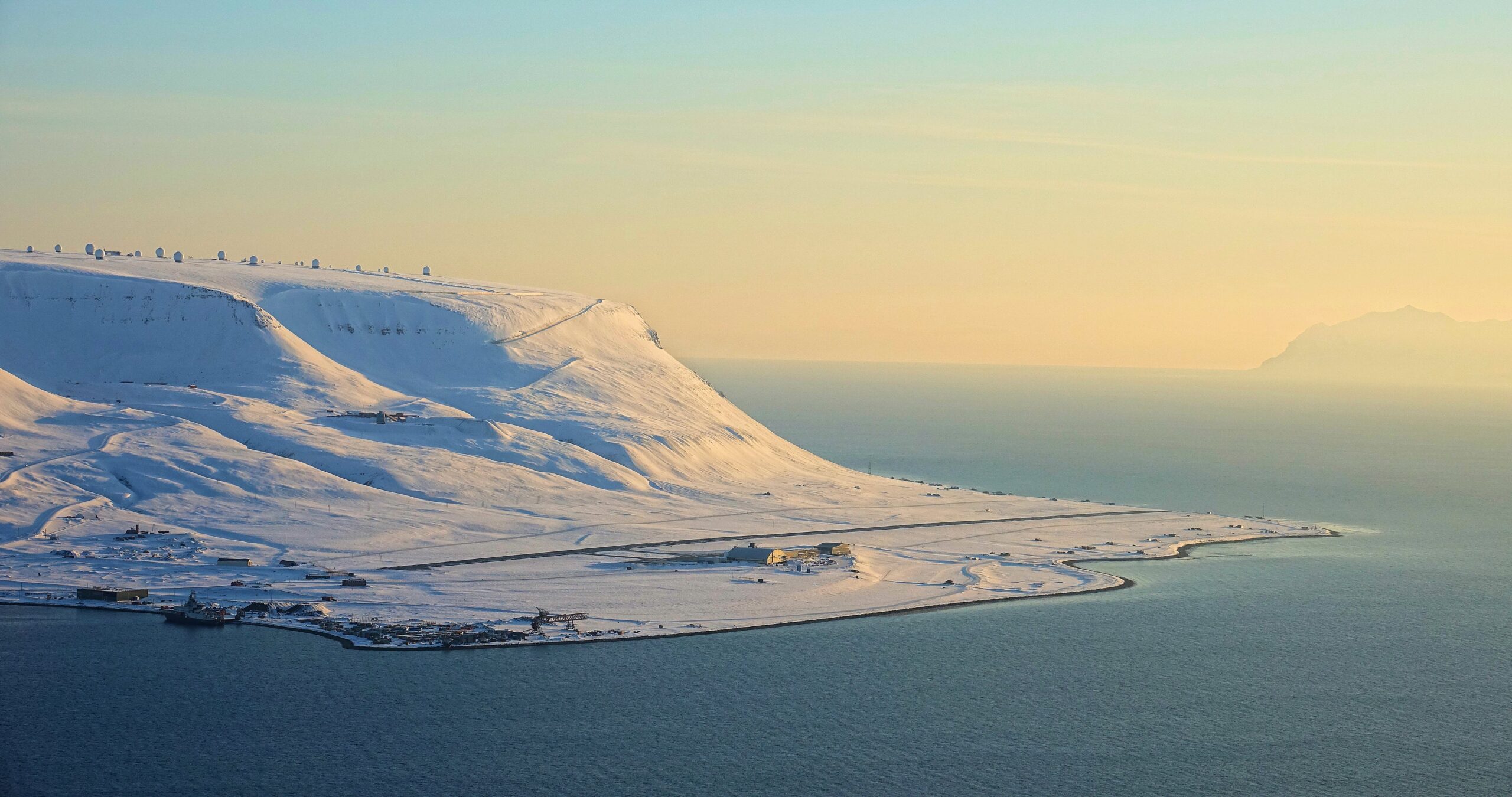
For an Arctic winter trip that is not another week in Lapland, look at Svalbard between early February and mid-March. SAS will run a third weekly flight from Tromsø to Longyearbyen from 6 February to 18 March 2027, as Aeroroutes reported on 22 October 2026. The schedule has been filed, so you can plan your dates around it now.
Late winter is a good moment in the Svalbard year. The polar night is over, the light returns a little more each day, and the evenings are still dark enough for the northern lights. It is also very cold, you cannot wander out of town on your own, and the islands see the aurora less often than northern Scandinavia. Here is how to plan around all of that. For the basics, start with our Svalbard guide.
The extra flight from Tromsø
The added rotation uses an Airbus A320neo. In the schedule Aeroroutes lists for the period, SK4424 leaves Tromsø at 12:15 and lands in Longyearbyen at 14:10 on Tuesdays, Thursdays and Saturdays, and SK4425 flies back at 14:55, reaching Tromsø at 16:35. The window is shorter than last season’s: in early 2026 the third weekly flight ran from 20 January to 28 March.
Tromsø is not the only gateway. SAS and Norwegian also fly to Longyearbyen from Oslo, according to Wikivoyage’s Svalbard guide. Starting in Tromsø, though, lets you spend a few nights in northern Norway first and add the islands as a second stage; our Norway guide covers the mainland part.
Plan the paperwork too. Svalbard is outside the Schengen area, and Norway treats the trip between the mainland and the islands as crossing an external Schengen border, where the new EU entry checks apply (see what the EES means for your trip). If you need a Schengen visa, it has to be multiple-entry so that you can come back through Norway. The UK Foreign Office reminds travellers that a passport is needed to travel to Svalbard (FCDO advice, updated 25 August 2026). Entry rules depend on your passport, so check the official advice for yours.
Light, dark and the northern lights
In Longyearbyen the polar night runs from 14 November to 29 January, and the sun stays below the horizon until 16 February. Because of where the town lies, direct sunshine does not reach it until 8 March, according to Wikivoyage’s Longyearbyen guide. The town marks its return with Solfestuka, the sun festival week, around that date.
For aurora watching, this is the useful end of the season. You need a dark sky, and from around 20 April Svalbard has the midnight sun. Wikivoyage’s northern lights guide notes that activity tends to peak around the equinoxes, which makes March nights a reasonable bet. Be realistic about the odds, though. The same guide says Svalbard sees the lights less often than northern Scandinavia, and cloud is the other variable, with fog common on the islands. If the aurora is your only goal, Tromsø is the better base, and Svalbard is the place you add for the high Arctic itself.
How many days to plan
On a three-a-week schedule, the flight days set the length of your stay. Thursday to Saturday gives you two nights, Saturday to Tuesday three, and Tuesday to Saturday four. Two nights leave room for a guided trip or two and one evening of sky watching. If the lights matter to you, four nights give you a better chance, since a single spell of cloud can wipe out a short stay.
Fill the days with guided outings. In winter, local operators run snowmobile trips and ice cave visits, generally from December to mid-May depending on the snow, and tours usually collect you from your accommodation. There is no public transport apart from the airport shuttle bus, which meets the flights.
Budget generously. Wikivoyage describes Svalbard as more expensive than mainland Norway by most measures, and notes that as of 2024 Longyearbyen had no banks or ATMs, with some businesses refusing cash.
Cold, rules and polar bears
March is one of the coldest months in Longyearbyen, with an average of about -15°C, and temperatures can fall to -40°C. Wind makes it feel colder still, and frostbite on the nose, cheeks, fingers and toes is a real risk, above all at speed on a snowmobile. The FCDO adds that emergency medical care and search and rescue are limited in Norway’s remote Arctic areas (see its Arctic travel safety advice).
The bigger change is that you cannot simply walk out of town. Signs with a polar bear on them mark the edge of the settlement. Around 500 bears live on the main islands, and anyone going beyond that line must carry a rifle and know how to use it. Renting one requires a firearms licence or a temporary permit from the Governor of Svalbard, which can take up to eight weeks to process, so for nearly everyone the answer is a guided tour. Trips outside the central part of Spitsbergen must be notified to the Governor. The FCDO tells travellers to follow the Governor’s safety advice on polar bears, glaciers and avalanches outside Longyearbyen.
Before you book
- Dates: choose a stay between 6 February and 18 March 2027 that fits the Tuesday, Thursday and Saturday flights, and confirm the times with SAS.
- Documents: travel with your passport, and if you need a Schengen visa, make sure it is multiple-entry.
- Activities: book guided trips for anything beyond the settlement, and do not plan to leave town on your own.
- Clothing: pack for -15°C and wind, with real protection for your face, hands and feet.
- Money: bring a card that works abroad, since there is no ATM to fall back on.
Then add the Svalbard leg to your Tromsø nights on a flight day, and recheck the FCDO advice for Norway in the week before you fly.
Cover photo: Bjørn Christian Tørrissen, CC BY-SA 4.0, via Wikimedia Commons