

- Local time
- 10:56
- Currency
- Bosnia-Herzegovina Convertible Mark (BAM)
- Capital
- Sarajevo
- Calling code
- +387
- Drive on the
- right
Overview
A mountainous Balkan country where East meets West: Sarajevo's bazaar, Mostar's Old Bridge, waterfalls, rafting rivers and Olympic ski slopes, with low prices. Stay on paved ground: landmines remain.
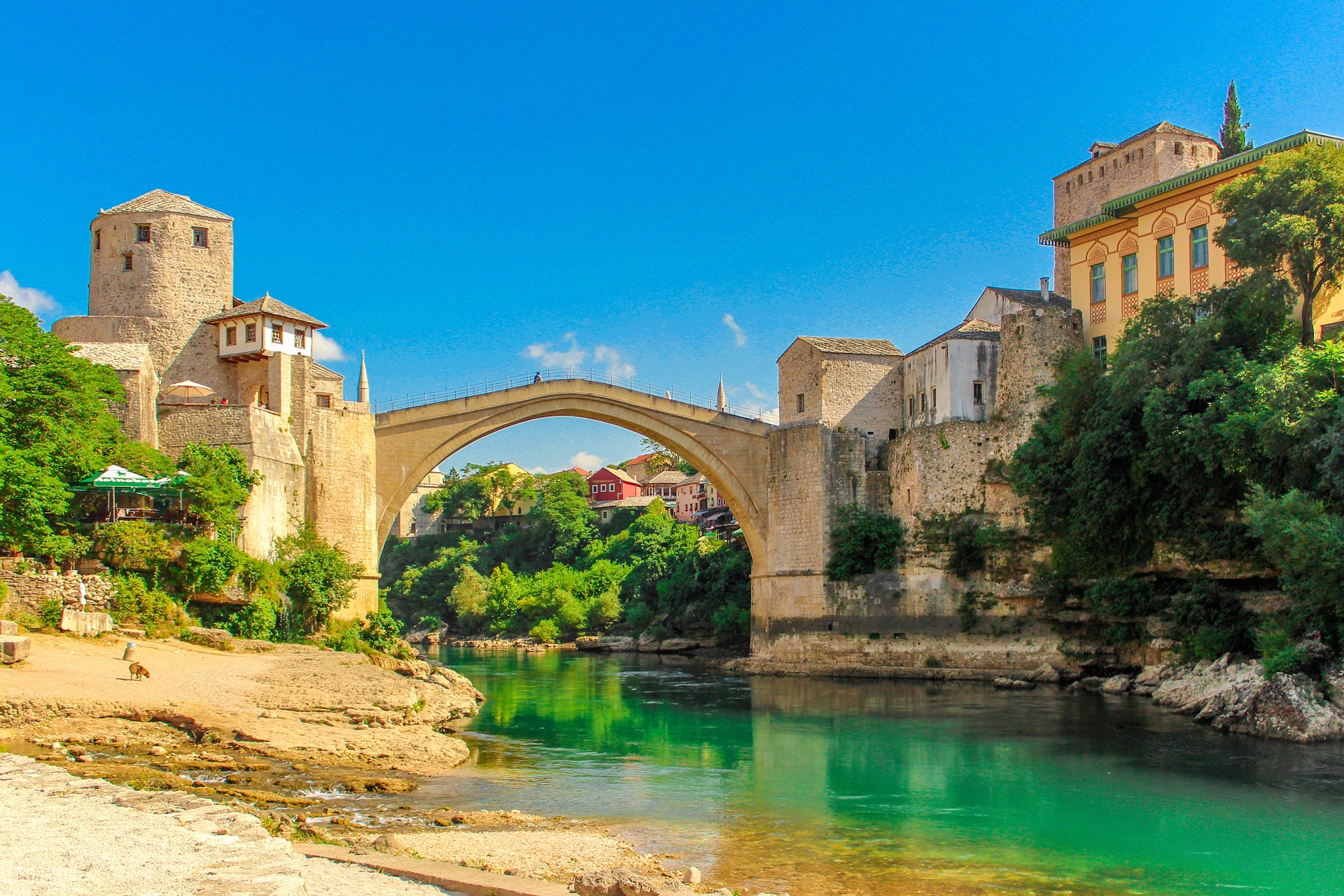
Bosnia and Herzegovina is mostly mountains, with only a sliver of Adriatic coast at Neum. Its cities mix Eastern and Western styles with socialist-era blocks: Sarajevo, the capital, has the Baščaršija bazaar, mosques, a cathedral and the venues of the 1984 Winter Olympics, while Mostar is known for its Old Bridge, carefully rebuilt and on the UNESCO list.
Outside the cities you find the Kravice waterfalls, the Jajce falls in the middle of town, Una and Sutjeska national parks, and rivers such as the Neretva, Una and Drina for rafting and kayaking. Bosniaks, Croats and Serbs share the country, which is split into two entities, the Federation and Republika Srpska. Landmines from the 1992 to 1995 war still lie in rural areas, so never step off paved roads and marked paths.
- Sarajevo: The Baščaršija bazaar, Gazi Husrev-beg Mosque, the Tunnel of Hope and the 1984 Olympic venues.
- Mostar: An old town on the Neretva, with the UNESCO-listed Old Bridge.
- Kravice waterfalls: Falls of about 30 m on the Trebižat river, some 40 km from Mostar.
- Jajce: A small town with a 17 m waterfall in its centre.
- Una National Park: The country's largest national park, with waterfalls and fly-fishing.
- Višegrad: The UNESCO-listed Mehmed Paša Sokolović Bridge over the Drina.
Places to visit
- City
- Town
- Park
- Historic site
Cities
- Sarajevo: The capital, a mix of East and West in architecture, religion and food.
- Mostar: An old town on the Neretva, symbolised by its rebuilt medieval bridge.
- Banja Luka: Second city and de facto capital of Republika Srpska, with green avenues and nightlife.
- Jajce: A small town with a waterfall at its heart and historic sites around it.
- Bihać: Near the Croatian border, surrounded by Una National Park.
- Tuzla: Third city, industrial but with an old town.
- Neum: The only coastal town, with beaches below steep hills.
Beyond the cities
- Stari Most (site): Mostar's Old Bridge, a UNESCO site; diving from it has caused serious injuries.
- Kravica (site): Waterfalls on the Trebižat river, popular with locals and rafters.
- Una National Park (park): The largest national park, with the Una falls and good hiking.
- Sutjeska National Park (park): A waterfall and one of Europe's last two primeval forests, near Foča.
- Mehmed Paša Sokolović Bridge (site): The UNESCO-listed Ottoman bridge at Višegrad.
- Blagaj (town): A village at the spring of the Buna river, near Mostar.
- Međugorje (town): A town between mountains, known for reported apparitions of the Virgin Mary.
Regions
- Sarajevo Region: The capital and the Olympic mountains Bjelašnica, Jahorina and Igman.
- Herzegovina: The compact southern part of the country, with Mostar and the Neretva valley.
- Central Bosnia
- Bosanska Krajina: The north-west, with Una National Park and its trout rivers.
- Northeastern Bosnia
- Posavina
Things to do
See
- Baščaršija Sarajevo: The old bazaar, with the Gazi Husrev-beg Mosque and the cathedral nearby.
- Tunnel of Hope Sarajevo: The wartime supply tunnel, now a museum.
- Old Bridge Mostar: The symbol of the city; leave the diving to professionals.
- Kravice and Blagaj Herzegovina: Waterfalls and the Buna spring, easy day trips from Mostar.
Do
- Rafting: On the Neretva, Una, Tara, Drina and Vrbas; currents can be very strong.
- Skiing Bjelašnica and Jahorina: The 1984 Olympic mountains near Sarajevo, also good for summer hikes.
- Hiking from Jablanica: One- to several-day hikes with mountain huts; stay on marked paths.
Eat
- Ćevapi: Grilled minced-meat kebabs in flatbread, in any ćevabdžinica.
Drink
- Bosnian coffee: Strong coffee in the Turkish style, served everywhere.
Itineraries
Sarajevo and Herzegovina in 6 days (6 days)
- Sarajevo (3 nights): Bazaar, museums and a trip up an Olympic mountain.
- Mostar (3 nights): By the scenic train or bus; day trips to Kravice and Blagaj.
The west and its waterfalls in 5 days (5 days)
- Sarajevo (1 night): Start in the capital.
- Jajce (2 nights): The waterfall and the Pliva lakes.
- Bihać (2 nights): Una National Park and rafting.
Climate and best time to visit
| Jan | Feb | Mar | Apr | May | Jun | Jul | Aug | Sep | Oct | Nov | Dec | |
|---|---|---|---|---|---|---|---|---|---|---|---|---|
| Max °C | 4 | 7 | 12 | 17 | 21 | 25 | 28 | 28 | 23 | 17 | 11 | 4 |
| Min °C | -3 | -2 | 1 | 5 | 9 | 13 | 14 | 14 | 10 | 7 | 3 | -2 |
| Rain mm | 68 | 67 | 67 | 78 | 89 | 88 | 75 | 63 | 89 | 91 | 85 | 89 |
Summers are hot and winters cold, especially in the mountains, where summers are short and winters long; the coast at Neum has mild, rainy winters. In Sarajevo the average high is about 28 °C in July and August and 4 °C in January, with rain in every month.
May, June and September are good for cities and hiking; winter suits skiing. Fog often delays or cancels flights at Sarajevo airport in December and January. Wildfires are possible from April to October, and heavy rain or snowmelt can cause floods and landslides.
Holidays and events
- 1 January 2026 · New Year's Day
- 2 January 2026 · New Year's Day
- 1 May 2026 · May Day / International Workers' Day
- 2 May 2026 · May Day / International Workers' Day
Getting around
| Main airports | SJJ |
|---|---|
| International driving permit | Recommended |
Buses are the best public transport, run by many small companies; a return ticket is only valid with the company that sold it, and journeys across the entity line can be slow. Trains are few and slow, though the Sarajevo to Mostar line is scenic. Use registered taxis with "TA" plates and insist on the meter; at Sarajevo airport agree the price first.
Driving: road deaths are high, mountain roads are narrow and many secondary roads have no petrol stations. Between November and April you need winter tyres and snow chains. Carry the required kit (vest, triangle, first-aid kit, spare tyre, tow rope, spare bulbs). The alcohol limit is 0.03%. If you hire a car in the country, a UK licence must be paired with a 1968 International Driving Permit.
Flying to Bosnia and Herzegovina? PartnerCompare fares and find the cheapest datesSearch flightsWhere to stay
- Hotels: Mostly 3 to 4 stars in the cities, some 5 stars; 2 to 4 stars in Neum.
- Hostels: Cheap hostels in Sarajevo.
- Motels and pensions: Common along the roads and in smaller towns.
- Mountain huts: On hiking trails, from basic to well catered.
Campsites are uncommon. Wild camping is often tolerated, but only where you are certain there are no mines. All visitors must be registered with the police within 72 hours; hotels do this for you.
Eat and drink
Dishes to try
- Ćevapi: Small grilled kebabs in somun flatbread; Banja Luka's are square, Sarajevo's round.
- Burek and pita: Filo pies with meat (burek), cheese (sirnica), spinach (zeljanica) or potato (krompiruša).
- Janjetina: Spit-roast lamb sold by the kilo at roadside restaurants.
- Trout: The local speciality in Mostar.
- Meza: A platter of smoked meats, cheese, ajvar and vegetables.
- Tufahija: Poached apple stuffed with walnuts, served with cream.
Drinks
- Bosnian coffee: Brewed in the Turkish style; Bosnians are among the world's biggest coffee drinkers.
- Rakija: Fruit brandy, commercial or home-made.
- Herzegovina wine: Red and white wines from the south, known for their quality.
Food is heavy on meat, with few vegetarian dishes, though burek with cheese or potato is an option. Restaurants serve few home-style dishes: look for an aščinica (cooked dishes) or a buregdžinica (pies). Smoking is allowed almost everywhere indoors, so expect smoky cafés. The drinking age is 18.
Entry requirements and visas
| Passport validity | Issued less than 10 years before arrival and valid at least 90 days after you leave (UK); valid 3 months beyond departure (Canada) |
|---|
| Passport | Entry | Max stay | Notes |
|---|---|---|---|
| EU / EEA | Visa free | 90 days | Up to 90 days; most EU and EEA citizens can enter with an ID card. |
| United Kingdom | Visa free | 90 days | Up to 90 days within a 6-month period. |
| Canada | Visa free | 90 days | Up to 90 days. |
| United States | Visa free | 90 days | Up to 90 days for tourism. |
| Australia | Visa free | 90 days | Up to 90 days for tourism. |
Other nationalities: check the official source below.
Bosnia and Herzegovina is not in the EU or Schengen. Make sure your passport is stamped on entry and exit: border police check the stamps for overstays and may fine you if one is missing. All foreigners must register with the police on arrival (within 72 hours according to the UK, 48 hours according to Canada); hotels do it for you.
Children travelling without both parents need a notarised letter of consent. Declare goods that may be prohibited or taxed. Rules depend on your passport: check the official link before you book.
Money and payments
| Currency | Bosnia-Herzegovina Convertible Mark (BAM) |
|---|---|
| Cards | Limited |
The currency is the convertible mark (KM, BAM), pegged to the euro at 1.95583 KM to €1. Euro notes up to €20 are widely accepted. The economy runs on cash: cards are not widely accepted, ATMs are scarce in rural areas, and most charge a fee. Avoid paying with 100 or 200 KM notes in small shops, and change leftover marks before you leave, as few places abroad will take them. Visitors can reclaim the 17% VAT on purchases over 100 KM.
Costs and budget
According to Eurostat, in 2024 the general price level in Bosnia and Herzegovina was about 59% of the EU average, food in shops about 83% and restaurants and hotels about 75%.
Health
| Recommended vaccines | Routine vaccines, including measles (MMR), Hepatitis A, Hepatitis B, Tick-borne encephalitis, if you will spend a lot of time outdoors |
|---|---|
| Malaria | None |
| Tap water | Safe |
The European (EHIC) and UK (GHIC) health cards are not valid: take travel insurance that covers evacuation. Medical facilities outside Sarajevo and the main towns are limited, and pharmacies may not accept foreign prescriptions. Air pollution can be high. Tap water is drinkable in most of the country. Dial 124 for an ambulance.
This is general information, not medical advice: check with a travel health professional before you go.
Safety
- United States: Level 2: Exercise Increased Caution (2026-10-20)
- Canada: Exercise a high degree of caution (2026-10-20)
- United Kingdom: No advice against travel (2026-10-20)
Landmines and unexploded weapons from the 1992 to 1995 war remain in rural and mountain areas. Never leave paved roads or marked paths without an experienced guide, avoid abandoned buildings, woods and overgrown land, and never touch unknown objects.
Pickpockets work in Sarajevo, Mostar and Banja Luka, and car break-ins are common on Mount Trebević. Organised crime shootings happen but rarely involve visitors. Traffic is probably the biggest everyday danger. Do not dive from Mostar's bridge, take care rafting in strong currents, and avoid demonstrations. Earth tremors are common.
Customs and etiquette
Bosniaks (mostly Muslim), Croats (mostly Catholic) and Serbs (mostly Orthodox) share the country. Avoid talking about the 1990s war or questions such as the status of Kosovo or Republika Srpska. Most Bosnian Muslims are liberal, but during Ramadan check opening hours and dress modestly.
Always carry your passport or photo ID. Do not photograph military or police sites or hydroelectric dams without permission. Same-sex relationships are legal, but public affection may attract unwelcome attention. Hospitality at home can be overwhelming: coffee comes with sweets and snacks.
Language
| Official languages | Bosnian, Croatian, Serbian |
|---|---|
| English | Common |
| Hello / Good day | Dobar dan DOH-bahr dahn |
|---|---|
| Hi | Zdravo ZDRAH-voh |
| Please | Molim MOH-leem |
| Thank you | Hvala HVAH-lah |
| Excuse me | Izvinite eez-VEE-nee-teh |
| Goodbye | Do viđenja doh vee-JEH-nyah |
What to pack
- Passport: You must carry ID, and get it stamped on entry and exit.
- Travel insurance: EHIC and GHIC are not valid in Bosnia and Herzegovina.
- Cash in marks or small euro notes: Cards are not widely accepted.
- Offline map such as OsmAnd: Google Maps is weak on trails, and staying on known paths matters because of mines.
- Winter tyres and chains: Required between November and April.
- Consent letter for children: Needed if a child travels without both parents.
Quick reference
Country facts
| Capital | Sarajevo |
|---|---|
| Population | 3,140,095 (2025) |
| Area | 51,200 km² |
| Time zone | Europe/Sarajevo (UTC+1) |
| Calling code | +387 |
| Driving side | right |
Staying connected
| SIM and eSIM | Prepaid SIM cards from networks such as HT Eronet, GSMBiH or m:tel are sold at kiosks for 10 KM or less, often with tourist data packages. |
|---|---|
| Roaming | Bosnia and Herzegovina is outside the EU: check your provider's roaming rates. |
Emergency numbers
| Police | 122 |
|---|---|
| Ambulance | 124 |
| Fire | 123 |
Frequently asked questions
Do I need a visa for Bosnia and Herzegovina?
Not for tourist stays of up to 90 days with an EU, UK, US, Canadian or Australian passport. Check the official rules before you book.
Are there still landmines?
Yes, in rural and mountain areas. Stay on paved roads and marked paths, avoid abandoned buildings and never touch unknown objects.
Can I pay by card?
Not reliably: the economy is cash-based. Carry convertible marks or small euro notes.
Is my EHIC or GHIC valid?
No. Take travel insurance that covers treatment and evacuation.
Can I drink the tap water?
In most parts of the country, yes.
Do I need to register with the police?
Yes, soon after arrival. Hotels do it for you; otherwise go to the nearest police or foreigners' office.
More Travel Stories from Europe
 Portugal
Sources This guide was last checked on · 18 sources
- Wikivoyage: Bosnia and Herzegovina · Overview, Places to visit, Things to do, Itineraries, Climate and best time to visit, Getting around, Where to stay, Eat and drink, Entry requirements and visas, Money and payments, Health, Safety, Customs and etiquette, Language, What to pack, Staying connected, Frequently asked questions
- Wikidata: Bosnia and Herzegovina · Overview, Places to visit, Money and payments, Country facts
- UK FCDO: Bosnia and Herzegovina safety and security (updated 13 August 2026) · Things to do, Climate and best time to visit, Getting around, Safety, Customs and etiquette, What to pack, Frequently asked questions
- WMO World Weather Information Service: Sarajevo · Climate and best time to visit
- Government of Canada: Bosnia and Herzegovina travel advice (updated 26 May 2026) · Climate and best time to visit, Getting around, Entry requirements and visas, Money and payments, Safety, Customs and etiquette, Frequently asked questions
- Nager.Date: public holidays in Bosnia and Herzegovina, 2026 · Holidays and events
- UK FCDO: Bosnia and Herzegovina entry requirements · Entry requirements and visas, What to pack, Frequently asked questions
- ISO 4217 (SIX), published 2026-09-17 · Money and payments
- Eurostat: price level indices, 2024 (EU27 = 100) · Costs and budget
- CDC Travelers' Health: Bosnia and Herzegovina · Health
- UK FCDO: Bosnia and Herzegovina health · Health, What to pack
- US Department of State: Bosnia and Herzegovina travel advisory · Safety
- UK FCDO: Bosnia and Herzegovina travel advice · Safety
- Wikivoyage: Bosnian phrasebook · Language
- World Bank, SP.POP.TOTL · Country facts
- World Bank, AG.LND.TOTL.K2 · Country facts
- IANA Time Zone Database, zone.tab · Country facts
- UK FCDO: Bosnia and Herzegovina getting help · Emergency numbers
Suggest an update
Travel rules, prices and timetables change. If something in this guide is out of date, tell us: we check every suggestion against an official source before changing the page.