

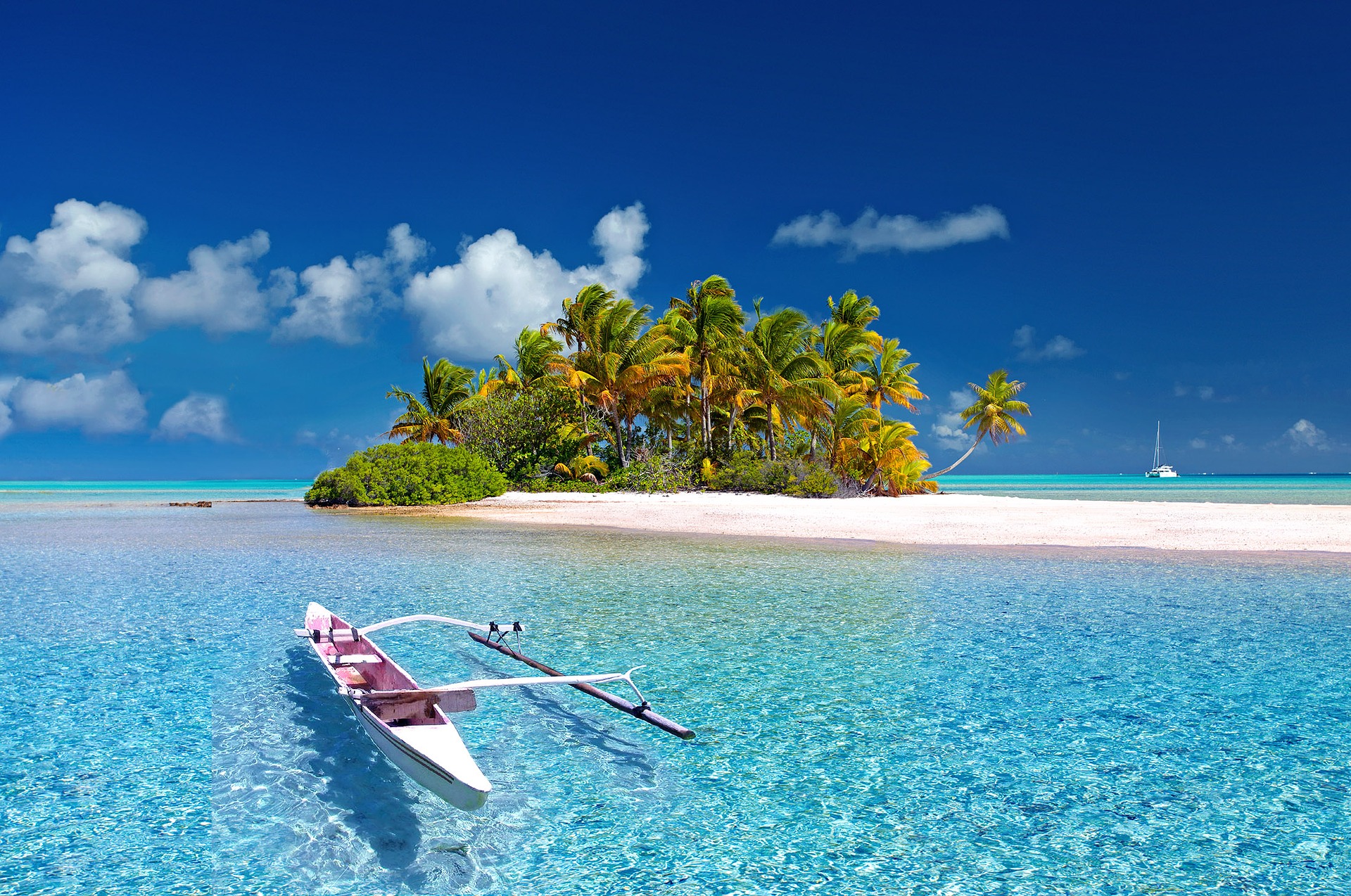
- Local time
- 04:30 (capital)
- Currency
- CFP Franc (XPF)
- Capital
- Papeete
- Calling code
- +689
- Drive on the
- right
Overview
French Polynesia is 118 islands in five archipelagos: Tahiti, Moorea and Bora Bora's lagoons, the atolls of the Tuamotus and the steep Marquesas. Superb diving and overwater bungalows, at very high prices.
French Polynesia is a French overseas country in the South Pacific, roughly halfway between California and Australia. Its 118 islands are spread over an area of ocean as large as the European Union, in five archipelagos: the high, reef-ringed Society Islands with Tahiti, Moorea and Bora Bora; the low coral atolls of the Tuamotus, such as Rangiroa and Fakarava; the steep Marquesas near the equator; and the remote Gambier and Austral islands.
Most people live on Tahiti and Moorea, which have roads, public transport and most of the hotels. Elsewhere, travel is by plane or boat, and island passes from Air Tahiti make multi-island trips easier. The lagoons offer some spectacular diving and snorkelling, with sharks and manta rays. Everything is very expensive, from overwater bungalows to groceries. The warmer, wetter season runs from November to April, when cyclones are possible; May to October is slightly cooler and drier.
- Bora Bora: A lagoon with manta rays and sharks along a coral wall.
- Moorea: Tahiti's neighbour, known for shark dives and its pineapple juice.
- Rangiroa and the Tuamotus: Coral atolls with pearl farms and rich diving.
- Marquesas Islands: High islands near the equator: Nuku Hiva and Hiva Oa.
- Tahiti: Papeete, Pointe Vénus, the Museum of Tahiti and her Islands.
Places to visit
- City
Cities
- Papeete: The capital, on Tahiti, close to the international airport.
Beyond the cities
- Tahiti (island): The main island, with Papeete, museums and the black-sand beach at Pointe Vénus.
- Moorea (island): A short ferry ride from Tahiti, known for shark dives.
- Bora Bora (island): The best-known island of the Leeward group, with a lagoon of rays and sharks.
- Huahine (island): A Leeward island on the classic island-hopping routes.
- Raiatea (island): A Leeward island on the classic island-hopping routes.
- Rangiroa (island): The best-known Tuamotu atoll, with pearl farms.
- Fakarava (island): A Tuamotu atoll reached by Air Tahiti and Air Moana.
- Nuku Hiva (island): A high island of the Marquesas.
- Hiva Oa (island): A Marquesas island with the village of Atuona.
Regions
- Society Islands: The most inhabited group: high islands with reefs and lagoons, including Tahiti, Moorea and Bora Bora.
- Tuamotu Islands: A vast central archipelago of low coral atolls; Rangiroa stands out.
- Marquesas Islands: High islands near the equator with steep mountains; Nuku Hiva and Hiva Oa stand out.
- Gambier Islands: Rarely visited, around the high island of Mangareva in the far south-east.
- Austral Islands: Small southern archipelagos of old volcanoes, far off the beaten track.
Things to do
See
- Pointe Vénus Tahiti: Captain Cook's observatory site, now a shaded black-sand beach with a lighthouse.
- Museum of Tahiti and her Islands Tahiti: Polynesian history, culture and ethnology.
- Gauguin Museum Tahiti: Artefacts and reproductions from Gauguin's time on Tahiti, next to botanical gardens.
- Pearl farm visit Rangiroa: Learn how black pearls are grown in the Tuamotu lagoons.
Do
- Dive or snorkel the lagoons: Diving centres on 11 islands; expect hundreds of fish species in the underwater canyons.
- Shark and ray dives Moorea and Bora Bora: Reef and lemon sharks at Moorea, manta rays and sharks at Bora Bora.
- Cruise the islands: Cruise ships, cargo-passenger boats such as the Aranui, or a chartered yacht.
Eat
- A Tahitian feast: Hotel buffets with local dishes and traditional dance.
Itineraries
Society Islands hop in 10 days (10 days)
- Tahiti (2 nights): Papeete and the museums.
- Moorea (2 nights): By ferry or catamaran, several times a day.
- Huahine (2 nights): By Air Tahiti.
- Raiatea (1 night): A short hop on the same pass.
- Bora Bora (3 nights): The lagoon, then back to Tahiti.
Bora Bora and the Tuamotus in 8 days (8 days)
- Tahiti (1 night): Arrival.
- Bora Bora (3 nights): Lagoon and diving.
- Rangiroa (4 nights): Atoll life and a pearl farm.
Holidays and events
- 1 January 2026 · New Year's Day
- 5 March 2026 · Missionary Day
- 3 April 2026 · Good Friday
- 5 April 2026 · Easter Sunday
- 6 April 2026 · Easter Monday
- 1 May 2026 · Labour Day
- 8 May 2026 · Victory Day
- 14 May 2026 · Ascension Day
- 24 May 2026 · Pentecost
- 25 May 2026 · Whit Monday
- 14 July 2026 · National Day
- 15 August 2026 · Assumption Day
- 1 November 2026 · All Saints' Day
- 11 November 2026 · Armistice Day
- 20 November 2026 · Matari'i
- 25 December 2026 · Christmas Day
Getting around
Air Tahiti and Air Moana fly between the islands; Air Tahiti's island passes cover set groups of islands and must be booked and confirmed in advance. Ferries and catamarans cross between Tahiti and Moorea several times a day, and schooners and cargo boats reach all inhabited islands from Papeete, from three times a week to the Society Islands to once a month to Mangareva. Driving is on the right, roads are narrow and many secondary roads are unlit; the UK says you need a 1968 International Driving Permit with your licence.
Flying to French Polynesia? PartnerCompare fares and find the cheapest datesSearch flightsWhere to stay
- International hotels: About 50 on 12 islands, mostly on Tahiti, Moorea and Bora Bora, many with overwater bungalows.
- Family hotels and guest houses: From bed and breakfasts to family-run guest houses with meals: simpler and more local.
Even budget accommodation is expensive. Tahiti, Moorea and Bora Bora have over 80% of hotel rooms.
Eat and drink
Dishes to try
- Poisson cru: Raw fish marinated in lemon juice and coconut milk, the signature dish.
- Ma'a tinito: A Chinese-Tahitian mix of pork, kidney beans, Chinese cabbage and macaroni.
- Tama'ara'a feast: Suckling pig, fish, breadfruit and bananas steamed in an earth oven.
Drinks
- Hinano: The local beer.
- Moorea pineapple juice: Fresh juices are everywhere.
| Tipping | Not a custom. |
|---|
Tourist restaurants are expensive: in 2019 mains started around 2,000 F. Locals eat at snacks and roulottes (food trucks), where poisson cru or grilled fish cost about 1,200 to 1,400 F.
Entry requirements and visas
| Passport validity | At least 3 months after the date you plan to leave |
|---|
| Passport | Entry | Max stay | Notes |
|---|---|---|---|
| United Kingdom | Visa free | 90 days | Up to 90 days for tourism or business. |
| Canada | Visa free | 90 days | Up to 90 days; you may be asked for an onward ticket and proof of funds. |
| United States | Visa free | 90 days | Up to 90 days, according to Wikivoyage. |
| Australia | Visa free | 90 days | Up to 90 days, according to Wikivoyage. |
| EU / EEA | Freedom of movement | No visa needed for any length of stay, according to Wikivoyage. |
Other nationalities: check the official source below.
If you need a visa, apply at a French embassy or consulate. You need a yellow fever certificate if you arrive from a country with a risk of yellow fever. Declare anything prohibited or dutiable. Rules depend on your passport and can change: check the French visa website before you book.
Money and payments
| Currency | CFP Franc (XPF) |
|---|---|
| Cards | Common |
The currency is the CFP franc (XPF, F), pegged to the euro, so euros give the best exchange. Cards are accepted, and banks on Tahiti and the main islands change money for a commission. Some atolls in the Austral and Gambier groups have no banks at all, so carry cash. Everything is very expensive.
Health
| Required vaccines | Yellow fever certificate, only if you arrive from a country with a risk of yellow fever |
|---|---|
| Recommended vaccines | Routine vaccines, including measles (MMR), Hepatitis A, Hepatitis B, Typhoid, for rural areas or longer stays, Rabies, only for some travellers: ask a travel clinic |
| Malaria | None |
| Tap water | Varies |
Dengue, chikungunya and Zika have broken out: avoid mosquito bites. Tap water is drinkable in some places and not others; bottled water is the safest choice. Medical care is generally good, with two major hospitals, but serious cases may need evacuation, and the EHIC and GHIC cards do not cover you. The only recompression chamber is in Papeete. For an ambulance, call 15.
This is general information, not medical advice: check with a travel health professional before you go.
Safety
- United States: Level 1: Exercise Normal Precautions (2026-10-20)
- Canada: Take normal security precautions (2026-10-20)
- United Kingdom: No advice against travel (2026-10-20)
Violent crime is rare, but petty theft happens: avoid isolated beaches after dark and keep valuables in the hotel safe. Beaches rarely have lifeguards and currents can be strong. Wear reef shoes against coral cuts and stonefish, and keep your fingers away from moray eels. Choose dive operators carefully. Cyclones and heavy rain are most likely from November to April, and tsunamis can follow earthquakes.
Customs and etiquette
Tahitians are relaxed and welcoming and live by "aita pea pea", no worries. Outside tourist areas, dress conservatively and behave discreetly. Approaching whales and other marine mammals is regulated and needs authorisation.
Language
| Official languages | French, Tahitian |
|---|---|
| English | Common |
| Hello | Ia ora na |
|---|---|
| Thank you | Mauruuru |
| Welcome | Maeva |
| Goodbye, see you later | Nana |
| How are you? | Maita'i? |
| Cheers | Manuaia |
| Yes / No | E / Aita |
What to pack
- Reef shoes: Against coral cuts and stonefish.
- Insect repellent: Dengue, chikungunya and Zika occur.
- Euros or cash: Euros exchange best, and some islands have no banks.
Quick reference
Country facts
| Capital | Papeete |
|---|---|
| Population | 282,465 (2025) |
| Area | 3,521 km² |
| Time zone | Pacific/Tahiti (UTC-10), Pacific/Marquesas (UTC-9.5), Pacific/Gambier (UTC-9) |
| Calling code | +689 |
| Driving side | right |
Staying connected
| SIM and eSIM | Mobile service from Vodafone and Vini; Vini sells prepaid travel cards with data. |
|---|---|
| Wi-Fi | Most hotels offer internet; paid wifi hotspots cover the main Society, Tuamotu and Marquesas islands. |
Emergency numbers
| Police | 17 |
|---|---|
| Ambulance | 15 |
| Fire | 18 |
Frequently asked questions
Do I need a visa for French Polynesia?
UK and Canadian visitors can stay up to 90 days without a visa, and EU citizens need no visa. Check the French visa website before you book.
Is French Polynesia expensive?
Yes, very. Snack bars and food trucks are the cheapest way to eat.
How do you get between the islands?
By Air Tahiti or Air Moana flights, with island passes, or by ferry and cargo boat.
Do I need to tip?
No, tipping is not a custom.
When is the best time to visit?
May to October is slightly cooler and drier; November to April is warmer and wetter, with cyclones possible.
Sources This guide was last checked on · 15 sources
- Wikivoyage: French Polynesia · Overview, Places to visit, Things to do, Itineraries, Getting around, Where to stay, Eat and drink, Entry requirements and visas, Money and payments, Health, Safety, Customs and etiquette, Language, What to pack, Staying connected, Frequently asked questions
- Nager.Date: public holidays in French Polynesia, 2026 · Holidays and events
- UK FCDO: French Polynesia safety and security · Getting around, Safety
- Government of Canada: French Polynesia travel advice (updated 15 October 2026) · Getting around, Entry requirements and visas, Safety, Customs and etiquette, What to pack, Frequently asked questions
- UK FCDO: French Polynesia entry requirements · Entry requirements and visas, Frequently asked questions
- Wikidata · Money and payments, Country facts
- ISO 4217 (SIX), published 2026-09-17 · Money and payments
- CDC Travelers' Health: French Polynesia · Health
- UK FCDO: French Polynesia health · Health
- US Department of State: French Polynesia travel advisory · Safety
- UK FCDO: French Polynesia travel advice · Safety
- World Bank, SP.POP.TOTL · Country facts
- World Bank, AG.LND.TOTL.K2 · Country facts
- IANA Time Zone Database, zone.tab · Country facts
- UK FCDO: French Polynesia getting help · Emergency numbers
Suggest an update
Travel rules, prices and timetables change. If something in this guide is out of date, tell us: we check every suggestion against an official source before changing the page.