

- Local time
- 23:37
- Currency
- Australian Dollar (AUD)
- Capital
- Kingston
- Calling code
- +6723
- Drive on the
- left
Overview
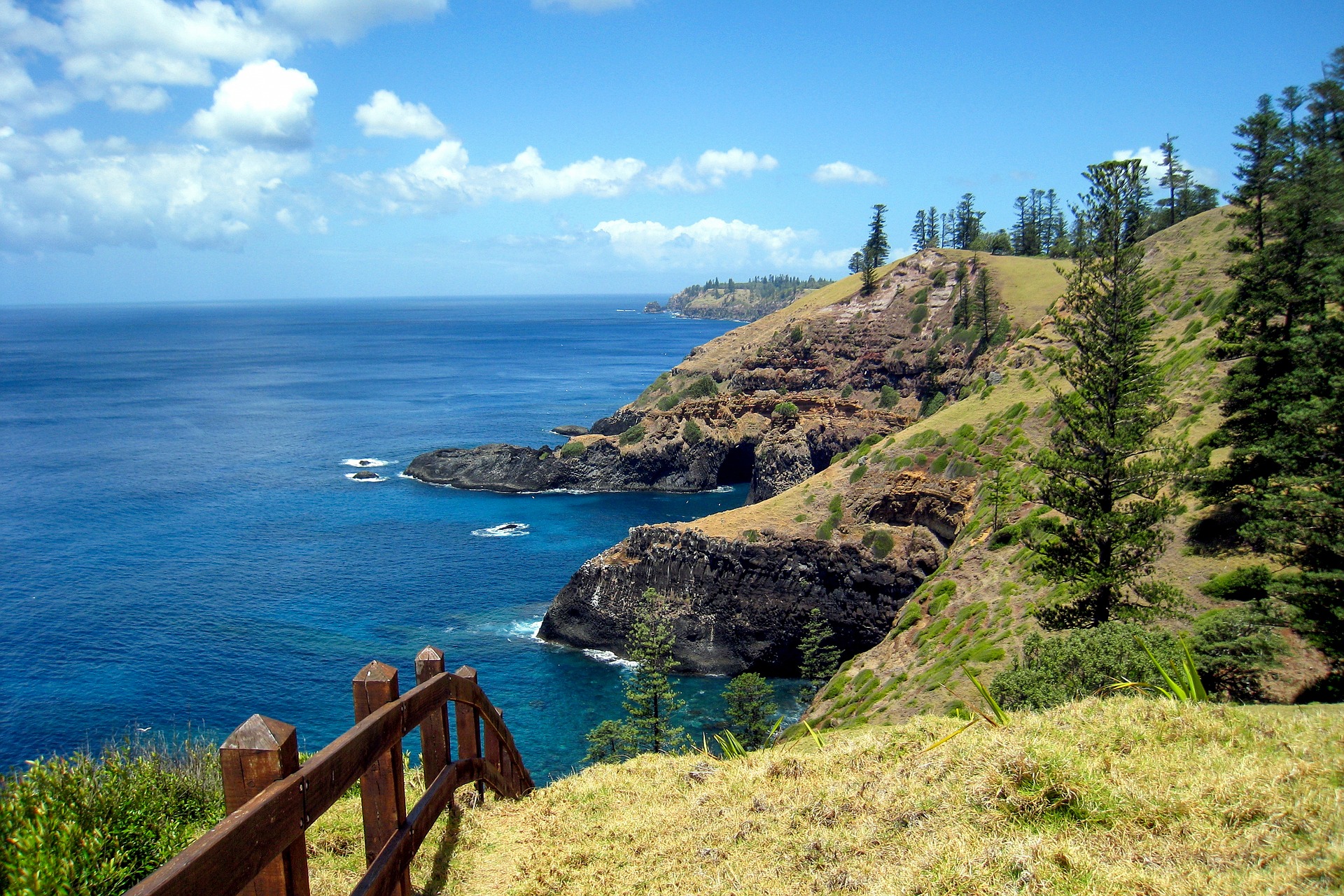
Norfolk Island is a small Australian territory in the Pacific, 1,600 km east of Sydney: UNESCO-listed convict ruins at Kingston, Bounty descendants, Norfolk pines, sheltered reef lagoons and coastal walks.
Norfolk Island lies in the Pacific about 1,600 km east of Sydney and Brisbane and 1,000 km north-west of Auckland, and is administered by Australia. Its history comes in three settlements: a British colony from 1788, a harsh all-male penal settlement from 1825 to 1855, and from 1856 the Pitcairn Islanders, descendants of the Bounty mutineers, who were given land here. About a third of today's roughly 2,200 residents descend from them, and many still speak Norfuk among themselves.
The convict buildings of Kingston are part of the UNESCO-listed Australian Convict Sites, and the island has museums, coastal lookouts, rainforest walks in the national park and safe snorkelling in the reef lagoon of Emily Bay. The climate is mild and subtropical, around 24 °C in summer and 19 °C in winter. Burnt Pine, next to the airport, is the commercial centre. Life runs at a relaxed pace, and planning ahead for cars, tours and dinner bookings is essential.
- Kingston convict ruins: Jails, hospital, salt house and the officers' houses of Quality Row, free to explore.
- Emily Bay: A sheltered reef lagoon for swimming and snorkelling among corals and tropical fish.
- Captain Cook's Lookout: Spectacular cliffs, islets and birdlife, and the start of the Bridle Track.
- Norfolk Island National Park: Rainforest walks and the views from Mount Pitt and Mount Bates.
- Kingston museums: Four museums on the settlements, the Bounty and the wreck of HMS Sirius.
- Bounty Day: 8 June: re-enactments, parades and a community picnic.
Places to visit
- City
- Park
- Mountain
- Historic site
Cities
- Kingston: The historic settlement and territorial capital, with convict ruins, museums and beaches.
- Burnt Pine: The commercial centre next to the airport: shops, restaurants, clubs and the visitor centre.
Beyond the cities
- Kingston and Arthur's Vale Historic Area (site): The UNESCO-listed convict settlement, with plaques explaining the ruins.
- Emily Bay (coast): With neighbouring Slaughter Bay, the only safe places to swim, protected by the reef.
- Norfolk Island National Park (park): Walking tracks, botanic garden and the island's highest points.
- Mount Pitt (mountain): Drive to the top for views and picnic tables.
- Mount Bates (mountain): The island's highest point, about 1 km along the ridge from Mount Pitt.
- Anson Bay (coast): A turquoise bay below a clifftop reserve; strong rips make swimming unsafe.
- Phillip Island (island): An island 6 km south of Kingston, a regeneration site for endangered species, visited only by boat tour.
Things to do
See
- Explore the convict ruins Kingston: Wander the jails, hospital and Quality Row; many buildings have plaques.
- Kingston museums pass Kingston: Four museums, including HMS Sirius and the Pier Store's Bounty story, with tag-along guided visits.
- Fletcher's Mutiny Cyclorama Burnt Pine: A 360° painting of the Bounty mutiny and the settlement of the island.
Do
- Snorkel Emily Bay Emily Bay: Corals and tropical fish off the beach; glass-bottom boat trips leave from here.
- Walk the Bridle Track: From Captain Cook's monument along cliffs and rainforest, with views of Bird Rock; allow a couple of hours.
- Mount Pitt to Mount Bates Norfolk Island National Park: A ridge walk of about 1 km to the highest point; the last stretch is steep.
- Golf by the ocean Kingston: A 9-hole course with its clubhouse in a Quality Row house; visitors welcome.
Eat
- Progressive dinner: Dinner in islanders' homes with dishes based on Polynesian traditions; book in Burnt Pine.
Shop
- Sunday arts and craft market Burnt Pine: Local souvenirs, preserves, baked goods and coffee.
Holidays and events
- 1 January 2026 · New Year's Day
- 26 January 2026 · Australia Day
- 6 March 2026 · Norfolk Island Foundation Day
- 3 April 2026 · Good Friday
- 6 April 2026 · Easter Monday
- 25 April 2026 · Anzac Day
- 8 June 2026 · Bounty Day
- 8 June 2026 · King's Birthday
- 12 October 2026 · Norfolk Island Agricultural Show
- 25 November 2026 · Thanksgiving Day
- 25 December 2026 · Christmas Day
- 26 December 2026 · St. Stephen's Day
Getting around
| Main airports | NLK |
|---|
There is no public transport, and the hills and distances make walking impractical: most independent visitors rent a car or scooter, often included in accommodation packages, and daily tours are available. A small ride-hailing service operates, and you can hire bicycles if you enjoy climbing. Driving is on the left; the speed limit is 50 km/h, 40 km/h in Burnt Pine. Cows and other animals have right of way, and locals greet every passing car with the "Norfolk wave". The road between Burnt Pine and Kingston is steep, with no footpath or lighting.
Flying to Norfolk Island? PartnerCompare fares and find the cheapest datesSearch flightsWhere to stay
- Guesthouses and apartments in Burnt Pine: Central, close to shops, cafés and clubs.
- Self-catering cottages and holiday homes: Spread around the island, often with views; good for groups.
- Resorts: With pools and restaurants; packages often include a rental car.
There is a wide range of accommodation, from simple rooms to resorts. There is no air-conditioning on the island and very little heating.
Eat and drink
Dishes to try
- Fresh fish: Seafood is the island's speciality; trumpeter is common.
- Local produce: Potatoes, sweet potatoes, bananas, figs and avocados are grown on the island.
- Homemade preserves: A local speciality sold in shops and markets.
Drinks
- Local liqueurs and soft drinks: From the distillery and soft-drink maker on Cascade Road, with free tastings some afternoons.
- Island wine: From the island's winery, tasted by appointment.
| Meal times | Lunch kitchens close by 2–3pm; dinner runs from about 5:30 to 8pm, and mini-markets close by 9pm. |
|---|
Book dinner, usually a day ahead, as tables are limited; club bistros take walk-ins. Most restaurants have a vegetarian dish, vegans may need to self-cater, and gluten-free food is easy to find. Wood barbecues and picnic tables are dotted around reserves and Kingston, and the supermarket in Norfolk Mall is the cheapest option.
Entry requirements and visas
Norfolk Island is part of Australia, so you must meet Australia's visa requirements. Travel from mainland Australia counts as domestic, but flights use the international terminals, so you must carry a passport or government photo ID. Strict quarantine rules apply: declare all food, plant material (including wooden items) and animal products; fresh fruit, vegetables, plants, seeds and meat cannot be brought in without a commercial permit. Rules differ in each direction, so check before you travel.
Money and payments
| Currency | Australian Dollar (AUD) |
|---|---|
| Cards | Widespread |
Norfolk Island uses the Australian dollar only; other currencies are hard to use, though banks exchange money in business hours. There is a single ATM, at the Commonwealth Bank in Burnt Pine, so do not let your cash run low. Almost all shops and restaurants accept cards. Many specialty shops open around 10 or 11am and close around 3pm, and are often closed on Saturday afternoons and Sundays.
Health
| Required vaccines | Yellow fever certificate, only if you arrive from a country with a risk of yellow fever (including transits of more than 12 hours) |
|---|---|
| Recommended vaccines | Routine vaccines, including measles (MMR), COVID-19, Hepatitis A, Hepatitis B, Typhoid, only for some travellers (long stays, visiting friends or relatives), Rabies, only for some travellers: ask a travel clinic |
| Malaria | None |
| Tap water | Safe |
Tap water is safe to drink, and bottled water is also sold. The island has one hospital, with a 24-hour service and a GP clinic, and a pharmacy in Burnt Pine. Medical evacuation to the mainland is very expensive, so visitors from outside Australia need good insurance. In an emergency call 000.
This is general information, not medical advice: check with a travel health professional before you go.
Safety
Crime is very low, though not unknown: use common sense with your belongings. Emily Bay and Slaughter Bay in Kingston are the only safe places to swim, protected by the reef; other bays are not patrolled and conditions are unpredictable, with strong rips at Anson Bay and sudden large waves that can sweep swimmers out to sea. At Emily Bay, avoid the reef channel on the left by the lone pine.
Customs and etiquette
Do not climb on or touch the convict ruins and artefacts: they are a valuable part of Australia's history. Return the "Norfolk wave" when you drive. Norfolk pine souvenirs are usually fine to take to Australia or New Zealand, but tell the seller where you are going and declare them, as wooden items must be declared.
Language
| Official languages | English |
|---|---|
| English | Widespread |
What to pack
- Passport or government photo ID: Flights leave from international terminals, even from Australia.
- Australian dollars in cash: There is only one ATM on the island.
- Snorkel gear: For Emily Bay and Slaughter Bay; you can also hire it in Burnt Pine.
Quick reference
Country facts
| Capital | Kingston |
|---|---|
| Population | 2,188 (2021) |
| Area | 35 km² |
| Time zone | Pacific/Norfolk (UTC+12) |
| Calling code | +6723 |
| Driving side | left |
Staying connected
| SIM and eSIM | The local mobile network is mainly for calls; Norfolk Island Data Services sells SIM cards and 4G dongles, with coverage mostly in Kingston and Burnt Pine. |
|---|---|
| Roaming | Australian networks are not present and roaming will not work in most cases; Telstra phones with Wi-Fi calling work on Wi-Fi. |
| Wi-Fi | Norfolk Telecom hotspots cover tourist areas with prepaid cards, most accommodation has Wi-Fi, and most cafés offer it free. |
Frequently asked questions
Do I need a passport for Norfolk Island?
Australians can travel with government photo ID, but a passport is easiest. Other visitors must meet Australia's visa rules.
How do I get there?
Fly with Qantas from Brisbane or Sydney, or with Air Chathams from Auckland. A few cruise ships also call.
Do I need a car?
Yes, for most visitors: there is no public transport and the island is hilly.
Where is it safe to swim?
Only at Emily Bay and Slaughter Bay in Kingston, which are protected by the reef.
Can I drink the tap water?
Yes, tap water is safe to drink.
What are the island's special holidays?
Foundation Day (6 March), Bounty Day (8 June) and Thanksgiving (fourth Wednesday of November), on top of the New South Wales holidays.
Sources This guide was last checked on · 6 sources
- Wikivoyage: Norfolk Island · Overview, Places to visit, Things to do, Getting around, Where to stay, Eat and drink, Entry requirements and visas, Money and payments, Health, Safety, Customs and etiquette, Language, What to pack, Staying connected, Frequently asked questions
- Nager.Date: public holidays in Norfolk Island, 2026 · Holidays and events
- Wikidata · Money and payments, Country facts
- ISO 4217 (SIX), published 2026-09-17 · Money and payments
- CDC Travelers' Health: Norfolk Island · Health, Frequently asked questions
- IANA Time Zone Database, zone.tab · Country facts
Suggest an update
Travel rules, prices and timetables change. If something in this guide is out of date, tell us: we check every suggestion against an official source before changing the page.