

- Local time
- 15:39
- Currency
- Saudi Riyal (SAR)
- Capital
- Riyadh
- Calling code
- +966
- Drive on the
- right
Overview
Islam's holiest cities, the Nabataean ruins of Hegra, restored Diriyah, the coral houses of old Jeddah and vast deserts. Open to tourists since 2019: check the current travel advice first.
Saudi Arabia covers most of the Arabian Peninsula and is home to Mecca and Medina, the two holiest cities of Islam, which draw millions of pilgrims every year. The country was closed to ordinary tourism until 2019, when tourist visas were introduced. Since then visitors can see a remarkable set of UNESCO World Heritage Sites: the ruined Nabataean city of Hegra, similar to Petra, the restored town of Diriyah outside Riyadh, the old trading port of Historic Jeddah, the date palms of the Al-Ahsa Oasis and rock art thousands of years old near Ha'il.
The country is more varied than its reputation: the Empty Quarter is one of the largest sand deserts on earth, the Red Sea coast has coral reefs and islands, and the Asir mountains in the south-west are green. The country still applies a strict interpretation of Islamic law, with tight limits on behaviour and free expression. In October 2026 the UK advised against all but essential travel to Saudi Arabia because of missile and drone attacks: read the Safety section before you plan a trip.
- Hegra (Madain Saleh): A ruined Nabataean city similar to Petra, on the UNESCO list.
- Diriyah (At-Turaif): The restored first capital of the House of Saud, on the edge of Riyadh.
- Historic Jeddah: The old Red Sea port, known for its coral-stone houses.
- Al-Ahsa Oasis: One of the largest oases in the world, with millions of date palms, springs and historic buildings.
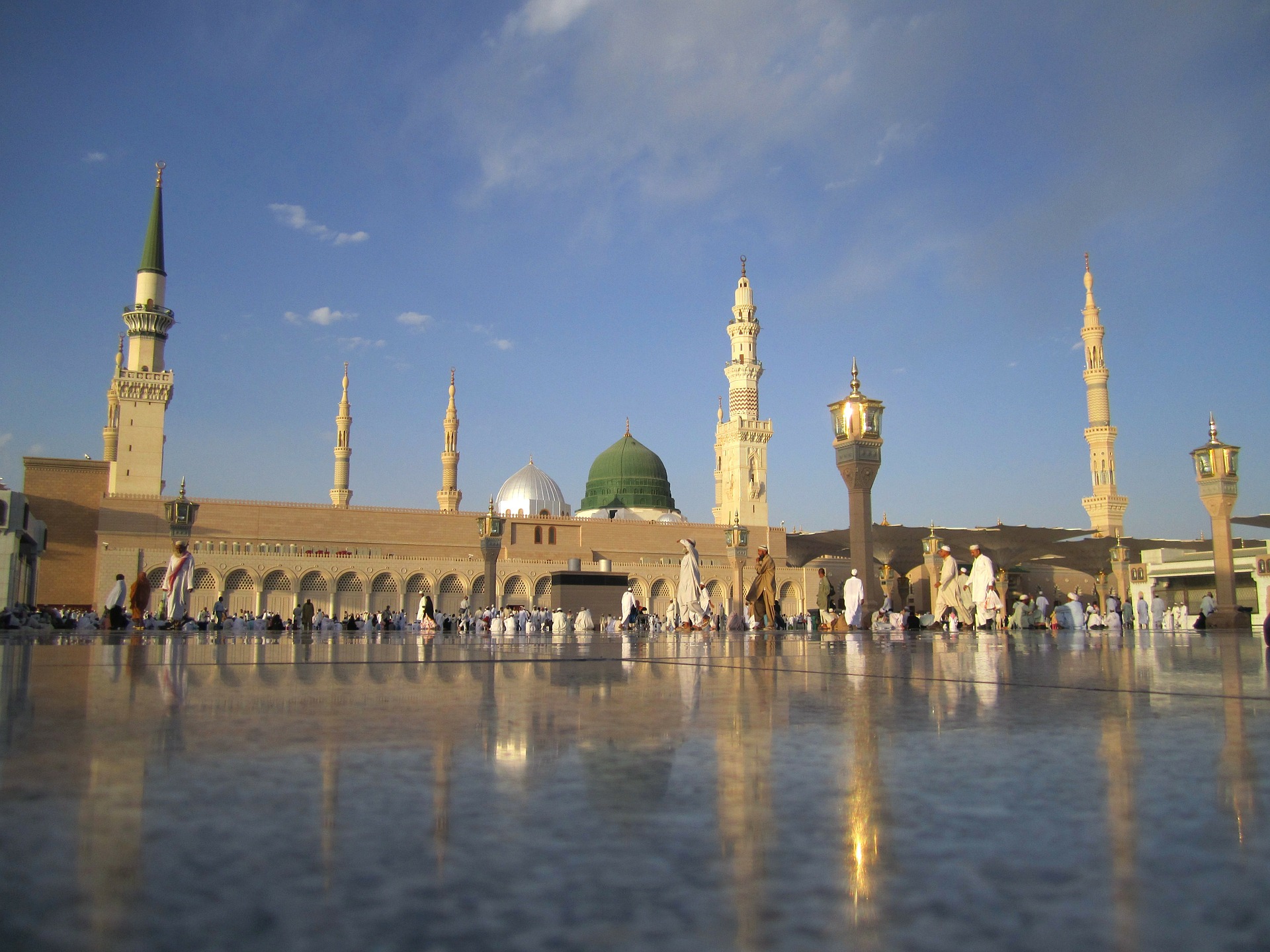
- Medina: The second holiest city of Islam; non-Muslims may now visit the centre outside the Hajj season.
- The Empty Quarter: One of the largest sand deserts on earth; never visit it alone.
Places to visit
Cities
- Riyadh: The capital and largest city, with Masmak Fort and Diriyah on its outskirts.
- Jeddah: A large Red Sea city, known for the coral houses of its old town and for diving.
- Medina: The second holiest city of Islam; non-Muslims may visit the centre up to the fence of the Prophet's Mosque, outside the Hajj season.
- Mecca: The holiest city of Islam and the goal of the Hajj; closed to non-Muslims.
- Ta'if: The unofficial summer capital, in the mountains, where it rarely passes 35 °C.
- Abha: A mountain resort in the south-west, near the Yemeni border; Canada advises against all travel to the province of Asir.
Beyond the cities
- Hegra (Madain Saleh) (site): A large Nabataean archaeological site in the north, a UNESCO World Heritage Site.
- Diriyah (At-Turaif) (site): The original home of the House of Saud, with a fine collection of Najdi architecture.
- Al-Ahsa Oasis (area): A vast oasis in the east with nearly 2.5 million date palms, canals, springs and archaeological sites.
- Rock Art in the Ha'il Region (site): Petroglyphs and inscriptions about 10,000 years old, near Jubbah in the north.
- Empty Quarter (area): The largest continuous body of sand on earth, covering most of the south of the peninsula.
- Farasan Islands (island): Protected coral islands off Jazan; Canada advises against all travel to Jazan province.
Regions
- Hejaz: The mountains along the Red Sea, with Mecca and Medina in their foothills and Jeddah on the coast.
- Nejd: The central plateau of desert steppe around Riyadh.
- Eastern Province (Saudi Arabia): The Gulf coast, with Dammam, Dhahran and Khobar and the oases of Qatif and Al-Ahsa.
- North (Saudi Arabia): Desert steppe and sand seas, with Hegra and the rock art of Ha'il.
- Asir: Greener mountains near Yemen, including Jabal Sawda, over 3,000 m high.
Things to do
See
- Masmak Fort Riyadh: One of the best-known museums in the country, in a fort linked to a key battle of Saudi history.
- Diriyah Riyadh: The restored district of At-Turaif, with fine Najdi architecture, a UNESCO World Heritage Site.
- Hegra North: A large Nabataean site similar to Petra, perhaps the country's best-known World Heritage Site.
- Historic Jeddah Jeddah: The old port quarter of coral-stone houses, still a trading hub.
- Al-Ahsa Oasis Eastern Province: Date palm gardens, springs and historic buildings in one of the largest oases in the world.
- Medina Medina: Non-Muslims can walk to the perimeter of the Prophet's Mosque and photograph it from outside, except in the Hajj season.
Do
- Red Sea diving Jeddah: Jeddah has several dive operators for the reefs of the Red Sea.
- Saudi Arabian Grand Prix Jeddah: The Formula One race on a tight street circuit, usually in March.
- Camel racing: A Bedouin tradition and still a popular sport.
- Desert trips: Saudis love the desert; go in a convoy and never alone, especially in the Empty Quarter.
Shop
- Souqs and gold markets: Every big city has gold and jewellery markets; bargaining is normal in small shops, and Jeddah is known for carpets.
Itineraries
Riyadh and Diriyah in 3 days (3 days)
- Riyadh (3 nights): Masmak Fort and the souqs.
- Diriyah (At-Turaif) (0 nights): Half a day in the restored town.
Jeddah and Medina in 5 days (5 days)
- Jeddah (3 nights): Historic Jeddah and a day of diving.
- Medina (2 nights): By the Haramain high-speed train; non-Muslims only outside the Hajj season.
Riyadh and the Al-Ahsa oasis in 3 days (3 days)
- Riyadh (1 night): Start in the capital.
- Al-Ahsa Oasis (2 nights): By train to Hofuf, for the palm gardens and springs.
Climate and best time to visit
| Jan | Feb | Mar | Apr | May | Jun | Jul | Aug | Sep | Oct | Nov | Dec | |
|---|---|---|---|---|---|---|---|---|---|---|---|---|
| Max °C | 20 | 23 | 28 | 33 | 39 | 43 | 44 | 44 | 41 | 36 | 28 | 22 |
| Min °C | 7 | 9 | 13 | 18 | 23 | 25 | 26 | 26 | 23 | 18 | 13 | 8 |
| Rain mm | 17 | 9 | 22 | 26 | 6 | 0 | 0 | 0 | 0 | 1 | 13 | 17 |
For most of the year most of the country is very hot. From May to September temperatures average 42 °C and often pass 50 °C in the shade; in Riyadh the average maximum is about 44 °C in July and August. The coasts stay a little cooler but are extremely humid, while the mountains are milder: Ta'if rarely passes 35 °C, and the Asir is cooler still.
Winter is a different country. In Riyadh the average maximum is about 20 °C in January, and nights can drop below zero. The best time to visit is November to March. Rain is rare but can come in violent bursts, mainly in winter and in April and May; between November and February heavy rain can cause flooding. The far south gets its rain from the monsoon between May and October.
Getting around
| Main airports | RUH, JED, MED, DMM |
|---|---|
| International driving permit | Recommended |
Distances are huge, so flying is the usual way to travel: Riyadh to Jeddah takes 90 minutes, with near-hourly flights. Trains are modern and comfortable: Riyadh to Hofuf and Dammam, Riyadh to Buraydah and Al Qurayyat, and the high-speed Haramain line between Mecca, Jeddah and Medina; book ahead, as trains often sell out. Riyadh and Mecca have metros. SAPTCO buses link the whole country, comfortably but slowly. In cities, use licensed taxis or apps such as Uber, Careem and Bolt.
Driving is the biggest everyday risk: speeding is common, traffic laws are often ignored and fatal accidents are frequent. A UK photocard licence is valid for 3 months; rental companies may require an International Driving Permit and a minimum age of 21. Fines arrive by text and must be paid through the Absher system before you leave. After an accident, call the police and Najm and do not move the car; if someone is injured, drivers can be held for days. In the desert, drive in daylight and in a convoy. Mecca is closed to non-Muslims, and zones near the borders with Yemen and Iraq are off limits.
Flying to Saudi Arabia? PartnerCompare fares and find the cheapest datesSearch flightsWhere to stay
- International hotels: Plentiful in all major cities and expensive; they can serve food during prayer times and room service in Ramadan.
- Furnished apartments: Short-term rentals in Mecca, Medina, Ta'if and Abha; prices are negotiable and payment is usually in cash.
- Small hotels: Cheaper and negotiable, usually cash in advance.
- Luxury resorts: New resorts in AlUla, Neom and the Red Sea Project, with summer discounts.
Unmarried tourists may share a hotel room under special arrangements for visitors. Smoking is common indoors, so ask for a non-smoking room if it matters to you.
Eat and drink
Dishes to try
- Kabsa: The national dish: spiced basmati rice with vegetables, topped with meat.
- Mandi: Chicken or mutton cooked with rice in a pot hung over a fire, popular in the south.
- Shawarma, foul and falafel: Cheap everyday food from small shops, with hummus and tabbouleh.
- Dates and baklava: Dates are served to guests, and baklava is part of every Ramadan iftar.
Drinks
- Arabic coffee (mirra): Bedouin-style coffee spiced with cardamom, best with fresh dates.
- Tea and juices: Sweet tea with mint, and endless fresh fruit juice combinations.
- Alcohol: Banned everywhere, with severe penalties; non-alcoholic "Saudi champagne" and malt drinks are popular.
| Tipping | Not generally expected; expensive restaurants often add a 10% service charge, and taxi fares are usually rounded. |
|---|
Saudi food is hard to find in restaurants outside large hotels, but Indian, Pakistani, Lebanese and fast-food places are everywhere. Food is traditionally eaten with the right hand. Most restaurants let diners stay inside during prayer times, but new customers wait until prayers are over.
During Ramadan all restaurants close in daylight and you may not eat, drink or smoke in public; after the evening prayer they open until the early hours, and hotel iftar buffets are popular, so book ahead.
Entry requirements and visas
| Passport validity | At least 6 months after the date you arrive |
|---|
| Passport | Entry | Max stay | Notes |
|---|---|---|---|
| United Kingdom | Evisa | 90 days | Tourist e-visa valid one year, 90 days in total, online or on arrival at international airports. An ETA or an electronic visa waiver are also possible. |
| Canada | Evisa | 90 days | Tourist visa online or on arrival at the airport, multiple entry, valid one year, up to 90 days per year. |
| United States | Evisa | 90 days | E-visa valid one year, up to 90 days per visit (Wikivoyage). |
| Australia | Evisa | 90 days | E-visa valid one year, up to 90 days per visit (Wikivoyage). |
| EU / EEA | Evisa | 90 days | E-visa valid one year, up to 90 days per visit (Wikivoyage). |
Other nationalities: check the official source below.
Tourists from many countries can get an e-visa online or on arrival at international airports; it includes health insurance up to 100,000 riyals. Other options for British visitors are an electronic travel authorisation and a single-entry visa waiver, which do not include insurance. None of them is valid for the Hajj, which needs its own visa booked through the official Nusuk platform. Overstaying leads to large fines, detention and a ban. Rules depend on your passport and can change: check the official link before you book.
You may be refused entry if your passport shows travel to Israel or birth there. It is illegal to bring in alcohol, pork, pornography, drugs, weapons or non-Islamic religious items beyond personal use, and phones, books and computers may be inspected. Some medicines need approval in advance, and UK prescriptions are not valid in Saudi Arabia. Declare more than SR 60,000 in cash. You need a yellow fever certificate if you come from a country with the disease, and pilgrims need a meningitis ACWY certificate. It is illegal to hold two passports in your name in the country.
Money and payments
| Currency | Saudi Riyal (SAR) |
|---|---|
| Cards | Common |
The currency is the Saudi riyal (SAR, SR), divided into 100 halalas and pegged at SR 3.75 to US$1; in practice prices are rounded to the riyal. Saudi Arabia is still largely a cash society: big businesses take cards, smaller ones may refuse them for small amounts, and shops do not accept foreign currency. ATMs are everywhere, but those of smaller banks often reject foreign cards. Money changers are found in the souqs. A 15% VAT applies.
Health
| Required vaccines | Yellow fever certificate, if you arrive from or transit through a country with yellow fever, Meningitis ACWY certificate, for Hajj and Umrah pilgrims |
|---|---|
| Recommended vaccines | Routine vaccines, including measles (MMR) and the seasonal flu, Hepatitis A, Hepatitis B, Typhoid, for some travellers, Rabies, for some travellers: ask a travel clinic |
| Malaria | Some areas |
| Tap water | Varies |
Ask a travel health professional about vaccines and malaria at least 6 to 8 weeks before you go: Canada reports malaria in certain areas and seasons, dengue and chikungunya, and low risks of leishmaniasis and Rift Valley fever, so protect yourself from mosquitoes and sandflies. Heat stroke and dehydration are a serious risk in summer, and altitude sickness in parts of the country. Infections spread quickly during the Hajj and Ramadan.
Hospitals in the big cities are of a high standard; most towns have a health centre or basic hospital, and serious cases may be transferred far away. Pharmacies are easy to find, but UK prescriptions are not accepted: only Saudi-licensed doctors can prescribe. Tap water in the major cities is generally safe, though not very tasty; bottled water is cheap. For an ambulance, dial 911, or 112 without a Saudi SIM card.
This is general information, not medical advice: check with a travel health professional before you go.
Safety
- United States: Level 3: Reconsider Travel (2026-10-20)
- Canada: Avoid non-essential travel (2026-10-20)
- United Kingdom: Advises against all travel to parts of the country; Advises against all but essential travel to the rest of the country (2026-10-20)
Read the current official advice before you go. On 17 October 2026 the UK advised against all travel within 10 km of the border with Yemen and against all but essential travel to the rest of Saudi Arabia. Canada advises avoiding non-essential travel to the country and all travel to King Khalid International Airport in Riyadh, to the provinces of Asir, Jazan and Najran, and within 30 km of the Yemeni border. According to the UK, since 13 July 2026 missiles and drones fired from Yemen have targeted places across the country, including Abha, Jazan, Najran, Riyadh, Jeddah, Dammam and Yanbu, especially airports, ports, military sites and energy facilities. Further attacks on airports and cancellations are very likely, and there is also a risk of renewed attacks by Iran.
Follow the Saudi authorities and Civil Defence alerts, keep away from oil and military sites, and if told to take shelter, stay indoors away from windows. Never approach debris, and do not photograph or share images of attacks: it is illegal. Zones within 20 km of the Iraqi border and around Hafr al Batin and Khafji are off limits without permission, and tourist trips to military zones and border posts are banned.
The threat of terrorism is real, and demonstrations are illegal. Ordinary crime is low, though pickpockets work in crowds and at holy sites, and women may face harassment. During the Hajj, crowds at the holy sites have caused deadly stampedes. Heavy rain from November to February can cause floods; call Civil Defence on 998.
Customs and etiquette
Saudi Arabia applies Islamic law strictly. Men and women must wear loose clothing that covers the elbows and the knees, with no profane or political slogans; women visitors do not have to wear an abaya or cover their hair. Avoid public displays of affection, swearing, rude gestures and loud music. Family areas and beaches are often separated from those for single men. Public worship of other religions and any attempt to convert people are illegal, though private practice is accepted. Same-sex relations are illegal, and being transgender is not recognised.
Be very careful about what you say and post. Criticising the King, the Crown Prince, the government, the police or Islam, or commenting on Israel and Palestine, can be treated as a threat to national security, even for posts made abroad or years ago, and has led to long prison sentences. Do not photograph government buildings, palaces or military sites, and ask before photographing people. Always carry a copy of your passport and visa. During Ramadan do not eat, drink, smoke or chew gum in public in daylight. Alcohol is banned and drug trafficking carries the death penalty. Eat and pass things with your right hand.
Language
| Official languages | Arabic |
|---|---|
| English | Common |
| Hello | مرحبا marḥaban |
|---|---|
| Peace be with you (formal greeting) | السلام عليكم as-salaamu alaikum |
| Please | من فضلك min faḍlak (to a man), min faḍlik (to a woman) |
| Thank you | شكرا shukran |
| Excuse me | لو سمحت law samaḥta (to a man), law samaḥti (to a woman) |
| Goodbye | مع السلامة ma'a as-salaamah |
| Do you speak English? | هل تتكلم الانجليزية؟ hal tatakallam al-ingliziyyah? |
| How much is this? | بكم هذا؟ bikam hatha? |
What to pack
- Passport valid at least 6 months, and only one: Holding two passports in your name is illegal; carry a copy with your visa.
- E-visa or travel authorisation: Arrange it online before you fly; check that it allows entry by road if you come from Bahrain.
- Doctor's letter for your medicines: Some medicines need approval, and UK prescriptions are not accepted locally.
- Loose clothes covering elbows and knees: Required for both men and women.
- A warm layer in winter: Nights in Riyadh can drop below zero.
- Cash in riyals: Many small businesses prefer cash, and some ATMs reject foreign cards.
Quick reference
Country facts
| Capital | Riyadh |
|---|---|
| Population | 36,973,555 (2025) |
| Area | 2,149,690 km² |
| Time zone | Asia/Riyadh (UTC+3) |
| Calling code | +966 |
| Driving side | right |
Emergency numbers
| Emergency | 911 |
|---|
Frequently asked questions
Is it safe to travel to Saudi Arabia now?
In October 2026 the UK advised against all but essential travel to Saudi Arabia, and against all travel near the Yemeni border, because of missile and drone attacks. Canada advises avoiding non-essential travel. Check the current advice in the Safety section.
Do I need a visa for Saudi Arabia?
Yes. Tourists from the UK, the US, Canada, Australia and the EU can get an e-visa online or on arrival, valid one year for up to 90 days. Check the official link before you book.
Can non-Muslims visit Mecca and Medina?
Mecca is closed to non-Muslims. In Medina, non-Muslims may visit the city centre up to the fence of the Prophet's Mosque, except in the Hajj season.
Do women have to wear an abaya in Saudi Arabia?
No. Women visitors do not have to wear an abaya or cover their hair, but men and women must wear loose clothing covering elbows and knees.
Is alcohol allowed in Saudi Arabia?
No. Alcohol is banned, cannot be brought into the country, and brewing, owning or selling it carries severe penalties.
When is the best time to visit Saudi Arabia?
November to March, when Riyadh averages around 20 to 30 °C by day. From May to September temperatures average 42 °C.
Sources This guide was last checked on · 19 sources
- Wikivoyage: Saudi Arabia · Overview, Places to visit, Things to do, Itineraries, Climate and best time to visit, Getting around, Where to stay, Eat and drink, Entry requirements and visas, Money and payments, Health, Safety, Customs and etiquette, Language, What to pack, Frequently asked questions
- UK FCDO: Saudi Arabia warnings and insurance · Overview, Getting around, Safety, Frequently asked questions
- Government of Canada: Saudi Arabia travel advice (updated 18 October 2026) · Places to visit, Getting around, Entry requirements and visas, Health, Safety, Customs and etiquette, Frequently asked questions
- WMO World Weather Information Service: Riyadh · Climate and best time to visit, Frequently asked questions
- UK FCDO: Saudi Arabia safety and security · Climate and best time to visit, Getting around, Where to stay, Eat and drink, Safety, Customs and etiquette, What to pack, Frequently asked questions
- UK FCDO: Saudi Arabia regional risks · Getting around, Safety
- UK FCDO: Saudi Arabia entry requirements · Entry requirements and visas, Health, What to pack, Frequently asked questions
- UK FCDO: Saudi Arabia pilgrimage · Entry requirements and visas
- Wikidata · Money and payments, Country facts
- ISO 4217 (SIX), published 2026-09-17 · Money and payments
- UK FCDO: Saudi Arabia health · Health, What to pack
- US CDC: Travelers' health, Saudi Arabia · Health
- US Department of State: Saudi Arabia travel advisory · Safety
- UK FCDO: Saudi Arabia travel advice · Safety
- Wikivoyage: Arabic phrasebook · Language
- World Bank, SP.POP.TOTL · Country facts
- World Bank, AG.LND.TOTL.K2 · Country facts
- IANA Time Zone Database, zone.tab · Country facts
- UK FCDO: Saudi Arabia getting help · Emergency numbers
Suggest an update
Travel rules, prices and timetables change. If something in this guide is out of date, tell us: we check every suggestion against an official source before changing the page.