

- Local time
- 14:37
- Currency
- Jordanian Dinar (JOD)
- Capital
- Amman
- Calling code
- +962
- Drive on the
- right
Overview
Petra, Wadi Rum, the Dead Sea and the Roman city of Jerash: Jordan packs some of the Middle East's great sights into a small, welcoming country that is easy to travel.
Jordan sits at the crossroads of Asia, Africa and Europe, and its sights span thousands of years: the Nabataean city of Petra, carved out of sandstone, the Roman ruins of Jerash, the mosaics of Madaba, a Crusader castle at Kerak, the 12th-century castle of Ajlun and the Umayyad desert castles around Azraq. Nature is just as strong a draw, from the sand and granite cliffs of Wadi Rum to the hiking trails of Dana and the Dead Sea, the lowest point on earth, where you float without effort.
Jordan is one of the most liberal countries in the region and very hospitable to visitors; English is widely spoken, and the main sights fit into a trip of a week or so. The pleasant seasons are spring and autumn: summer is hot and winter can bring rain and even snow to the highlands. Check the current travel advice, as regional tensions affect some areas near the borders.
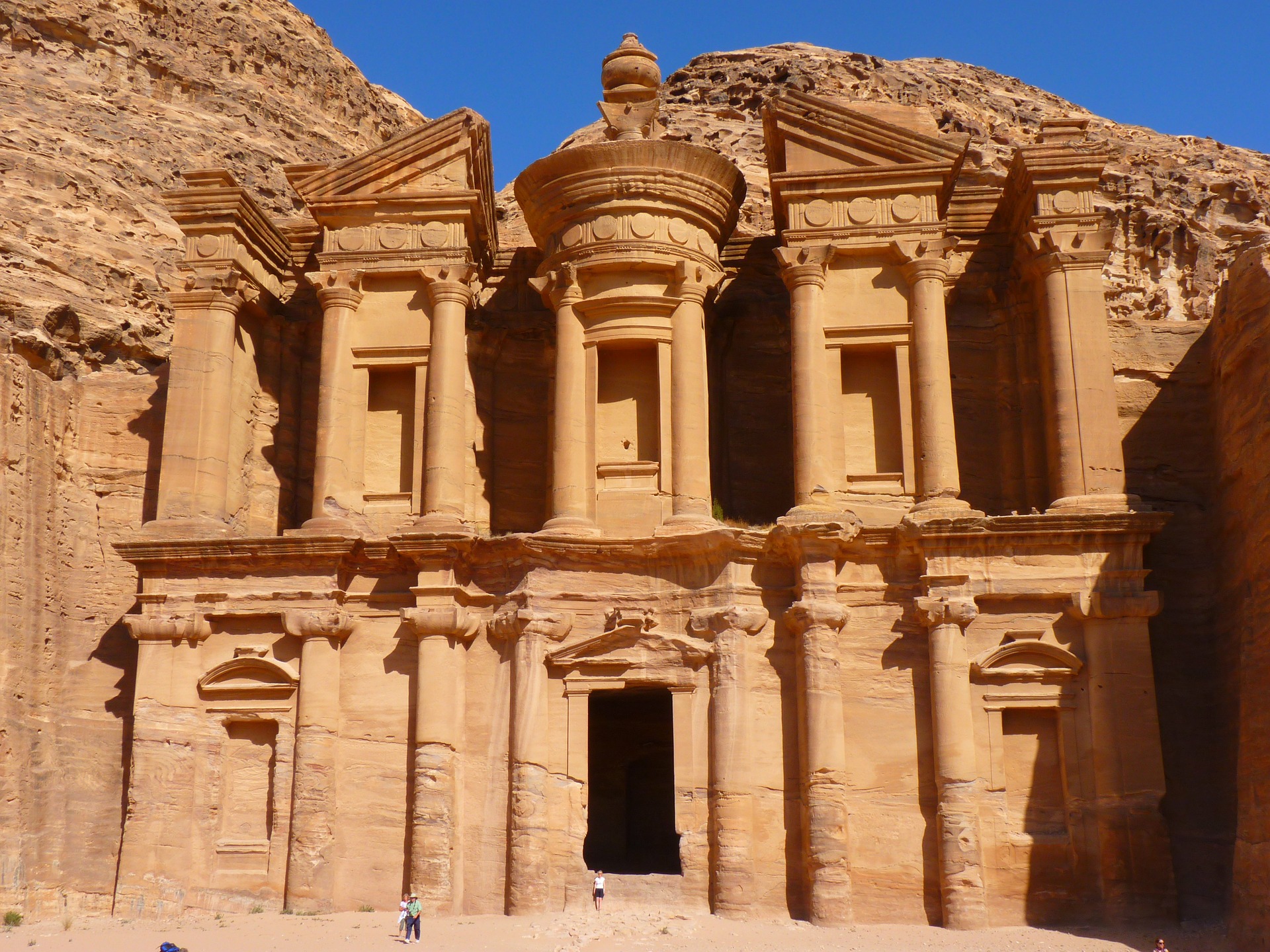
- Petra: The Nabataean city carved out of sandstone, Jordan's top attraction; allow at least two days.
- Wadi Rum: A desert of sand and granite cliffs, best seen with Bedouin guides.
- The Dead Sea: The lowest point on earth and one of the saltiest seas, where you float without trying.
- Jerash: Some of the most impressive Roman ruins in the eastern Mediterranean.
- Madaba: A town of mosaics, famous for its ancient map of Jerusalem and the Holy Land.
- Dana Nature Reserve: Hiking in a branch of the Great Rift, with a traditional village to stay in.
Places to visit
Cities
- Amman: The capital and the country's economic, political and cultural centre.
- Aqaba: Jordan's port on the Red Sea, for diving and links to the Sinai.
- Jerash: One of the largest Roman sites in the Middle East, north of Amman.
- Madaba: Known for its mosaic map of Jerusalem and the Holy Land, and a good place for souvenirs.
- Kerak: The site of a once-mighty Crusader castle, and the home of the best mansaf.
- Salt: An old town that was once the capital of Jordan.
- Irbid: The second largest city, in the north.
Beyond the cities
- Petra (site): An ancient city carved out of sandstone, one of the New Seven Wonders of the World.
- Wadi Rum (area): A remote desert of granite cliffs and sand, for jeep tours, climbing and camps.
- Dead Sea (coast): The lowest point on earth, with hotels and beaches for floating in the salty water.
- Dana Nature Reserve (park): Hiking trails, unusual rock formations and eco-lodges in a branch of the Great Rift.
- Ajlun Castle (site): The impressive ruins of a 12th-century castle in the green north.
- Umm Qais (site): A Roman-era settlement next to the ruins of ancient Gadara, with oak forests nearby.
- Azraq Wetland Reserve (park): An oasis in the eastern desert, near the Umayyad desert castles.
- Wadi Mujib (area): A canyon near the Dead Sea with streams, for hikes that include some climbing.
Regions
- Northern Jordan: The greenest part of the country, with Jerash, Ajlun, Umm Qais and Irbid.
- King's Highway: The old road south of Amman through Madaba, Wadi Mujib, Kerak and Dana to Petra, near the Dead Sea.
- Eastern Desert: Desert east of Amman, with the Umayyad desert castles around Azraq.
- Southern Desert: Petra, Wadi Rum and Aqaba on the Red Sea.
Things to do
See
- Petra Petra: Allow at least two days for the vast site, and walk the trail to Little Petra. Leave by closing time: staying inside after hours can lead to arrest.
- Jerash Jerash: Walk through one of the largest Roman cities in the region.
- Mosaics of Madaba Madaba: The archaeological park and some of the finest mosaics in the world.
- Castles Kerak and Ajlun: The Crusader castle of Kerak and the 12th-century ruins of Ajlun; the Umayyad desert castles lie east of Amman.
Do
- Desert tours in Wadi Rum Wadi Rum: Explore the desert with Bedouin guides and spend a night in a camp; the soft rock is also popular for climbing.
- Floating in the Dead Sea Dead Sea: One of the highlights of a trip: the salty water holds you up. Bethany, the site of Jesus's baptism, is nearby.
- Hiking Dana Nature Reserve: Dana, Wadi Mujib and the oak forests of the north are the best areas; the 675 km Jordan Trail runs from Umm Qais to Aqaba. Avoid canyons in the rainy season.
- Diving and snorkelling Aqaba: Red Sea reefs with turtles and a sunken tank; choose an operator with a recognised accreditation and never dive alone.
- Hammam: A Turkish bath, separate for men and women.
Eat
- Mansaf Kerak: Try the national dish of lamb and rice in a sauce of dried yogurt.
Itineraries
Jordan from north to south in 9 days (9 days)
- Amman (2 nights): The capital, with a day trip to Jerash.
- Madaba (1 night): The mosaics, then down to the Dead Sea.
- Dead Sea (1 night): A float in the salty water.
- Dana Nature Reserve (1 night): A day of hiking, via Kerak on the King's Highway.
- Petra (2 nights): Two full days for the site.
- Wadi Rum (1 night): A night in a desert camp.
- Aqaba (1 night): Snorkelling in the Red Sea before you leave.
Aqaba, Petra and Wadi Rum in 5 days (5 days)
- Aqaba (1 night): Arrive by air, by ferry from Egypt or overland.
- Petra (2 nights): Two days in the Nabataean city.
- Wadi Rum (1 night): Jeep tour and desert camp.
- Aqaba (1 night): Back to the coast for a dive.
Climate and best time to visit
| Jan | Feb | Mar | Apr | May | Jun | Jul | Aug | Sep | Oct | Nov | Dec | |
|---|---|---|---|---|---|---|---|---|---|---|---|---|
| Max °C | 12 | 14 | 17 | 23 | 28 | 31 | 32 | 32 | 31 | 27 | 20 | 14 |
| Min °C | 4 | 4 | 6 | 10 | 14 | 17 | 19 | 19 | 17 | 14 | 9 | 5 |
| Rain mm | 63 | 62 | 43 | 14 | 3 | 0 | 0 | 0 | 0 | 7 | 28 | 49 |
Jordan's climate changes with altitude. The western highlands, including Amman, have a Mediterranean climate; the east is arid desert, where the heat is drier and the nights are cool. In Amman the average maximum is about 12 °C in January and 32 °C in August, and nearly all the rain falls between November and March. Summers are hot and dry, sometimes above 40 °C in July and August.
Spring and autumn are the best seasons: March to May and October to November. Winter can bring frequent showers, flash floods in the wadis and occasional snow in the western highlands, which can block mountain roads, including around Petra.
Getting around
| Main airports | AMM, AQJ |
|---|---|
| International driving permit | Required |
Buses: JETT runs comfortable coaches from Amman to Aqaba and to the King Hussein Bridge; minibuses and white or cream shared taxis (servees) link smaller towns and leave when full. Canada advises avoiding the small "coaster" buses. Taxis are yellow and should use the meter, which is almost always cheaper than a negotiated fare; outside Amman many drivers do not use it, so agree the price per ride first. Uber and Careem are safer than street taxis, and women should sit in the back. There is one domestic flight, Amman to Aqaba, about 50 minutes.
Driving: you need an International Driving Permit (1949 version) together with your licence. The Desert Highway links Amman and Aqaba, and the slower King's Highway passes Madaba, Kerak and Petra. Radar traps are everywhere and fines are paid on the spot; seatbelts are compulsory in the front, phones are banned at the wheel, and cars must carry a fire extinguisher and a warning triangle. Avoid driving after dark outside Amman: stray animals, unlit vehicles and trucks with poor brakes make roads dangerous. After an accident, wait for the police (911). Wadi Rum and Dana are best explored in a four-wheel drive with a local guide.
Flying to Jordan? PartnerCompare fares and find the cheapest datesSearch flightsWhere to stay
- Hotels: From cheap one and two-star hotels in downtown Amman to international brands; local "5-star" hotels are closer to a Western 3-star.
- Desert camps: The way to spend a night in Wadi Rum, from simple to luxurious.
- Eco-lodges: Run by the nature reserves, for example in Dana.
- Furnished apartments: For longer stays, rented by the month.
Hotels and hostels list their rooms on the main booking websites, which helps to compare prices. Outside the high season you can often get a discount by quoting an online price at the reception; in Petra and at the Dead Sea in high season, book ahead.
Eat and drink
Dishes to try
- Mansaf: The national dish: lamb cooked in a sauce of jameed (dried yogurt), served on rice and thin bread with nuts; best in Kerak.
- Maqluba, stuffed vegetables and freekeh: Other popular dishes of everyday home cooking.
- Falafel and hummus: Cheap everyday food, with fresh khobez flat bread.
- Mezze: Levantine starters, served in Lebanese-style restaurants everywhere.
- Jordanian breakfast: Eggs, labaneh, cheese, zaatar and olive oil with bread and tea, or a manousheh pastry.
Drinks
- Beer and wine: Locally brewed beer in better restaurants and bars, and Jordanian wine, mostly from the Mount Nebo area.
- Tea and coffee: Served everywhere; Bedouins on the hiking trails often invite you for tea.
Eat where locals eat: hotel restaurants are expensive, while a falafel or shawarma sandwich costs very little. Alcohol is sold in licensed shops, often marked with the Amstel logo, and served in bars, hotels and some restaurants, but not in Wadi Rum outside the larger camps. Buy only well-known brands from shops: in 2025 several people died from methanol in adulterated alcohol. During Ramadan many restaurants outside Amman close in daylight, though those near tourist sites stay open.
Entry requirements and visas
| Passport validity | At least 6 months: from your arrival date for British citizens, beyond your departure date for Canadians |
|---|
| Passport | Entry | Max stay | Notes |
|---|---|---|---|
| United Kingdom | Visa on arrival | 90 days | Single-entry visa on arrival at airports and the Sheikh Hussein crossing, 40 dinars, valid 3 months; included in the Jordan Pass. |
| Canada | Visa on arrival | 90 days | Tourist visa on arrival at international airports, the Sheikh Hussein Bridge and the Wadi Araba crossing, valid 3 months. |
| United States | Visa on arrival | Visa on arrival at most border points (Wikivoyage). | |
| Australia | Visa on arrival | Visa on arrival at most border points (Wikivoyage). | |
| EU / EEA | Visa on arrival | Visa on arrival at most border points (Wikivoyage). |
Other nationalities: check the official source below.
Most Western visitors get a visa on arrival. If you will stay at least 3 nights, the Jordan Pass, bought online before you arrive from the official website only, includes the visa fee and entry to major sites such as Petra. No visa is issued at the King Hussein (Allenby) Bridge, so get one in advance if you arrive from the West Bank; if you plan to visit Israel or Palestine and come back, ask for a multiple-entry visa. In Aqaba you may be offered a free visa for the economic zone, but you must leave from the same point or pay the full fee. Rules depend on your passport and can change: check the official link before you book.
An Israeli stamp does not normally cause problems in Jordan, but a Jordanian stamp from a crossing with Israel can be a problem in other countries. Stays over 30 days require an HIV test, and visitors staying more than 14 days may need to register with the police. Drones need approval at least 10 working days before you travel. Luggage may be searched on departure for antiquities, which cannot be exported.
Money and payments
| Currency | Jordanian Dinar (JOD) |
|---|---|
| Cards | Common |
The currency is the Jordanian dinar (JOD, JD), divided into 1,000 fils or 100 piastres and pegged to the US dollar at about US$1.41 to the dinar, an artificially high rate that makes Jordan poorer value than it would otherwise be. ATMs are common in Amman and other big towns but scarce elsewhere, and some charge a fee: try several. Card acceptance is patchy, though most hotels, Petra's ticket office and the Wadi Rum camps take cards. Keep plenty of 1 and 5 dinar notes, as change is often short.
Bargaining is normal in markets but not in restaurants, buses or museums. Buy souvenirs in Madaba or Irbid rather than at Petra or Jerash, where prices are much higher, and beware of guides and drivers who earn commission on the shops and restaurants they bring you to. Non-Jordanians can claim a VAT refund at the airport on larger purchases.
Health
| Required vaccines | Yellow fever certificate, if you arrive from or transit through a country with yellow fever, HIV test, for stays over 30 days |
|---|---|
| Recommended vaccines | Routine vaccines, including measles (MMR) and the seasonal flu, Hepatitis A, Hepatitis B, Typhoid, for some travellers, Rabies, for some travellers: ask a travel clinic |
| Tap water | Varies |
Ask a travel health professional about vaccines at least 6 to 8 weeks before you go. Modern health care is available in Amman, which is a centre for medical tourism, and in Aqaba; elsewhere facilities are basic, and payment in cash is often required. Take insurance that covers medical evacuation.
Road accidents are the biggest risk to your health. Rabies is present: avoid dogs, which can be aggressive in remote areas, and get treatment at once after any bite or scratch. Cases of MERS have been reported (avoid camels), and schistosomiasis and tick-borne diseases occur, so do not swim in fresh water. Be careful with food from street stalls. Tap water is said to be drinkable in some areas, but bottled water is the safest choice. For an ambulance, dial 911.
This is general information, not medical advice: check with a travel health professional before you go.
Safety
- United States: Level 3: Reconsider Travel (2026-10-20)
- Canada: Exercise a high degree of caution (2026-10-20)
- United Kingdom: Advises against all travel to parts of the country (2026-10-20)
The UK, Canadian and US governments give different advice: see their current levels above. The UK advises against all travel within 3 km of the border with Syria; Canada advises against all travel within 5 km of the borders with Iraq and Syria and east of Ruwaished, and against non-essential travel to the governorates of Zarqa and Mafraq, because of the risk of missile and drone attacks and falling debris. In September 2026 attacks and interceptions also occurred around Aqaba, and Canada advises vigilance around its port and airport. Flights can be cancelled at short notice. If you hear sirens, stay indoors away from windows, never touch fragments, and do not film military sites or damage.
Terrorists are likely to try to carry out attacks, including at hotels, malls, tourist sites and border crossings, where attacks occurred in 2024 and 2025. Demonstrations are frequent, often on Friday afternoons in Amman and other cities: stay away. Crime is low, but pickpockets, bag-snatchers and aggressive beggars work in tourist areas, and touts are common. Women may face harassment: dress conservatively, sit in the back of taxis and prefer Uber or Careem. Celebratory gunfire, though illegal, sometimes kills.
Between November and March flash floods can sweep through the wadis: check the forecast and stay out of canyons after heavy rain. Landmines may remain near borders. Visiting the Syrian refugee camps requires government approval.
Customs and etiquette
Jordan is a mainly Muslim country with a large Christian minority, and one of the most liberal in the region. Western clothes are common in the cities, but dress modestly at religious and historic sites. Public displays of affection are frowned upon; same-sex relations are not illegal, but couples showing affection in public can be arrested under other laws. Drinking alcohol in the street is illegal, and encouraging someone to convert to Christianity is a crime.
The royal family is popular and protected by law: do not criticise it in public. Discussing Israel is best avoided. During Ramadan do not eat, drink or smoke in public in daylight. Ask before photographing people, especially women, and never photograph police or border crossings. Police carry out random checks, so keep your passport or ID with you. Queues can turn into crowds: arrive early and stay patient.
Language
| Official languages | Arabic |
|---|---|
| English | Widespread |
| Hello | مرحبا marḥaban |
|---|---|
| Peace be with you (formal greeting) | السلام عليكم as-salaamu alaikum |
| Please | من فضلك min faḍlak (to a man), min faḍlik (to a woman) |
| Thank you | شكرا shukran |
| Excuse me | لو سمحت law samaḥta (to a man), law samaḥti (to a woman) |
| Goodbye | مع السلامة ma'a as-salaamah |
| Do you speak English? | هل تتكلم الانجليزية؟ hal tatakallam al-ingliziyyah? |
| How much is this? | بكم هذا؟ bikam hatha? |
What to pack
- Passport valid at least 6 months, and ID for checkpoints: Police make random checks.
- Jordan Pass, bought online: Covers the visa fee and entry to Petra and other sites if you stay at least 3 nights.
- International Driving Permit: Required, together with your licence, to drive.
- Plug adapter: Sockets vary: European round-pin (C and F) and British (G) are common, at 230 V.
- Small notes in dinars: ATMs are scarce outside the cities, and change is often short.
- Modest clothes and good walking shoes: For religious sites and for long days in Petra and Wadi Rum.
- Warm clothes in winter: Highland nights are cold, and snow is possible.
Quick reference
Country facts
| Capital | Amman |
|---|---|
| Population | 11,520,684 (2025) |
| Area | 88,794 km² |
| Time zone | Asia/Amman (UTC+3) |
| Calling code | +962 |
| Driving side | right |
Electricity and plugs
| Plug types | C, F, G |
|---|---|
| Voltage | 230 V |
Staying connected
| SIM and eSIM | Three operators: Zain, the largest, Orange and Umniah; SIM cards are sold at the airport and in phone shops, and you need your passport. Near the Dead Sea, select your operator's network manually to avoid roaming on foreign networks. |
|---|---|
| Wi-Fi | Common in restaurants, cafes, hostels and hotels. GPS has been unreliable around Aqaba since 2024. |
Useful apps
- Uber and Careem: Safer and more reliable than street taxis.
Emergency numbers
| Emergency | 911 |
|---|
Frequently asked questions
Do I need a visa for Jordan?
Most Western visitors get a visa on arrival at the airport; the Jordan Pass, bought online, covers it if you stay at least 3 nights. No visa is issued at the King Hussein (Allenby) Bridge. Check the official link before you book.
How many days do I need for Petra?
At least two days to see the whole site. Leave before closing time: staying inside after hours is illegal.
When is the best time to visit Jordan?
Spring (March to May) and autumn (October and November). Summer is hot, and winter can bring rain, flash floods and snow in the highlands.
Can I drink alcohol in Jordan?
Yes, in bars, hotels, licensed restaurants and private homes, but not in the street. Buy only well-known brands from shops.
Is the tap water safe in Jordan?
It is said to be drinkable in some areas, but bottled water is the safest choice for visitors.
Is Jordan safe to visit?
Governments advise against travel near the borders with Syria and Iraq, and Canada also against non-essential travel to Zarqa and Mafraq; check the Safety section for the current levels.
Sources This guide was last checked on · 18 sources
- Wikivoyage: Jordan · Overview, Places to visit, Things to do, Itineraries, Climate and best time to visit, Getting around, Where to stay, Eat and drink, Entry requirements and visas, Money and payments, Health, Safety, Customs and etiquette, Language, What to pack, Electricity and plugs, Staying connected, Frequently asked questions
- UK FCDO: Jordan safety and security · Things to do, Climate and best time to visit, Getting around, Money and payments, Safety, Customs and etiquette, What to pack, Frequently asked questions
- WMO World Weather Information Service: Amman · Climate and best time to visit, Frequently asked questions
- UK FCDO: Jordan entry requirements · Getting around, Entry requirements and visas, Health, What to pack, Frequently asked questions
- Government of Canada: Jordan travel advice (updated 16 October 2026) · Getting around, Eat and drink, Entry requirements and visas, Health, Safety, Customs and etiquette, Frequently asked questions
- Wikidata · Money and payments, What to pack, Country facts, Electricity and plugs
- ISO 4217 (SIX), published 2026-09-17 · Money and payments
- UK FCDO: Jordan health · Health, What to pack
- US CDC: Travelers' health, Jordan · Health
- US Department of State: Jordan travel advisory · Safety
- UK FCDO: Jordan travel advice · Safety
- UK FCDO: Jordan warnings and insurance · Safety
- UK FCDO: Jordan regional risks · Safety
- Wikivoyage: Arabic phrasebook · Language
- World Bank, SP.POP.TOTL · Country facts
- World Bank, AG.LND.TOTL.K2 · Country facts
- IANA Time Zone Database, zone.tab · Country facts
- UK FCDO: Jordan getting help · Emergency numbers
Suggest an update
Travel rules, prices and timetables change. If something in this guide is out of date, tell us: we check every suggestion against an official source before changing the page.