

- Local time
- 02:54
- Currency
- Syrian Pound (SYP)
- Capital
- Damascus
- Calling code
- +963
- Drive on the
- right
Overview
Damascus, Aleppo, Krak des Chevaliers and Palmyra: some of the richest history in the Middle East. In 2026 the UK, Canada and the US advise against all travel to Syria.
The UK, Canada and the United States advise against all travel to Syria, and Canada tells its citizens to leave. The reasons are terrorist attacks, including in Damascus in 2026, a very high threat of kidnapping, armed clashes and airstrikes, unexploded weapons and a humanitarian crisis that has left water, food, power and health care in short supply. The UK cannot provide consular help inside Syria. See the Safety section for the details.
Syria holds some of the oldest cities and greatest monuments of the region: Damascus, which claims to be the oldest continuously inhabited city in the world, the citadel of Aleppo, much of which was destroyed in the war, the Crusader castle of Krak des Chevaliers, the Roman cities of Bosra and Apamea, the Dead Cities and Palmyra, a UNESCO site badly damaged in 2015. Arabic is the official language.
- Damascus: The capital, which claims to be the oldest continuously inhabited city in the world.
- Krak des Chevaliers: The archetypal Crusader castle, remarkably well preserved.
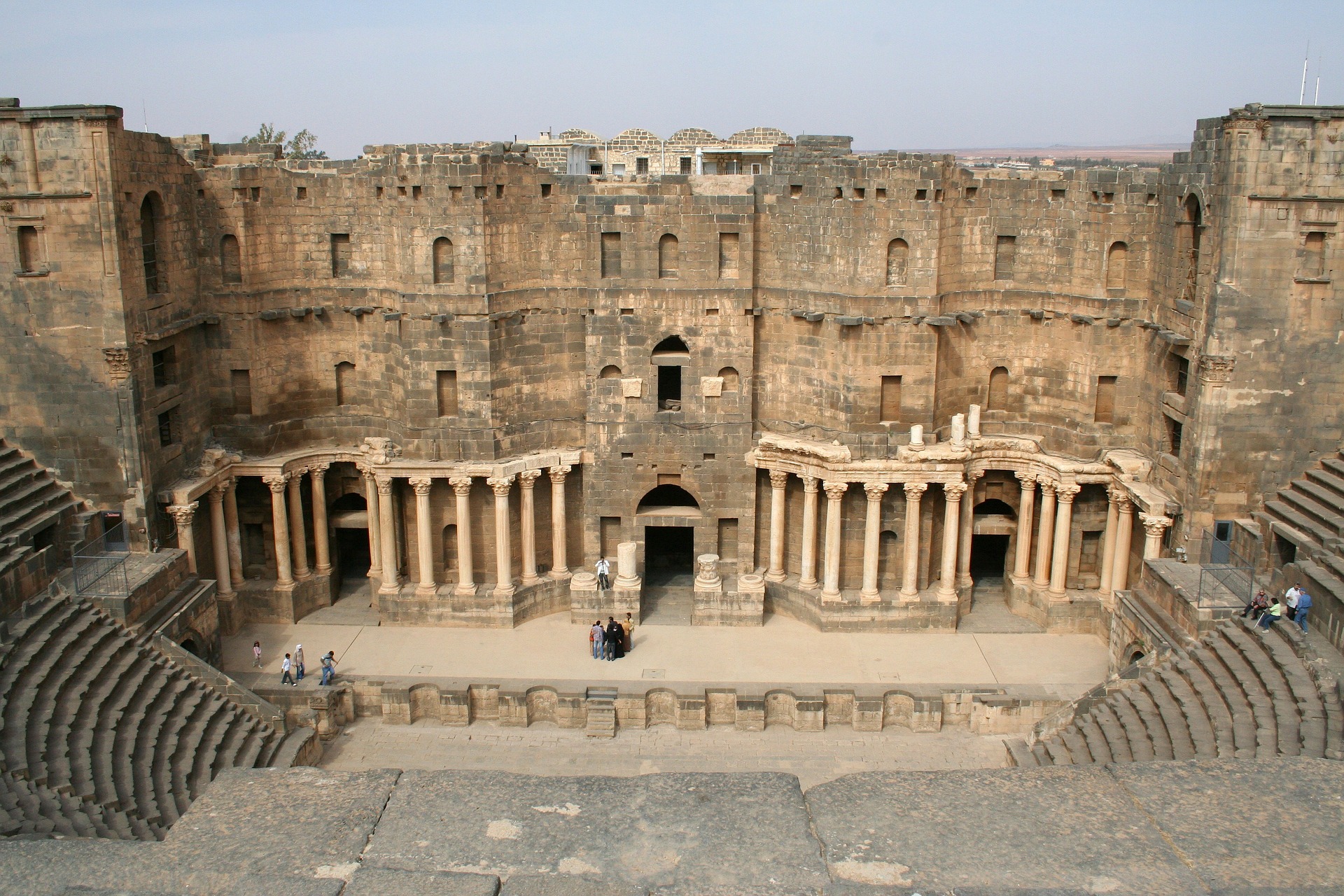
- Bosra: A Roman city of black basalt with a well-preserved theatre, near the Jordanian border.
- Palmyra: The Roman city in the desert, a UNESCO site severely damaged in 2015.
- Apamea: A Roman city with a long colonnaded street.
Places to visit
Cities
- Damascus: The capital, claimed to be the oldest continuously inhabited city in the world. The UK reports regular Daesh attacks in Damascus, including bombings in July 2026.
- Aleppo: A city with a great ancient citadel, much of it destroyed in the war.
- Hama: Known for its famous waterwheels.
- Homs: An ancient city on the Orontes river.
- Latakia: A major port, near Saladin's Castle and forests.
- Tartous: A historic port facing the small island of Arwad.
Beyond the cities
- Krak des Chevaliers (site): The archetypal Crusader castle, magnificently preserved.
- Palmyra (site): The ruins of a Roman city in the desert, a UNESCO site severely damaged in 2015. The UK warns of landmines and unexploded weapons in the Syrian desert.
- Bosra (site): A Roman city of black basalt with a well-preserved theatre. Canada reports frequent kidnapping for ransom across southern Syria, where Bosra lies.
- Apamea (site): A Roman city with a long street of columns, some with twisted fluting.
- Dead Cities (site): Abandoned ancient towns, such as Al Bara and Serjilla.
- Deir Mar Musa (site): An active Christian monastery promoting dialogue between faiths, 80 km north of Damascus.
Climate and best time to visit
| Jan | Feb | Mar | Apr | May | Jun | Jul | Aug | Sep | Oct | Nov | Dec | |
|---|---|---|---|---|---|---|---|---|---|---|---|---|
| Max °C | 13 | 15 | 19 | 25 | 30 | 34 | 37 | 36 | 33 | 28 | 20 | 14 |
| Min °C | 0 | 1 | 4 | 7 | 11 | 14 | 17 | 17 | 13 | 9 | 4 | 1 |
| Rain mm | 28 | 23 | 17 | 8 | 3 | 0 | 0 | 0 | 0 | 7 | 21 | 26 |
In Damascus summers are hot and dry, with an average maximum of about 37 °C in July and almost no rain from June to September, while winters are cool, with average minimums close to freezing in January. Most of the rain falls from November to March. The mildest months, judging by these averages, are April, May and October.
Holidays and events
- 1 January 2026 · New Year's Day
- 18 March 2026 · Syrian Revolution Day
- 21 March 2026 · Newroz
- 21 March 2026 · Mother's Day
- 5 April 2026 · Easter Sunday (Gregorian calendar)
- 12 April 2026 · Orthodox Easter Sunday (Julian calendar)
- 17 April 2026 · Independence Day
- 1 May 2026 · Labour Day
- 8 December 2026 · Liberation Day
- 25 December 2026 · Christmas Day
Eat and drink
Dishes to try
- Falafel and foul: Chickpea patties and a fava bean paste with cumin and olive oil, served with flatbread.
- Fattoush: Salad of tomatoes, onions, cucumber and herbs with fried bread.
- Ice cream and sweets: Syrian ice cream is famous, as are baklava and knafeh.
Drinks
- Fresh fruit juices: Sold at street stalls in most towns.
Entry requirements and visas
| Passport validity | UK: at least 3 months after the date you arrive. Canada: at least 6 months beyond the date you leave |
|---|
| Passport | Entry | Max stay | Notes |
|---|---|---|---|
| United Kingdom | Evisa | Visa required, applied for online; processing takes about 5 to 7 days. | |
| Canada | Visa required | Non-Arab nationals cannot get a visa at the border: get one from a Syrian embassy or consulate before you leave. |
Other nationalities: check the official source below.
Visitors need a visa before they travel. The UK says you can apply online; Canada says non-Arab nationals cannot get one at the border and must get it from a Syrian embassy or consulate. Holders of Israeli or Iranian citizenship cannot enter, and you may be refused entry if your passport shows travel to Israel. Canada says this includes an Israeli visa or stamp, or an Egyptian or Jordanian stamp from a border post with Israel. Entering illegally can mean a fine or prison. Journalists must check the rules with the Syrian authorities. Canada says stays of more than 14 days must be registered with the Immigration and Passports Office before the 15th day. Rules depend on your passport and can change: check the official link before you book.
Money and payments
| Currency | Syrian Pound (SYP) |
|---|---|
| Cards | Rare |
The currency is the Syrian pound (SYP). After 14 years of conflict, financial transactions are restricted, cash withdrawals are limited and electronic payments are almost never used: bring cash. Changing money on the street is illegal, and Syrian pounds cannot be exchanged outside the country. Some prices are listed in US dollars. Food and fuel are scarce and often very expensive.
Health
| Recommended vaccines | Routine vaccines, including measles (MMR) and polio, Hepatitis A, Hepatitis B, Typhoid, for most travellers, Rabies, for some travellers: rabid dogs are common and vaccine is often not available after a bite, Cholera, for some high-risk travellers |
|---|
Health care has deteriorated badly: many hospitals and clinics have been destroyed or no longer work, even basic medicines are short, and emergency services may not respond. Cholera, malaria and other infectious diseases occur, especially in rural areas, and altitude sickness is a risk in parts of the country. Bring all the medicines you need and take insurance that covers evacuation.
This is general information, not medical advice: check with a travel health professional before you go.
Safety
- United States: Level 4: Do Not Travel (2026-10-20)
- Canada: Avoid all travel (2026-10-20)
- United Kingdom: Advises against all travel (2026-10-20)
The UK, Canada and the US advise against all travel to Syria; Canada tells its citizens to leave. The UK provides no consular support inside the country. Terrorist groups, including Daesh, carry out regular attacks, also in Damascus: in July 2026 bombs exploded outside a hotel and the Ministry of Tourism and inside a crowded cafe, and in June 2025 an attack on a church killed at least 30 people. There is a very high threat of kidnapping by terrorist and criminal groups, and foreigners are considered lucrative targets.
Fighting, artillery and airstrikes can break out unpredictably; some areas, particularly Suwayda province, are controlled by armed groups. Canada reports that missile and drone attacks have resumed in the region and struck targets in Syria. Flights, roads and border crossings can close and curfews can be imposed at short notice. Only a few international flights use Damascus and Aleppo airports. Roads are very dangerous, especially at night, with checkpoints on major routes. Landmines and unexploded weapons remain, mostly in less populated and rural areas but also in destroyed or abandoned buildings in towns: never leave roads and paved areas without an experienced guide. Electricity, internet and phone services are intermittent, and taking part in political activity can lead to detention.
Customs and etiquette
Syria is a multi-faith country with Sunni, Shia, Christian, Druze and Alawite communities, but sectarian divisions remain and violence can flare. Political parties are banned and unlicensed political activity is restricted. Carry copies of your passport and visa. Drug possession is punished with life imprisonment and trafficking with death. Same-sex relations are illegal, and Canada warns that a conviction can carry the death penalty. Photographing military or government buildings and using a phone at checkpoints are prohibited. During Ramadan check opening hours and follow local dress codes.
Syrians communicate indirectly to save face, often ask personal questions as a way of getting to know you, and talk loudly and with lively gestures without meaning to argue.
Language
| Official languages | Arabic |
|---|---|
| English | Limited |
| Hello | مرحبا marḥaban |
|---|---|
| Peace be with you (formal greeting) | السلام عليكم as-salaamu alaikum |
| Please | من فضلك min faḍlak (to a man), min faḍlik (to a woman) |
| Thank you | شكرا shukran |
| Excuse me | لو سمحت law samaḥta (to a man), law samaḥti (to a woman) |
| Goodbye | مع السلامة ma'a as-salaamah |
| Do you speak English? | هل تتكلم الانجليزية؟ hal tatakallam al-ingliziyyah? |
| How much is this? | بكم هذا؟ bikam hatha? |
Quick reference
Country facts
| Capital | Damascus |
|---|---|
| Population | 25,620,427 (2025) |
| Area | 183,630 km² |
| Time zone | Asia/Damascus (UTC+3) |
| Calling code | +963 |
| Driving side | right |
Emergency numbers
| Police | 112 |
|---|---|
| Ambulance | 110 |
| Fire | 113 |
Frequently asked questions
Is it safe to travel to Syria?
No. In 2026 the UK, Canada and the US advise against all travel to Syria because of terrorism, kidnapping, fighting and a humanitarian crisis, and the UK cannot provide consular help inside the country.
Can I use cards or ATMs in Syria?
Hardly at all: withdrawals are limited and electronic payments are rarely used. Bring cash.
Sources This guide was last checked on · 17 sources
- Wikivoyage: Syria · Overview, Places to visit, Climate and best time to visit, Eat and drink, Customs and etiquette, Language
- UK FCDO: Syria warnings and insurance · Overview, Safety, Frequently asked questions
- Government of Canada: Syria travel advice (updated 23 July 2026) · Overview, Places to visit, Entry requirements and visas, Money and payments, Health, Safety, Customs and etiquette, Emergency numbers, Frequently asked questions
- UK FCDO: Syria safety and security · Places to visit, Money and payments, Safety, Customs and etiquette, Frequently asked questions
- WMO World Weather Information Service: Damascus · Climate and best time to visit
- Nager.Date: public holidays in Syria, 2026 · Holidays and events
- UK FCDO: Syria entry requirements · Entry requirements and visas
- Wikidata · Money and payments, Country facts
- ISO 4217 (SIX), published 2026-09-17 · Money and payments
- UK FCDO: Syria health · Health
- US CDC: Travelers' health, Syria · Health
- US Department of State: Syria travel advisory · Safety
- UK FCDO: Syria travel advice · Safety
- Wikivoyage: Arabic phrasebook · Language
- World Bank, SP.POP.TOTL · Country facts
- World Bank, AG.LND.TOTL.K2 · Country facts
- IANA Time Zone Database, zone.tab · Country facts
Suggest an update
Travel rules, prices and timetables change. If something in this guide is out of date, tell us: we check every suggestion against an official source before changing the page.