

- Local time
- 22:05
- Currency
- Euro (EUR)
- Capital
- Fort-de-France
- Calling code
- +596
- Drive on the
- right
Overview
A French overseas department between Dominica and Saint Lucia: the volcano and rainforest of the north, white sand beaches in the south, rum distilleries and Creole cooking. It uses the euro.
Martinique is an island in the Caribbean Sea, north of Saint Lucia and south of Dominica, and an overseas department of France, so it is part of the European Union. Its culture is both French and Caribbean, and so is its food. The island is mountainous and dominated by Montagne Pelée, an active volcano 1,397 metres high, which on 8 May 1902 destroyed the city of Saint-Pierre; Wikivoyage puts the death toll at 30,000. In 2023 the volcano and the pitons of the north were listed as a UNESCO World Heritage Site.
The two halves of the island feel different. The north draws hikers to its mountains, rainforest and black sand beaches, while the south has the white sand beaches, many of them busy with tourists, and the shopping. The capital, Fort-de-France, sits on a bay with a seaside promenade, and ferries cross to the resorts of Trois-Îlets. French and Creole are spoken, and English only by some people.
- Montagne Pelée: The active volcano of the north, part of a UNESCO World Heritage Site since 2023.
- Saint-Pierre: The former capital, destroyed by the 1902 eruption, with many historic remains.
- Les Salines: The best-known white sand beach of the south, near Sainte-Anne, and often crowded.
- Jardin de Balata: A garden with thousands of tropical plants.
- Rhum agricole: Rum made from fresh sugar cane juice, with many distilleries open to visitors.
- Presqu'île de la Caravelle: An easy 30-minute walk to a lighthouse with a view over the whole island.
Places to visit
- Mountain
Cities
- Fort-de-France: The capital, with a seaside promenade of bars and restaurants, a spice market and the Schoelcher Library.
- Trois-Îlets: A resort town across the bay from Fort-de-France, reached by ferry, with restaurants and a casino.
- Sainte-Anne: The gateway to the white sand beaches of the south, including Les Salines.
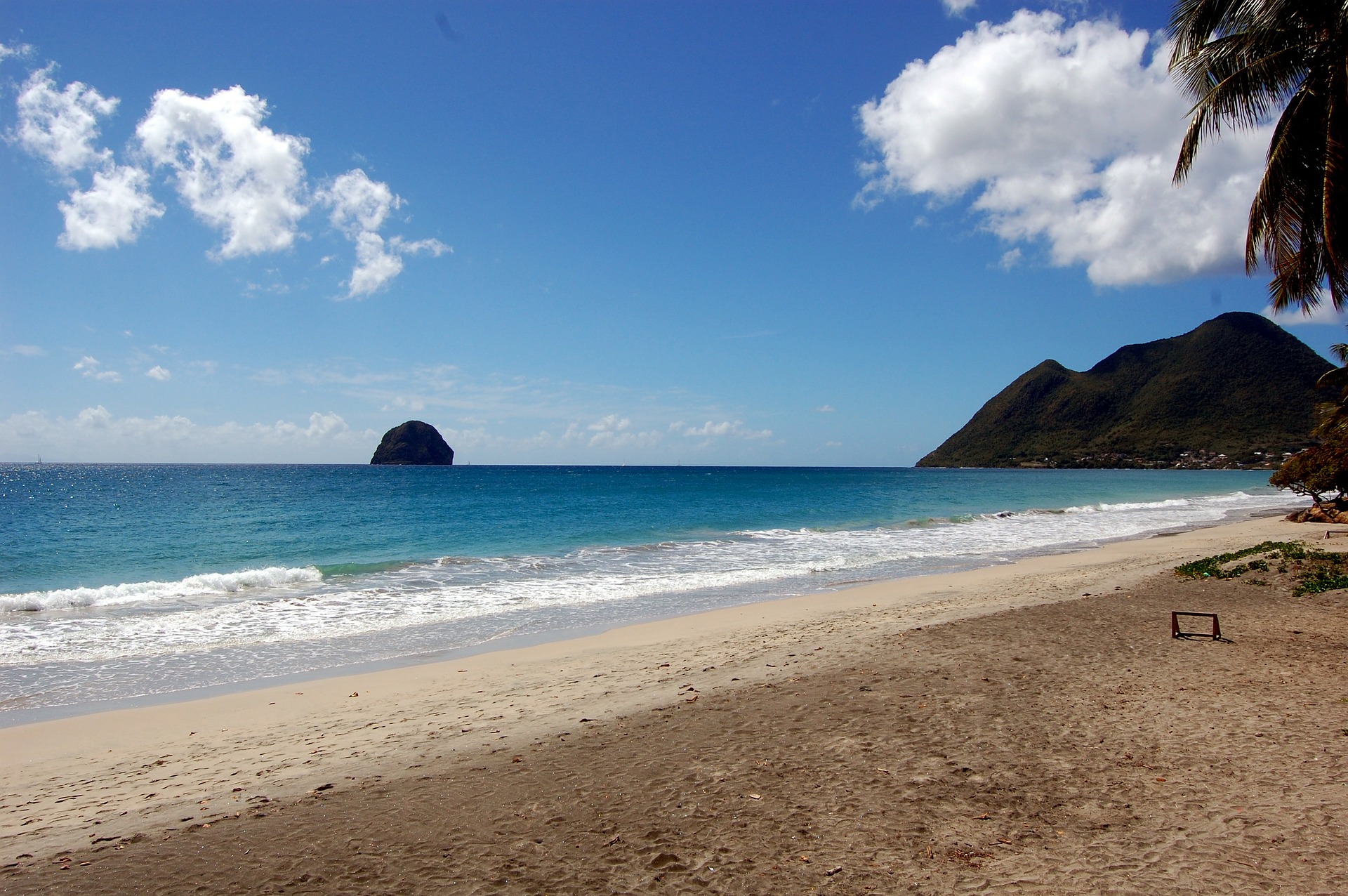
- Le Diamant: A beach and diving town facing Diamond Rock.
- Le Marin: The main harbour for sailboats, on a bay.
- Saint-Pierre: The former capital, destroyed by the 1902 eruption, with many historic remains.
- Morne Rouge: The starting point for Montagne Pelée.
Beyond the cities
- Montagne Pelée (mountain): An active, closely monitored volcano, 1,397 metres high, listed by UNESCO with the pitons of the north.
- Les Salines (coast): The best-known beach of the south, and a crowded one.
- Anse Noire (coast): A black sand beach with free access.
- Presqu'île de la Caravelle (area): A peninsula with a 30-minute walk up to a lighthouse.
- Savane des Pétrifications (area): The desert-like southern tip of the island, near Sainte-Anne.
- Gorges de la Falaise (site): A canyon about 200 metres long near Ajoupa-Bouillon, explored on foot and by swimming with a guide.
- Balata (town): A small town with a First World War memorial church and the Jardin de Balata.
- Macouba (town): A former tobacco town and lookout over sea and mountains; on a clear day you can see Dominica.
- La Trinité (town): A fishing village with the most consistent surf on the island.
Things to do
See
- Ruins of Saint-Pierre Saint-Pierre: The remains of the former capital destroyed by the 1902 eruption.
- Jardin de Balata Balata: A garden with thousands of tropical plants.
- History of sugar and slavery Near Trois-Îlets: The Maison de la Canne on sugar cane production and its use of slave labour, and La Savane des Esclaves, an open-air museum.
- Habitation Clément: A historic sugar plantation.
Do
- Hike Montagne Pelée Morne Rouge: Stay on marked trails, never start after 3 pm, and check whether the authorities have restricted access to the trail.
- Walk and swim the Gorges de la Falaise Ajoupa-Bouillon: A guided route through a narrow canyon on private land, for a fee; wear swimwear and hiking shoes.
- Walk to the Caravelle lighthouse Presqu'île de la Caravelle: An easy 30-minute walk with a view over the whole island.
- Surf at La Trinité La Trinité: The fishing village with the most consistent surf.
Drink
- Distillery tours: Many distilleries welcome visitors and explain rhum agricole, made from fresh cane juice rather than molasses.
Shop
- Spice market Fort-de-France: Stalls of flowers, fresh fruit and vegetables, herbs and spices.
Itineraries
A week from south to north (7 days)
- Trois-Îlets (3 nights): The ferry to Fort-de-France, the Maison de la Canne and La Savane des Esclaves.
- Sainte-Anne (2 nights): Les Salines and the Savane des Pétrifications.
- Morne Rouge (2 nights): Montagne Pelée, the ruins of Saint-Pierre and the Gorges de la Falaise.
A long weekend in Fort-de-France (3 days)
- Fort-de-France (3 nights): The spice market and the promenade, the Jardin de Balata and a shuttle boat to Trois-Îlets.
Holidays and events
- 1 January 2026 · New Year's Day
- 6 April 2026 · Easter Monday
- 1 May 2026 · International Workers' Day
- 8 May 2026 · Victory Day
- 14 May 2026 · Ascension Day
- 22 May 2026 · Abolition Day
- 25 May 2026 · Whit Monday
- 14 July 2026 · National Day
- 21 July 2026 · Schoelcher Day
- 15 August 2026 · Assumption Day
- 1 November 2026 · All Saints' Day
- 11 November 2026 · Armistice Day
- 25 December 2026 · Christmas Day
Getting there and around
| Main airports | FDF |
|---|
Getting there
By air: Martinique Aimé Césaire International Airport (FDF) is the only airport with scheduled flights. Air Caraïbes, Corsair and Level fly from Paris-Orly, according to Wikivoyage, which notes that using Orly can make international connections awkward. Since 29 March 2026 Air France has flown from Paris-Charles de Gaulle rather than Orly. There are also flights from Miami (American Airlines), Montreal and Toronto (Air Canada, Air Transat), Cayenne (Air France) and other Caribbean islands (Air Antilles, Air Caraïbes). Routes change, so check current schedules.
By sea: Express des Iles runs ferries from the surrounding islands. Cruise ships visit in season, docking near downtown Fort-de-France or tendering passengers ashore.
Getting around
Public transport is very limited. From the airport, public transport is the TCSP rapid bus, with tickets from a machine at the stop. Elsewhere you rely on minibuses marked TC (taxis collectifs), which mostly leave from a terminal in Fort-de-France, have no timetables and can be unreliable; most stop by 18:00 on weekdays and 13:00 on Saturdays, and none run on Sundays. Shuttle boats link Pointe du Bout and Trois-Îlets with Fort-de-France every 30 minutes, until between 17:45 and 20:00 depending on the day. Taxis are not cheap and add 40% from 20:00 to 06:00 and on Sundays and public holidays.
Wikivoyage recommends hiring a car to see the island. You drive on the right and French road rules apply, including priority to the right at junctions, while cars already on a roundabout have priority. According to Wikivoyage, limits are generally 50 km/h in towns, 90 km/h on main roads and 110 km/h on the motorway between the airport and Fort-de-France, and there are speed cameras. Canada says you can drive with a Canadian licence for up to 6 months if it is in French, officially translated or accompanied by an International Driving Permit; the UK advice says you may need a permit with a UK licence. Roads are very good but can be narrow and winding, driving at night can be dangerous, particularly in the mountains, and scooters can appear suddenly. The N5 and Lamentin are very busy between 06:30 and 09:30 and between 15:30 and 18:30, so allow time to reach the airport.
Flying to Martinique? PartnerCompare fares and find the cheapest datesSearch flightsWhere to stay
- Hotels and resorts: Trois-Îlets has big resorts; Wikivoyage also lists smaller resorts and a holiday village.
- Gîtes (bed and breakfasts) and villas: Some families also rent out cheap rooms: search online or ask taxi drivers.
- Hostel: Wikivoyage lists one official hostel, in Fort-de-France.
- Camping: Available in mountain and beach settings for a small fee, not just anywhere: the Office National des Forêts has the details.
- Private islands: Ilet Oscar and Ilet Thierry can be rented.
The high season runs from December to late April, with peak prices and crowds. In July and August many residents travel to mainland France, and prices for tourist services and flights can rise steeply, so book well ahead. Wikivoyage suggests May or June for fewer crowds and affordable rates.
Eat and drink
Dishes to try
- Accras: Fritters sold at beach stands and snack bars.
- Boudin: Black pudding, another beach and snack-bar favourite.
- Crêpes: Sold by food sellers on the beach and in town.
Drinks
- Rhum agricole: Rum made from fresh sugar cane juice rather than molasses.
- Jus de canne: Sugar cane juice, often sold from vans in lay-bys; ask for it fresh and drink it at once, with ice and lime.
- Bière Lorraine: The local beer.
- Fresh fruit juices: Very popular on the island.
The cooking mixes French and Creole traditions, and the range runs from gourmet restaurants to snack stands. Many restaurants cater for both Creole and French tastes, and interest in traditional island dishes is growing. Wikivoyage reports that tap water is safe, and restaurants will bring it free if you ask for l'eau du robinet.
Entry requirements and visas
| Passport validity | At least 3 months beyond the date you plan to leave Martinique, according to the UK and Canada |
|---|
| Passport | Entry | Max stay | Notes |
|---|---|---|---|
| United Kingdom | Visa free | 90 days | Up to 90 days for tourism or business. |
| Canada | Visa free | 90 days | No tourist or business visa for stays of up to 90 days. |
Other nationalities: check the official source below.
Martinique is an overseas department of France and part of the EU, but not part of the Schengen Area, so there are immigration controls even between mainland France and Martinique. British and Canadian visitors can stay up to 90 days without a visa.
Customs officials may ask for a return or onward ticket, proof of accommodation, enough money for your stay and proof of health insurance. You need a yellow fever certificate if you arrive from, or have transited through an airport of, a country where yellow fever occurs. You cannot bring meat, milk or products containing them, with some exceptions such as baby food. Rules depend on your passport and can change: check the official link before you book.
Money and payments
| Currency | Euro (EUR) |
|---|---|
| Cards | Common |
Martinique uses the euro (EUR, €), like the rest of France. US dollars are not accepted in shops. Some shops and many restaurants and hotels take credit cards, and the best exchange rates come from your own card or from banks; not all banks change money, and some send you to Fort-de-France. Very few shops open on Sundays and public holidays. Do not carry large amounts of cash, and check which cash and valuables you must declare on arrival. Check what cash and valuables you need to declare when you bring them into Martinique.
Health
| Required vaccines | Yellow fever, only if you are coming from or have transited through an airport of a country where yellow fever occurs |
|---|---|
| Recommended vaccines | Routine vaccines, including measles (MMR), Hepatitis A, recommended for all travellers, Hepatitis B, recommended for all travellers, Typhoid, for some travellers: rural areas, long stays or visiting friends and relatives, Rabies, if you will work directly with wildlife, Mpox, for travellers at risk of sexual exposure |
| Tap water | Varies |
Dengue, Zika and chikungunya are spread by mosquitoes, so protect yourself from bites at all times; if you are pregnant or planning a pregnancy, discuss Zika with a doctor before you go. Wikivoyage says there is no malaria on the island. Check with a travel health professional at least 8 weeks before your trip. Wikivoyage reports that tap water is safe to drink, but the UK, Canada and the CDC do not confirm it, so use bottled water if you prefer. The sun is strong: use sunscreen, wear a hat and drink plenty of water when hiking.
Watch out for manchineel trees (mancenilliers): their sap is corrosive, so never shelter under one in the rain. In Martinique they are marked with a red stripe on the trunk. Healthcare is very good and similar to mainland France, but not all doctors speak English and clinics often ask you to pay in advance. UK and EU visitors should bring a GHIC or EHIC, which does not replace travel insurance. Bring prescription medicines in their original containers in your hand luggage. For an ambulance, call 15 or 112.
This is general information, not medical advice: check with a travel health professional before you go.
Safety
- United States: Level 1: Exercise Normal Precautions (2026-10-20)
- Canada: Take normal security precautions (2026-10-20)
- United Kingdom: No advice against travel (2026-10-20)
Canada advises normal security precautions, and the UK says crime levels are low. Petty crime such as pickpocketing, bag snatching and car break-ins occurs, especially in Fort-de-France. Avoid deserted beaches and isolated areas after dark, do not show off jewellery or cash, use the hotel safe and never leave valuables in sight in a car.
Demonstrations and strikes occur and can disrupt traffic, public transport and fuel supplies. The UK advice, updated in October 2026, says demonstrations can take place with little or no warning, particularly in larger towns, and the authorities may impose partial and localised curfews; monitor local media for the latest information about measures in your area. Martinique also has regular water shortages and may ration water, so keep a supply at hand.
At sea, some areas have strong currents or dangerous seabeds: swim where swimming is allowed and respect warning flags, and check a dive operator's credentials and equipment. If you hike, stay on marked trails, never set out after 3 pm and take insurance that covers helicopter rescue. Montagne Pelée is an active volcano, closely monitored, and the island lies in an active seismic zone where tremors occur regularly. The hurricane season runs from June to November, and Wikivoyage gives the rainy season as June to October. Emergency numbers: 112, or 15 for an ambulance, 17 for the police, 18 for the fire service and 196 for the coastguard.
Customs and etiquette
Good manners matter. Say Bonjour when you walk into a shop and Merci, au revoir when you leave, and be patient: Wikivoyage describes the Martiniquais as proud and dignified, and wary of impatient visitors. Women on their own in tourist and beach areas may face catcalling; ignoring it or firmly saying you are not interested is the advice.
Penalties for drugs can be severe: pack your own bags and never carry anyone else's. Check that any prescription medicine you bring is legal in Martinique, and declare any goods that may be prohibited or taxed.
Language
| Official languages | French |
|---|---|
| English | Limited |
| Hello (when entering a shop) | Bonjour |
|---|---|
| Thank you, goodbye | Merci, au revoir |
| Tap water | L'eau du robinet |
What to pack
- Sunscreen and a hat: The sun can be extremely hot; local pharmacies sell French sunscreen.
- Insect repellent: Dengue, Zika and chikungunya are spread by mosquitoes.
- An International Driving Permit or official translation: Canada requires one unless your licence is in French, and the UK advice says you may need one.
- GHIC or EHIC, and travel insurance: For state healthcare; insurance should cover evacuation, helicopter rescue and water activities.
- Swimwear and hiking shoes: The Gorges de la Falaise route includes swimming over slippery stones.
- A supply of water: Water shortages are regular.
Quick reference
Country facts
| Capital | Fort-de-France |
|---|---|
| Population | 360,630 (2023) |
| Area | 1,128 km² |
| Time zone | America/Martinique (UTC-4) |
| Calling code | +596 |
| Driving side | right |
Emergency numbers
| Emergency | 112 |
|---|---|
| Police | 17 |
| Ambulance | 15 |
| Fire | 18 |
Frequently asked questions
Do I need a visa for Martinique?
Not for up to 90 days with a UK or Canadian passport. Martinique is not part of the Schengen Area, and rules depend on your passport, so check the official link before you book.
Can I pay in US dollars in Martinique?
No. The currency is the euro and US dollars are not accepted in shops; many restaurants and hotels take credit cards.
Is tap water safe to drink in Martinique?
Wikivoyage reports that it is, as in mainland France, and that restaurants serve it free. The UK, Canada and the CDC do not confirm it, so use bottled water if you prefer.
Do I need a car in Martinique?
Public transport is very limited and minibuses do not run on Sundays, so Wikivoyage recommends hiring one. Shuttle boats link Trois-Îlets and Fort-de-France.
When is the best time to visit Martinique?
The high season runs from December to late April. Wikivoyage suggests May or June for fewer crowds; the hurricane season runs from June to November.
Is English spoken in Martinique?
Only by some people. French and Creole are the main languages.
More Travel Stories from Caribbean
 Bermuda
Sources This guide was last checked on · 14 sources
- Wikivoyage: Martinique · Overview, Places to visit, Things to do, Itineraries, Getting there and around, Where to stay, Eat and drink, Entry requirements and visas, Money and payments, Health, Safety, Customs and etiquette, Language, What to pack, Frequently asked questions
- Wikidata: Martinique · Overview, Money and payments, Country facts
- UK FCDO: Martinique safety and security · Overview, Getting there and around, Money and payments, Safety, Frequently asked questions
- Government of Canada: Martinique travel advice (updated 3 June 2026) · Things to do, Getting there and around, Entry requirements and visas, Health, Safety, Customs and etiquette, What to pack, Frequently asked questions
- Nager.Date: public holidays in Martinique, 2026 · Holidays and events
- AeroRoutes: Air France Moves Paris Orly Long-Haul to CDG in NS26 · Getting there and around
- UK FCDO: Martinique entry requirements · Entry requirements and visas, Money and payments, Customs and etiquette, What to pack, Frequently asked questions
- ISO 4217 (SIX), published 2026-09-17 · Money and payments
- UK FCDO: Martinique health · Health, What to pack
- US CDC: Travelers' health, Martinique · Health
- US Department of State: Martinique travel advisory · Safety
- UK FCDO: Martinique travel advice · Safety
- IANA Time Zone Database, zone.tab · Country facts
- UK FCDO: Martinique getting help · Emergency numbers
Suggest an update
Travel rules, prices and timetables change. If something in this guide is out of date, tell us: we check every suggestion against an official source before changing the page.