Uzbekistan Airways plans to start flying between Tashkent and Warsaw on 29 March 2027, twice a week on Mondays and Thursdays with an Airbus A321neo. Aeroroutes reported the schedule in early November 2026: the flight leaves Warsaw at 09:35 and lands in Tashkent at 18:15, and the return leaves Tashkent at 04:25 and arrives at 08:05. Sooner than that, Pegasus plans three flights a week from Istanbul Sabiha Gökçen to Bukhara from 14 December 2026, so you can land in one of the Silk Road cities after a single change in Istanbul.
The Warsaw route starts at the right moment. Spring and autumn are the comfortable seasons for this trip, and the numbers show why: the World Meteorological Organization’s climate normals for Samarkand give average highs of 21 °C in April and 26 °C in May, against 34 °C in July and 6 °C in January. What follows is a route for eight to ten days by train: Tashkent, Samarkand, Bukhara and Khiva.
Why April and May, and what the rain does
Summer on the plains is hot. The normals for Tashkent put the average July high at almost 36 °C, and in Samarkand the average night falls below freezing from December to February. April and May sit between the two.
The catch is rain. March and April are Samarkand’s wettest months, with about 63 mm falling over 12 or 13 days in April, so pack a waterproof jacket and accept that some of your Registan photos will have grey skies. May is drier, at 33 mm, and warmer. If your dates are flexible, May gives you better odds of dry days than April.
The route: four cities by train
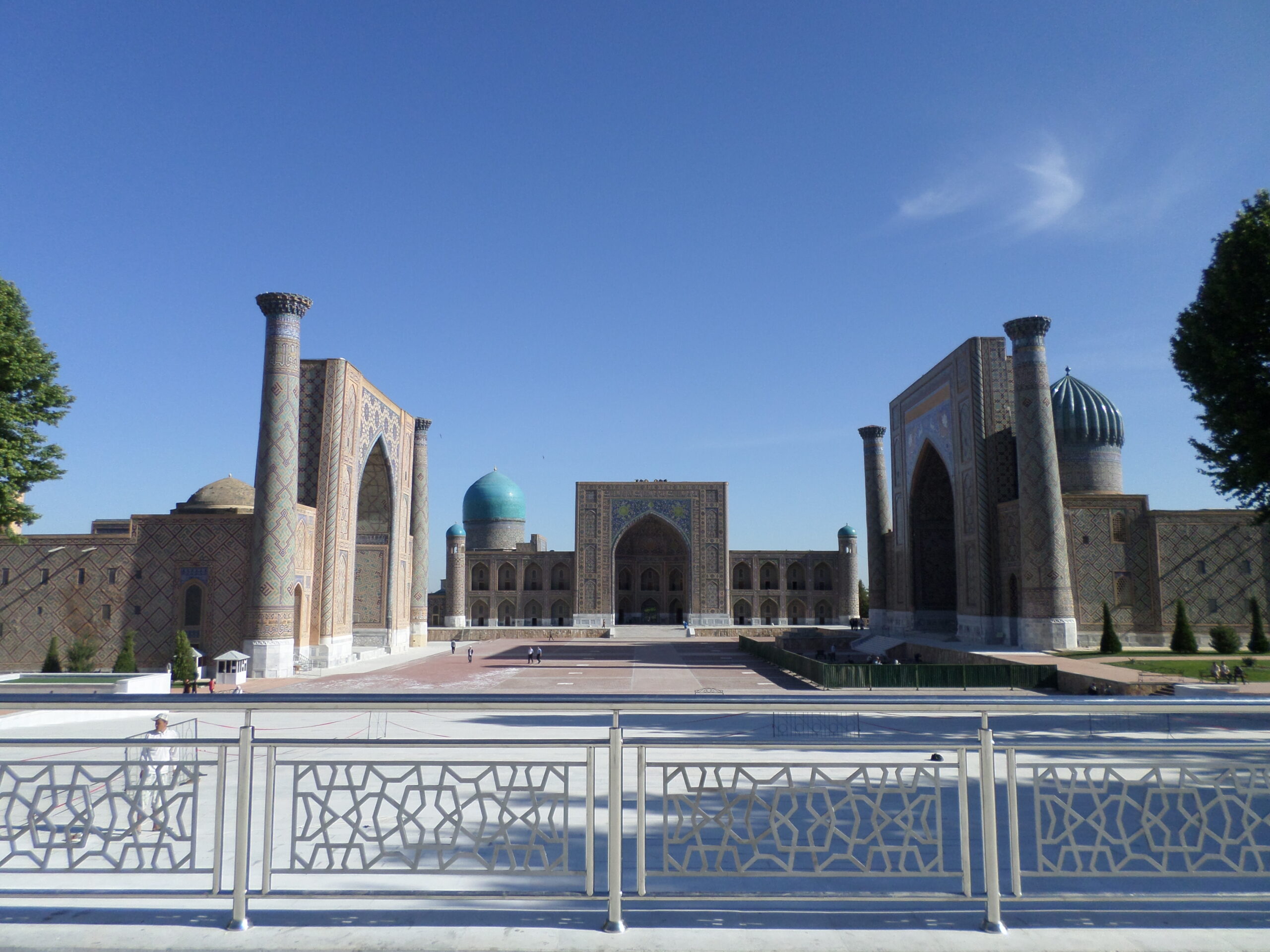
Start in Tashkent and take the Afrosiyob high-speed train to Samarkand. Wikivoyage’s Uzbekistan guide gives a journey time of about two and a half hours and an economy fare of 270,000 so’m (Uzbek so’m) as of February 2025. Samarkand needs two full days. The Registan, a square lined by three madrasahs, the oldest from 1417, is the image everyone comes for. The Shah-i-Zinda necropolis and the Gur-e-Amir mausoleum, where Timur is buried, are the other two sights not to skip. UNESCO listed the city in 2001.
From Samarkand the fast train continues to Bukhara; Wikivoyage’s Bukhara page puts the run from Tashkent at about four hours. The old centre has been on the UNESCO list since 1993. Walk from the pool of Lyab-i Hauz, laid out in the 16th century, to the Po-i-Kalyan complex and the Ark citadel, whose earth-brick walls rise up to 20 m. The Ismail Samani mausoleum is the oldest Muslim monument in town. Two days work well here too.
Khiva is the long leg. Wikivoyage lists several daily rail connections from Bukhara to Urgench and Khiva, and Khiva’s station is 1.25 km from Itchan Kala, the walled inner town inscribed by UNESCO in 1990. One ticket, 250,000 so’m in February 2026 according to Wikivoyage’s Khiva page, is valid for two days and covers the museums and buildings inside the walls, apart from two mausoleums. To get back, Urgench airport is about 40 km from Khiva and has flights to Tashkent that take around an hour and a half.
Booking trains, paying, and the crowds
The weak point of this route is the train seats. Wikivoyage advises booking at least two weeks ahead on the Uzbekistan Railways website, because trains sell out. If the Afrosiyob is full, the slower Sharq covers the same line. Expect company at the big sights as well: the same guide warns that the staircase of Shah-i-Zinda is often thronged with tour groups.
On money, Wikivoyage reports that ATMs are found in the larger cities, that Visa is accepted more widely than Mastercard, and that paying by card often adds a surcharge of about 1%, as of 2026. Carry some cash in small notes for minor purchases.
Entry rules, registration and health
Rules depend on your passport, so check your own government’s page. For British citizens, the UK Foreign Office’s entry requirements for Uzbekistan (updated 19 March 2026) allow visits of up to 30 days without a visa for tourism, with a passport valid for at least three months after arrival. Canada’s travel advice (updated 14 October 2026) gives Canadians the same 30 days but asks for six months of passport validity. The UK page stresses two things: get your passport stamped on entry, and do not overstay.
Three practical points from the same page. You must be registered within three days of arrival, and again in any city where you stay longer than three days; hotels do this for you, so ask for the slips and keep them. Some medicines, codeine among them, must be declared and can cause trouble at the border. And drones are largely prohibited without a licence. Canada advises normal security precautions in Uzbekistan and tells travellers to avoid all travel within 5 km of the border with Afghanistan; none of the four cities on this route is in that strip.
For health, the CDC’s page for Uzbekistan lists hepatitis A and typhoid among the vaccines to discuss with a doctor, and notes that dogs infected with rabies are commonly found in the country. Keep your distance from strays.
What to do now
If Warsaw is a convenient starting point, note the launch date, 29 March 2027, and remember that schedules filed months ahead can change. Fix the flights first, then the trains as soon as booking opens, then the hotels. Our Uzbekistan travel guide has the details on money, transport and customs, and the Asia section covers the neighbours.
A change of planes in Istanbul or Warsaw can also become a stopover: see the guides to Turkey and Poland. And if you want to travel before spring, Laos in the dry season is the January and February alternative.
Cover photo: Bobyrr, CC BY-SA 4.0, via Wikimedia Commons