

- Local time
- 05:28
- Currency
- East Caribbean Dollar (XCD)
- Capital
- Basseterre
- Calling code
- +1869
- Drive on the
- left
Overview
Two volcanic islands with British-style towns, the UNESCO-listed Brimstone Hill Fortress, a scenic railway on the old sugar line, Mount Liamuiga to climb and reefs and wrecks to dive.
Saint Kitts and Nevis is a pair of volcanic islands in the Caribbean, separated by The Narrows, a channel 3 km wide. Long, bat-shaped St Kitts ends in the Great Salt Pond at its southern tip and rises to Mount Liamuiga, at 1,156 metres the highest point; almost circular Nevis has Nevis Peak at its centre. The islands changed hands many times between the English and the French, and have been independent since 1983. Basseterre, the capital, keeps a very British, Victorian look.
Sugar shaped the islands: settlers planted the land and brought enslaved Africans to work it, and the ruins of the plantations are now among the main sights, along with festivals and crafts. Brimstone Hill Fortress is a national park and a UNESCO World Heritage Site, and the old sugar railway now carries visitors. Off the coast there are reefs, wrecks and caves for divers, and inland, rain forest and monkeys. English is the language and the East Caribbean dollar is the currency.
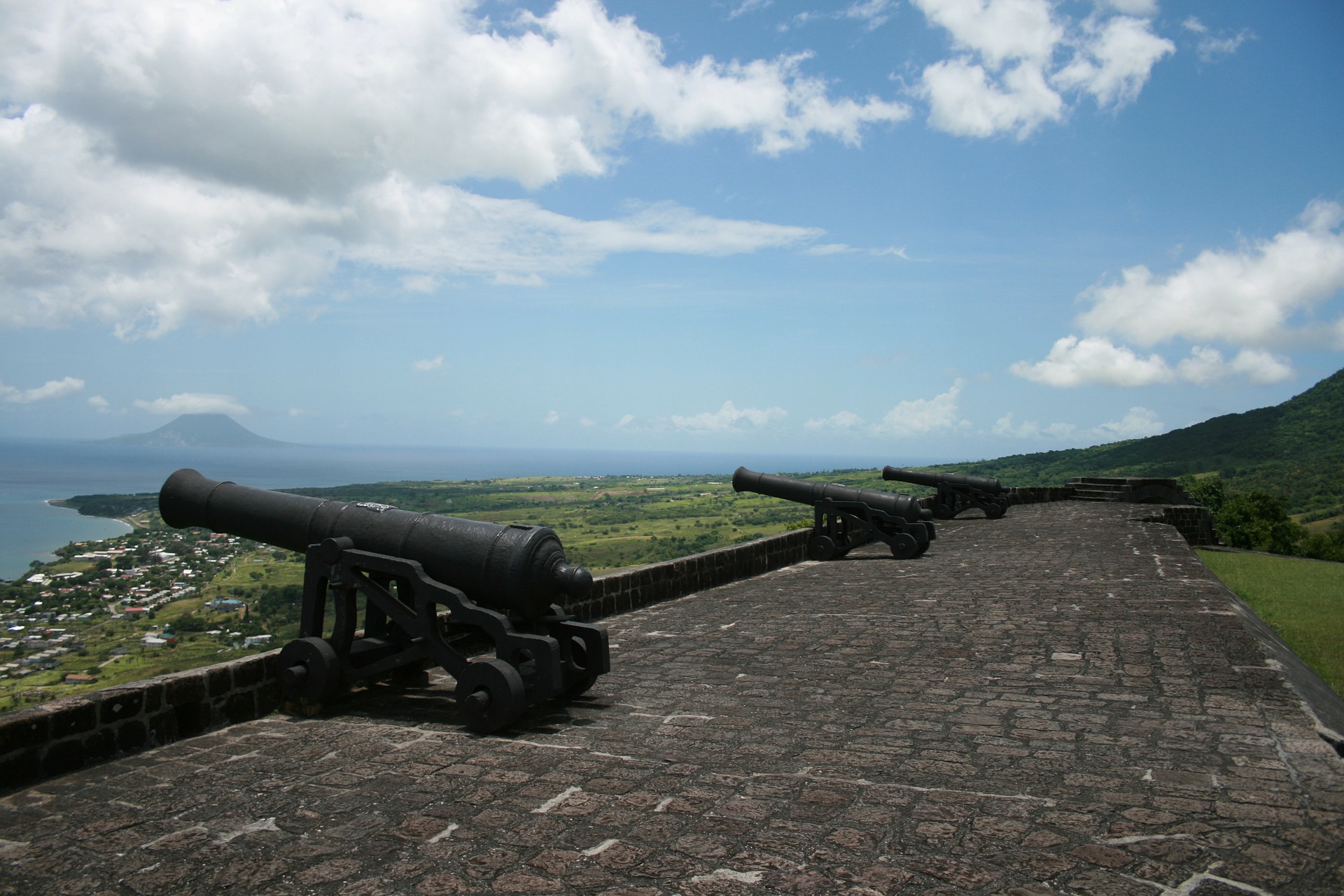
- Brimstone Hill Fortress: A well-preserved fortress, national park and UNESCO World Heritage Site, with views as far as nearby islands.
- The Scenic Railway: Double-decker observation cars on the narrow-gauge line once used for the sugar mill.
- Mount Liamuiga: A dormant volcano and the highest peak of the islands, a popular climb for the view from the top.
- Basseterre: The capital, with the Circus, Independence Square and the National Museum in the Old Treasury building.
- Diving: Reefs, caves and wrecks, from easy sites for beginners to strong currents at Nags Head.
- Nevis: The round sister island, linked by daily ferries from Basseterre to Charlestown.
Places to visit
Cities
- Basseterre: The capital, on St Kitts, with Victorian architecture, the Circus clock, St. George's Anglican Church, the cruise terminal and the ferries to Nevis.
- Charlestown: The capital of Nevis, linked to Basseterre by passenger ferries, with the ruins of Fort Charles.
Beyond the cities
- Brimstone Hill Fortress (site): A national park and UNESCO World Heritage Site, with views over the surrounding area and nearby islands.
- Mount Liamuiga (mountain): A dormant volcano on St Kitts and the highest point of the islands, at 1,156 metres.
- Nevis Peak (mountain): The peak at the centre of the almost circular island of Nevis.
- Wingfield Estate (site): Plantation ruins with the Old Road Rum distillery, one of the most accessible estates.
- Fort Charles (site): Part of the fortifications of Charlestown on Nevis; only a few ruins and some cannons remain.
- Turtle Beach (coast): At the southeast end of St Kitts, reached by road, where monkeys come out of the woods.
- Frigate Bay (area): An area outside the bus network, served by taxis, with a reef where you often see turtles.
- Great Salt Pond (area): The salt pond at the southern tip of St Kitts.
- The Narrows (coast): The 3 km channel between St Kitts and Nevis, crossed every year by a swimming race.
Regions
- Saint Kitts
- Nevis
Things to do
See
- Brimstone Hill Fortress: Its impressive, well-preserved remains make the islands' history tangible, and the views reach nearby islands.
- Basseterre Basseterre: St. George's Anglican Church, Independence Square, once the site of the slave market, and the 1894 Old Treasury, home of the National Museum.
- Fort Charles Charlestown: A few ruins and cannons from the old defences of Charlestown.
Do
- Ride the scenic railway: Double-decker cars, each with a restroom and bar, run on parts of the old sugar line. Book in advance: it does not run every day and can sell out when large cruise ships are in.
- Climb Mount Liamuiga: A popular hike up the dormant volcano for the view; expect rock scrambles, a rope at the last lookout and unmarked, muddy trails.
- Diving: Monkey Shoals and Friars Bay Reef suit beginners; the wrecks of the River Taw, the Talata and the Corinthian are popular, turtles gather at Turtle Bar, and Nags Head has strong currents for experienced divers.
- Catamaran and snorkel trips Basseterre: Several companies run catamaran and snorkelling excursions and boat charters.
- Nevis to St Kitts swim The Narrows: A 4.1 km race across the channel every year in March or April; you must register in advance, and Wikivoyage gave the fee as US$250 in 2026.
Drink
- Old Road Rum distillery Wingfield Estate: A distillery among the ruins of a plantation estate.
Itineraries
A week on both islands (7 days)
- Basseterre (4 nights): The town and the museum, Brimstone Hill Fortress, the scenic railway, a climb up Mount Liamuiga and a dive.
- Charlestown (3 nights): Take the ferry from Basseterre to Nevis for Fort Charles and the island around Nevis Peak.
A cruise day on St Kitts (1 days)
- Basseterre (0 nights): The Circus, Independence Square and the National Museum near the cruise terminal.
- Brimstone Hill Fortress (0 nights): By taxi or on a tour; agree the fare before you set off.
Holidays and events
- 1 January 2026 · New Year's Day
- 2 January 2026 · Carnival Day
- 28 January 2026 · Buckley's Uprising Day
- 3 April 2026 · Good Friday
- 6 April 2026 · Easter Monday
- 4 May 2026 · Labour Day
- 25 May 2026 · Whit Monday
- 3 August 2026 · Emancipation Day
- 4 August 2026 · Culturama Day
- 16 September 2026 · National Heroes' Day
- 19 September 2026 · Independence Day
- 25 December 2026 · Christmas Day
- 26 December 2026 · St. Stephen's Day
Getting there and around
| Main airports | SKB, NEV |
|---|
Getting there
By air: Robert L Bradshaw International Airport (SKB) on St Kitts is the main airport, and Vance W. Amory International Airport (NEV) on Nevis is smaller, with connections from several Caribbean hubs. Wikivoyage lists flights from San Juan, Miami, New York and Atlanta, a weekly flight from London Gatwick and, from December to April, a non-stop flight from Toronto: check current schedules. Arrival and departure taxes are usually included in the ticket, but if you leave Robert L Bradshaw on a LIAT flight you must pay the departure tax, in cash or by card, at the Airport Finance Office.
By sea: Basseterre has a cruise ship terminal and a marina. Makana Ferry sails to Sint Maarten, Sint Eustatius and Saba. Canada lists ferries to Antigua and Barbuda and to Montserrat, while Wikivoyage reports that the Montserrat ferry has been discontinued, so check before you plan on it. If you arrive on your own boat, contact the Port Authority at least 24 hours ahead and fill in the immigration form.
Getting around
Between the islands, several passenger ferries run every day between Port Zante in Basseterre and Charlestown on Nevis; Wikivoyage gave the fare as US$12.50 per adult in 2025. The Sea Bridge car ferry crosses from Majors Bay on St Kitts to Cades Bay on Nevis, from 8:00 to 19:00.
You drive on the left, and you need a local driving licence. The UK travel advice (updated January 2026) says you can buy a temporary one from the Inland Revenue Department, valid for 3 months (EC$62.50) or one year (EC$125), showing your own licence and passport; hire companies usually help. The minimum age to hire a car is 21, but most companies require 25. Expect potholes and unmarked speed bumps on minor roads, narrow roads with blind corners, unlit stretches and pedestrians on the road, and drive with extra care at night. If you have an accident, call the police on 911 and do not move your vehicle.
Taxis are not metered: there are standard fares for most destinations, but agree the fare first, and check whether it is in US or EC dollars. Licensed taxis have yellow plates beginning with T or TA; Wikivoyage adds that they charge 50% extra from 22:00 to 06:00. Buses are minibuses with green plates beginning with H: you flag them down, they are much cheaper than taxis (EC$3.50 for up to 5 miles in 2025), but they do not generally serve Frigate Bay or the Southern Peninsula and stop running around 19:00 to 20:00. Canada warns that some minibus drivers are reckless.
Flying to St. Kitts and Nevis? PartnerCompare fares and find the cheapest datesSearch flightsEntry requirements and visas
| Passport validity | At least 6 months after the date you arrive, according to the UK; Canada advises 6 months beyond your departure date |
|---|
| Passport | Entry | Max stay | Notes |
|---|---|---|---|
| United Kingdom | Eta | No visa for up to 6 months, but you need an Electronic Travel Authorisation (eTA) before you travel. | |
| Canada | Eta | No tourist visa needed according to Canada; the UK advice says all visitors need an eTA. |
Other nationalities: check the official source below.
British travellers can visit without a visa for up to 6 months, and Canada says Canadians do not need a tourist visa. According to the UK advice, all visitors must get an Electronic Travel Authorisation (eTA) before travel, online or through the official app. Fill in the immigration form online before you go, or on arrival on your own device using the free public wifi.
Customs officials may ask for a return or onward ticket and proof of enough money for your stay. If you arrive from a country with a risk of yellow fever, you need a vaccination certificate. Customs rules are strict: declare anything that may be prohibited or taxed. To stay longer, apply and pay for an extension at the Immigration Department. Rules depend on your passport and can change: check the official link before you book.
Money and payments
| Currency | East Caribbean Dollar (XCD) |
|---|---|
| Cards | Widespread |
The currency is the East Caribbean dollar (XCD, EC$), pegged at US$1 = EC$2.70 and shared with seven other Caribbean nations. US dollar cash is widely accepted, though usually at a rate of 2.5, which favours the shop. Credit cards are widely accepted, and you can pay in EC or US dollars at the official rate; ATMs are widely available.
Wikivoyage describes prices as fairly reasonable for the Caribbean: many everyday products and fresh food are reasonably priced, though fresh food choice is limited, while fuel is expensive because it is imported. Do not carry large amounts of cash, and leave valuables in the hotel safe.
Health
| Required vaccines | Yellow fever, but only if you arrive from a country with a risk of yellow fever transmission |
|---|---|
| Recommended vaccines | Routine vaccines, including measles (MMR), Hepatitis A, recommended for all travellers, Hepatitis B, recommended for all travellers, Typhoid, for some travellers: rural areas, long stays or visiting friends and relatives, Rabies, particularly if you will be in close contact with animals, travel with children or explore caves, Mpox, for travellers at risk of sexual exposure |
| Tap water | Safe |
Canada reports no risk of yellow fever, but you need a certificate if you arrive from a country where it is transmitted. Canada says rabies is common and is carried by dogs and some wildlife, including bats. The CDC says rabid dogs are not common but rabies vaccines are typically not readily available on the islands, so ask about vaccination. Dengue, Zika and chikungunya are spread by mosquitoes, so protect yourself from bites at all times; if you are pregnant or planning a pregnancy, talk to a doctor about Zika before you go. Check with a travel health professional at least 8 weeks before your trip. Wikivoyage says tap water is safe to drink.
The main government hospitals are the Joseph N France General Hospital in Brumaire, on St Kitts, and Alexandra Hospital in Charlestown, on Nevis. Care is good at the main hospital on St Kitts but limited elsewhere, treatment is expensive, and providers often ask for payment upfront. Serious cases may need evacuation, so take travel insurance that covers it and hospital stays. For an ambulance, call 911.
This is general information, not medical advice: check with a travel health professional before you go.
Safety
- United States: Level 1: Exercise Normal Precautions (2026-11-03)
- Canada: Take normal security precautions (2026-10-20)
- United Kingdom: No advice against travel (2026-10-20)
Canada advises normal security precautions. The UK advice reports incidents of serious crime, including murder, armed robbery and sexual assault. Make sure your accommodation, or your yacht, is secure, take care walking alone off main roads, avoid isolated areas and beaches after dark, and be careful at large gatherings and street and beach parties, especially at night and in the festival season. Use only licensed taxis, keep car doors locked and do not stop if people try to flag you down. Never leave food or drinks unattended, and be wary of snacks or drinks offered by new acquaintances, which may be drugged.
Currents can be deceptively strong, and beaches usually have no lifeguards or warning flags, so ask locally which beaches are safe. On Mount Liamuiga the trails are unmarked and muddy, with little shelter from rain. The hurricane season runs from June to November, and the rainy season from May to November. Earthquakes are a risk, and Mount Liamuiga is a potentially active volcano monitored by the Seismic Research Centre of the University of West Indies (UWI). In hot, dry spells report any fire at once: starting a wildfire can mean up to 10 years in prison. In an emergency, call 911; for the fire service, 333.
Customs and etiquette
Camouflage clothing is illegal, even for children: the UK advice warns of a fine of EC$250 and 3 months in prison. Canada adds that carrying items made of camouflage material is also illegal. Wear shoes and a shirt in town and in public places such as the airport and shops, since beach clothes there are seen as disrespectful. Wikivoyage reports that loud swearing in public is frowned upon and can be fined.
Penalties for drug offences are severe, especially for trafficking. Cannabis for personal use has been decriminalised, but you need a licence, and smoking it in some public places is fined. Same-sex relationships are legal, but attitudes are mostly conservative, and public affection between any couple is uncommon and may draw negative attention.
Language
| Official languages | English |
|---|---|
| English | Widespread |
| Coming | A-come |
|---|---|
| Knocking | A-knock |
What to pack
- Your eTA confirmation: The UK advice says all visitors need an Electronic Travel Authorisation.
- Your driving licence and passport: You need both to buy the temporary local licence.
- Clothes without camouflage patterns: Camouflage clothing is illegal, even for children.
- A shirt and shoes for town: Beachwear in town is seen as disrespectful.
- Insect repellent: Dengue, Zika and chikungunya are spread by mosquitoes.
- Rain gear and shoes with grip: The Mount Liamuiga trails are muddy, with little shelter from rain.
Quick reference
Country facts
| Capital | Basseterre |
|---|---|
| Population | 46,922 (2025) |
| Area | 261 km² |
| Time zone | America/St_Kitts (UTC-4) |
| Calling code | +1869 |
| Driving side | left |
Staying connected
| SIM and eSIM | Mobile coverage is good in most areas, and you can buy a local SIM card or use international roaming. |
|---|---|
| Wi-Fi | Most hotels, restaurants and cafes offer free wifi, and there is free public wifi on arrival for the immigration form. |
Useful apps
- WhatsApp: Popular for messaging.
Emergency numbers
| Police | 911 |
|---|---|
| Ambulance | 911 |
| Fire | 333 |
Frequently asked questions
Do I need a visa for St Kitts and Nevis?
Not for short stays with a UK or Canadian passport. The UK advice says all visitors need an eTA before travel. Check the official link before you book.
How do I get from St Kitts to Nevis?
Passenger ferries run several times a day between Basseterre and Charlestown, and the Sea Bridge car ferry crosses from Majors Bay to Cades Bay.
What currency is used in St Kitts and Nevis?
The East Caribbean dollar, pegged at US$1 = EC$2.70. US dollars and credit cards are widely accepted.
Can I drive in St Kitts and Nevis?
Yes, with a temporary local licence that hire companies usually help you buy. Traffic drives on the left.
Is tap water safe to drink in St Kitts and Nevis?
Wikivoyage says it is safe to drink.
What is the emergency number in St Kitts and Nevis?
Call 911 for police and ambulance, and 333 for the fire service.
Sources This guide was last checked on · 16 sources
- Wikivoyage: Saint Kitts and Nevis · Overview, Places to visit, Things to do, Itineraries, Getting there and around, Entry requirements and visas, Money and payments, Health, Safety, Customs and etiquette, Language, What to pack, Staying connected, Frequently asked questions
- Wikidata: Saint Kitts and Nevis · Overview, Money and payments, Country facts
- Nager.Date: public holidays in St. Kitts and Nevis, 2026 · Holidays and events
- UK FCDO: St Kitts and Nevis safety and security · Getting there and around, Money and payments, Safety, Customs and etiquette, What to pack
- UK FCDO: St Kitts and Nevis entry requirements · Getting there and around, Entry requirements and visas, Health, What to pack, Staying connected, Frequently asked questions
- Government of Canada: Saint Kitts and Nevis travel advice (updated 26 May 2026) · Getting there and around, Entry requirements and visas, Money and payments, Health, Safety, Customs and etiquette, What to pack, Frequently asked questions
- ISO 4217 (SIX), published 2026-09-17 · Money and payments
- UK FCDO: St Kitts and Nevis health · Health
- US CDC: Travelers' health, St. Kitts and Nevis · Health
- US Department of State: St. Kitts and Nevis travel advisory · Safety
- UK FCDO: St. Kitts and Nevis travel advice · Safety
- US Department of State: Saint Kitts and Nevis travel advisory · Safety
- World Bank, SP.POP.TOTL · Country facts
- World Bank, AG.LND.TOTL.K2 · Country facts
- IANA Time Zone Database, zone.tab · Country facts
- UK FCDO: St. Kitts and Nevis getting help · Emergency numbers
Suggest an update
Travel rules, prices and timetables change. If something in this guide is out of date, tell us: we check every suggestion against an official source before changing the page.