Guadeloupe is known for the beaches of Grande-Terre and the rainforest of Basse-Terre, but two smaller islands off its south coast offer the Caribbean at a slower pace, without big resorts. Les Saintes is a pair of inhabited islands, Terre-de-Haut and Terre-de-Bas, where most people get around on foot, by bike or in an electric cart. Marie-Galante, about an hour by boat from Pointe-à-Pitre, has more than 10,000 inhabitants, old windmills and sugar refineries, and hiking trails that link them (Wikivoyage, Guadeloupe).
The reason to plan now is the calendar. The dry season runs from December to April. At the WMO weather station of Le Raizet, on the main island, average monthly rainfall falls from 220 mm in November to 64 mm in February, with average highs around 29°C from January to March (World Meteorological Organization). The hurricane season runs from early June to the end of November, according to the Government of Canada. Guadeloupe is a French overseas department, part of France and of the European Union, and it uses the euro (€, EUR). Our Guadeloupe travel guide covers the main islands.
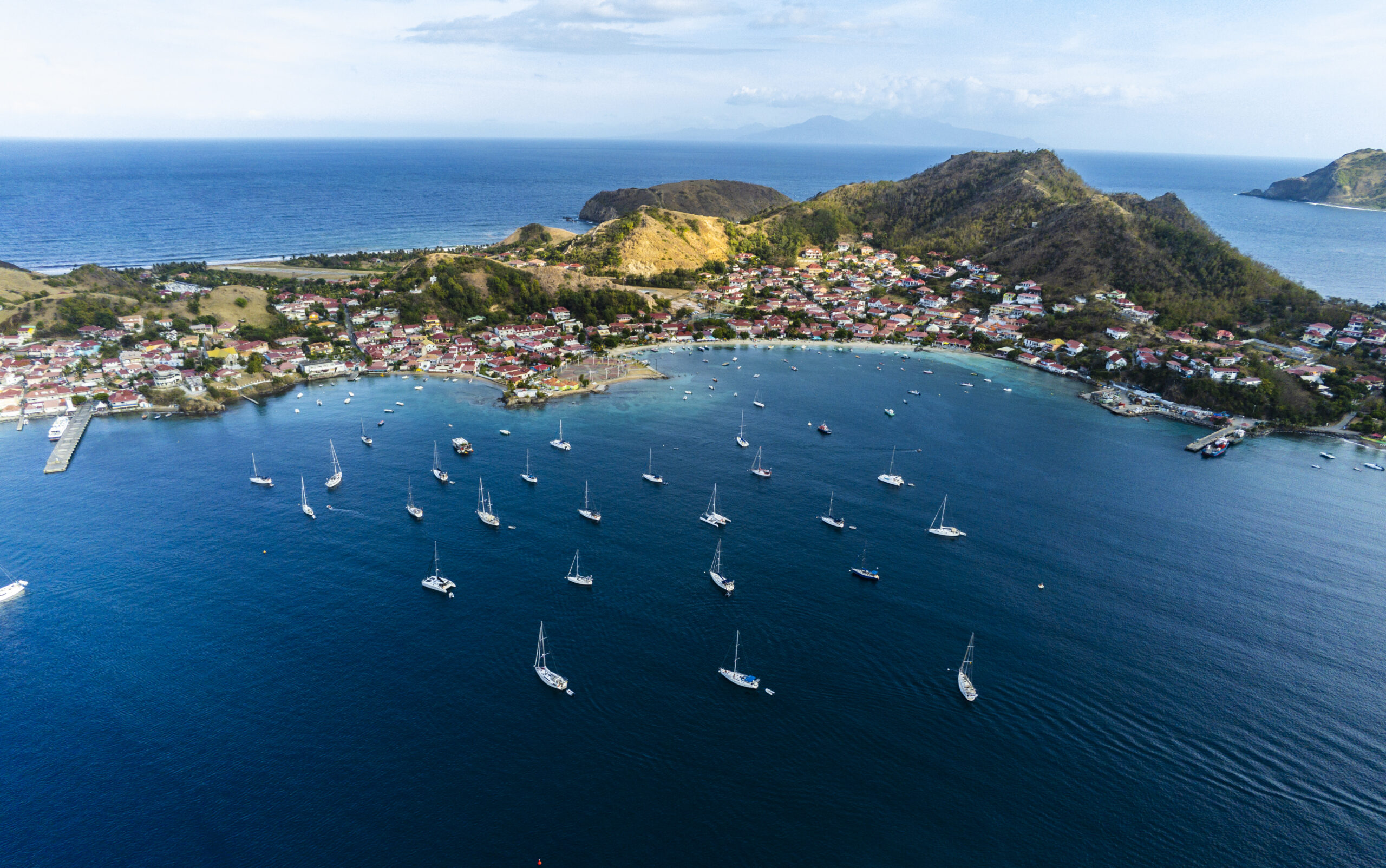
Terre-de-Haut and the bay of Les Saintes
Most visitors see Terre-de-Haut, where the ferries land at the village pier. Above the bay, Fort Napoléon has a museum and a botanical garden. Fort Joséphine stands on the islet of Cabrit, and the Pain de Sucre has basalt columns. Trails climb Le Chameau, and the beaches include Pompierre, Marigot and Figuier (Wikivoyage, Les Saintes).
Cars are rare: the few vehicles on the roads belong to the gendarmerie, the fire service and the town hall, so you walk or rent a scooter, a bike or an electric cart. Fish is at the centre of most menus, and at the pier local women sell the tourment d’amour, a pastry filled with coconut jam.
Terre-de-Bas is mainly residential, with the ruins of an old pottery at Grand-Baie and fewer restaurants: the place for a quiet afternoon.
Marie-Galante for a slower day or two
Marie-Galante lives mainly from farming (Wikivoyage, Marie-Galante, in French). Its history shows in the restored windmills and old sugar refineries that the trails connect, and Wikivoyage suggests a day or two to see them. A scooter suits the small roads, and accommodation is simple: a few small hotels and many rooms in private homes.
Wikivoyage lists rum distillery tours across Guadeloupe, with opening times that change with the season, so check before you plan a day around one.
Getting there by ferry
You fly into Pointe-à-Pitre (PTP), which Wikivoyage lists with direct flights from Paris-Orly, Montreal, Miami and New York JFK. The fares below come from Wikivoyage pages that give no year, so read them as listed in November 2026:
- Trois-Rivières to Les Saintes: about €20, with a crossing listed at 15 minutes in the English page and 25 minutes in the French one, plus parking.
- Pointe-à-Pitre to Les Saintes: at least €10 more than from Trois-Rivières, and about an hour and a half at sea.
- Pointe-à-Pitre to Marie-Galante: about one hour.
- Les Saintes to Marie-Galante: boats link the two, so you can combine them without returning to the main island.
Les Saintes has an airfield but no scheduled flights. Check timetables with the ferry operators before you book.
What does not work so well
December is not dry yet. The WMO station records 137 mm of rain in December, over twice the February figure, so aim for January to March. Terre-de-Haut is also the busy island: it is a classic day trip from the main island, and cruise ships call there. A night or two lets you see it at a different hour.
Few people speak English outside tourism, according to Wikivoyage, and mobile data does not reach every corner of Les Saintes. The islands have doctors and a pharmacy, but serious cases go by helicopter to the hospital in Basse-Terre. The FCDO also warns that demonstrations can disrupt transport at short notice.
Entry rules and health
Guadeloupe is part of the EU but not part of the Schengen area, so there are passport checks even on flights from Paris. EU, EEA and Swiss citizens can travel with a valid ID card. If you need a visa for France, a Schengen visa is not valid here: you need a separate one from a French consulate (Wikivoyage). The rules depend on your passport:
- British passports: no visa for up to 90 days, and the passport must be valid for at least 3 months after you leave (FCDO, updated 22 October 2026).
- Canadian passports: no visa for up to 90 days, the same 3 months of validity, and officials may ask for a return ticket, funds and health insurance (Government of Canada, updated 2 November 2026).
Other passports: confirm on your own government’s official page. For health, the CDC recommends the hepatitis A vaccine for unvaccinated travellers and keeps its global Level 1 measles notice of 28 May 2025. The FCDO lists dengue and Zika, says a GHIC or EHIC covers necessary state healthcare, and requires a yellow fever certificate only if you arrive from a country with transmission risk. The emergency number is 112, or 15 for an ambulance.
Canada advises travellers to take normal security precautions in Guadeloupe (2 November 2026), and neither Canada nor the FCDO marks any part of the islands as an area to avoid. The details are in the safety section of our guide.
What to do now
Pick your months first, then choose your port: Trois-Rivières for the shortest crossing to Les Saintes, Pointe-à-Pitre for Marie-Galante. Book the first nights on Terre-de-Haut and check your passport has 3 months of validity beyond the day you leave. If your flight comes from Paris, our article on EU air passenger rights explains what changes from October 2027. To add another island, start from our Caribbean guides.
Cover photo: Jonathan SALAÜN, CC BY-SA 4.0, via Wikimedia Commons