

- Local time
- 16:28 (capital)
- Currency
- US Dollar (USD)
- Capital
- Quito
- Calling code
- +593
- Drive on the
- right
Overview
Ecuador packs the Galápagos Islands, colonial Quito and Cuenca, Andean volcanoes such as Cotopaxi and the Amazon into a small country on the Equator.
Ecuador takes its name from the Equator, which crosses it. The Andes run through the country from north to south, with Quito and Cuenca, both UNESCO World Heritage Sites, and some of the highest active volcanoes in the world, such as Cotopaxi. East of the Andes lies the Amazon rainforest, west of them the tropical coast, and offshore the Galápagos Islands, famous for their wildlife. Wikivoyage calls Ecuador perhaps the most biodiverse country in the world, with more than a hundred kinds of hummingbird.
The highlands combine Quito, the market town of Otavalo, the volcanoes and crater lakes, Baños for outdoor sports, and Cuenca. Plan for altitude, as Quito is the second highest capital in the world. Safety needs real attention: the UK and Canada advise against travel to several areas, including most coastal provinces, so read the safety section before you plan your route. The currency is the US dollar.
- Galápagos Islands: Islands famous for their wildlife, reached only by domestic flights from the mainland.
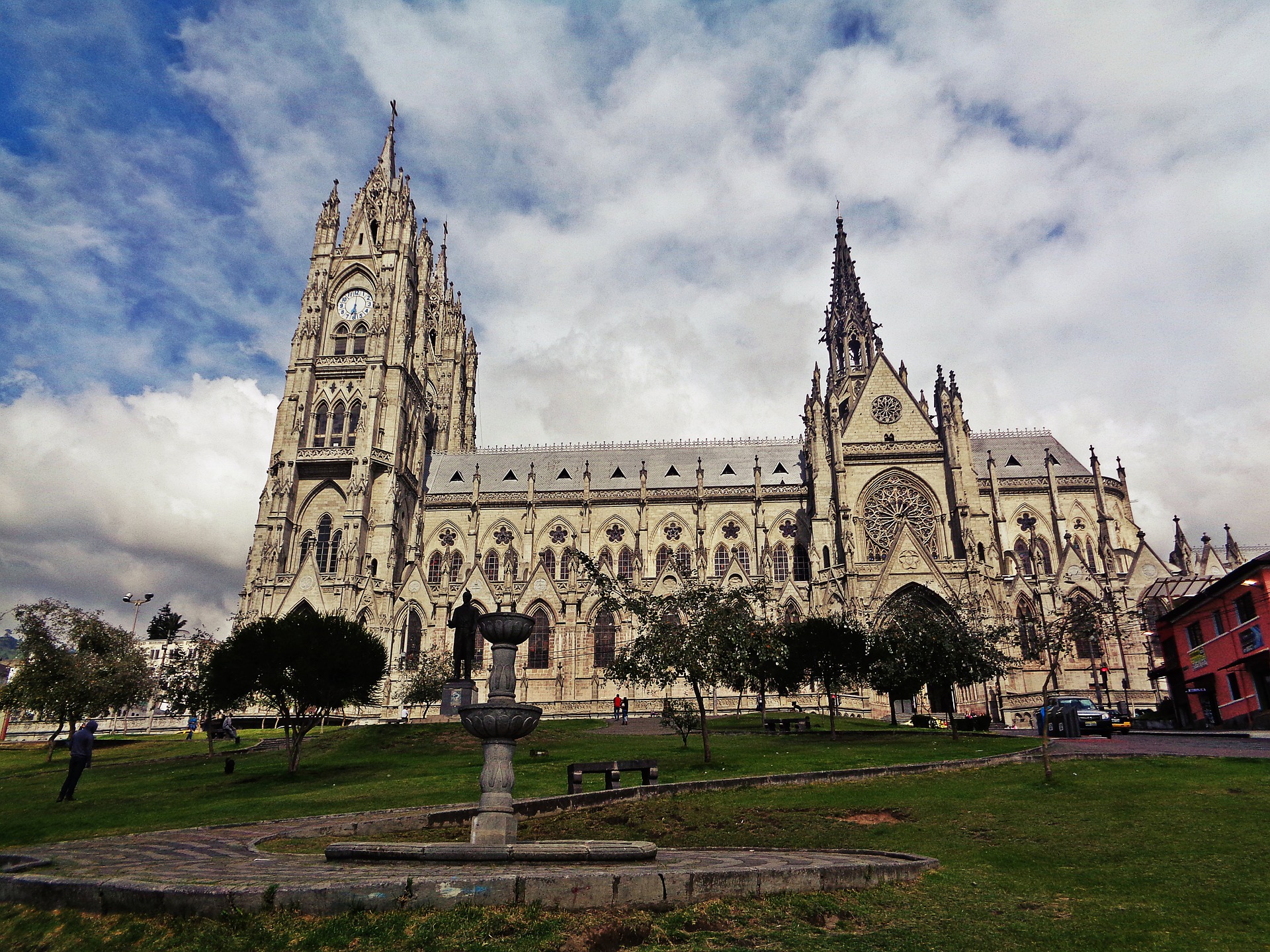
- Quito: The capital at high altitude, with a well-preserved colonial centre and a cable car above the city.
- Cuenca: The third largest city, a UNESCO World Heritage Site in the Andes.
- Cotopaxi: One of the highest active volcanoes in the world, in its own national park.
- Otavalo: A small town north of Quito, famous for its Saturday market of indigenous crafts and livestock.
- Baños: Hot springs at the foot of the Tungurahua volcano, and a base for rafting and climbing.
Places to visit
- City
- Town
- Park
- Mountain
Cities
- Quito: The capital, the second highest in the world after La Paz, with a well-preserved colonial centre and spring-like but changeable weather.
- Cuenca: The third largest city, on the UNESCO World Heritage list.
- Guayaquil: The largest city and main port; the UK advises against all but essential travel to Guayas province, except airside transit at the airport.
- Otavalo: A small town an hour and a half north of Quito, known for its Saturday market of crafts and livestock.
- Baños: A town at the foot of the Tungurahua volcano, with hot spring baths and outdoor sports.
- Riobamba: The gateway to Chimborazo, the highest peak in Ecuador, and to Sangay National Park.
- Loja: A colonial city in the southern highlands, founded in 1548.
- Ibarra: A town of about 100,000 people halfway between Quito and the northern border, a base for Imbabura province.
- Ambato: A city in the centre of the country, with special celebrations at Carnival.
Beyond the cities
- Galápagos Islands (island): An island province famous for its wildlife, with airports on Baltra and San Cristóbal.
- Cotopaxi (mountain): One of the highest active volcanoes in the world, protected in Cotopaxi National Park.
- Quilotoa Loop (area): An Andean route around the Quilotoa crater lake and the villages of Zumbahua and Chugchilán.
- Mindo (town): Bird watching, including hummingbirds, in cloud forest.
- Tena (town): An Amazon town known for white-water rafting and kayaking.
- Sangay National Park (park): A UNESCO World Heritage Site, reached from Riobamba.
- Pululahua Geobotanical Reserve (park): A geobotanical reserve, listed among Ecuador's national parks.
- Cuyabeno Wildlife Reserve (park): Amazon reserve with ecolodges and many hummingbirds; the UK advises travelling there in daylight with an official guide.
- Vilcabamba (town): A town popular with foreign residents and retirees, known for the claimed long lives of its older inhabitants.
Regions
- Andean Highlands: The Sierra: Quito, Cuenca, the volcanoes and the Quechua-speaking villages, cooler with altitude, where potatoes come with lunch and dinner.
- Amazon: Tropical rainforest in the east, around towns such as Tena and Puyo.
- Coastal Lowlands: The tropical coast and Guayaquil; the UK advises against all but essential travel to all the coastal provinces.
- Galápagos Islands: The island province, with its own entry rules for visitors.
Things to do
See
- Wildlife in the Galápagos Galápagos Islands: The islands are famous for their wildlife; book boats with reputable operators and check the safety equipment.
- Quito's colonial centre Quito: Walk the historic streets of the old town, with care, as pickpockets work there.
- La Mitad del Mundo: The place where you can stand on the Equator line.
- Bird watching in Mindo Mindo: Cloud forest with many of Ecuador's more than one hundred kinds of hummingbird.
Do
- The Teleférico Quito: A cable car to Cruz Loma at 4,050 m, with views over the city; it cost US$9 in July 2025. Bring warm clothes.
- Hot springs and adventure in Baños Baños: A public mineral bath, rafting, climbing and bike rides down to Puyo in the Amazon; go early for the cleanest water.
- The Quilotoa Loop Quilotoa Loop: A route through Andean villages to the Quilotoa crater lake.
- Rafting from Tena Tena: White-water rafting and kayaking in the Amazon; use licensed, insured operators.
- Climbing the volcanoes Cotopaxi and Chimborazo: Climbing a glaciated mountain without an accredited guide is illegal, and access to the parks has extra rules.
Shop
- Otavalo market Otavalo: The Saturday market of indigenous crafts and livestock; prices can be bargained.
Itineraries
Quito and the north in 7 days (7 days)
- Quito (3 nights): Acclimatise slowly: the city is at high altitude. Visit the old town and the Teleférico.
- Otavalo (2 nights): Be there on a Saturday for the market.
- Mindo (2 nights): Cloud forest and bird watching.
Volcanoes and Baños in 8 days (8 days)
- Quito (2 nights): Start in the capital and get used to the altitude.
- Cotopaxi (1 night): Carry sunglasses, a hat, water and food; high climbs follow park rules.
- Quilotoa Loop (2 nights): The crater lake and the villages of Zumbahua and Chugchilán.
- Baños (3 nights): Hot springs and outdoor sports; avoid road travel after dark.
Quito and the Galápagos in 7 days (7 days)
- Quito (2 nights): Buy the Galápagos transit control card at the airport before you check in.
- Galápagos Islands (5 nights): Flights leave from the mainland only; use reputable boat operators.
Climate and best time to visit
| Jan | Feb | Mar | Apr | May | Jun | Jul | Aug | Sep | Oct | Nov | Dec | |
|---|---|---|---|---|---|---|---|---|---|---|---|---|
| Max °C | 21 | 21 | 21 | 21 | 21 | 21 | 22 | 22 | 22 | 22 | 21 | 21 |
| Min °C | 10 | 10 | 10 | 10 | 10 | 10 | 9 | 10 | 9 | 10 | 10 | 10 |
| Rain mm | 83 | 111 | 147 | 171 | 106 | 40 | 22 | 28 | 69 | 115 | 109 | 100 |
Ecuador's climate changes with altitude: the coast is tropical, the Andes get cooler the higher you go, and the Amazon lowlands are tropical. In Quito the average maximum stays between 21 °C and 22 °C all year and the minimum around 9 °C to 10 °C, and the weather can change quickly within a day.
The difference is the rain. In Quito the wettest months are March and April, with about 147 mm and 171 mm, while June to September are the driest, from about 22 mm in July to 69 mm in September: the best time for the highlands. Across the country the rainy season usually runs from October to May and can last into June, bringing landslides that close roads. The Ecuadorean authorities have issued a red alert for the 2026 to 2027 El Niño, which is expected to bring unusually heavy rain, floods and higher temperatures.
Holidays and events
- 1 January 2026 · New Year's Day
- 16 February 2026 · Carnival
- 17 February 2026 · Carnival
- 3 April 2026 · Good Friday
- 1 May 2026 · International Workers' Day
- 24 May 2026 · The Battle of Pichincha
- 10 August 2026 · Declaration of Independence of Quito
- 9 October 2026 · Independence of Guayaquil
- 2 November 2026 · All Souls' Day
- 3 November 2026 · Independence of Cuenca
- 25 December 2026 · Christmas Day
Getting there and around
| Main airports | UIO, GYE |
|---|---|
| International driving permit | Recommended |
Getting there
By air: the main airports are Mariscal Sucre in Quito (UIO), about 30 km east of the city, and Guayaquil (GYE). The UK advises against all but essential travel to Guayas province except airside transit at Guayaquil airport, so check before you book a connection there. Use the authorised taxi booths at the airports. The Galápagos have two airports, on Baltra and San Cristóbal, with flights only from the mainland.
By land: most border crossings are closed. On the Colombian border the Rumichaca bridge near Tulcán is open; towards Peru, the UK lists the Huaquillas, Macará, Zapotillo and Lalamor checkpoints as open, while Canada lists only the Pan-American Highway crossing south of Huaquillas. If you enter by land or river from Peru or Colombia, you need a criminal record certificate (see Entry), and you must stop at the official checkpoint for your entry stamp. Cross in daylight.
Getting around
Domestic flights with LATAM and Avianca link the main cities and the Galápagos. Passenger trains have been suspended since 2022. Buses reach almost everywhere and are cheap, but Canada advises avoiding local and intercity public buses because of poor safety and robberies, especially around Guayaquil. If you use them, the first-class Ejecutivo buses are more comfortable and safer; keep your bag with you rather than overhead or under the seat, and ignore uniformed 'inspectors' in Quito bus stations who tell you to put luggage overhead. Avoid road travel after dark.
Taxis: book through your hotel or a radio taxi company, or use a ride-sharing app. In Quito and Guayaquil registered taxis are yellow, with a municipal number on the windscreen and doors and orange plates (or white plates with an orange strip). In Quito ask for the meter; elsewhere agree the price first. Never hail a taxi in the street. Driving: Ecuador has one of the highest road accident rates in Latin America. If you are in an accident that causes injuries, you will be temporarily detained, whoever is at fault. UK drivers can use a photocard licence for 6 months; hire companies may ask for an International Driving Permit, and Canada advises carrying one. Some cities restrict cars on certain days by plate number, and a car with high ground clearance helps with the tall speed bumps.
Flying to Ecuador? PartnerCompare fares and find the cheapest datesSearch flightsWhere to stay
- Hostels: Low-cost hostels across the country; in small towns they are often private homes.
- Hotels: Family-friendly places; many do not let non-guests beyond reception.
- Eco lodges and haciendas: A growing number, many in restored traditional haciendas, some in the Amazon.
A 'motel' in Ecuador is a short-stay room for couples, not a roadside hotel. Air conditioning often costs a dollar or two extra a night, as listed on Wikivoyage in October 2026. Choose accommodation with good security and check reviews, even in a group. Ignore street touts ('enganchadores') offering cheap hotels or tours, and be careful about inviting strangers into rented accommodation, where drug-assisted robberies have been reported.
Eat and drink
Dishes to try
- Locro de papa: A potato soup with cheese and avocado.
- Ceviche: A cold seafood dish from the coast, served with chifles (thin fried plantain) and popcorn.
- Encebollado: A hearty fish and tomato soup with yuca, from the coast.
- Cuy: Guinea pig, roasted or fried whole, eaten in the highlands.
- Empanadas: Pastries filled with cheese or chicken, an afternoon snack.
- Bolón: Mashed plantain with cheese or pork, eaten at breakfast with coffee.
Drinks
- Fresh fruit juices: Naranjilla, mora (blackberry), maracuyá (passion fruit) and many more; ask for a batida to have it with milk.
- Coffee: Sold in cafés and as beans, usually served after the meal.
- Aguardiente: The local spirit, often made from fermented sugar cane.
| Tipping | Bars, restaurants and hotels add a 10% service charge, so tipping is not required; in restaurants people leave some change for good service. |
|---|
In the Sierra, potatoes come with lunch and dinner; on the coast it is rice, and soup is part of most main meals. Breakfast is usually toast, eggs and juice, while the coast makes filling dishes from plantain and yuca. For a cheap local meal, order the set almuerzo (lunch) or merienda (dinner): soup, a meat main course and dessert. More expensive restaurants add 12% tax and a 10% service charge.
The bill only comes when you ask: say 'La cuenta, por favor'. Smoking is banned in closed spaces. Methanol in alcoholic drinks has caused serious illness in travel destinations and cannot be tasted or smelled, and drinks can be spiked: never leave yours unattended.
Entry requirements and visas
| Passport validity | At least 6 months after the date you arrive (UK advice); Canada says 6 months beyond your departure date |
|---|
| Passport | Entry | Max stay | Notes |
|---|---|---|---|
| United Kingdom | Visa free | 90 days | Up to 90 days in any 12-month period; a paid 90-day extension is possible if you apply before the first 90 days end. |
| Canada | Visa free | 90 days | Tourist visa not required for stays up to 90 days per 12 months; extendable once by 90 days. |
Other nationalities: check the official source below.
UK and Canadian tourists can stay up to 90 days in a 12-month period without a visa. Your passport should be valid for at least 6 months, and you may be asked for your reason for travel and a return or onward ticket. All entries and exits are registered, so make sure your passport is stamped. Overstaying brings a fine and can lead to a ban on re-entry.
Arriving overland: if you enter by land or river from Peru or Colombia, you must show a criminal record certificate from the country where you lived for the past 5 years, apostilled and translated into Spanish, or ask the border officials for a check in their system; under-18s are exempt. Use an official checkpoint: buses that skip it leave you without an entry stamp, which causes serious problems when you leave.
Galápagos: tourists can stay up to 60 days. You need a transit control card, bought at the Quito or Guayaquil airport before check-in, a return flight to the mainland, a hotel booking or invitation letter, and travel health insurance, which is mandatory. Some Indigenous groups in the Amazon require permits to enter their land. If you carry US$10,000 or more in cash, register online at least three days before travelling. Rules depend on your passport and can change: check the official link before you book.
Money and payments
| Currency | US Dollar (USD) |
|---|---|
| Cards | Common |
Ecuador uses the US dollar (USD), adopted in 1999, alongside its own coins of the same size and value; other currencies are not readily accepted. Dollar coins are used more than $1 notes. Many businesses refuse $50 and $100 notes and check $10 and $20 notes carefully, and outside Quito and tourist areas change is scarce: bring plenty of new $1 and $5 notes.
Cards are generally accepted in the cities but not elsewhere, sometimes with a commission, and you may be asked for your passport. ATMs are common in major cities and tourist areas. Use ATMs inside banks or shopping centres, never at night, and take out only what you need; violent robberies have happened outside banks. If you must withdraw or deposit a large sum, the police offer a free escort: call 911. When you leave Ecuador, you must declare the cash you carry and pay tax on amounts over US$1,350. If you carry cash or taxable goods worth US$10,000 or more into or out of Ecuador, you must register online at least three days before you travel.
Health
| Required vaccines | Yellow fever certificate if you arrive from the Democratic Republic of the Congo or Uganda; the CDC adds travellers aged 1 to 60 who have spent over 10 days in Colombia, Peru, Brazil or Bolivia |
|---|---|
| Recommended vaccines | Routine vaccines, including measles (MMR), Hepatitis A, Hepatitis B, Yellow fever, for areas below 2,300 m east of the Andes, such as Napo, Orellana, Pastaza and Sucumbíos, Typhoid, for some travellers, Rabies, for some travellers, Mpox, for travellers at risk of sexual exposure |
| Malaria | Some areas |
| Tap water | Not safe |
Altitude sickness is a risk in the highlands, including Quito: acclimatise slowly and avoid hard exercise at first. UV radiation is strong, so use high-factor sunscreen, a hat and sunglasses.
The CDC recommends yellow fever vaccination for areas below 2,300 m east of the Andes, in Morona-Santiago, Napo, Orellana, Pastaza, Sucumbíos, Tungurahua and Zamora-Chinchipe, but not for Quito, Guayaquil or the Galápagos. Malaria is present below 1,500 m in Cotopaxi, Esmeraldas, Morona-Santiago, Orellana, Pastaza and Sucumbíos provinces, with rare cases at that altitude elsewhere, and none in Quito, Guayaquil or the Galápagos. Dengue and Oropouche are also present, so avoid mosquito bites. Ask a travel health professional at least 8 weeks before you go.
Tap water is not safe: drink bottled, boiled or filtered water and avoid ice. Public healthcare is free for foreigners too but stretched, and private hospitals are expensive and ask for a credit card guarantee. The Galápagos have limited medical care, so make sure your insurance covers air ambulance evacuation. For an ambulance, call 911; the ECU 911 app also lets you request help.
This is general information, not medical advice: check with a travel health professional before you go.
Safety
- United States: Level 2: Exercise Increased Caution (2026-10-20)
- Canada: Exercise a high degree of caution (2026-10-20)
- United Kingdom: Advises against all but essential travel to parts of the country (2026-10-20)
The UK advises against all but essential travel to the coastal provinces of Esmeraldas, Manabí, Santa Elena, Guayas (except airside transit at Guayaquil airport), El Oro, Los Ríos and Santo Domingo de los Tsáchilas, and to areas within 20 km of the Colombian border, except El Ángel reserve, Tulcán, the Rumichaca crossing and the Pan-American Highway. Canada advises against all travel within 20 km of the Colombian border in Carchi (except the Pan-American Highway to the Tulcán crossing), Esmeraldas and Sucumbíos and within 2 km of the Peruvian border in parts of Zamora-Chinchipe, where there are landmines, and against non-essential travel to Esmeraldas province and parts of El Oro, Guayas and Los Ríos. Canada advises normal precautions in the Galápagos. A state of exception is in force in many provinces, including Pichincha around Quito: expect police and army checks and always carry ID.
Mugging and pickpocketing are common in Quito's old town and at transport hubs; thieves use distractions such as spilled liquids or staged fights. Express kidnappings often start with a taxi hailed in the street, and criminals use scopolamine, a drug that can be put in food, drinks or leaflets, so refuse items from strangers. Use ATMs inside banks, avoid road travel and quiet streets after dark, and if you are robbed, do not resist. Women travellers should take particular care, and hikers should go in groups.
Ecuador has a high risk of earthquakes and, on the coast and in the Galápagos, tsunamis. Several volcanoes are active: ash can close airports, and mudflows threaten areas around Cotopaxi such as Latacunga. Riptides are common and most beaches have no lifeguards. Foreigners may not take part in political activities.
Customs and etiquette
Greet people with buenos días, buenas tardes or buenas noches; men shake hands, and women are greeted with a kiss on the cheek. Use the formal usted with older people and anyone you do not know well. People stand quite close when talking. In the Sierra, do not show someone's height with your palm facing down, which is for animals, and beckon with the palm down rather than up. Dress is warmer in the Sierra and more casual on the coast.
By law you must carry ID: keep a printed copy of your passport photo page and entry stamp. Drug penalties are harsh. Same-sex relations are legal, but attitudes can be conservative, especially in small towns. Prices in craft markets can be bargained. Ayahuasca ceremonies are unregulated, and tourists have died after taking part.
Language
| Official languages | Spanish |
|---|---|
| English | Limited |
| Hello | Hola OH-lah |
|---|---|
| Good morning | Buenos días BWEH-nohs DEE-ahs |
| Please | Por favor POHR fah-BOHR |
| Thank you | Gracias GRAH-syahs |
| Excuse me | Disculpe dees-KOOL-peh |
| Do you speak English? | ¿Habla usted inglés? AH-blah oos-TEHD een-GLEHS |
| I don't understand | No entiendo NOH ehn-TYEHN-doh |
| Where is the toilet? | ¿Dónde está el baño? DOHN-deh ehs-TAH EHL BAH-nyoh |
What to pack
- A printed copy of your passport and entry stamp: You must carry ID by law; keep the original safe.
- Warm, waterproof layers: The Sierra is cool, and the weather changes quickly, especially on the volcanoes.
- High-factor sunscreen, a hat and sunglasses: UV radiation is strong.
- Insect repellent: Malaria, dengue and yellow fever are present in parts of the lowlands.
- Small, new US dollar notes: Large notes are often refused and change is scarce.
- Travel health insurance: Mandatory for the Galápagos, where you also need air ambulance cover.
- A torch and a power bank: Power outages can hit lighting, phones and ATMs.
- Apostilled criminal record certificate: Needed if you enter overland from Peru or Colombia.
Quick reference
Country facts
| Capital | Quito |
|---|---|
| Population | 18,289,896 (2025) |
| Area | 248,360 km² |
| Time zone | America/Guayaquil (UTC-5), Pacific/Galapagos (UTC-6) |
| Calling code | +593 |
| Driving side | right |
Staying connected
| SIM and eSIM | Claro, Movistar and CNT sell prepaid SIM cards, as does the Movistar-owned Tuenti; you need your passport. Claro is said to cover rural areas best and Movistar to be cheaper for data. Avoid buying at the airport, where prices are higher; pharmacies, supermarkets and phone shops sell SIMs and top-ups. |
|---|---|
| Wi-Fi | Free Wi-Fi is available in some cafés, restaurants and hotels; usually you ask for the password. |
Useful apps
- ECU 911: Emergency assistance and registering medical issues
Emergency numbers
| Emergency | 911 |
|---|
Frequently asked questions
Do I need a visa for Ecuador?
Not as a UK or Canadian tourist: you can stay up to 90 days in a 12-month period. If you arrive overland from Peru or Colombia, you need an apostilled criminal record certificate. Check the official link before you book.
What currency does Ecuador use?
The US dollar, with Ecuadorian coins of the same value. Bring small, new notes, as $50 and $100 notes are often refused.
What do I need to visit the Galápagos?
A transit control card bought at the Quito or Guayaquil airport before check-in, a return flight to the mainland, a hotel booking or invitation letter and travel health insurance. Tourists can stay up to 60 days.
Can I drink the tap water in Ecuador?
No. Drink bottled, boiled or filtered water and avoid ice.
When is the best time to visit Quito?
June to September are the driest months in Quito. Temperatures barely change, with maximums around 21 °C to 22 °C all year.
Is it safe to visit the Ecuadorian coast?
The UK advises against all but essential travel to all the coastal provinces, including Guayas, Manabí and Santa Elena, because of gang-related violence. Read the official advice before planning a coastal trip.
More Travel Stories from South America
 Colombia +1
Sources This guide was last checked on · 20 sources
- Wikivoyage: Ecuador · Overview, Places to visit, Things to do, Itineraries, Climate and best time to visit, Getting there and around, Where to stay, Eat and drink, Entry requirements and visas, Money and payments, Health, Safety, Customs and etiquette, Language, What to pack, Staying connected, Frequently asked questions
- Wikidata: Ecuador · Overview, Places to visit, Money and payments, Country facts
- Wikidata: Loja · Places to visit
- UK FCDO: Ecuador warnings and insurance · Places to visit, Safety, Frequently asked questions
- UK FCDO: Ecuador safety and security (updated 2 October 2026) · Things to do, Itineraries, Climate and best time to visit, Getting there and around, Where to stay, Eat and drink, Money and payments, Safety, Customs and etiquette, What to pack
- Government of Canada: Ecuador travel advice (updated 14 October 2026) · Things to do, Getting there and around, Where to stay, Entry requirements and visas, Money and payments, Health, Safety, Customs and etiquette, What to pack, Frequently asked questions
- UK FCDO: Ecuador entry requirements (updated 2 October 2026) · Itineraries, Getting there and around, Entry requirements and visas, Money and payments, What to pack, Frequently asked questions
- WMO World Weather Information Service: Quito · Climate and best time to visit
- Nager.Date: public holidays in Ecuador, 2026 · Holidays and events
- ISO 4217 (SIX), published 2026-09-17 · Money and payments
- CDC Travelers' Health: Ecuador · Health, Frequently asked questions
- UK FCDO: Ecuador health (updated 2 October 2026) · Health, What to pack, Staying connected, Frequently asked questions
- US Department of State: Ecuador travel advisory · Safety
- UK FCDO: Ecuador travel advice · Safety
- UK FCDO: Ecuador regional risks (updated 2 October 2026) · Safety, Frequently asked questions
- Wikivoyage: Spanish phrasebook · Language
- World Bank, SP.POP.TOTL · Country facts
- World Bank, AG.LND.TOTL.K2 · Country facts
- IANA Time Zone Database, zone.tab · Country facts
- UK FCDO: Ecuador getting help · Emergency numbers
Suggest an update
Travel rules, prices and timetables change. If something in this guide is out of date, tell us: we check every suggestion against an official source before changing the page.