

- Local time
- 03:24 (capital)
- Currency
- Mexican Peso (MXN)
- Capital
- Mexico City
- Calling code
- +52
- Drive on the
- right
Overview
Mexico is known for its food, pyramids and colonial cities, with 9,600 km of coast, Mayan sites in Yucatán and the museums of Mexico City.
Mexico is one of the most visited countries in the world, and most visitors head for the beach resorts or the high central plateau. It has 35 UNESCO World Heritage Sites (as of 2018), more than any other country in the Americas, most of them linked to the pre-Columbian civilisations or to the colonial cities founded by the Spanish. The scenery runs from snow-capped mountains, some above 5,000 m, to rainforest in the south-east and desert in the north-west, and the food changes from region to region: beef and goat in the north, corn-based dishes in the centre, spicy dishes in the south-east and seafood on the coasts.
Mexico City has Aztec ruins, museums and colonial buildings, and on the Caribbean, Cancún is one of the best-known beach resorts in the world. Plan your route with the official advice in mind: the US rates Mexico at Level 2: Exercise Increased Caution, Canada advises a high degree of caution because of high levels of crime and kidnapping, and both the UK and Canada advise against travel to parts of several states. Read the safety section before you choose where to go.
- Mexico City: The capital, with a 700-year history: Aztec ruins, colonial architecture, museums, parks and nightlife.
- Teotihuacan: A huge pre-Columbian site with several large pyramids near Mexico City, a UNESCO World Heritage Site.
- Chichen Itza: A Mayan city on the Yucatán Peninsula, a UNESCO World Heritage Site since 1988, with its own Tren Maya station.
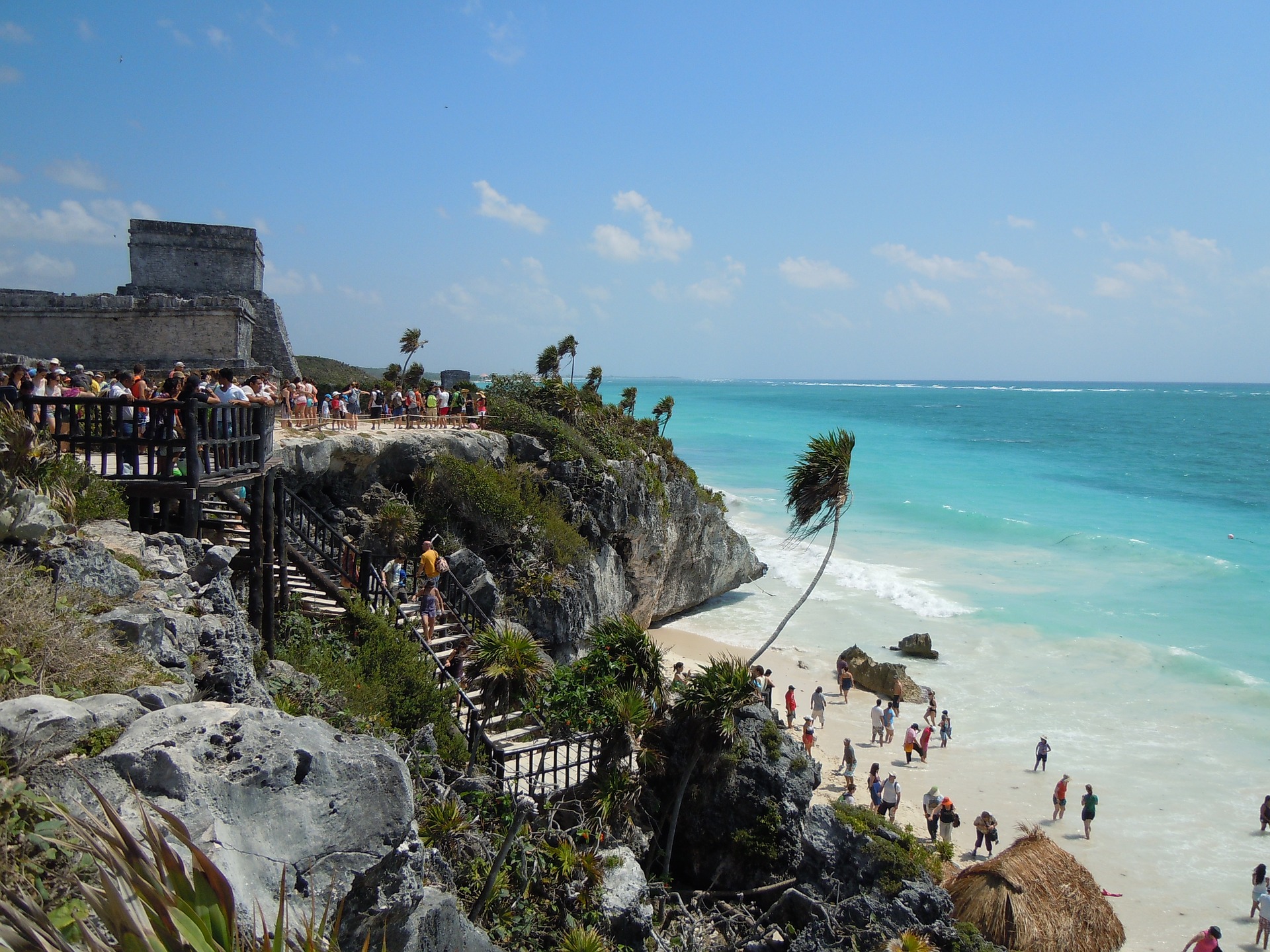
- The Mexican Caribbean: Beaches around Cancún and Tulum, coral reefs for diving and the cenotes of the Yucatán Peninsula.
- Monte Albán: A Zapotec site in the state of Oaxaca dating from about 500 BC.
- Guadalajara: The capital of Jalisco and the home of mariachi music and tequila.
Places to visit
- City
- Coast
- Historic site
- Area
Cities
- Mexico City: The capital and one of the largest cities in the world, with Aztec ruins, colonial buildings, museums, parks and nightlife.
- Guadalajara: The capital of Jalisco, home of mariachi and tequila, with a colonial centre and mild weather all year.
- Cancún: A beach resort on clear Caribbean water with a party scene, very busy during the US spring break from mid-February to the end of March.
- Puebla: One of the largest and oldest cities in Mexico, 110 km south-east of Mexico City, which gives its name to the poblano style of mole.
- Mérida: A city of the Yucatán Peninsula reached by the Tren Maya, and a focus city of the airline VivaAerobus.
- Oaxaca: Oaxaca City, with Spanish language schools and small planes to the beaches of the Oaxaca coast.
- Monterrey: The commercial and industrial hub of northern Mexico, in a dry, mountainous setting.
- San Luis Potosí: A colonial city of central Mexico, once an important silver producer, that now lives on manufacturing.
Beyond the cities
- Teotihuacan (site): A huge pre-Columbian site with several large pyramids near Mexico City.
- Chichen Itza (site): A Mayan city declared a UNESCO World Heritage Site in 1988, with a Tren Maya station.
- Uxmal (site): A Mayan city-state in the Puuc region, a UNESCO World Heritage Site since 1996.
- Tulum (site): A late Mayan city on the Caribbean coast, with a Tren Maya station.
- Palenque (site): A Mayan city in Chiapas known for its paintings, next to the largest tract of rainforest in Mexico. Reach it by Tren Maya or highway 186.
- Monte Albán (site): A Zapotec site in the state of Oaxaca dating from about 500 BC, a UNESCO World Heritage Site.
- Sea of Cortez (coast): The warm gulf along the eastern coast of Baja California, near La Paz, for whales, dolphins and sea kayaking.
- Cozumel (island): A snorkelling and diving destination of the Mexican Caribbean.
- Copper Canyon (area): Canyons of the Sierra Madre crossed by the El Chepe railway between Los Mochis and Creel. Read the UK and Canadian advice for Chihuahua and Sinaloa first.
Regions
- Baja Peninsula: Whales and sea kayaking on the Sea of Cortez, surfing, and the Valle de Guadalupe, which makes more than 90% of Mexico's wine.
- Northern Mexico: Deserts and rugged mountains, the industrial city of Monterrey, very hot summers and cold winters away from the coast.
- Bajío: Includes the state of Querétaro, the second wine region of the country.
- Central Mexico: Mexico City, the pyramids of Teotihuacan and colonial cities such as San Luis Potosí.
- Pacific Coast: Pacific beach resorts such as Mazatlán; several coastal states fall under UK and Canadian travel warnings.
- Yucatán and the South: Mayan sites, the Caribbean beaches of Cancún and Tulum, and the Tren Maya.
Things to do
See
- The pyramids of Teotihuacan Near Mexico City: The largest pyramids built in the pre-Columbian Americas, near Mexico City.
- Mayan cities of Yucatán Chichen Itza, Uxmal, Ek Balam, Tulum: Chichen Itza and Uxmal are UNESCO sites; at Ek Balam you can climb the carved temples.
- Whale watching Baja California: Migrating whales, sea lions and dolphins in the Sea of Cortez and at Guerrero Negro.
Do
- The Tren Maya Yucatán Peninsula: A modern train between Cancún and Chetumal, serving Mérida, with stations at Chichen Itza, Tulum and Palenque.
- Diving, snorkelling and cenotes Cancún, Cozumel, Isla Mujeres: Coral reefs of the Mesoamerican Barrier Reef, and cave diving in the cenotes of the Yucatán Peninsula.
- The Copper Canyon railway Los Mochis to Creel: El Chepe climbs through the canyons of the Sierra Madre. The UK exempts the rail route from its warning for Chihuahua, while Canada advises against non-essential travel to the state outside Chihuahua City; stay on the tourist trail and travel in daylight.
- A Liga MX football match Mexico City, Guadalajara, Monterrey: Football is the national sport; Chivas against América, El Clásico, sells out every time.
Eat
- Tacos and regional dishes: Ask for the 'platillo típico', the local speciality of each town; mole in Puebla, seafood on the coasts.
Drink
- Tequila and mezcal Jalisco: The Jose Cuervo Express and the Tequila Express run from Guadalajara to the distilleries.
Shop
- Artesanías: Textiles, wood carvings, paintings and masks; many artists welcome visitors to their workshops.
Itineraries
Mexico City and Puebla in 7 days (7 days)
- Mexico City (5 nights): Aztec ruins, museums and colonial buildings, with a day at the pyramids of Teotihuacan.
- Puebla (2 nights): One of the oldest cities in the country, 110 km south-east of the capital; try the mole.
Yucatán by train in 9 days (9 days)
- Cancún (3 nights): Beaches and diving; the Tren Maya runs south along the Caribbean coast.
- Tulum (2 nights): The Mayan coastal city, with views over the Caribbean.
- Chichen Itza (1 night): The Tren Maya has a station at the site.
- Mérida (3 nights): Reached by the Tren Maya; a base for the Mayan sites of the peninsula.
Guadalajara and the tequila country in 4 days (4 days)
- Guadalajara (4 nights): Mariachi and the colonial centre, with a day on the Jose Cuervo Express to the town of Tequila.
Climate and best time to visit
| Jan | Feb | Mar | Apr | May | Jun | Jul | Aug | Sep | Oct | Nov | Dec | |
|---|---|---|---|---|---|---|---|---|---|---|---|---|
| Max °C | 30 | 30 | 30 | 31 | 32 | 32 | 32 | 32 | 32 | 32 | 32 | 31 |
| Min °C | 23 | 24 | 24 | 24 | 25 | 25 | 25 | 25 | 25 | 25 | 25 | 24 |
| Rain mm | 13 | 3 | 1 | 4 | 23 | 261 | 243 | 280 | 299 | 128 | 17 | 12 |
The reference table is for Acapulco on the Pacific coast, which shows the pattern of the tropical coast; note that the UK advises against all but essential travel to Acapulco itself. Maximums stay between 30 °C and 32 °C all year. Almost all the rain falls from June to September, between 243 mm and 299 mm a month, with 128 mm in October, while from November to April each month has less than 20 mm. December to March is dry and outside the hurricane season, which normally runs from June to November and can hit both the Pacific and the Atlantic coasts.
Away from the coast the weather varies. April is already the hottest month on the coast and in Yucatán, while Mexico City, Toluca, San Cristóbal de las Casas, Pachuca and Zacatecas are not that hot in April and summer. Northern Mexico gets hot summers, with days above 39 °C and violent afternoon storms, and rather cold winters away from the coast; snow sometimes falls in the Sierra Madre.
Holidays and events
- 1 January 2026 · New Year's Day
- 2 February 2026 · Constitution Day
- 16 March 2026 · Benito Juárez's birthday
- 2 April 2026 · Maundy Thursday
- 3 April 2026 · Good Friday
- 1 May 2026 · Labour Day
- 16 September 2026 · Independence Day
- 16 November 2026 · Revolution Day
- 25 December 2026 · Christmas Day
Getting around
| Main airports | MEX, CUN |
|---|
Buses reach every part of the country. Executive and first-class buses are modern and comfortable, use the toll roads and cost only a little more than second class. The UK and Canada both advise taking first-class or executive buses on toll roads, in daylight, because theft and hijacking are more common on second-class buses on the free ('libre') roads; keep valuables with you, not in the hold. Flights: the main hubs are Mexico City (Benito Juárez, and Felipe Ángeles at Santa Lucía, NLU), Guadalajara, Cancún and Monterrey, and the low-cost airlines VivaAerobus and Volaris have fares that rival the bus over long distances. Trains are coming back: the Tren Maya serves the Yucatán Peninsula, the Tren Interoceánico crosses the Isthmus of Tehuantepec, and El Chepe runs through the Copper Canyon.
In cities, use 'sitio' taxis from official ranks, or ask your hotel or restaurant to call one; in Mexico City the official taxis are pink and white with plates starting with A or B. Uber, Cabify and Didi work in many cities. The Mexico City Metro is fast and cheap (a ticket cost M$5 in February 2020) but crowded, with cars for women and children at rush hour; the last trains leave around midnight.
Driving is on the right. The UK says a UK photocard licence is valid. Use the toll roads ('cuotas', with a D after the number), drive only in daylight, keep doors locked and fill the tank before you set off. Mexican car insurance is required. Always stop at checkpoints and roadblocks. In Mexico City the Hoy No Circula rules keep cars off the road on some days by number plate, and cars without Mexico City or State of Mexico plates cannot enter from 05:00 to 11:00 Monday to Friday and from 05:00 to 22:00 on Saturday.
Flying to Mexico? PartnerCompare fares and find the cheapest datesSearch flightsWhere to stay
- Chain hotels: International and Mexican chains throughout the country, usually clean and comfortable.
- All-inclusive resorts: Common in the main beach destinations.
- Boutique hotels: All over the country, in a range of prices, with Mexican style and traditions.
- Hostels: A large backpacker scene; a dorm bed cost M$100 to 300 in November 2021, sometimes with breakfast.
- Budget hotels: Usually found around the central bus station of a town.
Roadside hotels and motels may not be safe or comfortable: ask to see the room before you pay, which is not considered rude. Cheap hotels in cool highland areas have no heating, so bring warm clothes in winter. Balcony railings are often low, and Canada reports break-ins at private and rental homes, so choose accommodation with good security and keep doors and windows locked. Quintana Roo charges visitors a state entry tax; you can get help paying it online at Cancún airport.
Eat and drink
Dishes to try
- Tacos: Soft corn tortillas with steak, pork al pastor, carnitas or chorizo; an 'orden' is usually five.
- Mole: A chili sauce with cocoa, often over chicken or turkey; the Puebla style is the best known, and there are green, yellow and black versions.
- Tamales: Corn dough with meat or vegetable fillings; sweet versions contain fruit or nuts.
- Pozole: Chicken or pork broth with hominy corn, oregano, radish and chili.
- Chiles en nogada: Poblano chiles with a walnut sauce and pomegranate, served around Independence Day on 16 September.
- Chilaquiles: Tortilla chips in green or red sauce, usually with chicken or eggs.
Drinks
- Tequila and mezcal: Spirits distilled from agave and maguey; raicilla is a mezcal from Jalisco.
- Pulque: A traditional fermented drink made from maguey.
- Agua de jamaica and horchata: Hibiscus iced tea and a rice drink, sold everywhere.
- Mexican wine: Most of it comes from the Valle de Guadalupe in Baja California.
- Coffee: Chiapas produces excellent coffee, but many places that are not cafés serve instant.
| Meal times | The main meal is in the middle of the afternoon, around 15:00; dinner can be light or a full meal of pozole, tacos or tamales. |
|---|---|
| Tipping | 10% to 15% in restaurants, less often at street stands. Taxi and bus drivers do not expect a tip, except on tours. |
Food can be very spicy: ask '¿Esto tiene chile?' if you are not used to it. Eat from street carts with care, and pick busy places, as hygiene is not always reliable. Drink bottled water and avoid ice. Some bars and nightclubs add 15% to the bill.
The legal drinking age is 18, and drinking in public is illegal in many places. The UK and Canada report illness and blackouts from unregulated alcohol, and deaths from drinks containing methanol, which you cannot taste or smell: buy alcohol from reputable places, order drinks in sealed bottles or cans and never leave your glass unattended.
Entry requirements and visas
| Passport validity | Valid for the length of your stay; the Mexican Embassy in the UK recommends at least 180 days |
|---|
| Passport | Entry | Max stay | Notes |
|---|---|---|---|
| United Kingdom | Visa free | 180 days | Tourism only. The officer stamps the number of days you may stay, up to 180. |
| Canada | Visa free | 180 days | No tourist visa required for up to 180 days; the immigration officer decides the exact length. |
| United States | Visa free | 180 days | Tourist card (FMM), according to Wikivoyage. |
| Australia | Visa free | 180 days | Tourist card (FMM), according to Wikivoyage. |
| EU / EEA | Visa free | 180 days | Tourist card (FMM), according to Wikivoyage, whose list names every EU and EEA country except Croatia. |
Other nationalities: check the official source below.
Visitors from the UK, Canada, the US, Australia and most of the EU do not need a visa for tourism. The immigration officer decides how many days you get, from a few days up to 180, and writes it on your passport stamp or e-gate receipt: check it before you leave the desk, and leave before it runs out. Officers may ask for a return or onward ticket, proof of accommodation and enough money for your stay, and a letter of invitation if you stay with someone.
If you arrive by air, the entry fee is normally in your ticket, and you complete the digital migration form (FMMd) online; keep the printed e-gate receipt, as you must show it when you leave. By land you fill in the FMM form and pay the fee at the border, unless you stay 7 days or less for tourism. You may need your passport with the entry stamp to leave the country; replacing a lost stamp cost about 700 pesos in October 2026. Quintana Roo charges a state entry tax, payable online, and you show the receipt at the airport when you leave. Tourists cannot work or volunteer, and some research or eco-tourism activities need a visa. Since 22 October 2023 travellers who need a visa for Mexico also need one to transit a Mexican airport. Rules depend on your passport and can change: check the official link before you book.
Money and payments
| Currency | Mexican Peso (MXN) |
|---|---|
| Cards | Widespread |
The currency is the Mexican peso (MXN), written with the $ sign (M$ in this guide). In tourist areas some prices are in US dollars, marked US$. Dollars are sometimes accepted in border towns and resorts, at a poor rate, while euros and pounds are accepted only by banks and exchange offices (casas de cambio). Change cash at an airport exchange after customs or at official booths, not at your hotel.
Visa and Mastercard are widely accepted in department stores, larger restaurants and petrol stations, though a 5% surcharge is common and small family businesses take only cash. Carry pesos outside the cities, keep notes in good condition and small change for tips. ATMs charge a fee per withdrawal, which in January 2024 ranged from M$22 to M$174 on a UK Mastercard, depending on the bank; those in small towns can run out of cash. Use ATMs in daylight inside banks, shops or malls, cover the keypad and check your statements, as card fraud and robberies after withdrawals are reported.
Costs and budget
- Bed in a hostel dorm: M$100 to 300
- Breakfast burrito at McDonald's: about M$30
- Telcel prepaid SIM card: M$29
- Telcel top-up, 1.3 GB for 15 days: M$100
These prices are from Wikivoyage in November and December 2021, so expect them to be higher now. A ride on a city colectivo cost M$5 to 15 in February 2022. Toll roads are relatively costly but faster, and first-class bus tickets cost only slightly more than second class.
Health
| Recommended vaccines | Routine vaccines, including measles (MMR), Hepatitis A, Hepatitis B, Typhoid, for most travellers, Rabies, for some travellers, Chikungunya, for stays of 6 months or more |
|---|---|
| Malaria | Some areas |
| Tap water | Not safe |
No vaccines are required to enter Mexico, and the CDC does not recommend the yellow fever vaccine. Malaria is present in Campeche, Chiapas and the south of Chihuahua, where the CDC recommends preventive medicine; it is rare in Oaxaca, Sinaloa, Sonora and Tabasco, and absent along the US border. Mosquitoes also carry dengue, Zika and chikungunya, so use repellent. In December 2025 the CDC reported Rocky Mountain spotted fever along the US border, especially in Baja California, Sonora, Chihuahua, Coahuila and Nuevo León. Altitude sickness and air pollution are risks in parts of the country. Ask a travel health professional at least 8 weeks before you go.
The UK advises drinking only boiled or bottled water and avoiding ice. Private hospitals in the cities are good and faster than the crowded public ones, but outside the larger cities emergency care can be limited, and not all hospitals deal with insurers, so be ready to pay up front: get travel insurance that covers evacuation. Pharmacies in large cities often open 24 hours; prescriptions from abroad must be translated into Spanish. For an ambulance, dial 911.
This is general information, not medical advice: check with a travel health professional before you go.
Safety
- United States: Level 2: Exercise Increased Caution (2026-10-20)
- Canada: Exercise a high degree of caution (2026-10-20)
- United Kingdom: Advises against all but essential travel to parts of the country (2026-10-20)
Official advice differs by state. The US State Department rates Mexico at Level 2: Exercise Increased Caution, and Canada says to exercise a high degree of caution because of high levels of criminal activity and kidnapping. The UK FCDO advises against all but essential travel to: the cities of Tijuana (except airport transit, the Cross Border Xpress and toll road 1D to the border) and Tecate in Baja California; Chihuahua state, except Chihuahua city, the Ciudad Juárez crossing and the Copper Canyon rail route with Creel; Sinaloa, except Los Mochis, Mazatlán and the 15D toll road; Tamaulipas, except the south of the state and the Nuevo Laredo crossing from Monterrey; all of Zacatecas; Guanajuato south-west of road 45D, including Celaya and Irapuato; Michoacán, except Morelia, Pátzcuaro and Lake Pátzcuaro; parts of Jalisco south of Lake Chapala and in the far north; Colima, except Manzanillo reached by sea or air; Guerrero, including Acapulco, except Zihuatanejo/Ixtapa reached by air; and in Chiapas, the area within 40 km of the Guatemalan border and Federal Highway 199 between San Cristóbal de las Casas and Palenque.
Canada advises avoiding non-essential travel to Chiapas, except Palenque, Tuxtla Gutiérrez, San Cristóbal de las Casas and highways 186 and 190D to them; Chihuahua, except Chihuahua City; Colima, except Manzanillo reached by air; Guanajuato south of highways 43D and 45D; Guerrero, except Ixtapa/Zihuatanejo reached by air; Jalisco within 50 km of Michoacán; Lagunas de Zempoala National Park in Morelos; Michoacán, except Morelia and Pátzcuaro; Nayarit within 20 km of Sinaloa and Durango; Nuevo León, except Monterrey; Sinaloa, except Los Mochis and the tourist zones of Mazatlán reached by air or sea; Sonora, except Hermosillo, Guaymas/San Carlos and Puerto Peñasco; Tamaulipas, except Tampico reached by air or sea; and Zacatecas, except the city of Zacatecas. The UK also asks for extreme care outside tourist areas in the northern states, and great caution in Tabasco and Veracruz. Travelling against UK advice can invalidate your travel insurance.
Where you can travel, the UK and Canada advise care with these risks:
- Resorts: the authorities protect the main destinations, such as Cancún, Tulum, Cozumel, Los Cabos, Playa del Carmen and Puerto Vallarta, but violent crime still happens there. Be very cautious after dark in downtown Cancún, Tulum and Playa del Carmen and stay in well-lit tourist streets.
- Theft and ATMs: pickpocketing is common on public transport and at bus stations. Use ATMs in daylight inside shops or malls, wear no expensive jewellery and carry few cards. Express kidnappings, where victims are forced to withdraw cash, happen in cities.
- Taxis: do not hail them in the street; use sitio taxis, apps, your hotel or authorised airport taxis.
- Police: fake and real officers have demanded cash from tourists, especially drivers. Do not hand over money or your passport; ask for the officer's name and badge number and a written fine to pay later.
- Phone scams: callers pretend a relative has been kidnapped, or call hotel rooms posing as family. Hang up, and never give your room number to strangers.
- Drinks: drugs and eye drops have been put in drinks before robberies and assaults; keep your drink with you.
- Roads: carjackings happen on the Pacific coast and near the northern border, and armed gangs run illegal roadblocks: always stop, and do not resist.
- Timeshares: sellers use strong pressure; in Mexico you can cancel a timeshare contract without penalty within 5 working days.
- Ayahuasca and Bufo ceremonies are unregulated and have led to assaults, serious illness and deaths.
On the beach, riptides are common and many beaches have no lifeguards or flags; crocodiles live in lagoons, including at Cancún, so respect the signs. Hurricanes can hit both coasts from June to November. Earthquakes can happen in most of the country, especially Oaxaca and Guerrero, and the volcanoes Popocatépetl and Colima are active and closed, with a 12 km exclusion zone around Popocatépetl. Demonstrations are common in Mexico City; foreigners who join them can be detained and deported.
Customs and etiquette
Mexicans have a relaxed sense of time, and arriving half an hour late is common. Say 'salud' (bless you) when anyone sneezes, even a stranger. Use the formal 'usted' rather than 'tú' with people you do not know, and always with police and officials. Take off hats and sunglasses in churches and avoid showing too much skin; away from the beaches and the north, adults rarely wear shorts in town. Most Mexicans are Roman Catholic, so avoid religious debates with people you have just met. Offering a bribe can get you into trouble.
Foreigners may not take part in political activity, including demonstrations. You must be able to show your passport and entry stamp, not a copy. Bringing in or buying e-cigarettes and vapes is illegal, smoking or vaping in public places can be fined up to 3,000 pesos, and drug sentences reach 25 years. Same-sex relationships are legal and Wikivoyage says all states perform or recognise same-sex marriage; Mexico City and the big beach resorts are very open, while the UK and Canada note that acceptance is limited, especially in rural areas. Customs allow one laptop per passenger.
Language
| English | Limited |
|---|
| Hello | Hola OH-lah |
|---|---|
| Please | Por favor POHR fah-BOHR |
| Thank you | Gracias GRAH-syahs |
| Excuse me | Disculpe dees-KOOL-peh |
| How much does it cost? | ¿Cuánto cuesta? KWAHN-toh KWEHS-tah |
| Do you speak English? | ¿Habla usted inglés? AH-blah oos-TEHD een-GLEHS |
| I don't understand | No entiendo NOH ehn-TYEHN-doh |
| Where is the toilet? | ¿Dónde está el baño? DOHN-deh ehss-TAH EHL BAH-nyoh |
What to pack
- Passport, entry stamp and migration form: Officials can ask to see the originals, and you need them to leave the country.
- Printed e-gate receipt: If you enter through an airport e-gate, you must show it when you leave.
- Insect repellent with DEET: Mosquitoes carry dengue, Zika and chikungunya, and malaria in some southern areas.
- Warm layers: Cheap hotels in cooler areas have no heating in winter.
- Pesos in small notes: Small shops, markets and rural areas take only cash, and change can be scarce.
- Spanish translation of your prescriptions: Mexican pharmacies require it and may still refuse foreign prescriptions.
- No vape or e-cigarette: Bringing them into Mexico is illegal and customs will confiscate them.
Quick reference
Country facts
| Capital | Mexico City |
|---|---|
| Population | 131,946,900 (2025) |
| Area | 1,943,950 km² |
| Time zone | America/Mexico_City (UTC-6), America/Cancun (UTC-5), America/Merida (UTC-6), America/Monterrey (UTC-6), America/Matamoros (UTC-5), America/Chihuahua (UTC-6), America/Ciudad_Juarez (UTC-6), America/Ojinaga (UTC-5), America/Mazatlan (UTC-7), America/Bahia_Banderas (UTC-6), America/Hermosillo (UTC-7), America/Tijuana (UTC-7) |
| Calling code | +52 |
| Driving side | right |
Staying connected
| SIM and eSIM | With an unlocked phone you can buy a prepaid SIM at an Oxxo store. Telcel is the most expensive provider but has good coverage across the country: in November 2021 a SIM cost M$29 and M$100 bought 1.3 GB for 15 days. Coverage is unreliable in rural areas. |
|---|---|
| Roaming | Check roaming charges with your provider before you go; data can be expensive. |
| Wi-Fi | Almost every restaurant in the big cities offers Wi-Fi. |
Useful apps
- Moovit: Routes on city buses
- Uber, Cabify and Didi: Ride-hailing in many cities; check the driver and plate before you get in
- 911 CDMX: Earthquake warnings in Mexico City; works only with a local phone number
Emergency numbers
| Emergency | 911 |
|---|
Frequently asked questions
Do I need a visa for Mexico?
Not for tourism with a UK, Canadian, US, Australian or most EU passports. The immigration officer decides how many days you get, up to 180. Check the official link before you book.
Is it safe to travel to Mexico?
The US rates Mexico at Level 2 and Canada advises a high degree of caution. The UK and Canada advise against travel to parts of several states, including Guerrero with Acapulco, Michoacán, Zacatecas, Colima and much of Chihuahua, Sinaloa and Tamaulipas. Check the advice for each state on your route.
Can I drink the tap water in Mexico?
It is better not to. The UK advises drinking only boiled or bottled water and avoiding ice; bottled water is easy to find.
Do I need malaria tablets for Mexico?
Only for some areas: the CDC recommends preventive medicine for Campeche, Chiapas and the south of Chihuahua. Ask a travel health professional.
When is the best time to visit Mexico?
On the Pacific coast, December to March is dry and outside the hurricane season, which runs from June to November. Mexico City and some highland towns are not that hot in April and summer.
How much should I tip in Mexico?
Usually 10% to 15% in restaurants. Taxi and bus drivers do not expect a tip, except on tours.
More Travel Stories from North America
 United States
Sources This guide was last checked on · 17 sources
- Wikivoyage: Mexico · Overview, Places to visit, Things to do, Itineraries, Climate and best time to visit, Getting around, Where to stay, Eat and drink, Entry requirements and visas, Money and payments, Costs and budget, Health, Safety, Customs and etiquette, Language, What to pack, Staying connected, Frequently asked questions
- Wikidata: Mexico · Overview, Places to visit, Money and payments, Country facts
- Government of Canada: Mexico travel advice (updated 19 October 2026) · Overview, Places to visit, Things to do, Getting around, Where to stay, Eat and drink, Entry requirements and visas, Money and payments, Health, Safety, Customs and etiquette, What to pack, Staying connected, Frequently asked questions
- UK FCDO: Mexico travel advice (updated 16 October 2026) · Overview, Places to visit, Safety, Frequently asked questions
- UK FCDO: Mexico safety and security · Things to do, Climate and best time to visit, Getting around, Where to stay, Eat and drink, Money and payments, Safety, Customs and etiquette, What to pack, Staying connected
- WMO World Weather Information Service: Acapulco · Climate and best time to visit
- Nager.Date: public holidays in Mexico, 2026 · Holidays and events
- UK FCDO: Mexico entry requirements · Getting around, Entry requirements and visas, What to pack, Frequently asked questions
- ISO 4217 (SIX), published 2026-09-17 · Money and payments
- CDC Travelers' Health: Mexico · Health, Frequently asked questions
- UK FCDO: Mexico health · Health, What to pack
- US Department of State: Mexico travel advisory · Safety
- Wikivoyage: Spanish phrasebook · Language
- World Bank, SP.POP.TOTL · Country facts
- World Bank, AG.LND.TOTL.K2 · Country facts
- IANA Time Zone Database, zone.tab · Country facts
- UK FCDO: Mexico getting help · Emergency numbers
Suggest an update
Travel rules, prices and timetables change. If something in this guide is out of date, tell us: we check every suggestion against an official source before changing the page.