

- Local time
- 12:23 (capital)
- Currency
- Canadian Dollar (CAD)
- Capital
- Ottawa
- Calling code
- +1
- Drive on the
- right
Overview
Canada pairs the Rockies, lakes, forests and three ocean coasts with Toronto, Montreal, Vancouver and old Quebec City, for road trips, rail journeys and winter sports.
Canada is the second largest country in the world by area, with more lakes than any other country, the Rocky Mountains, the Prairies, coasts on three oceans and an Arctic archipelago. Most of it is forest or wilderness: more than 90% of Canadians live within about 160 km of the border with the United States, and the north is very thinly populated. The Trans-Canada Highway runs about 8,000 km from St. John's to Victoria, and crossing the country by land takes at least a week.
English and French are the official languages, and Quebec is mostly French-speaking. Toronto and Vancouver are among the most multicultural cities, with about half their people born abroad, and Indigenous cultures are more visible than in the US. Winters are harsh in most places, so pick your season with care, and expect metric units, prices shown without sales tax and a very polite culture.
- Banff National Park: The oldest and best-known national park, in the Rockies, home of Lake Louise.
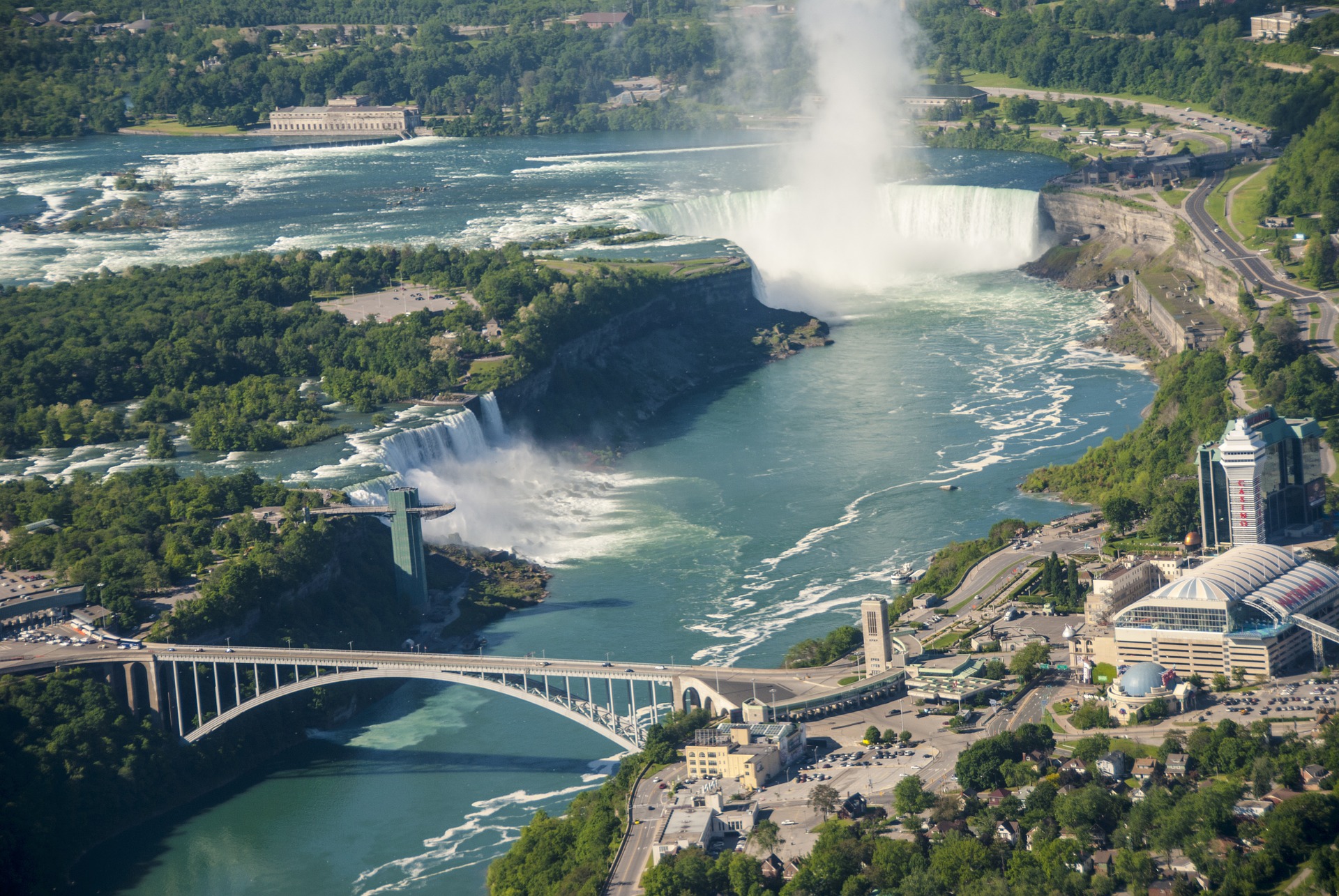
- Niagara Falls: The famous waterfalls on the Niagara Peninsula, also a wine region.
- Quebec City: Founded in 1608, with a walled old town and the Château Frontenac.
- Montreal: The centre of French-speaking culture in North America, with galleries, festivals and Mount Royal.
- Toronto: The largest city, with the CN Tower, museums, theatres and beaches.
- Vancouver: Mountains and sea together: you can ski and sit on the beach on the same day.
Places to visit
- City
- Town
- Island
- Park
- Area
Cities
- Toronto: The largest city and the business and media capital, with the CN Tower, museums and theatres.
- Montreal: The heart of francophone North America, known for its galleries, festivals and Mount Royal; English also works.
- Vancouver: A city of glass towers between mountains and sea, host of the 2010 Winter Olympics.
- Ottawa: The capital, with Parliament Hill, the National Gallery and the ByWard Market.
- Quebec City: The capital of Quebec, founded in 1608, with a walled old town and a big winter festival.
- Calgary: A financial city close to the Rockies, home of the Calgary Stampede rodeo.
- Halifax: A historic port on a huge natural harbour, with the Citadel and a walkable nightlife.
- Winnipeg: Near the centre of the continent, with French-Canadian and First Nations culture and historic commercial blocks.
- Whitehorse: The capital of Yukon, on the Alaska Highway, gateway to the far north.
Beyond the cities
- Banff National Park (park): The oldest Canadian national park, in the Rockies, with Lake Louise.
- Niagara Peninsula (area): The falls, the best-known wine region of Central Canada and sites of the War of 1812.
- Algonquin Park (park): The oldest provincial park, between Toronto and Ottawa, for camping and boating.
- Saguenay-St. Lawrence Marine Park (park): The most popular national park east of the Rockies, known for watching beluga whales.
- Okanagan (area): A dry valley in British Columbia with a deep lake, the warmest summers in Canada, fruit and wine.
- Southern Gulf Islands (island): Quiet islands a short ferry ride from Vancouver.
- Writing-on-Stone Provincial Park (park): A World Heritage site on the prairies with rock formations and Indigenous rock art.
- Dawson City (town): The hub of the 1890s Klondike gold rush, with many buildings of that time preserved.
Regions
- Atlantic Canada: Fishing villages, the Appalachians and Acadian and Celtic traditions along the Atlantic coast.
- Quebec: The mostly French-speaking province, with Montreal, Quebec City and the St. Lawrence River.
- Ontario: Toronto, Ottawa, Niagara Falls and the lakes and cottage country of Algonquin Park.
- Prairies: Flat farmland, wide skies and grain elevators, with very cold winters and sudden temperature swings.
- British Columbia: The Pacific coast, Vancouver and Vancouver Island, the Okanagan wine valley and ski resorts such as Whistler.
- Northern Canada: Yukon, the Northwest Territories and Nunavut: the least touched nature in the country, expensive to reach.
Things to do
See
- Niagara Falls Niagara Peninsula: The famous falls, with wineries and War of 1812 sites in the same area.
- Lake Louise and the Rockies Banff National Park: Mountain scenery in the oldest national park; Jasper National Park is also in Alberta.
- Old Quebec Quebec City: The walled old town, the Château Frontenac and the Plains of Abraham battlefield.
- Whale watching Saguenay-St. Lawrence Marine Park: A marine park known for beluga whale watching.
Do
- Winter festivals Quebec City and Ottawa: Carnaval de Québec and Winterlude take place in late January and February.
- Skiing Whistler, Banff and Jasper: Whistler Blackcomb is about two hours' drive from Vancouver.
- The Canadian train Toronto to Vancouver: VIA Rail's four-day trip across the Prairies and the Rockies, with dome observation cars.
- An ice hockey game: The national sport; seven NHL teams play in Canadian cities, from Montreal to Vancouver.
Eat
- Poutine Quebec and across Canada: French fries with cheese curds and gravy.
Drink
- Ice wine Niagara and the Okanagan: A very sweet dessert wine made from frozen grapes, a Canadian speciality.
Itineraries
Toronto to Quebec City in 11 days (11 days)
- Toronto (3 nights): The CN Tower, museums and theatres.
- Niagara Peninsula (1 night): The falls and the wineries.
- Ottawa (2 nights): Parliament Hill and the museums; VIA Rail is well developed in this corridor.
- Montreal (3 nights): The old town, Mount Royal and the shopping streets.
- Quebec City (2 nights): The walled old town and the Château Frontenac.
Vancouver and the Rockies in 10 days (10 days)
- Vancouver (3 nights): The city, the beaches and, in winter, skiing nearby.
- Okanagan (2 nights): The lake, fruit and wineries; many natural sights are only reachable by car.
- Banff National Park (3 nights): Lake Louise and the mountains.
- Calgary (2 nights): Museums, the zoo and flights home.
Yukon in 7 days (7 days)
- Whitehorse (3 nights): The base for the outdoors of the far north, on the Alaska Highway.
- Dawson City (3 nights): The preserved buildings of the Klondike gold rush.
- Whitehorse (1 night): Back for flights south.
Climate and best time to visit
| Jan | Feb | Mar | Apr | May | Jun | Jul | Aug | Sep | Oct | Nov | Dec | |
|---|---|---|---|---|---|---|---|---|---|---|---|---|
| Max °C | -6 | -4 | 2 | 11 | 19 | 24 | 27 | 25 | 20 | 13 | 5 | -3 |
| Min °C | -15 | -13 | -7 | 1 | 8 | 13 | 15 | 14 | 9 | 3 | -3 | -11 |
| Rain mm | 70 | 59 | 74 | 72 | 79 | 85 | 91 | 87 | 85 | 79 | 80 | 82 |
In most of Canada winters are harsh. In Ottawa, the reference city here, the average maximum is about -6 °C in January and the minimum about -15 °C, while July reaches an average maximum of about 27 °C. June to September are the warm months, with average maximums between about 20 °C and 27 °C; summer in the populated south usually lasts only from June to August, so September is the mild end of the season. Bring a warm jacket from October to April, and for longer in the mountains and the north.
The coast of British Columbia is mild, with little snow but a lot of rain in winter and drier, sunny summers. The Prairies swing quickly between extremes and are the coldest populated areas in winter, while the Okanagan has the warmest summers. In Iqaluit, in Nunavut, July averages a maximum of only 12 °C. Winter storms are frequent from November to April, tornadoes can occur from May to September, hurricanes can reach the coasts from July to November, and wildfires are a summer risk.
Holidays and events
- 1 January 2026 · New Year's Day
- 3 April 2026 · Good Friday
- 18 May 2026 · Victoria Day
- 1 July 2026 · Canada Day
- 7 September 2026 · Labour Day
- 30 September 2026 · National Day for Truth and Reconciliation
- 12 October 2026 · Thanksgiving
- 25 December 2026 · Christmas Day
Getting around
| Main airports | YYZ, YVR, YUL |
|---|
Flying is the best way to cover the distances: Toronto to Vancouver takes over four hours. Air Canada has the largest network and WestJet is strong in the west; fares are usually higher than in the US, and flights to the north are expensive. Trains are slow and often delayed, but VIA Rail is good in the corridor from Quebec City through Montreal and Ottawa to Toronto and Windsor. Long-distance trains include the Canadian (Toronto to Vancouver in four days) and the Ocean (Montreal to Halifax). Buses link most cities but rarely run overnight, and flights between distant cities often cost less.
Canada is car-dependent and many natural sights can only be reached by car. Traffic drives on the right and road signs are metric. Rental cars carry high one-way fees, unlimited kilometres usually apply only in the province of hire, and you may drive only on paved roads. You can generally drive on a foreign licence for up to 90 days if it is in English or French; other licences need an International Driving Permit. Rules vary by province, including turning right on a red light. In winter, snowstorms and avalanches close highways in Alberta and British Columbia: use snow tyres and carry emergency supplies. Watch for wild animals on country roads. In Toronto, Montreal and Vancouver, park and use public transport. On the coasts, BC Ferries and Marine Atlantic run the main ferry routes.
Flying to Canada? PartnerCompare fares and find the cheapest datesSearch flightsWhere to stay
- Hotels: Including the grand railway hotels of the early 1900s, which are sights in their own right.
- Motels: Small, simple hotels in rural areas, fewer now that budget chain hotels line the highways.
- Bed and breakfasts: Rooms in private homes, found in most villages, with breakfast included.
- Hostels: Dorms and private rooms; most hostels meet high standards.
- Cottages: Holiday homes for rent on the lakes and in the countryside.
- University residences: Some universities rent rooms from May to August.
- Campgrounds: From RV parks to campgrounds in national and provincial parks; most are seasonal.
Prices vary a lot with the season and the place. Always ask whether taxes are included: they usually are not, and local, provincial and federal taxes can add about 15%. Even if you do not stay in one of the old railway hotels, you can visit the lobby or eat in the restaurant. Houseboats can be rented on some lakes and rivers in summer.
Eat and drink
Dishes to try
- Poutine: French fries with cheese curds and gravy, from Quebec but now found everywhere.
- Tourtière: A French-Canadian meat pie that goes back to the 1600s.
- Montreal bagels and smoked meat: Jewish specialities of Montreal.
- Maple syrup: Sold everywhere, and a popular souvenir along with smoked salmon.
- Butter tarts and Nanaimo bars: A sweet tart of butter, sugar and eggs, and a no-bake chocolate square with a custard filling.
- Peameal bacon: Lean back bacon rolled in cornmeal, for breakfast or in a sandwich.
- Ukrainian food: Borshch and varenyky on the Prairies.
Drinks
- Ice wine: A very sweet dessert wine from frozen grapes; Niagara and the Okanagan are the main wine regions.
- Rye whisky: The Canadian whisky, sold in most liquor stores.
- Craft beer: Microbreweries and brew pubs in many cities.
- Coffee: Tim Hortons is the most common coffee chain.
| Tipping | About 15 to 18% of the pre-tax total for restaurant staff. No tip in cafeterias, fast-food places or takeaways, and hotel housekeeping does not normally expect one. Some restaurants add a service charge, so check the bill. |
|---|
With sales taxes and a tip, a restaurant bill can end up 25 to 30% above the menu prices. The drinking age is 18 in Alberta, Manitoba and Quebec and 19 elsewhere. Bring your passport to bars, since a foreign driving licence may not be accepted (US licences usually are). In many provinces alcohol is sold only in licensed stores, and some supermarkets sell only beer and wine. Almost every small town has a Chinese-Canadian restaurant, and the big cities have food from all over the world.
Entry requirements and visas
| Passport validity | Valid for the length of your stay |
|---|
| Passport | Entry | Max stay | Notes |
|---|---|---|---|
| United Kingdom | Eta | eTA needed to fly in, not by land or sea. Short visits normally up to 6 months. | |
| United States | Visa free | No eTA needed; by land, a passport or other proof of citizenship and ID, according to Wikivoyage. | |
| Australia | Eta | eTA needed to fly in; stays generally up to 6 months, according to Wikivoyage. | |
| EU / EEA | Eta | eTA needed to fly in; stays generally up to 6 months, according to Wikivoyage. Romanian citizens need a biometric passport. |
Other nationalities: check the official source below.
Most visitors from the UK, the EU, Australia and other visa-exempt countries need no visa for short visits, normally up to 6 months, but must get an eTA (Electronic Travel Authorization) to fly to or through Canada. You do not need one if you arrive by land or sea, and US citizens are exempt. An eTA lasts five years or until your passport expires. Apply only through the Canadian government: some unofficial websites charge to submit applications.
Canada is strict about criminal records: even an old or minor offence, including a drunk-driving conviction, can make you inadmissible, so contact a Canadian mission before you travel. Officers may ask for a return or onward ticket and proof of enough money. Children travelling alone or with one parent should carry a consent letter from the parent not travelling. Declare all food, any firearms and cash of C$10,000 or more, and do not carry cannabis across the border. Time spent in Canada counts towards a US Visa Waiver stay if you return to the US before leaving North America. Rules depend on your passport and can change: check the official link before you book.
Money and payments
| Currency | Canadian Dollar (CAD) |
|---|---|
| Cards | Widespread |
The currency is the Canadian dollar (CAD, $), divided into 100 cents. The $1 coin is the 'loonie' and the $2 coin the 'toonie'; banknotes are polymer. There is no 1¢ coin, so cash totals are rounded to the nearest 5¢. Visa and Mastercard are accepted in most places, American Express a little less, and many Canadians pay almost everything by card. In tourist areas shops often take US dollars, but at a rate below the official one.
Displayed prices usually exclude sales tax, which is added at the till. As of 2024 the total ranged from 5% in Alberta and the territories to 15% in New Brunswick, Newfoundland and Labrador and Prince Edward Island, with about 15% in Quebec and 13% in Ontario; visitors cannot claim the tax back. Fuel prices on the pump include tax. ATMs are everywhere; bank machines usually charge lower fees than independent ones. At petrol pumps, cards without chip and PIN do not work, so pay inside.
Costs and budget
- Prepaid mobile plan, 20 GB a month (Lucky Mobile, Chatr): about C$25
- Prepaid mobile plan, 28 GB a month (Koodo): about C$29
Prices for the same goods are often higher in Canada than in the US, and sales taxes and tips add a lot to restaurant bills. The mobile prices above date from April 2026.
Health
| Recommended vaccines | Routine vaccines, including measles (MMR), Hepatitis A, for most travellers, Hepatitis B, for unvaccinated travellers under 60, Rabies, for some travellers |
|---|---|
| Malaria | None |
| Tap water | Safe |
No vaccines are required to enter Canada, and the CDC does not recommend yellow fever vaccination. It suggests hepatitis A for most travellers, especially for rural areas or street food, and in June 2026 it reported a hepatitis A outbreak in Manitoba. Rabies is found in some wild animals and bats: if you wake up with a bat in the room, get medical care at once. Use a repellent with 20% or more DEET against ticks and mosquitoes, and check your body for ticks after walks. Altitude sickness is a risk in the Rockies around Banff and Lake Louise. Ask a travel health professional which vaccines you need.
Tap water is clean and safe in all cities and towns. In the backcountry, boil or filter water from lakes and rivers, which can carry Giardia. Health care is good but not free for visitors and can be very expensive, and an air ambulance from a remote area costs a great deal: take travel insurance for your whole stay. In an emergency, dial 911 or go to a hospital emergency room or walk-in clinic.
This is general information, not medical advice: check with a travel health professional before you go.
Safety
- United States: Level 1: Exercise Normal Precautions (2026-10-20)
- United Kingdom: No advice against travel (2026-10-20)
Violent crime rarely affects travellers, but take care with petty crime: do not leave bags unattended, and keep luggage and valuables out of sight in cars, since parked cars in big cities are targets for smash-and-grab thefts. In Montreal and some other places you can be fined for leaving a car unlocked or valuables in view. FCDO warns that terrorists are likely to try to carry out attacks in Canada, so stay aware in crowded places. Never offer a bribe to the police.
Nature is the main risk. In bear country keep your distance from wildlife and take all rubbish and food with you. Winter storms make driving dangerous and close mountain highways in Alberta and British Columbia, where avalanches are also possible; follow avalanche advice and stay off closed trails. Wildfires are a summer risk, especially in western Canada and in the forests of Quebec, Ontario and Nova Scotia, and earthquakes are most likely in British Columbia and Yukon. In the Arctic, rescue and medical help are limited. Near the border, do not cross into the US by mistake where it is unmarked. Avoid hitchhiking on Highway 16 between Prince Rupert and Prince George.
Customs and etiquette
Canadians are polite, and saying sorry, please and thank you is part of daily life. Take off your shoes when you enter a home unless your host says otherwise. Do not suggest, even as a joke, that Canada is part of the United States, and remember that in Quebec many people identify as Québécois; regional questions such as Quebec's place in Canada can be sensitive. A few words of French are appreciated in Quebec. Bargaining is rare outside flea markets and antique shops.
Use 'First Nations', 'Inuit' or 'Métis' rather than 'Indian' or 'Eskimo', which are offensive, and respect the rules of Indigenous communities you visit. Same-sex marriage is recognised nationwide, and hate speech is illegal. Cannabis is legal for adults, but buy it only from licensed shops, and it is illegal to take it across the border. Smoking is banned indoors in public places in most provinces. Switchblades, knuckle dusters and pepper spray (unless sold for use against animals) are illegal.
Language
| Official languages | English, French |
|---|---|
| English | Widespread |
What to pack
- Warm jacket and layers: Needed from October to April, and for longer in the mountains and the north.
- Passport: Bars may not accept a foreign driving licence as ID.
- Plug adapter: Sockets are type A and B at 120 V; check that your devices accept 120 V.
- Insect repellent with DEET: Against ticks and mosquitoes outdoors.
- Water filter or tablets: Lakes and rivers in the backcountry can carry Giardia.
- Winter emergency kit: For road trips in winter, when storms can strand drivers.
- Bear spray, bought in Canada: It is banned on flights, so buy it after you arrive.
Quick reference
Country facts
| Capital | Ottawa |
|---|---|
| Population | 41,651,653 (2025) |
| Area | 8,788,700 km² |
| Time zone | America/St_Johns (UTC-2.5), America/Halifax (UTC-3), America/Glace_Bay (UTC-3), America/Moncton (UTC-3), America/Goose_Bay (UTC-3), America/Blanc-Sablon (UTC-4), America/Toronto (UTC-4), America/Iqaluit (UTC-4), America/Atikokan (UTC-5), America/Winnipeg (UTC-5), America/Resolute (UTC-5), America/Rankin_Inlet (UTC-5), America/Regina (UTC-6), America/Swift_Current (UTC-6), America/Edmonton (UTC-6), America/Cambridge_Bay (UTC-6), America/Inuvik (UTC-6), America/Vancouver (UTC-7), America/Creston (UTC-7), America/Dawson_Creek (UTC-7), America/Fort_Nelson (UTC-7), America/Whitehorse (UTC-7), America/Dawson (UTC-7) |
| Calling code | +1 |
| Driving side | right |
Electricity and plugs
| Plug types | A, B |
|---|---|
| Voltage | 120 V |
Staying connected
| SIM and eSIM | Prepaid SIMs from budget brands such as Lucky Mobile, Chatr, Koodo, Public Mobile and Freedom Mobile; you need a name and a Canadian address. A physical SIM costs C$10 to activate, while some brands activate eSIMs free. |
|---|---|
| Roaming | Some Freedom Mobile and Public Mobile plans include US roaming. Coverage is good in cities and on main roads but has gaps in rural British Columbia and Ontario and in the north. |
| Wi-Fi | Free in public libraries, cafés, chain restaurants, shopping centres, most airports, larger VIA Rail stations and BC Ferries terminals; Halifax, Montreal, Mississauga and Vancouver have free public networks. |
Useful apps
- Busbud: Timetables and fares of many intercity bus companies
Emergency numbers
| Emergency | 911 |
|---|
Frequently asked questions
Do I need a visa or an eTA for Canada?
UK, EU and Australian visitors need no visa for short visits, normally up to 6 months, but need an eTA to fly in. US citizens need neither. Check the official link before you book.
Can I drink the tap water in Canada?
Yes, tap water is clean and safe in all cities and towns. In the backcountry, boil or filter water from lakes and rivers.
When is the best time to visit Canada?
June to September for warm weather in most of the country. Winter, from about November to March, brings skiing and winter festivals but harsh cold and storms.
Are prices in Canada shown with tax?
Usually not. Sales tax, from 5% to 15% depending on the province (2024 rates), is added at the till; fuel prices already include tax.
How much should I tip in Canada?
About 15 to 18% of the pre-tax bill in restaurants. You do not tip in cafeterias, fast-food places or takeaways. Check whether a service charge is already on the bill.
Do I need to speak French in Quebec?
In Montreal, Gatineau and the tourist areas of Quebec City you can usually get by in English. Elsewhere in the province French is very useful, at least for road signs.
More Travel Stories from North America
 United States
Sources This guide was last checked on · 15 sources
- Wikivoyage: Canada · Overview, Places to visit, Things to do, Itineraries, Climate and best time to visit, Getting around, Where to stay, Eat and drink, Entry requirements and visas, Money and payments, Costs and budget, Health, Safety, Customs and etiquette, Language, What to pack, Electricity and plugs, Staying connected, Frequently asked questions
- Wikidata: Canada · Overview, Money and payments, Country facts, Electricity and plugs
- WMO World Weather Information Service: Ottawa, Ontario · Climate and best time to visit
- UK FCDO: Canada safety and security (updated 2 June 2026) · Climate and best time to visit, Getting around, Safety, Customs and etiquette, What to pack
- Nager.Date: public holidays in Canada, 2026 · Holidays and events
- UK FCDO: Canada entry requirements (updated 2 June 2026) · Entry requirements and visas, Frequently asked questions
- ISO 4217 (SIX), published 2026-09-17 · Money and payments
- CDC Travelers' Health: Canada (reviewed 8 October 2026) · Health, What to pack, Frequently asked questions
- UK FCDO: Canada health (updated 2 June 2026) · Health
- US Department of State: Canada travel advisory · Safety
- UK FCDO: Canada travel advice · Safety
- World Bank, SP.POP.TOTL · Country facts
- World Bank, AG.LND.TOTL.K2 · Country facts
- IANA Time Zone Database, zone.tab · Country facts
- UK FCDO: Canada getting help · Emergency numbers
Suggest an update
Travel rules, prices and timetables change. If something in this guide is out of date, tell us: we check every suggestion against an official source before changing the page.