

- Local time
- 10:51
- Currency
- Nicaraguan Córdoba (NIO)
- Capital
- Managua
- Calling code
- +505
- Drive on the
- right
Overview
Nicaragua is a land of lakes and volcanoes, with the colonial cities of Granada and León, the twin volcanoes of Ometepe in Lake Nicaragua and the Corn Islands off the Caribbean coast.
Nicaragua is the largest country in Central America by area and the least densely populated. Nicaraguans call it the country of lakes and volcanoes: a chain of mostly active volcanoes runs from north-west to south-east, and Lake Nicaragua, also called Cocibolca, is the largest body of fresh water in Central America. The low plain west of Lake Nicaragua has a real dry season and has always been the most densely populated part of the country, while the east is rainforest, with Creole English and indigenous languages spoken along the Caribbean coast. The cool mountains of the north grow coffee and tobacco.
Food and accommodation are cheap by Western standards. Official advice is serious: the US State Department rates Nicaragua at Level 3: Reconsider Travel, and Canada advises a high degree of caution due to the political situation, the potential for civil unrest and crime. Foreigners may not take part in any political activity. Read the entry and safety sections before you go.
- Granada: A colonial city popular with visitors and expats, with Volcán Mombacho nearby.
- León: A colonial city known for its students and for one of the largest churches in Central America.
- Isla de Ometepe: An island in Lake Nicaragua with two volcanoes, Concepción and Maderas.
- Masaya and the Pueblos Blancos: A craft market, hammock workshops and villages of potters and furniture makers.
- Corn Islands: Two Caribbean islands for diving, fishing and doing very little; Little Corn has no cars.
- Río San Juan: The river to the Caribbean, with the Spanish fortress of El Castillo and the rainforest beyond.
Places to visit
- City
- Town
- Island
- Park
- Historic site
- Area
Cities
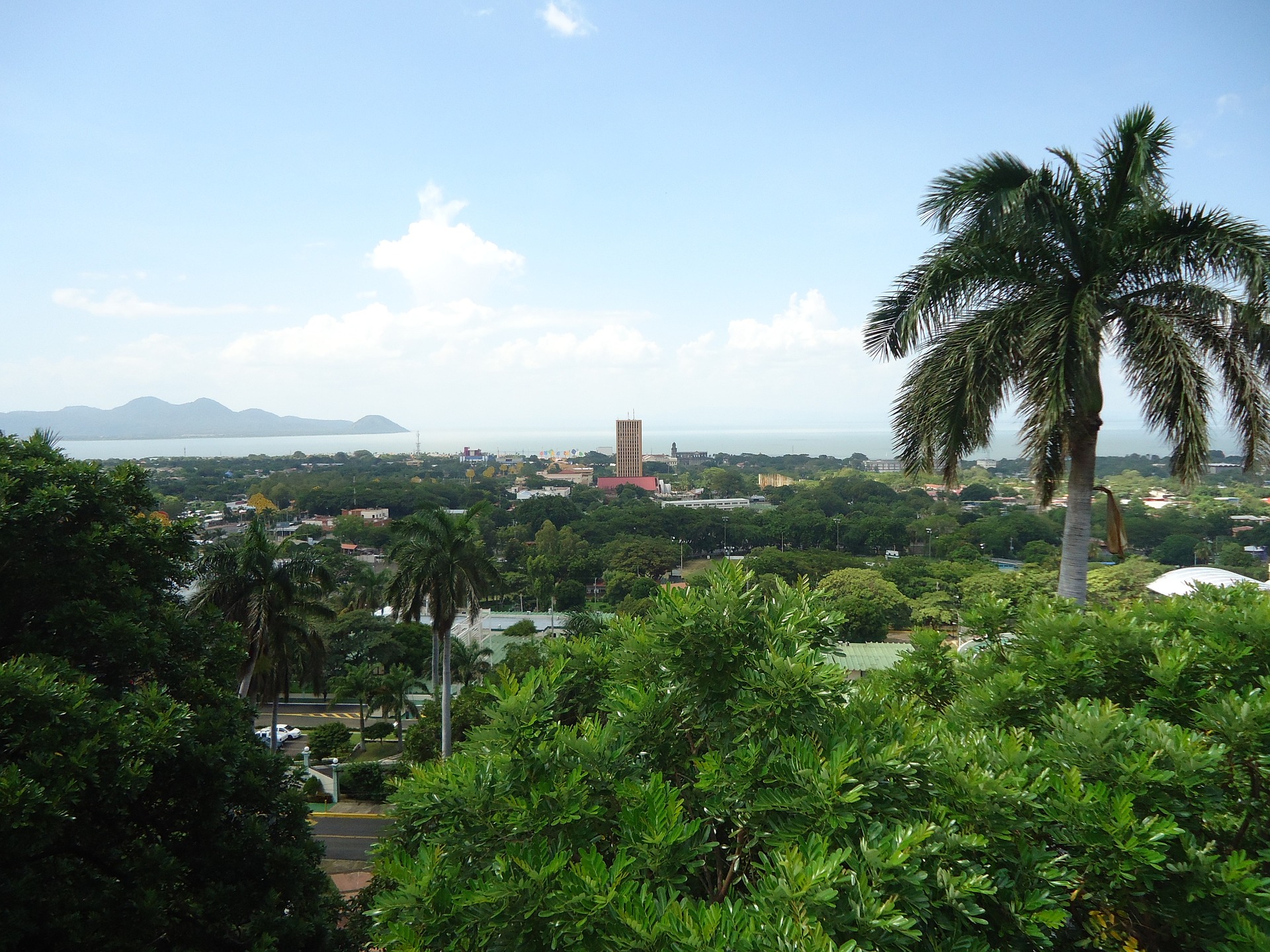
- Managua: The capital and largest city, flattened by an earthquake in 1972 and rebuilt around a new centre.
- Granada: A colonial city popular with visitors and expats, and the main place for Spanish schools.
- León: A colonial city known for its students, its large cathedral and many churches.
- Masaya: A pre-colonial city with a well-known craft market and the best hammocks, close to the Pueblos Blancos.
- Estelí: A city of murals, surrounded by nature reserves.
- Matagalpa: The 'Northern Pearl' in coffee country, with a mild climate all year.
- Bluefields: The largest city on the Caribbean coast and the hub for boats and flights to the Corn Islands.
- San Carlos: The gateway to the Río San Juan region, with a border crossing to Costa Rica.
- San Juan del Sur: A surf and party town where large cruise ships anchor.
Beyond the cities
- Isla de Ometepe (island): An island of two big volcanoes in Lake Nicaragua, with plenty of wildlife.
- Laguna de Apoyo (area): A crater lake and nature reserve with dark sand beaches.
- Volcán Masaya (park): A smoking volcano in the oldest national park of the country; you can drive to the top when it is considered safe.
- Somoto Canyon (area): A beautiful and peaceful canyon.
- Big Corn Island (island): A Caribbean island for diving and fishing, reached by plane from Managua or by boat.
- Little Corn Island (island): The smaller Corn Island, with no cars.
- Pearl Lagoon (town): A relaxed Caribbean town on the lagoon of the same name, reached by boat from Bluefields.
- El Castillo (site): An old Spanish fortress on the Río San Juan and a starting point for the jungle nearby.
- Solentiname Islands (island): Islands in Lake Nicaragua known for naive painting and balsa wood figurines, reached only by boat.
Regions
- Capital Region: Managua and its surroundings, where between a quarter and a third of the population lives.
- Caribbean Nicaragua: The rainforest and wet coast of the east, where Creole English and indigenous languages are spoken.
- Northern Highlands: The coldest part of the country: coffee and tobacco farms, cloud forest and foggy mornings.
- Northern Pacific Coast: Part of the Pacific side, with a clear dry season from November to April.
- Rio San Juan Region: The river along the Costa Rican border, with rainforest on both banks.
- Southern Pacific Coast: Part of the Pacific side, with a clear dry season from November to April.
Things to do
See
- Volcán Masaya Volcán Masaya: Drive or climb to the smoking crater when it is not considered too dangerous.
- Colonial churches León and Granada: León has one of the largest churches in Central America, and both cities keep much colonial architecture.
Do
- The volcanoes of Ometepe Isla de Ometepe: Concepción and Maderas rise from Lake Nicaragua; the UK advises hiking volcanoes only with an experienced guide.
- Surf and beaches San Juan del Sur: The surf and party town; the UK warns that strong currents off parts of the Pacific coast have drowned people, with no lifeguards.
- Diving off the Corn Islands Big Corn Island: Choose a reputable dive company: the only recompression chamber is in Puerto Cabezas, 5 hours by speedboat from Corn Island.
- Baseball: The national sport; the professional league plays in November and December, with playoffs after, in Managua, Chinandega, Rivas, León and Estelí.
- Learn Spanish Granada: Spanish schools in most cities, especially Granada, often with homestays and about 20 hours of classes a week.
Shop
- Crafts in the Pueblos Blancos Masaya: Pottery in San Juan del Oriente, rocking chairs in Masatepe and plant nurseries in Catarina, with a view over Laguna de Apoyo. Bargaining is expected.
- A Masaya hammock Masaya: Nicaraguan hammocks are well made, and Masaya has the most choice and the best prices.
- Solentiname art Solentiname Islands: Watch balsa wood figurines being carved and buy paintings directly from the artists' homes.
Itineraries
Granada, Masaya and Ometepe in 7 days (7 days)
- Granada (3 nights): The colonial centre and Volcán Mombacho nearby.
- Masaya (1 night): The craft market, the Pueblos Blancos and Volcán Masaya.
- Isla de Ometepe (3 nights): The fastest ferry runs from San Jorge, near Rivas; high winds can cancel crossings.
León and the northern highlands in 7 days (7 days)
- León (3 nights): The cathedral and the colonial churches.
- Estelí (2 nights): Murals in town and the nature reserves around it.
- Matagalpa (2 nights): Coffee where it is grown, in a mild mountain climate.
The Río San Juan in 5 days (5 days)
- San Carlos (1 night): The gateway to the river, by road or domestic flight.
- Solentiname Islands (2 nights): Reachable only by boat; naive painting and balsa carving.
- El Castillo (2 nights): The Spanish fortress and the rainforest nearby.
Holidays and events
- 1 January 2026 · New Year's Day
- 1 February 2026 · Air Force Day
- 2 April 2026 · Holy Thursday
- 1 May 2026 · Labour Day
- 27 May 2026 · Army Day
- 19 July 2026 · Liberation Day
- 14 September 2026 · Battle of San Jacinto
- 15 September 2026 · Independence Day
- 12 October 2026 · Indigenous Resistance Day
- 8 December 2026 · Immaculate Conception
- 25 December 2026 · Christmas Day
- 31 December 2026 · New Year's Eve
Getting there and around
| Main airports | MGA |
|---|
Getting there
By air: most visitors land at Augusto C. Sandino airport in Managua (MGA), with flights from Houston, Miami and Fort Lauderdale among others. For the Río San Juan or the south-west, some travellers fly to Liberia or San José in Costa Rica instead and continue overland, passing immigration twice. You pay an arrival tax of US$10 in cash; the departure tax of US$35 is normally included in your air ticket.
By land: there are two crossings with Costa Rica (Peñas Blancas, west of Lake Nicaragua, and Los Chiles to San Carlos, by bridge) and three with Honduras, Las Manos being on the shortest route to Tegucigalpa. Coaches such as Tica Bus and King Quality link Managua with San José, San Salvador and Honduras, and seats can sell out days ahead. Expect to pay border fees at land crossings, so carry small US dollar notes. Almost no rental contract lets you take a car across the border, and right-hand-drive vehicles cannot be driven or imported.
Getting around
Buses are the main way to get around, mostly old US school buses that are often packed; on many routes you can buy a numbered seat a day ahead. Canada says public transport is unreliable and overcrowded, that pickpockets target tourists on buses and that travellers have been assaulted getting off: keep your bag in sight. The UK advises avoiding public transport after dark and 'colectivo' minibuses. Domestic flights from Managua reach Big Corn Island in about 1.5 hours, against a full day overland, and also serve Bluefields and San Carlos; planes book out and the baggage allowance is small. Boats are the only way to the Solentiname Islands and the usual way to Ometepe. Bags are often searched before boat trips, and the UK advises checking the operator's insurance first.
Taxis: the UK advises radio taxis or authorised taxis with red plates, with the driver's ID and photo on the dashboard; note the colour and number before you get in. Canada advises booking ahead or using a trusted ride-sharing app, and warns against hailing taxis in the street or sharing them with strangers. Agree the fare before you get in, as there are no meters. Driving: you can drive with a UK photocard licence or a valid Canadian licence. Driving standards and roads are poor away from the Pan-American Highway, main highways have no street lighting, and on the Caribbean side dirt roads can become impassable in the rains: avoid driving at night. Canada says the nationwide speed limit is 50 km/h for cars and 40 km/h for motorcycles, whatever the road signs show, and that speeding is fined. After an accident, do not move the car until the police arrive; after a serious accident you are likely to be detained while it is investigated.
Flying to Nicaragua? PartnerCompare fares and find the cheapest datesSearch flightsWhere to stay
- Pensiones and hospedajes: The cheapest beds, usually family-run; ask what time they lock the door at night.
- Hostels: In Granada, San Juan del Sur, Ometepe, Masaya, Managua and León.
- Hotels: More comfort at a higher price; real luxury mainly in Managua, León and Granada.
- Resorts: A very few, such as Montelimar.
- Homestays: Offered by Spanish schools, a way to practise the language.
Accommodation is generally cheap. Prices rise sharply in Semana Santa (Easter week), when most Nicaraguans take their holidays and rates in San Juan del Sur can double or triple, and less so around Christmas and New Year. Choose well-secured accommodation; the UK advises women to use hotels with staff at the front desk 24 hours a day. In Managua, Wikivoyage advises against Barrio Martha Quezada, where robberies have happened in daylight. Canada advises against camping or sleeping overnight on beaches.
Eat and drink
Dishes to try
- Gallo pinto: Rice and beans, the best-known Nicaraguan dish, usually served at breakfast.
- Nacatamal: A large tamal of corn dough with pork or beef, wrapped in banana leaf; a Sunday tradition.
- Vigorón: Pork crackling with yuca and cabbage salad, sold in the street.
- Quesillo: Soft string cheese with pickled onion and sour cream in a thick tortilla.
- Indio viejo: A corn-based stew with shredded chicken or beef, flavoured with mint.
- Carne en baho: Beef, yuca, sweet potato and potato steamed in plantain leaves for hours.
- Rondón: A slow-cooked Caribbean fish stew; order it up to a day in advance.
Drinks
- Flor de Caña rum: The local rum and the most common spirit; buy it in local shops, not at duty-free.
- Beer: Local brands include Victoria, Toña and Brahva, sold in 12 oz bottles.
- Pinolillo and cacao: Traditional drinks of corn, cocoa and milk, often with cinnamon.
- Refrescos naturales: Fresh fruit juice with water and sugar: tamarind, hibiscus, mango, papaya and more.
| Tipping | Mid-range and upscale restaurants often add a 10% 'propina voluntaria'; with 15% IVA (sales tax) on top of menu prices, the bill can be 25% higher than the menu. Taxi drivers do not expect tips. |
|---|
Street food stalls and fritangas, grills found in most neighbourhoods, serve grilled meat and fried food, including 'tacos' and 'enchiladas' that are deep fried and quite unlike Mexican ones. Food is rarely spicy, though chilero, a pickled onion and chilli relish, is usually on the table. Vegetarians can live on gallo pinto, cheese, plantains and cabbage salad, but many people consider chicken not to be meat. Avoid juices made with tap water and ask for no ice unless you know it is purified.
Entry requirements and visas
| Passport validity | At least 6 months: the UK counts from your arrival, Canada from your departure |
|---|
| Passport | Entry | Max stay | Notes |
|---|---|---|---|
| United Kingdom | Visa free | 90 days | Up to 90 days, shared with Guatemala and El Salvador under the CA-4 agreement. You may be refused entry without an onward ticket. |
| Canada | Visa free | 90 days | Tourist visa not required for up to 90 days, shared across the CA-4 countries; the officer decides the exact stay. |
Other nationalities: check the official source below.
UK and Canadian visitors can stay up to 90 days without a visa. On arrival you pay US$10 in cash for a tourist card. Your passport needs at least 6 months of validity, and officials may ask for a return or onward ticket and proof of enough money. Make sure the officer stamps your passport and writes the number of days allowed: without the stamp you face fines and delays when you leave.
CA-4: Nicaragua, Guatemala, El Salvador and Honduras share one period of up to 90 days, which starts in the first of them you enter. The UK says you can extend by up to 30 days for a fee; Canada says up to 90 days, with a maximum stay of 180 days in Nicaragua. Ask the General Directorate of Migration before your time runs out. If you come for business, study, volunteering or work, the authorities recommend pre-registering your trip by email at least 7 days before you leave.
Border checks are thorough. Wikivoyage says officers ask about your profession and travel plans, and that social media posts against the government or signs that you are a journalist can lead to delays or refusal of entry. E-cigarettes are banned and are confiscated at the border, and since a law of December 2024 drones may not be owned or used. Wikivoyage adds that plastic bags are banned and confiscated at the airport. You need a yellow fever certificate only if you come from a country with yellow fever risk. Minors may be subject to exit requirements, and children with Nicaraguan nationality may need documents to leave with one parent. Rules depend on your passport and can change: check the official link before you book.
Money and payments
| Currency | Nicaraguan Córdoba (NIO) |
|---|---|
| Cards | Common |
The currency is the córdoba (NIO, written C$). Most places accept US dollars, sometimes at less than face value, and give change in córdobas, but you need córdobas for buses, taxis, small meals and daily shopping: carry small notes. The US dollar is the only foreign currency freely exchanged; banks do not change British pounds and give poor rates for euros. Bring dollars in US$20 notes or smaller and in perfect condition, as US$50 and US$100 notes are often refused outside banks and damaged notes are turned down.
ATMs give córdobas and most also give dollars; most work only with Visa/Plus cards, so check the network on your card. Cards are accepted in the big supermarket chains (Palí, La Colonia, La Unión) and many hotels, but remote places often add 4 to 6% for card payments. Card and ATM fraud happens: use ATMs inside a bank or business. Changing money in the street risks assault, and some street changers try to pass off old 1980s córdobas; changers with official ID stand outside banks. Banks ask for your passport. Canada warns that ATMs may not be available outside the major cities.
Health
| Required vaccines | Yellow fever certificate, only if you arrive from a country with yellow fever risk (from 1 year of age) |
|---|---|
| Recommended vaccines | Routine vaccines, including measles (MMR), Chikungunya, as there is an outbreak, Hepatitis A, Hepatitis B, Typhoid, for some travellers, Rabies, for some travellers, Mpox, for travellers at risk of sexual exposure |
| Malaria | Some areas |
| Tap water | Varies |
Chikungunya: on 3 September 2026 the CDC issued a Level 2 notice for an outbreak in Nicaragua and recommends the vaccine for travellers to outbreak areas. If you are pregnant, the CDC advises you to reconsider travel to the affected areas. Malaria is found in the two Caribbean autonomous regions (RAAN and RAAS), where the CDC recommends preventive medicine; there are rare cases in Boaco, Chinandega, Estelí, Jinotega, León, Matagalpa and Nueva Segovia, where avoiding bites is enough, and none in Managua. Dengue and Zika are also spread by mosquitoes, so use a DEET repellent, above all on Ometepe, on the Río San Juan and on the Caribbean coast. The CDC does not recommend the yellow fever vaccine. Ask a travel health professional at least 8 weeks before you go.
Wikivoyage reports that tap water in Managua is considered safe, but bottled water is the better choice and is easy to find. Public hospitals are poorly equipped, except some in Managua; emergency treatment there is normally free. Private hospitals usually want payment up front and in cash, few take cards, and staff rarely speak English. You cannot use British prescriptions; pharmacy chains include FarmaValue, MEDCO, Saba, Kielsa and El Ahorro. Get insurance that covers repatriation. For an ambulance, dial 911.
This is general information, not medical advice: check with a travel health professional before you go.
Safety
- United States: Level 3: Reconsider Travel (2026-10-20)
- Canada: Exercise a high degree of caution (2026-10-20)
- United Kingdom: No advice against travel (2026-10-20)
Official advice is serious. The US State Department rates Nicaragua at Level 3: Reconsider Travel. Canada says to exercise a high degree of caution due to the political situation, the potential for civil unrest and crime. The UK FCDO does not advise against travel to any part of the country, but there is no resident British mission: British travellers get help from the British Embassy in San José, Costa Rica.
Politics and the law: it is illegal for foreigners to take part in any political activity. The UK says you can be arrested, detained or deported for joining a protest, for a breach of the peace, for political meetings or campaigns, or for using the national flag or its blue and white colours in a campaign or protest. Canada advises you not to discuss the political situation in public or online, to avoid posting on social media, and warns that the authorities may search personal phones and computers. Wikivoyage says the police may look in your luggage and phone when protests are expected. Avoid all demonstrations.
Other risks the UK and Canada describe:
- Crime: violent crime has affected foreigners, and attacks on people in cars happen. Take care in markets, bus stations, around the old cathedral in Managua and in poorer areas, and do not walk there after dark. In Managua, Canada lists Mercado Oriental, Reparto Shick, Jorge Dimitrov, Ciudad Belén, Américas 1 and 2 and Barrio Camilo Ortega as having very high levels of assault and robbery. Do not resist a robbery.
- Taxis: express kidnappings happen in unauthorised taxis, and tourists have been robbed in taxis called by strangers.
- Borders: criminal gangs are more active near the borders with Costa Rica and Honduras. Wikivoyage adds that landmines may remain off the main roads in rural northern Nicaragua.
- Water: strong currents off the Pacific coast have drowned people, and there are no lifeguards or warning signs. Divers have died off the Caribbean coast.
Several volcanoes are active, including San Cristóbal, Masaya, Cerro Negro, Telica and Concepción on Ometepe: hike only with an experienced guide and follow local authorities. Earthquakes are a risk, and the hurricane season runs from June to November.
Customs and etiquette
Use the polite 'usted' with strangers and older people until you are invited to be informal, and address people as Don or Doña with their first name. Nicaraguans care about appearance and do not understand why foreigners dress shabbily: a clean, tidy look earns respect. Most people are Catholic and do not take kindly to mockery of their faith or to preaching. Few local men wear shorts, and long trousers also help against mosquitoes. Topless sunbathing is not acceptable.
Strangers often give you nicknames based on your looks, such as 'chele' for a fair-skinned person, and may comment on your weight; this is not meant to offend. Political passions can run high: listen politely and keep your opinions to yourself. Keep your passport separate from your other ID and carry a photocopy, including the page with your entry stamp. Even small amounts of drugs can lead to prison. It is illegal to photograph official buildings.
Language
| Official languages | Spanish |
|---|---|
| English | Limited |
| Hello | Hola OH-lah |
|---|---|
| Good morning | Buenos días BWEH-nohs DEE-ahs |
| Please | Por favor POHR fah-BOHR |
| Thank you | Gracias GRAH-syahs |
| Excuse me | Disculpe dees-KOOL-peh |
| Do you speak English? | ¿Habla usted inglés? AH-blah oos-TEHD een-GLEHS |
| I don't understand | No entiendo NOH ehn-TYEHN-doh |
| Where is the toilet? | ¿Dónde está el baño? DOHN-deh ehs-TAH EHL BAH-nyoh |
What to pack
- US$10 in cash: For the tourist card on arrival.
- US dollars in clean US$20 notes and smaller: Larger and damaged notes are often refused.
- Passport photocopy with the entry stamp: Carry it day to day and keep the passport somewhere safe.
- DEET insect repellent: Mosquitoes carry chikungunya, dengue, Zika and, in the east, malaria.
- Rain jacket: Downpours in the rainy season (May to October) can soak you in minutes, even on the Pacific side.
- Long trousers: Few local men wear shorts, and they protect against mosquitoes.
- Phone and charger: Canada advises carrying both when you drive, as coverage is patchy outside towns.
Leave e-cigarettes and drones at home: both are banned and can be confiscated.
Quick reference
Country facts
| Capital | Managua |
|---|---|
| Population | 7,007,502 (2025) |
| Area | 120,340 km² |
| Time zone | America/Managua (UTC-6) |
| Calling code | +505 |
| Driving side | right |
Emergency numbers
| Emergency | 911 (UK) |
|---|---|
| Police | 118 (Canada) |
| Ambulance | 128 (Canada) |
| Fire | 115 (Canada) |
Frequently asked questions
Do I need a visa for Nicaragua?
Not if you hold a UK or Canadian passport, for stays of up to 90 days, but you pay US$10 in cash for a tourist card on arrival. Check the official link before you book.
Is Nicaragua safe to visit?
The US rates it Level 3: Reconsider Travel, and Canada advises a high degree of caution due to the political situation, the potential for civil unrest and crime. Foreigners must not take part in any political activity. Read the safety section before you go.
Can I bring an e-cigarette or a drone to Nicaragua?
No. E-cigarettes are banned and can be confiscated at the border, and drones may not be owned or used.
Can I pay in US dollars in Nicaragua?
Yes, in most places, though you get change in córdobas and need córdobas for buses, taxis and small purchases. Bring clean US$20 notes or smaller.
Is there malaria in Nicaragua?
Yes, in the Caribbean regions, where the CDC recommends preventive medicine, with rare cases in several other departments and none in Managua. Ask a travel health professional.
Can I drink the tap water in Nicaragua?
Wikivoyage reports that tap water in Managua is considered safe, but bottled water is the better choice and is easy to find. Avoid ice and juices made with tap water.
Sources This guide was last checked on · 17 sources
- Wikivoyage: Nicaragua · Overview, Places to visit, Things to do, Itineraries, Getting there and around, Where to stay, Eat and drink, Entry requirements and visas, Money and payments, Health, Safety, Customs and etiquette, Language, What to pack, Frequently asked questions
- Wikidata: Nicaragua · Overview, Places to visit, Money and payments, Country facts
- US Department of State: Nicaragua travel advisory · Overview, Safety
- Government of Canada: Nicaragua travel advice (updated 14 October 2026) · Overview, Getting there and around, Where to stay, Entry requirements and visas, Money and payments, Health, Safety, Customs and etiquette, What to pack, Emergency numbers, Frequently asked questions
- UK FCDO: Nicaragua safety and security · Things to do, Getting there and around, Where to stay, Entry requirements and visas, Money and payments, Health, Safety, Customs and etiquette, What to pack
- Nager.Date: public holidays in Nicaragua, 2026 · Holidays and events
- UK FCDO: Nicaragua entry requirements · Getting there and around, Entry requirements and visas, Money and payments, What to pack, Frequently asked questions
- CDC Travelers' Health: Nicaragua · Entry requirements and visas, Health, What to pack, Frequently asked questions
- ISO 4217 (SIX), published 2026-09-17 · Money and payments
- UK FCDO: Nicaragua health · Health
- CDC Travel Health Notice: Chikungunya in Nicaragua (Level 2) · Health
- UK FCDO: Nicaragua travel advice · Safety
- Wikivoyage: Spanish phrasebook · Language
- World Bank, SP.POP.TOTL · Country facts
- World Bank, AG.LND.TOTL.K2 · Country facts
- IANA Time Zone Database, zone.tab · Country facts
- UK FCDO: Nicaragua getting help · Emergency numbers
Suggest an update
Travel rules, prices and timetables change. If something in this guide is out of date, tell us: we check every suggestion against an official source before changing the page.