

- Local time
- 14:40
- Currency
- Costa Rican Colón (CRC)
- Capital
- San José
- Calling code
- +506
- Drive on the
- right
Overview
Costa Rica fits rainforest, cloud forest, volcanoes and beaches on two coasts into a small country, with national parks for wildlife, surfing and rafting.
Costa Rica is one of the best-known nature destinations in the world. About a quarter of the country is protected as national parks and conservation areas, home to monkeys, sloths, tapirs, wild cats, macaws, poison dart frogs, many birds and about 1,500 kinds of orchids. Within a short trip you move from the rainforest of Tortuguero and Corcovado to the cloud forest of Monteverde, the volcanoes of the north and the centre, and beaches on both the Pacific and the Caribbean: the two coasts are about five hours apart.
The Central Valley, with San José, Alajuela, Heredia and Cartago, is the economic heart of the country, and the main airport is here. The Caribbean side is different again, with an Afro-Costa Rican community and an English-based Creole spoken in Limón Province. Costa Rica is a little more expensive than its northern neighbours, most parks charge entrance fees, and roads are slow, so allow more time than the map suggests. The dry season runs from December to April.
- Arenal Volcano: A volcano near La Fortuna, with trails, rafting rivers and Lake Arenal nearby.
- Monteverde: The Monteverde and Santa Elena cloud forest reserves, high in the mountains.
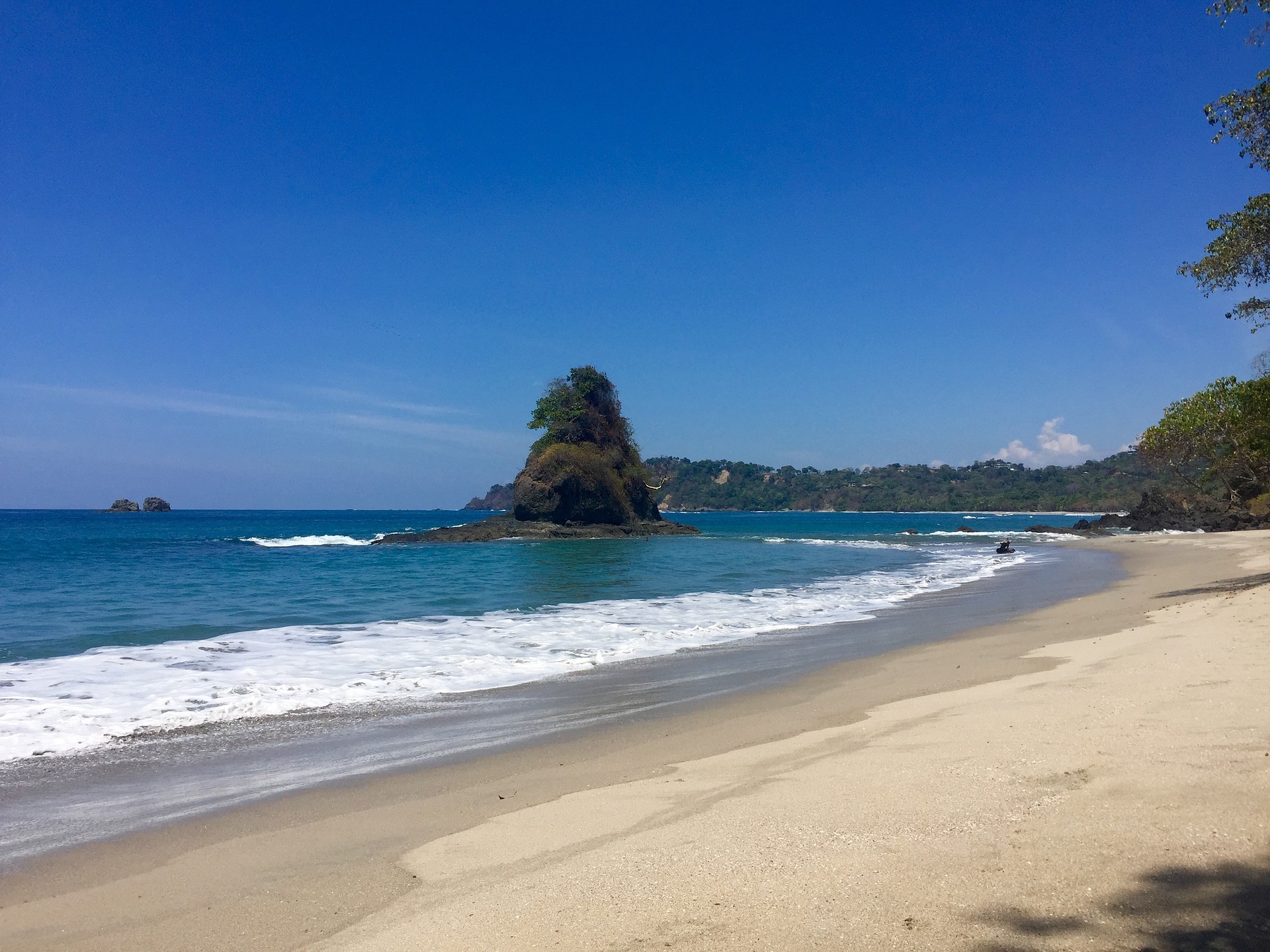
- Manuel Antonio National Park: A small park on the Pacific with clear-water beaches and plenty of wildlife.
- Tortuguero: Caribbean rainforest around a town reached only by boat, for manatees, monkeys and birds.
- Corcovado National Park: Black sand beaches and dense rainforest on the Osa Peninsula.
- Surfing in Guanacaste: Breaks for every level, from Tamarindo for beginners to Playa Negra for experts.
Places to visit
- City
- Island
- Park
- Mountain
Cities
- San José: The capital and the hub of the national bus network, in the Central Valley.
- Alajuela: A Central Valley city 3 km from Juan Santamaría International Airport.
- Heredia: A city among coffee plantations, with many Spanish language schools.
- Cartago: Costa Rica's first capital, close to the Irazú Volcano.
- Liberia: Home of Guanacaste Airport and the gateway to the beaches of Guanacaste, such as Sámara and Nosara.
- Jacó: The largest town on the Central Pacific coast, known for surfing and nightlife.
- Puerto Limón: The main city on the Caribbean side.
- Quesada: The largest city in the north, known locally as San Carlos, surrounded by hot springs popular with Costa Ricans.
Beyond the cities
- Arenal Volcano (mountain): A volcano with lava domes near La Fortuna, very active until 2010 and dormant since.
- Irazú Volcano (mountain): The highest volcano in the country, at 3,432 m, near Cartago; it last erupted in 1994.
- Monteverde and Santa Elena Cloud Forest Reserves (park): Cloud forest in the mountains, reached on unpaved roads.
- Manuel Antonio National Park (park): A tiny park on the Pacific with clear-water beaches and lots of wildlife.
- Corcovado National Park (park): Black sand beaches backed by thick rainforest, the main attraction of the Osa Peninsula.
- Tortuguero National Park (park): Caribbean rainforest and waterways around a small town reached only by boat.
- Cahuita National Park (park): A coastal protected area on the South Caribbean, near Puerto Viejo.
- Chirripó National Park (park): Serious mountain hiking near San Isidro de El General; Cerro Chirripó, at 3,820 m, is the highest point in the country.
- Rincón de la Vieja Volcano National Park (park): A volcano national park, one of the more popular natural attractions of the country.
- Cocos Island National Park (island): A remote island of 24 km², 480 km from Puntarenas in the Pacific.
- Tamarindo (town): An upscale beach town in Guanacaste, with boutique shops and a good beach to learn to surf.
- Puerto Viejo (town): The laid-back main town of the South Caribbean, with small hotels and light sand beaches.
Regions
- Central Valley: The heart of the country, with San José, Alajuela, Heredia and Cartago.
- Central Pacific: Pacific beaches and surf around Jacó, the largest town on this coast.
- Guanacaste: The north-west Pacific coast, with beaches such as Tamarindo, Sámara and Nosara, reached through Liberia.
- Limón Province: The Caribbean coast around Puerto Limón, where an English-based Creole is spoken, with Cahuita and Puerto Viejo in the south.
- North Costa Rica: The north, around Quesada and the Arenal Volcano, with hot springs and rafting rivers.
- South Pacific Costa Rica: The southern Pacific coast, from Dominical to the rainforest of Corcovado on the Osa Peninsula.
Things to do
See
- Wildlife in the national parks: Monkeys, sloths, tapirs, macaws and frogs; the further you go from the main routes, the more you see. You need a permit to enter national parks.
- Volcanoes Arenal, Irazú, Poás: Several active volcanoes can be visited. Follow the warning signs and local advice, and check for recent eruptions before you go.
- Turtles at Playa Grande Guanacaste: The largest nesting site of the leatherback turtle on the Pacific coast.
Do
- White-water rafting Turrialba and Arenal: From half-day trips to 2 or 3 days on the Pacuare River (class III to IV). Use an established company with experienced staff.
- Surfing Guanacaste and the Pacific coast: The best season is November to August. Tamarindo suits beginners, Playa Grande works most days of the year and Pavones is for experts.
- Canopy tours: Zip lines between platforms in the treetops, all over the country; ask about certification and attend the safety briefing.
- Hiking Chirripó Chirripó National Park: The most alpine mountains of the country, near San Isidro de El General, for experienced hikers.
- Sport fishing: Catch and release fishing for sailfish, marlin and tuna on the Pacific, and tarpon and snook on the Caribbean side.
Eat
- A casado at a soda: The typical lunch of rice, beans, meat or fish, salad and fried plantain, in a simple local restaurant.
Shop
- Roasted coffee: The classic thing to take home: buy whole beans in sealed bags, as local ground coffee often contains sugar.
Itineraries
Volcanoes and cloud forest in 8 days (8 days)
- San José (1 night): Buses to La Fortuna and Monteverde leave from Terminal 7-10.
- Arenal Volcano (3 nights): Stay in La Fortuna; trails around the volcano and rafting on nearby rivers.
- Monteverde and Santa Elena Cloud Forest Reserves (3 nights): The mountain roads are unpaved: a four-wheel drive is strongly recommended.
- San José (1 night): Back to the Central Valley for your flight.
The Caribbean coast in 7 days (7 days)
- Tortuguero National Park (3 nights): The town is reached only by boat; look for manatees, monkeys and birds.
- Puerto Viejo (4 nights): Beaches and Cahuita National Park nearby. Read the safety section: Canada reports thefts here.
Pacific beaches and parks in 8 days (8 days)
- Jacó (2 nights): Surfing, with Carara National Park to the north.
- Manuel Antonio National Park (3 nights): Beaches and wildlife in a small park.
- Corcovado National Park (3 nights): Rainforest and black sand beaches on the Osa Peninsula.
Climate and best time to visit
| Jan | Feb | Mar | Apr | May | Jun | Jul | Aug | Sep | Oct | Nov | Dec | |
|---|---|---|---|---|---|---|---|---|---|---|---|---|
| Max °C | 23 | 24 | 25 | 26 | 26 | 26 | 25 | 25 | 26 | 25 | 24 | 23 |
| Min °C | 15 | 15 | 16 | 16 | 17 | 17 | 16 | 17 | 17 | 16 | 16 | 16 |
| Rain mm | 9 | 5 | 12 | 44 | 222 | 283 | 208 | 252 | 325 | 326 | 139 | 40 |
Costa Rica is tropical all year, and its seasons are about rain, not temperature. The dry season, which locals call summer, runs from December to April; the rainy season, or winter, from May to November, with daily afternoon rain in some regions. In San José the dry months get between 5 and 44 mm of rain, against 208 to 326 mm a month from May to October, and September and October are the wettest. Temperatures barely change: average maximums of 23 °C to 26 °C and minimums of 15 °C to 17 °C.
Altitude makes the difference. The coastal lowlands average about 27 °C, the populated areas of the central mountains about 20 °C, and the highest summits less than 10 °C. The Caribbean slopes of the central mountains are the wettest part of the country, and the Caribbean side is more humid than the Pacific. The rainy season coincides with the hurricane season, from June to November, though Costa Rica is rarely hit directly; floods and landslides can close roads. The tourist industry calls September and October the 'green season': fewer visitors, more rain.
Holidays and events
- 1 January 2026 · New Year's Day
- 2 April 2026 · Maundy Thursday
- 3 April 2026 · Good Friday
- 11 April 2026 · Juan Santamaría Day
- 1 May 2026 · Labour Day
- 25 July 2026 · Annexation of the Party of Nicoya to Costa Rica
- 2 August 2026 · Feast of Our Lady of the Angels
- 15 August 2026 · Mother's Day
- 15 September 2026 · Independence Day
- 1 December 2026 · Army Abolition Day
- 25 December 2026 · Christmas Day
Getting there and around
| Main airports | SJO, LIR |
|---|
Getting there
By air: Juan Santamaría International Airport (SJO) is 3 km from Alajuela and 25 km from San José, with flights from the Americas and some European capitals. Guanacaste Airport (LIR), near Liberia, is closest to the north Pacific beaches, with flights from many US and Canadian cities and London; the UK notes that services there have been interrupted, so follow your airline's updates. Tobías Bolaños airport (SYQ) in San José handles domestic flights and some flights to Nicaragua and Panama.
By land: the Pan-American Highway crosses the country, with border posts at Peñas Blancas (Nicaragua) and Paso Canoas (Panama), which closes at 22:00. International buses run from Panama, Nicaragua, Honduras, El Salvador, Guatemala and Mexico. Leaving by land, Wikivoyage listed an exit tax of US$8 in October 2026 if you pay online or at the border terminal, or US$10 if you pay through the people waiting at the border. By air the departure tax was US$29 in 2026, included in the fare by most airlines.
Getting around
Buses are cheap and cover most of the country, with San José as the hub. There is no central bus station: each company and region has its own terminal, several in less safe areas, so take a taxi to the terminal entrance. Departures tend to be punctual but trips run long, and Canada calls the service unreliable. Pickpockets target tourists on buses: keep your bag on your lap, not in the overhead rack, and try not to fall asleep. Domestic flights with Sansa, Aerobell and Skyway link the main tourist towns; check their limits on surfboards.
Taxis: official taxis are red with a yellow triangle (orange at the airport). Make sure the driver uses the meter, called 'la maría', and avoid unofficial 'pirate' taxis; Canada advises booking ahead rather than hailing in the street. Driving: UK drivers can use a photocard licence and Canadian drivers their licence for up to 180 days, or for the length of stay you were granted. Carry your original passport when you drive: Canada says photocopies are not acceptable. Roads are slow, with potholes, few signs, one-lane bridges and, in the rainy season, landslides; a four-wheel drive helps outside the Central Valley and is strongly recommended for Monteverde. Avoid driving at night. Private cars may enter San José only on certain weekdays, by the last digit of the plate. Never leave luggage in a parked car. If you think a collision was deliberate, drive on to a safe place such as a police station or garage, and be ready to explain this to the traffic police. After an accident with injuries or a dispute over blame, do not move the car until the traffic police arrive. Canada warns that the authorities may stop you leaving the country until all injury claims are settled, whoever was at fault. Many drivers use Waze for traffic.
Flying to Costa Rica? PartnerCompare fares and find the cheapest datesSearch flightsWhere to stay
- Hotels: Everywhere; many do not let non-guests beyond reception.
- Eco-lodges: Many places call themselves eco-lodges; they tend to cost more, and there is a government certification programme.
- Cabinas, condos and vacation rentals: Often cheaper than hotels and more flexible.
- Hostels: All over the country, with dorm beds.
- Home stays and guesthouses: Many are listed on online maps and can be booked by phone or WhatsApp.
In Costa Rica a 'motel' is a hotel for short stays by couples, not a roadside hotel for travellers. Canada reports burglaries at rental accommodation: choose a well-secured place and lock doors and windows at night and when you go out. Some hotels and hostels have lock boxes for valuables.
Eat and drink
Dishes to try
- Gallo pinto: Rice and beans with a little cilantro or onion, mostly for breakfast.
- Casado: The typical lunch: rice and beans with meat, chicken or fish, salad and fried plantain.
- Sopa negra: Black bean soup, often served with rice.
- Chicharrones: Fried pork with its rind.
- Tres leches: A rich cake made with condensed milk, evaporated milk and cream.
Drinks
- Coffee: Costa Rican coffee is considered among the best in the world.
- Refrescos: Fresh fruit drinks with water or milk, served in every soda.
- Beer: Pilsen and Imperial are served everywhere.
- Guaro: The national sugar cane spirit, usually drunk with water and lemon. Buy it only from reputable places: cheap spirits laced with methanol have caused deaths.
| Tipping | Not customary. Some higher-end restaurants add a 10% service charge, and in tourist areas waiters sometimes ask for a tip even when it is already on the bill. Tips are welcome for guides, drivers, porters and room cleaners. |
|---|
Food is simple and mild rather than spicy; if you dislike cilantro, ask for it to be left out. The cheapest and most typical place to eat is a soda, a small local restaurant. Salsa Lizano, a mild, slightly sweet vegetable sauce, is on every table. Fruit is cheap and varied, and pineapple is everywhere. Vegetarians eat well, but note that 'pollo' (chicken) is not considered 'carne' (meat). In some parts of the country alcohol cannot be sold on the Thursday and Friday before Easter.
Entry requirements and visas
| Passport validity | Valid for your whole stay (UK: at least 1 day after the day you leave) |
|---|
| Passport | Entry | Max stay | Notes |
|---|---|---|---|
| United Kingdom | Visa free | 180 days | Up to 180 days; the immigration officer decides the exact period on arrival. |
| Canada | Visa free | 180 days | No tourist visa for stays up to 180 days; the officer sets the length of stay. |
Other nationalities: check the official source below.
UK and Canadian visitors need no visa for up to 180 days, but the immigration officer decides how long you can stay and stamps your passport: keep that stamp, as police check foreigners' legal stay on public transport. Officials will ask for a return or onward ticket and proof of enough money for your stay. Overstaying can bring a fine of US$100 for each month and a refusal of future entry.
You need a yellow fever certificate if you arrive from a country with yellow fever risk. Declare cash or goods worth US$10,000 or more, and do not take wildlife out of the country, including seashells. Children with dual Costa Rican nationality need an exit permit requested by both parents. Rules depend on your passport and can change: check the official link before you book.
Money and payments
| Currency | Costa Rican Colón (CRC) |
|---|---|
| Cards | Widespread |
The currency is the Costa Rican colón (CRC), written ₡. US dollars are widely used: in tourist places almost everything is priced in dollars, while shops and markets for locals expect colones. When you pay in dollars you often get change in colones. Bring clean notes, as even slightly torn dollar bills are refused.
Visa and Mastercard are accepted almost everywhere, even for small amounts, except in small restaurants; American Express less so. ATMs are common and give both dollars and colones, though around payday, the 15th of the month, they can run out of cash in small towns. Change money at state banks such as Banco Nacional rather than at the airport. Canadian dollars are extremely difficult to exchange, and ATM withdrawals work only with a 4-digit PIN. Card and ATM fraud happens: use ATMs inside banks or businesses or in well-lit places and cover the keypad.
Costs and budget
Costa Rica is not a cheap country, and more expensive than its northern neighbours in Central America. Most national parks and attractions charge entrance fees, and tours add up quickly. Our sources have no recent accommodation prices: the hostel prices on Wikivoyage date from 2022, so check current prices before you budget. Local sodas, buses and fruit markets keep costs down.
Health
| Required vaccines | Yellow fever certificate, only if you arrive from a country with yellow fever risk (from 9 months of age) |
|---|---|
| Recommended vaccines | Routine vaccines, including measles (MMR), Hepatitis A, Hepatitis B, Chikungunya, for travel to an area with an outbreak, Typhoid, for some travellers, Rabies, for some travellers, Mpox, for travellers at risk of sexual exposure |
| Malaria | Some areas |
| Tap water | Varies |
In 2026 the CDC reported an outbreak of chikungunya in the north-west of the country (July) and an outbreak of hepatitis A, mostly in San José province (September). Malaria is present in Alajuela and Limón provinces, where the CDC recommends preventive medicine; elsewhere transmission is rare. Dengue and Zika are also carried by mosquitoes, so use repellent everywhere. The CDC does not recommend the yellow fever vaccine for Costa Rica itself. Rabies is found in bats. Ask a travel health professional at least 6 weeks before you go.
Tap water is safe in most places, especially in towns, but take care in rural areas and some beach towns such as Puerto Viejo, where bottled water is cheap. Medical care is generally of a high standard, with good hospitals in San José, but only initial emergency treatment is free for visitors: get travel insurance. UK prescriptions cannot be used locally, though big pharmacy chains are easy to find. For an ambulance, dial 911.
This is general information, not medical advice: check with a travel health professional before you go.
Safety
- United States: Level 2: Exercise Increased Caution (2026-10-20)
- Canada: Exercise a high degree of caution (2026-10-20)
- United Kingdom: No advice against travel (2026-10-20)
Canada advises a high degree of caution in Costa Rica because of crime, and the US rates it at Level 2. Theft is the most common problem: pickpocketing, bag snatching and passport theft, which rises in the peak seasons from November to May and in July and August. Canada lists areas of particular concern:
- San José: the Coca-Cola bus terminal area, the inner downtown, the Mercado Central and public parks.
- Pacific coast: Dominical, Jacó and the crocodile viewing area on the Tárcoles River, Manuel Antonio National Park, Quepos, Mal País, Montezuma, Santa Teresa and the port of Puntarenas.
- Caribbean coast: Cahuita, Puerto Limón and Puerto Viejo, where violent assaults on travellers have also occurred.
Car break-ins are very common, including at beach and national park car parks: never leave anything in the car. Thieves slash tyres and then 'help', and some cause collisions to rob drivers. Never leave drinks unattended, and buy spirits only from reputable places, as methanol poisoning has killed people. Avoid walking alone at night. The FCDO reports that gang violence, with shootings, has become more frequent in urban areas, including some places popular with visitors. Foreigners may not take part in political activity, so stay away from demonstrations.
Nature brings its own risks. Rip currents are very common and most beaches have no lifeguards or warning signs: ask locals where it is safe to swim. Crocodiles are seen near surf beaches on the Pacific between Playa Azul and Playa Esterillos. Costa Rica has 16 volcanoes, several active, and the UK reports a recent series of eruptions at Poás: follow local advice and avoid volcanic areas after heavy rain. Small earthquakes are frequent, and stronger ones happen from time to time. Go into jungle areas with an experienced local guide, and use established companies for boat trips and adventure sports.
Customs and etiquette
Good manners matter. Greet people with 'buenos días' or 'buenas' when you enter a shop, say 'disculpe' to excuse yourself, and ask for things gently ('¿me podría dar…, por favor?') rather than with a blunt command. Life runs on a relaxed sense of time, summed up in the local phrase 'pura vida'. In the cities, locals wear long trousers and collared shirts, and shorts mark you out as a tourist. Respect nature: do not litter, feed wild animals or damage plants.
Smoking is banned in businesses, public buildings, public transport, parks and hotel rooms. Carry ID: police usually accept a printed copy of your passport, but keep the original safe. Drug offences carry a minimum of 8 years in prison. Photographing official buildings is illegal, and bringing in or taking out archaeological items or antiquities is restricted. Costa Rica is a Catholic and fairly conservative country, but generally welcoming to LGBT+ travellers, with a gay scene in San José and Manuel Antonio. Relations with Nicaragua are a sensitive topic, best avoided.
Language
| Official languages | Spanish |
|---|---|
| English | Common |
| Hello | Hola OH-lah |
|---|---|
| Good morning | Buenos días BWEH-nohs DEE-ahs |
| Please | Por favor POHR fah-BOHR |
| Thank you | Gracias GRAH-syahs |
| Excuse me | Disculpe dees-KOOL-peh |
| Do you speak English? | ¿Habla usted inglés? AH-blah oos-TEHD een-GLEHS |
| I don't understand | No entiendo NOH ehn-TYEHN-doh |
| Where is the toilet? | ¿Dónde está el baño? DOHN-deh ehs-TAH EHL BAH-nyoh |
What to pack
- Insect repellent and long sleeves: Mosquitoes carry dengue, Zika and chikungunya, and malaria in Alajuela and Limón.
- A light jacket: Days are hot, but mornings and evenings can be cool.
- Closed shoes for walks: Snakes are common in the countryside: do not walk barefoot away from the beach.
- Small, clean US dollar notes: Useful as a back-up; torn notes are refused.
- A printed copy of your passport and entry stamp: You must carry ID, and police usually accept a copy.
- Yellow fever certificate: Only if you arrive from a country with yellow fever risk.
- An unlocked phone: Local prepaid SIM cards are sold almost everywhere.
Quick reference
Country facts
| Capital | San José |
|---|---|
| Population | 5,152,950 (2025) |
| Area | 50,560 km² |
| Time zone | America/Costa_Rica (UTC-6) |
| Calling code | +506 |
| Driving side | right |
Staying connected
| SIM and eSIM | Prepaid SIM cards from Kölbi, Claro and Liberty are sold almost everywhere; Kölbi has the widest coverage. Activation may not work on Sundays. |
|---|---|
| Wi-Fi | Most hotels, cafés, bars and restaurants in tourist areas have free Wi-Fi: ask for the password. |
Useful apps
- Waze: The favourite navigation app of Costa Ricans, with live traffic
- OsmAnd or Mapy.cz: Offline maps and hiking trails
Emergency numbers
| Emergency | 911 |
|---|
Frequently asked questions
Do I need a visa for Costa Rica?
Not with a UK or Canadian passport: you can stay up to 180 days, as decided by the immigration officer. You need a return or onward ticket. Check the official link before you book.
Can I drink the tap water in Costa Rica?
In most places, especially in towns, yes. In rural areas and some beach towns such as Puerto Viejo, drink bottled water.
Is there malaria in Costa Rica?
Only in parts of the country: the CDC recommends preventive medicine for Alajuela and Limón provinces. Dengue, Zika and chikungunya are also present, so use repellent.
Can I pay with US dollars and cards in Costa Rica?
Yes. Tourist places price in US dollars and cards are accepted almost everywhere, but local shops and markets expect colones.
When is the best time to visit Costa Rica?
The dry season runs from December to April. September and October are the wettest months, with fewer visitors.
Is there a departure tax in Costa Rica?
Yes. Leaving by air it was US$29 in 2026, included in the fare by most airlines. Leaving by land there is a smaller border tax.
More Travel Stories from Costa Rica
 Costa Rica
Sources This guide was last checked on · 17 sources
- Wikivoyage: Costa Rica · Overview, Places to visit, Things to do, Itineraries, Climate and best time to visit, Getting there and around, Where to stay, Eat and drink, Entry requirements and visas, Money and payments, Costs and budget, Health, Safety, Customs and etiquette, Language, What to pack, Staying connected, Frequently asked questions
- Wikidata: Costa Rica · Overview, Places to visit, Money and payments, Country facts
- UK FCDO: Costa Rica safety and security · Things to do, Climate and best time to visit, Getting there and around, Eat and drink, Safety, Customs and etiquette, What to pack
- Government of Canada: Costa Rica travel advice (updated 14 October 2026) · Things to do, Getting there and around, Where to stay, Entry requirements and visas, Money and payments, Health, Safety, Customs and etiquette, Frequently asked questions
- WMO World Weather Information Service: San Jose · Climate and best time to visit
- Nager.Date: public holidays in Costa Rica, 2026 · Holidays and events
- UK FCDO: Costa Rica entry requirements · Entry requirements and visas, Health, What to pack, Frequently asked questions
- CDC Travelers' Health: Costa Rica · Entry requirements and visas, Health, What to pack, Frequently asked questions
- ISO 4217 (SIX), published 2026-09-17 · Money and payments
- UK FCDO: Costa Rica health · Health
- US Department of State: Costa Rica travel advisory · Safety
- UK FCDO: Costa Rica travel advice · Safety
- Wikivoyage: Spanish phrasebook · Language
- World Bank, SP.POP.TOTL · Country facts
- World Bank, AG.LND.TOTL.K2 · Country facts
- IANA Time Zone Database, zone.tab · Country facts
- UK FCDO: Costa Rica getting help · Emergency numbers
Suggest an update
Travel rules, prices and timetables change. If something in this guide is out of date, tell us: we check every suggestion against an official source before changing the page.